






earthset from the moon, from the Artemis II crew, via NASA
There should be a name for the paradox in which a large group of individuals, each biophilic by nature, each doing their best under the circumstances, each quietly knowing the consequences of runaway ecological collapse, the exhaustion of cheap energy, endless wars, and relentlessly drawing more and more from the resources future generations and the rest of life on Earth need for their very survival, who somehow nevertheless behave collectively in a horrifically destructive, cruel and ruinous way, as if in utter ignorance or denial of this knowledge.
Psychologists have names like “mass psychosis” to describe breakouts of groups with collective symptoms of a physical illness. But these are considered delusional and temporary. The head-shrink establishment doesn’t seem capable of acknowledging that living under chronically unbearable circumstances can easily, understandably, and permanently mentally damage and incapacitate large numbers of people, perhaps even every human on the planet when these circumstances become global. Such an acceptance would explode all their models, and deprive the profession of its pathways to “cures”.
So I suppose until someone actually acknowledges the pervasive nature of this utterly incurable collective mental illness, I’ll have to continue to call it what I’ve called it for two decades: Civilization Disease. Due to the complex nature of human-made systems, and the inherent nature of humans (and any creature) suffering from high levels of chronic stress over which they have no control, no agency, and no hope of relief, the only possible resolution for Civilization Disease is the end of its cause, through global civilizational collapse.
Nature appears well on its way to cleaning up our mess by invoking that collapse. That is no consolation for those of us who will have to suffer from this drastic and awful cleansing. But at least whoever or whatever remains after the fall will have the opportunity to live, once again, in healthy harmony with the rest of life on Earth. Instead of denial and terror in the face of accelerating collapse, my approach will continue to be to celebrate it.
One day, everything will be free.
COLLAPSE WATCH
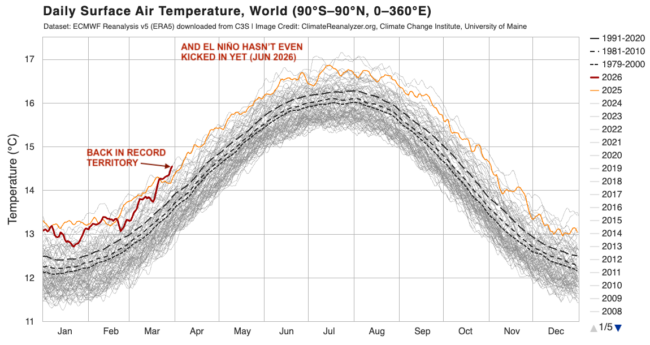
the latest climate data from C3S speaks for itself
The oil is only for us (US): Energy analyst Steven Newbury explains how, as cheap oil runs out and war is constricting supply of what’s left, the US is (incompetently) attempting to siphon the remainder to its corpocracy, not even sharing it with its ‘allies’ or its own citizens.
The starvation of Cuba as a test run for the end of affordable energy: Also from Steven, an explanation of how the US siege of Cuba will necessarily lead to either massive starvation and/or massive and costly humanitarian US military-supplied aid. Don’t hold your breath for the latter.
And the end of affordable energy for Germany looms: Finally, from Steven, an explanation of why Germany’s decision to shut its nukes before the end of their useful lives (as demanded by well-meaning Greens), by forcing that country to burn huge quantities of scarce coal lignite instead, has accelerated the end of Germany’s energy-dependent economy and hence its total economic collapse.
Can’t keep it a secret forever: Erik Michaels compares the eight stages of an illicit affair with the eight stages of concealment and denial we are currently demonstrating with civilizational collapse.
The trouble with ‘If we just start now…’: Also from Erik, an exploration of how, like Wile E Coyote, we have run out of road, but have yet to accept that reality. Uh, oh.
LIVING BETTER
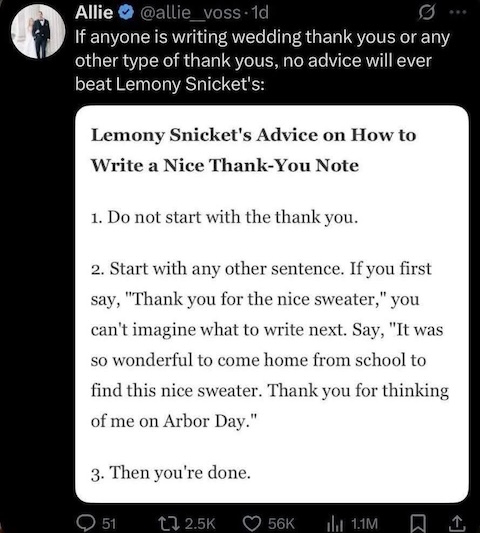
from the memebrary; the magic of saying why you are thankful, via a story
No to war: How Spain’s government has rejected the cowardly appeasement of the US by the rest of the US-Israeli Empire’s vassal states.
Tired, bruised, staggered, betrayed and ashamed: Southern US poet-activist Robert Arnold’s stunning summary of the US ‘State of the Union’ from the viewpoint of average struggling Americans. (full text + video)
Iran, in words that the forgotten working and middle classes can relate to: Also from Robert, some thoughts on how to explain the folly of the US-Israeli middle east wars to conservatives. Thanks to Peter Frinton and Don Shafer for the link.
Montana introduces ballot initiative to challenge Citizens United: A citizens’ initiative proposes a ballot measure to prohibit corporate spending on elections and ballot measures in that state, a direct challenge to the heinous Citizens United ruling that made corporations ‘persons’ with rights greater than those of citizens. Of course, it is being fiercely opposed by corporatists, but so far the citizens are winning. Thanks to Kavana Tree Bressen for the link.
A coherent statement about our current incoherence: From the inestimable Yanis Varoufakis, a long, casual, entertaining reflection on how his own and his family’s encounters with fascist terror in Greece and elsewhere over decades shaped his thinking, and where we stand now, on the precipice of another global war. Excerpt from 49:00:
Why did I [recently] stop talking about proto-fascism and start talking about fascism? Because for fascism to become full blooded fascism, they have to be in alliance with big business. [Mussolini’s term for fascism was ‘corporatism’.] And up until two, three years ago, they weren’t in alliance with fascists, but now they are. In the United States, in Reform here in the UK, there are now large chunks of big capital that are now banking, like they did in the 1920s and 30s, that it was a lever they could use against the left, against the communists. Big business backed the fascists on the basis that they could control them and use them, in order to maintain control for themselves.
And you can see this with the tech oligarchs. So finally, when you have the fascist parties in power, immediately what they do is they betray their own base, the blue collar workers, the proletariat that they promised to look after. Look at the “Big Beautiful Bill” by Trump. If Farage gets into 10 Downing Street, the first thing he’s going to do is get into bed, proverbially, with big business, and he’s going to wreck what is left of the British working class. There’s no doubt in my mind about that. So to the extent that this is my understanding of how fascism wins power, we are now in the grasp of fascism.
POLITICS AND ECONOMICS AS USUAL
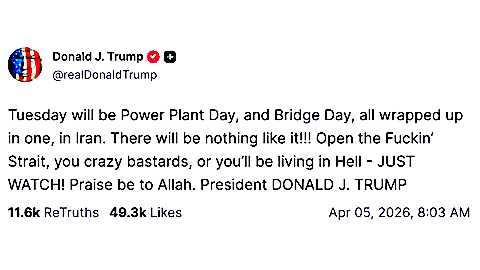
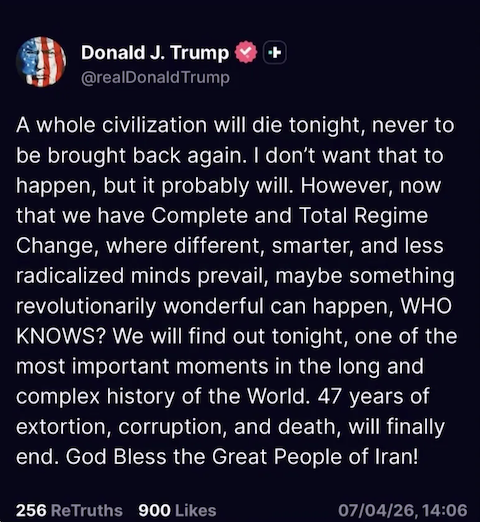
if you needed more evidence of Trump’s advanced state of senile dementia; contrast the above with the message below from “The White House” the next day, obviously NOT written by Trump (perhaps he used AI to edit it?):
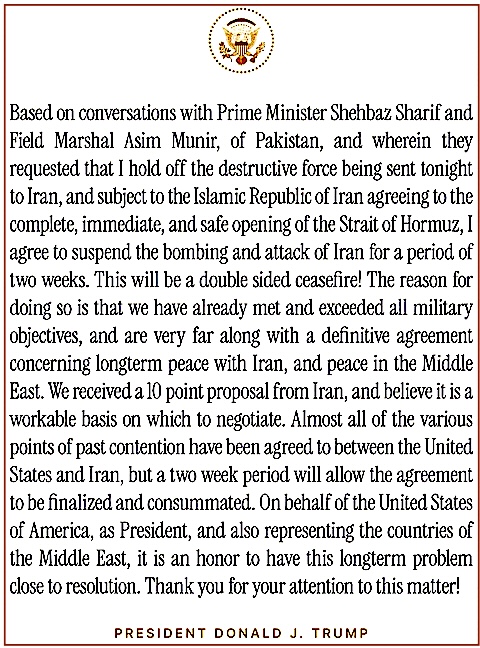
Imperialism, Militarism & Fascism: Short takes:
- Trump’s latest no-plan, no-strategy, no-exit war: Iran:
The alleged ceasefire agreement explained.
What it’s like living in Iran now.
Iranian-Americans, realizing what the US was actually ‘selling’, turn staunchly anti-war.
The markets thus far are oblivious to what this war will ultimately cost, even if it ends soon, and how long the damage will last. (thanks to Bart Anderson for the link)
The Dems just blather on about there being no ‘plan’ for the war, not about its criminality. Case in point. (thanks to Bart Anderson and Gerry Gras for the links)
Why Iran’s defensive strategy of controlling Hormuz instead of building nukes makes sense. - Israeli immediately ignores the ceasefire, expands its genocide in Lebanon. A million displaced Lebanese now rely on mutual aid networks.
- US hospitals, especially those run by churches, are telling employees to cooperate with ICE/CBP agents, rather than respecting their patients’ legal rights.
- The American Prospect questions why the No Kings protests in the US are overwhelmingly attended by seniors, and asks Where are the kids?
Propaganda, Censorship, Misinformation and Disinformation: Short takes:
- Now that Tucker Carlson has abandoned Trump, Trump has sic’d the CIA and DOJ on him as a “foreign agent”.
- How the mainstream media deliberately obfuscate disastrous war outcomes and embed anti-Moslem and anti-Arabic bias in their headlines.
Corpocracy, Enshittification, and Unregulated Capitalism: Short takes:
- When the AI bubble spectacularly bursts, that, combined with the blowback from the Trump Administration’s US-Israeli war on Iran, will collapse the global economy. The immediate consequences, explains Cory, are (1) government imposition of austerity, and (2) fascist governments:
In 2008, Obama decided to bail out the banks and not the people. His treasury secretary Tim Geithner told him the banks were headed for a catastrophic crash and could only be saved if he “foamed the runways” with everyday Americans’ mortgages. Millions of Americans lost their homes to foreclosure as banks, flush with public cash, threw them out of their homes and then flipped them to investment banks who became the country’s worst slumlords…
In “Public Service Decline and Support for the Populist Right” four economists from the LSE and Bocconi provide an excellent look at the linkage between austerity and support for fascists.
Here’s how they break it down. Political scientists have assembled a large, reproducible body of evidence to show that “public service provision is crucial to people’s perceptions of their quality of life and living standards.” Good public services are the basis for “the social contract between rulers and the ruled” – pay your taxes and obey the laws, and in return, you will be well served.
When public services go wrong, people don’t always know who to blame, but they definitely notice that something is going wrong, so when public services fail, people stop trusting the state, and that social contract starts to fray. They start to suspect that elites are lining their pockets rather than managing the system, and they “withdraw their support” for the system.
Fascists thrive in these conditions. Fascists come to power by mobilizing grievances. By choosing a scapegoat, fascists can create support from people who are justifiably furious that the services they rely on have collapsed. So when you can’t get shelter, or health care, or elder care, or child care, or an education for your kids, you become a mark for a fascist grifter with a story about “undeserving migrants” who’ve taken the benefits that should rightly accrue to “deserving natives.”
Administrative Mismanagement & Incompetence: Short takes:
- Trump is paying a French energy company, TotalEnergies, a billion dollars to NOT build two wind farms off the coasts of North Carolina and New York.
Power Abuse (the Patriciate): Short takes:
- From Barry Ferns, the five components that collectively have enabled the Epstein Class/Patriciate to flourish: obscene concentration of wealth, lack of consequences for illegal and immoral behaviour by the powerful, the capture of the political system, the manufacture of desperation, despair and precarity, and the ‘normalization’ (acceptance) of abuses of power. And our brains addict us to outrage at individual wrongdoing, they simultaneously inure us against empathy for collective suffering.
- Also from Barry, How our economic system creates and enables the Epstein Class/Patriciate’s abuses and turbocharges inequality.
- How governments use ‘sanctions’ to terrorize innocent individuals they don’t like with no accountability, no recourse, and no need to even lay legal charges.
Dementia Watch: Short takes:
- The three ‘tweets’ reproduced in the images above make it pretty clear Trump’s ‘gone’.
- Despite all evidence he brags that Iran has been “beat to shit”; his hand-selected incompetent toadies line up to nod agreement. As for soaring oil prices he says “We have so much oil, our country is not affected by this.”
- He has insisted he is in close personal talks with a “new more reasonable regime” in Iran. Iran confirms no one there has been in talks with him.
- The EU’s response to the above ‘tweets’?: “No comment… Honestly if we reacted every time somebody posted something outrageous online, that is all we would do.”
Department of Health Prevention: Short takes:
- While no one was watching, US Dems joined Republicans to pass a farm omnibus bill deregulating pesticides, eliminating animal rights for farm animals, subsidizing factory farms, and prohibiting state laws that restrict the use of toxins in foods.
- RFK Jr’s fraudulent MAHA is collapsing as courts have ruled all his vaccine regulations (and his anti-vaxx-stacked advisory panel) contravene sound scientific process and must be set aside.
- God wants you to suffer: Alberta’s neofascist government has passed a law prohibiting MAID unless doctors assert you are certain to die within a year anyway.
FUN AND INSPIRATION
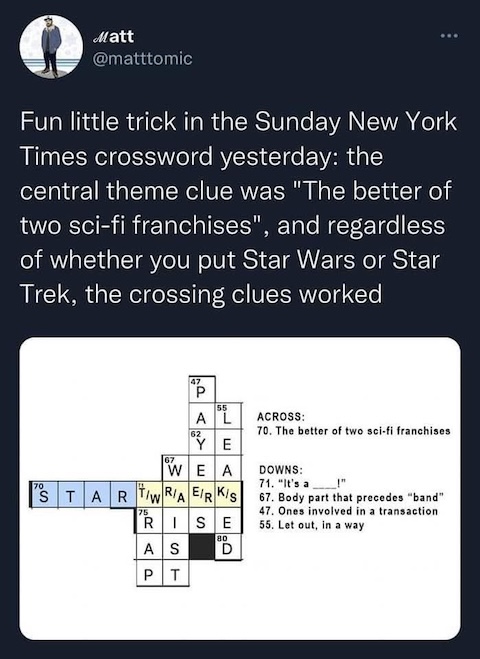
from the memebrary; crossword was by Canadian Stephen McCarthy on Feb 7, 2022
Why AI models deliberately ‘lie’: The way AI models are designed precludes them from admitting they don’t know, so they fall back on their ‘best guess’, which is provided with great ‘authority’. And when they are provided with a tool they’re not very familiar with, they may simply not use it, and pretend that they did!
“I humanize AI-produced essays and resumes for a living”: A writer confesses to reintermediating the process of employers’ AI tools vetting prospective employees’ AI-produced applications. Thanks to Siyavash Abdolrahimi for the link.
Time for a global wealth tax: Barry Ferns explains that, now the era of growth is permanently over and we’ve moved into global economic contraction, it’s time for a massive global wealth tax. Correct, but impossible to implement. It’s a predicament, not a problem, Barry!
How we are ‘trained’ (conditioned) by social media: Also from Barry, a crash course in Behaviourism 101, and how social media have been designed to ruthlessly condition unhealthy (profitable) behaviours both in readers/viewers (endless scrolling) and in ‘content providers’ (I hate that term) — dopamine hits for content that goes viral.
More on how AI is making us dumb: Claude AI warns two researchers using it for their upcoming book, that the greatest danger of AI is that, because it’s easy, we will use it to the point we will lose the capacity to do many thinking and language tasks from lack of practice, and then we’ll be totally dependent on AI (should it last) to do those tasks for us. Thanks to Mike Whatley for the link.
Still we can dream: A cute short video about a little girl watching the Artemis II launch. Thanks to Hank and John for the link.
THOUGHTS OF THE MONTH
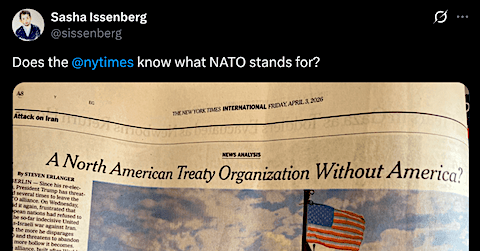
it appears no one at the NYT — not the writers, not the fact-checkers, not the editors, not the publishers — knows what the ‘A’ in the acronym NATO actually stands for; this is the depth to which US journalism has fallen; thanks to Caitlin Johnstone for the link
From Maurice Maeterlinck, in The Treasure of the Humble:
As soon as we put something into words, we devalue it in a strange way. We think we have plunged into the depths of the abyss, and when we return to the surface the drop of water on our pale fingertips no longer resembles the sea from which it comes. We delude ourselves that we have discovered a wonderful treasure trove, and when we return to the light of day we find that we have brought back only false stones and shards of glass; and yet the treasure goes on glimmering in the dark, unaltered.
From Marco Rubio and Donald Trump, ironically the same week, on the record (thanks to Aaron Maté for the links):
[Rubio:] “Imagine an Iran that, instead of spending their wealth, billions of dollars, supporting terrorists or weapons, had spent that money helping the people of Iran. You’d have a much different country.”
[Trump, two days later:] “It’s not possible for the US government to fund Medicare, Medicaid and child care programs. We can’t take care of day care. We’re a big country. We have 50 states. We have all these other people. We’re fighting wars.”
From Yalt, in a comment in Naked Capitalism about Iranian representatives not showing up in Islamabad for ‘peace talks’ (thanks to Siyavash for the link):
While we’re waiting to see if the Iranians even show, how about Beckett?
KUSHNER:
Let’s wait and see what he says.
WITKOFF:
Who?
KUSHNER:
Ghalibaf.
WITKOFF:
Good idea.
KUSHNER:
Let’s wait till we know exactly how we stand.
WITKOFF:
On the other hand it might be better to strike the iron before it freezes.
KUSHNER:
I’m curious to hear what he has to offer. Then we’ll take it or leave it.
WITKOFF:
What exactly did we ask him for?
KUSHNER:
Were you not there?
WITKOFF:
I can’t have been listening.
KUSHNER:
Oh . . . Nothing very definite.
From Robert Arnold, an unpublished poem, The Sun Doesn’t Fall:
The sun doesn’t fall — it exhales.
That’s what I’ve come to believe.
And after enough endings that it felt like dying,
and enough mornings that have proved me wrong,
it doesn’t crash into the horizon.
It doesn’t beg the sky to hold up a little longer —
it just lets go, slowly and certainly,
like a man losing his grip
on something he finally understands
he was never meant to keep.
But oh, the colours! —
like the sky itself is trying to make sense of itself,
with bruised purples and burning golds
and that soft, stubborn orange that lingers
like a love that doesn’t quite know how to leave.
I used to think these sunsets were sad,
the quiet kind of ending,
the kind that creeps in behind you
and taps you on the shoulder when you’re least ready.
But I’ve seen what happens after that fall.
I’ve stood back up with shaking hands and a busted heart
and eyes that don’t quite trust the light yet.
I’ve had grief that sits heavy on my chest
like a cinder block of memory,
and still, somehow my chest keeps rising,
breathing against all reason.
And that’s a kind of sunrise, too.
You don’t always notice it.
It doesn’t come with colour or applause.
Sometimes it just looks like getting out of bed
when you don’t think you can.
Sometimes it looks like answering the call
or not answering one.
Sometimes it looks like just finally letting go.
And there’s a softness in that hour
between what was and what will be,
a twilight of the soul,
where the world doesn’t ask too much of you,
where the light is gentle,
like it understands what you’ve been through,
like it knows you’re carrying pieces
you don’t quite know how to put back together.
And maybe the world won’t rush you down,
just paint the sky
like a reminder
that broken things still make beautiful things
when the light hits them just right.
I’ve come to love that hour,
not because it’s easy,
but because it’s honest,
because it doesn’t pretend the dark isn’t coming.
It doesn’t pretend the light won’t return.
It just stands there holding both truths at once.
So you find yourself there between the fall and the rise,
between who you were and who you’re becoming.
Stand still a minute and look up.
Let the sky remind you you’re allowed to change.
You’re allowed to break
and you’re allowed to begin again, and again, and again.
Because the sun doesn’t fall,
it exhales —
and so do we.