







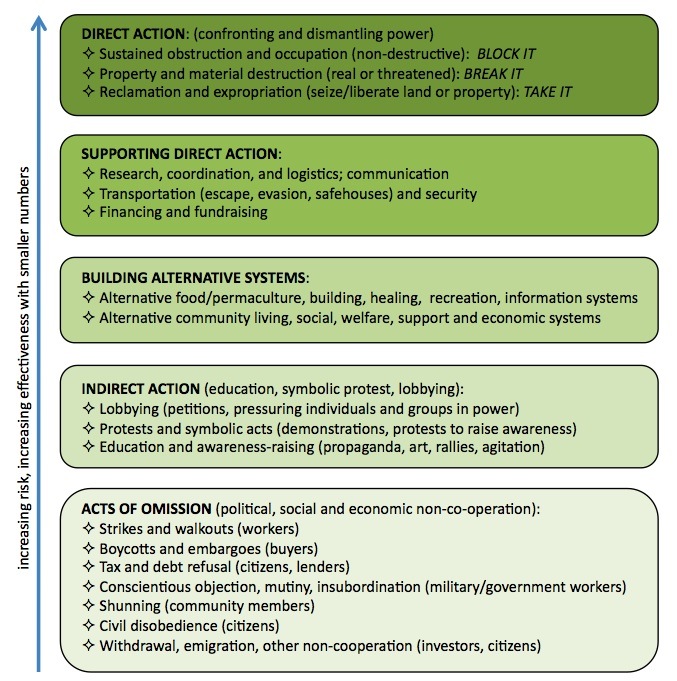
forms of activism, adapted from the book Deep Green Resistance
The latest impassioned article from Patrick Lawrence, entitled We Must Learn to Disobey, asserts:
The fate of democracy, whether it endures or disappears, is decided in the minds and hearts of its citizens before it is decided in legislatures, in elections, in courts, or in any of the other institutions on which a republic rests…
[After the invasion of Iraq and the failure of protests against it,] Americans began to assume they were impotent in the face of a new kind of power—sequestered power, unanswerable power… Power is now exercised with indifference not only to the citizenry but to law itself.
[Citing Georges Bernanos in 1946] “I have thought for a long time now that if, some day, the increasing efficiency for the technique of destruction finally causes our species to disappear from the earth, it will not be cruelty that will be responsible for our extinction, and still less, of course, the indignation that cruelty awakens and the reprisals and vengeance that it brings upon itself … but the docility, the lack of responsibility of the modern [hu]man, [the] base, subservient acceptance of every common decree. The horrors that we have seen, the still greater horrors we shall presently see, are not signs that rebels, insubordinate, untameable [humans] are increasing in number throughout the world, but rather that there is a constant increase in the number of obedient, docile [humans].”…
What about us, now? What are we to do in the face of … lawlessness in the name of law? Any useful answer must involve one or another form of disobedience, each of us to determine his or her own kind. And the paradox of our time is that our disobedience must begin by declaring our obedience to law while those charged with upholding it breach it…
If we have responsibilities in our time of lawful lawlessness, and of course we do, they must begin with acting while accepting the price action exacts, and with learning how to disobey.
What exactly do we mean by “disobey”, however? Especially if, as Patrick seems to be insisting, we have to do so “lawfully”? All my life, since Vietnam protests, I have seen that if “disobey” means to protest, to object, to boycott, to withdraw, or to commit what Derrick Jensen in Deep Green Resistance calls “acts of omission” and “indirect action”, then “disobedience” alone just doesn’t work, and never has. These acts, the bottom two (and least effective) groups on the chart above, are necessary actions but not sufficient ones to bring about meaningful change.
And it is very much in the nature of the human to try these actions and hope fervently that they will be enough, because we’re risk-averse. We take risks only when we are left with no real alternative. The protests against the Vietnam War (and against all the subsequent wars our governments have launched or supported) arguably caused pro-war advocates to become even more entrenched in their beliefs. It was when conscripts put their personal safety and freedom at risk that the tide started to turn. And they did that because they had no choice. The fear of dying or being injured in an unjust war exceeded, for them, the fear of incarceration and having to start life over in another country.
Likewise, the Valve Turners risked their personal safety and freedom when, to them, the fear and shame of complicity with a capitalist civilization that was rendering our planet inhabitable for future generations and all life on Earth, exceeded the fear of incarceration or death or injury for breaking the law. Like the Vietnam draft-dodgers, they knowingly broke the law.
Adam Smith said, famously, “the real purpose of government is to protect those who run the economy from the outrage of injured citizens”, and the law is their principal tool for doing so. The law shackles us from bringing about change; it doesn’t provide us with a means to achieve meaningful change.
Five years ago, I wrote:
My guess is that, soon enough, activists in more and more countries will have to turn their full attention to fighting fascism, principally within their own country. The war against climate collapse, ecological collapse, and economic inequality will have to be shelved, as it so often has been in past, to focus on the more immediate, personal existential threat of political and social oppression. And power is so unequally distributed now, and public opinion so imbued with disinformation and misinformation, that that struggle is likely to be long, and not go well.
And that’s where we find ourselves now. And then I predicted:
Before it’s resolved, global economic collapse will be upon us, and over the following decades it will be exacerbated by the more severe manifestations of climate and ecological collapse. Power will then inevitably devolve to the local level, and we will have no choice but to put aside our political differences and work together to deal with the everyday crises at hand. We will all, at last, be activists.
We will become real activists when we have no other choice. We will start to do the actions in the top three boxes: Direct action (blocking, breaking, and taking the tools and property that are used by the rich and powerful to oppress us, steal from us, and destroy our planet), and supporting that direct action, and starting to build alternative systems responsive to the needs of all citizens, as the current dysfunctional systems crumble and collapse.
And doing these things is going to be much harder than it would have been even a decade or two ago, because automation, AI, the financialization of our economy, the replacement of military ‘manpower’ with drones and computer-controlled bombers, and soaring wealth inequality, have greatly shifted the ‘balance of power’ from labour to capital. Our labour is not as essential to the economy as it once was, so withholding it as a means of fighting the abuse of power is no longer as effective a tool as it once was.
This article isn’t an admonition for us to do any of these things. We do what we must, and we will do these things when we have to, and not before.
Patrick is one of my favourite writers, and yes, we will have to learn to disobey, and we will, when we have to. But disobedience will never be enough, and we risk wasting a lot of time and energy if we hope that disobedience by itself is going to get us anywhere, other than prompting the rich and powerful, before their empires collapse, to pass more and more draconian laws to dissuade us from disobeying.
We’re going to do what we’re going to do. We’re going to disobey, when we have no other choice. And then we will learn how to disobey. And we’re going to resist, to commit direct actions, most of them ‘illegal’ (many of them newly-made-illegal), when we have no other choice. And we’ll learn how to do that, too.
It’s going to be a hard ride. But also an exciting one. We’re going to learn a lot about ourselves and about the prosthetic world we have created and the real world we have pushed away in the process.
But don’t listen to anyone who tells you what we ‘must’ do. It’s already happening, the only wonderful, terrible way it possibly could. Hang on, here we go.