







This is #55 in a series of month-end reflections on the state of the world, and other things that come to mind, as I walk and hike in my local community.
For most of my life, I’ve loved doing statistical analysis. Part of that, I suppose, is the ‘collector’ in me. And part of it is unearthing information from the data that isn’t obvious, and provides some interesting insights.
Recently during my wanderings in the neighbourhood I started observing people’s facial expressions, and wondering if they might be a ‘barometer’ for what’s happening in our local community and the world at large.
The only thing I could discern without having to collect data was that people are happier when it’s sunny. Hardly a revelation. So I decided to do some very low-quality highly-unscientific data collection to see what I was missing. On recent walks around the neighbourhood, I identified 20 areas where people were engaged in relatively homogenous activities, that were significantly different from the activities in the other 19 areas.
Then, I took a mental ‘snapshot’ of each of the areas, by scanning around the area and looking at people’s faces, rating their apparent happiness on a scale of 0-3, with a 3 being mostly smiling or laughing faces, and a 0 being mostly frowning or scowling faces. I did this on four separate occasions, doing the rounds of all 20 locations each time.
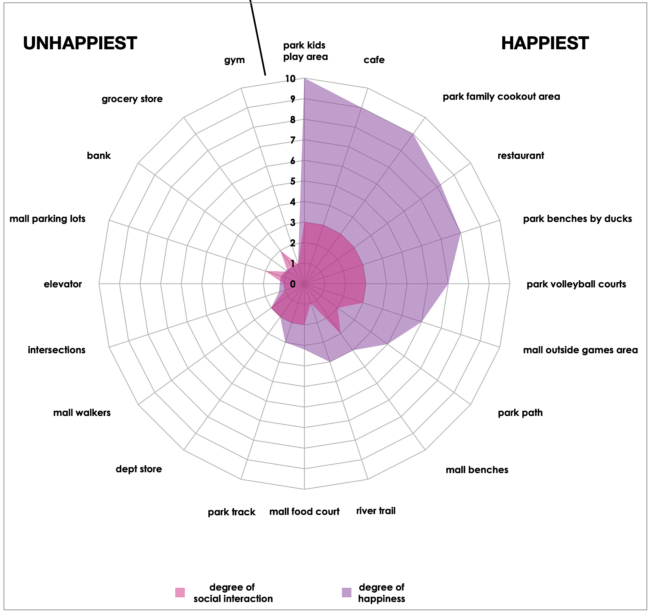
The ‘scores’ (out of a possible total of 12) are in the radar chart above, sorted from happiest to least happy. The obvious correlation (also not rocket science) is that people are happiest when they’re socializing with other people (specifically family and friends, rather than clerks and customers). I rated each of the 20 locations by degree of social interaction on a smaller scale of 1 to 3, shown in the pink spiral, and you can see how closely it correlates with apparent happiness (the purple spiral).
Happiest Places:
- Kids’ Play Area (score: 10). I could watch the kids in the sprinklers and on the slides all day. Expressions of sheer joy. Even after falling and scraping knees, they’re almost instantly shrugging off the pain and damage and hankering to get back to play. Even the parents watching them are smiling.
- Café (score: 9). This was a little biased, because it’s my regular hangout, but not only are most customers either smiling or wearing ‘engaged’ open expressions, the café is far and away the ‘body language’ leader among these 20 places — hands, nods, and eye and facial movements galore. But this café is particularly social (and noisy). Few laptops or people talking on phones compared to most cafés, I suspect.
- Family Cookout Area (score: 9). One section of the park is set aside for families to do barbecuing and otherwise spend time together. Most of the groups clearly do this often, because they arrive with armloads of cookout supplies, including tents, loungers, game sets, portable cookers, blankets etc. Lots of baby carriages. Lots of dogs. Few of the groups are speaking English, and some of them are quite large.
- Restaurant (score: 8). Almost as happy as the café crowd, but men in suits seem to drag the happiness quotient of the customers down a bit.
- Duck ‘Pond’ (score: 8). This is the part of the lake where the ducks and geese hang out (these days with their newborns in tow). Not just delighted kids smiling, but also the ‘old friends’ hanging out on the nearby benches. Old people’s smiles (like mine) are quite different from those of younger people, but still unmistakeable.
- Volleyball Courts (score: 7). These are not for serious players, but they’re usually in use. Smiles of celebration of great moves, and of consolation for good tries.
- Mall Exterior Games Area (score: 6). Just outside the local mega-mall is a games area with foosball and table tennis tables, and in warmer months, a DJ and some contests. I have never seen the table tennis tables not in use. And never heard players arguing.
- Park Path (score: 5). It’s a lovely path around the lake, so I was surprised at the number of unhappy faces. Quite a few people walking by themselves, or in very serious conversations. Lots of people on ‘constitutionals’, or walking dogs, presumably because it had to be done, rather than for enjoyment.
- Mall Interior Benches (score: 4). The anonymous owner of our mega-mall (rumour is it’s Russian mafia), quite unusually for malls these days, provides ample, comfortable casual sitting areas between all the walkways of the mall’s air-conditioned interior. So lots of relaxed conversations and meetups, especially in inclement weather.
- River Trail (score: 4). It’s a gorgeous trail, but like the Park Path, mostly frequented by dog walkers and joggers, mostly solo and on a mission. The small, cheerful, homeless group that gathers here brings the score up.
Unhappiest Places:
- Gym (score: 1). Such an unhappy place that if you smile at others they look at you as if you’re deranged. Coincidently, Lyle Fass just wrote a wonderful little essay explaining exactly why gyms must be among the unhappiest places on earth.
- Grocery Store (score: 1). One of two of my 20 places that were unhappy despite the fact there was a lot of socializing going on. But if they were talking about the oligopolies’ grocery prices, no wonder they were unhappy. Not to mention security that makes you feel like a criminal.
- Bank (score: 1). Even before Stephen Leacock’s famous satire on the banking experience, written in 1910 (!) banks have been notoriously unhappy places to go. My ‘experience’ watching a bank’s customers was no different. Faces bordering on dread going in, and mild relief exiting. They are the symbols of our ubiquitous precarity.
- Mall Parking Lot (score: 1). Walking from your car to/from the mall, or trying to navigate it safely as a pedestrian to get somewhere else, is not a happy experience. Used to be, I think, that shopping itself was a pleasant experience, so at least the people going in looked expectant and happy. No more. Expectations kept low.
- Elevator (score: 1). There’s a ‘thing’ in our community that we almost always greet strangers on elevators and wish them a good day as they exit. It’s a nice politeness, but the tight expressions betray its formality.
- Intersections (score: 1). The fact that I live in one of the country’s most pedestrian-hostile communities probably accounts for the low happiness score of people waiting endlessly for ‘walk’ lights (which you have to push a button to get at all). Our only amusement is watching the people in expensive cars demonstrate their Epstein Class zero-empathy tendencies honking their way through intersections, while those in more modest vehicles wait their turn. The world in microcosm.
- Mall Walkers (score: 2). Slightly higher score than those in the nearby parking lot, but I’m guessing that’s because it’s slightly less treacherous to navigate, and lots of people are checking each other out and commenting to their fellow mall-rats.
- Department Store (score: 2). Slightly higher score than grocery store customers. I’m guessing that’s because they’re poorer on average; we take small joys where we can find them. The staff in department stores, on the other hand, look uniformly miserable, probably for good reason.
- Track (score: 3). Our park has a reasonably fancy track usually open to the public between events for walkers, joggers, and runners. It’s a surprisingly social location, mostly older couples walking on the padded lanes and chatting.
- Mall Food Court (score: 3). Most places serving food and drink seem to be relatively happy places (see above). Not so for mall food courts. The industrial-style ambiance doesn’t help. I suspect for people struggling, including most of the mall stores’ staff, this is as good as ‘eating out’ gets for them.
This was a fun exercise in cultural anthropology, though it didn’t offer many surprises.
I have no idea why most people walking alone or sitting alone seem to adopt stern facial expressions. It’s not like I live in an unsafe area. Is solitude in public somehow socially suspect? I confess that (usually while people-and-animal-watching) I often smile or laugh, even when I’m alone, though that does sometimes attract strange looks. Nothing wrong with being a bit eccentric at my age, I guess.
So — People usually expect blog essayists to proffer some advice at the end of their analysis. You know better than to expect that from me. But if I had to summarize my ‘findings’ from this most-unscientific ‘survey’, I guess they would be:
- The world needs more genuine (non-competitive, non-serious) play, and fun.
- ‘Breaking bread together‘ is an essential, joyful, social activity. Eating alone really isn’t natural for our species.
- When we have beautiful, natural places close at hand, we are blessed. We should use them and protect them.
Way back in 2000, Robert Putnam’s Bowling Alone warned about the consequences of our atomized, fragmented, distrustful ‘communities’ and how that disconnection threatens our very social fabric. I think each of us, in our own way, realizes that loss and that danger, but we seem helpless to do anything about it. We do what we can, I guess.
Two incidents on the park’s busy ‘beach’ (sand) volleyball courts that I found especially memorable this month:
I noticed a small group of spectators buzzing around one of the courts, so I walked over to see what was up. There was clearly a ‘ringer’ in the group — a young man whose skill level was so far above the others’ it was rather breathtaking. He ‘saved’ volleys by redirecting the ball effortlessly to exactly where he wanted to send it — on one occasion like a soccer player with his head, and on another using his knee to keep the ball from hitting the ground and perfectly setting up a teammate for an overhead spike. And a moment later, just as one of the ‘opposing’ players had rifled a shot right by him, sure of scoring a point, this amazing player dove blindly to the sand just inside the out-of-bounds line and ricocheted the ball back over the net with two clenched fists. Even the star’s teammates groaned at this, and, in respect and frustration, all the players mobbed the guy with fake punches while he was still lying on the ground.
A couple of days later, I watched another casual pick-up volleyball game with a unique difference: There were two very small children, one on each side of the net, happily playing in the sand with dump trucks and pails, while the game was going on. The players (presumably including the parents of the children) had ‘drawn’ a circle around each child in the sand, and these were apparently ‘out of bounds’ areas. Instead of being frightened, the little kids laughed each time the ball came close to them. And on one occasion, one of the kids put her hand up and effectively redirected the ball to one of her ‘teammates’, earning a point and ‘high fives’ from the rest of the team.