




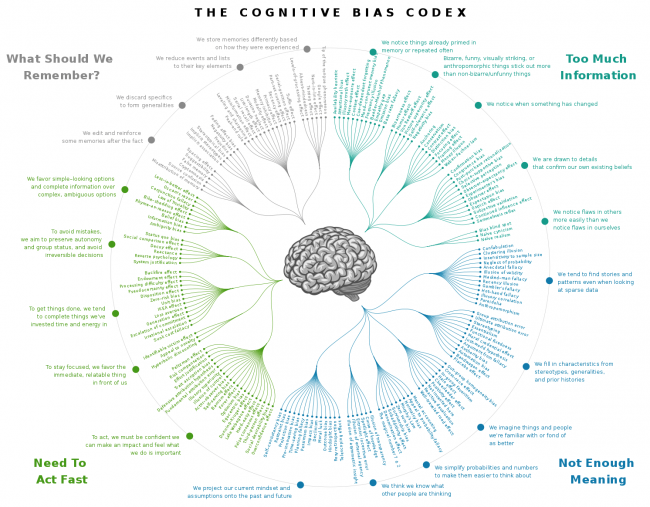
The cognitive bias codex from wikipedia; if you want to print it out so it’s legible and useful, print the original over four letter-sized pages and paste them together (my printout is taped, tellingly perhaps, over my rarely-used TV). The model was developed by John Manoogian III and refined by Buster Benson; the online version includes links to, and pop-up summaries of, the wikipedia articles explaining each bias, by TillmanR.
The technical term for the phenomena described in this article’s title — the things we don’t know, don’t notice, don’t ask about, and don’t remember — is negative cognition or negative epistemology. But if I’d titled my post that, even I wouldn’t read it.
Those of you old enough to remember the execrable Bush Jr war criminal Donald Rumsfeld will probably recall his blather about “unknown unknowns” — the things we don’t even know we don’t know. Of course he didn’t invent the terms — the matrix of known/unknown known and unknown things has been used in defence and space planning for decades.
But their matrix is principally about identifying ‘facts’ that we know or want/need to find out. Far more interesting, I think, are the psychological factors that largely determine what we do and don’t ‘know’.
As someone who used to have the pretentious title of Chief Knowledge Officer, I suppose I should start with a non-Rumsfeldian definition of ‘knowledge’. My definition is simple:
Knowledge is what we believe to be true.
We can’t ‘know’ what we believe to be false. We believe what we believe. If information gets incorporated in our belief system (aka our ‘worldview’), then it’s knowledge. Even if we believe x to be incorrect, then x’s incorrectness is part of our knowledge.
That much is pretty simple. It’s when we start to deal with human proclivities, emotions, and psychology that things quickly get very complicated.
For a start, our belief system and its constituent ‘knowledge’ has to navigate a minefield of cognitive biases that threaten to clutter up our belief system with misinformation. The cognitive bias ‘codex’ illustrated above describes some of these biases.
Even worse, as I have written about an annoying number of times on this blog:
We believe what we want to believe to be true.
Why would we want to belief a falsehood? Well, our beliefs, like our behaviours, are entirely determined by our biological conditioning, our cultural conditioning, and the circumstances of the moment. If our body tells us we’re hungry (even when we’ve eaten a huge meal), or if our friends and the people we trust tell us the Rapture will soon be upon us (even without any evidence), then that’s what we are very likely to believe, and hence claim to ‘know’. Our prejudices are largely ‘inherited’ from others, and invisible to us.
Our conscious brains play an infinitesimally small role in what our bodies do, fortunately for us, or else we might forget to breathe or instruct our hearts to beat. Our bodies ‘unconsciously’ make almost all our decisions, and what we call ‘our’ knowledge is an after-the-fact rationalization of their ‘decisions’ and behaviours. And on top of that, we are essentially social creatures, utterly dependent on each other for our survival as a species, so we are understandably inclined to mimic and reinforce the behaviours and beliefs of others we (want to believe we) ‘know’ and come into contact with (eg through our reading).
What we pay attention to also plays an enormous role in determining what we (want to believe we) know. Of course, we have no agency over that either — What we pay attention to is determined largely by what people who influence us point us toward, including what we read, what music we listen to, and whose opinions we value (and hence want to believe). We may hold a position, for example, on Venezuela’s kidnapped president Maduro that is devoid of any factual or evidence basis. It’s what we’re exposed to (and mostly not exposed to), and what, to ‘get along’ with those we have to or want to get along with, we are conditioned to believe. And the cognitive biases, such as the desire for horrifically complex issues to be simple and hence not require further consideration from us, and the desire for all our belief systems to be internally coherent and free from uncertainty and ambiguity, also play into these beliefs and hence our ‘knowledge’.
Another factor influencing what we (want to believe we) know is our curiosity and our related capacity to imagine. If we aren’t curious about why the US continues to ‘officially’ recognize Taiwan as a part of China, even as it’s arming Taiwan to break away, we will believe what we want to believe in the absence of that information. And if we can’t imagine what it’s like for the people of Palestine and Lebanon living in conditions of constant terror, precarity and misery as a result of Israel’s ongoing genocide, our beliefs about what is happening and what ‘should or shouldn’t’ be done about it, will be affected. Because we have to ration our very limited attention, “don’t ask, don’t tell” is inevitably our preferred modus operandi except when our bodies or our cultural influencers insist a matter is both urgent and important. And those of afflicted with excessively curious minds are punished with overload and helplessness, while those with ‘unpracticed’ curiosity quickly lose the capacity to conceive of, consider and ask the questions that would be necessary to really ‘know’ what is going on.
Yet another factor is our memories, and particularly how they fade, are forgotten, and are constantly ‘reinvented’ to be more consistent with the rest of our worldview. And conversely how they ‘anchor’ our beliefs, making us less and less able to ‘change our minds’ as we age.
And finally, thanks to the incessant demands on our time, energy, and attention in our modern world, we usually don’t have the time to think that would be needed to actually consider alternatives, missing questions and information, our own biases, and the other ‘data points’ needed to construct a coherent and credible set of beliefs on most subjects. Our beliefs remain frustratingly incomplete, tentative, unsatisfying. We don’t have enough time to make sense of things.
In short, what we (want to believe we) know is inevitably, often catastrophically, flawed, not just because of (accidental or deliberate) misinformation but because it is necessarily seriously incomplete and biased (our cognitive ‘machinery’ is just not really up for the job, especially as our lives become ever more complex. We do our best, but not very well.
Hank Green has been reading a ridiculously expensive (sorry, I have no choice but to believe that) academic treatise by Jessie Munton’s cleverly titled Priority and Prejudice: The Epistemology of Salience and Attention. So while I have no intention of reading it, my cultural conditioning (causing me to trust Hank Green) leaves me with no choice but to read and obtain synopses and critiques of it.
The points I’ve made above cover, I think, the main arguments in the book.
Of course, we all want to know what to ‘do about’ the negative ‘spaces’ in our cognitive capacities and the ‘knowledge’ they have assembled. How can we ‘know better’?
We cannot. Not really. The best we can do, as I’m trying to do here, is to explain the predicament, not very completely, coherently, or convincingly. We do what we do.
Jessie’s book does suggest some things she thinks we can do. While I’m not terribly convinced they are possible, here is a list of those things:
- Cultivate a practice of asking “What am I missing?” What information, what questions, what perspectives, what distortions, what motivations (cui bono?), what alternatives, what ‘gaps’, might change my beliefs about this?
- Allow yourself to be exposed to people and ideas that disagree or conflict with your current beliefs.
- Study anthropology to learn how we form our beliefs, and why other cultures believe differently from us.
- Pay attention to strong emotions. If you (or someone you’re with) has very strong feelings about a subject, probe to find out why.
- Look for conspicuous (or subtle) absences. What groups are not represented in what we’re told? Where are the explanations from history missing?
- Track things you’ve changed your mind about, what biases that reveals, and why you changed it.
- Learn about how objective data-gathering and statistical analysis can reveal what isn’t obvious or popularly believed.
- Practice humility and learn to tolerate uncertainty, ambiguity, and missing information rather than rushing to conclusions.
- Expose yourself to new situations: Travel, literature, different kinds of friendships, and art can open your eyes, and mind, to new possibilities.
- Collaborate: Get peers to review your thinking. Do projects with intellectual foils, adversaries and cross-sectional groups like citizens’ assemblies.
So, now you might know, a bit, about what you didn’t know you didn’t know.
Or at least, you might want to believe you do.
Postscript: When I wrote my book Finding the Sweet Spot, it encouraged readers to find work that was at the intersection of (1) what they love to do, (2) what they are uniquely skilled at doing, and (3) what the world needs.
It was only after I started to run workshops based on the book, that I came to a startling realization: Most people don’t really have the faintest idea what they love to do (they have been channeled into certain vocations since childhood, and have no experience or knowledge of the hundreds of things they might love to do for a living, if only they knew they existed. And also: Most people don’t really have the faintest idea what they’re uniquely skilled at doing, for the same reason.
Negative cognition at work. We don’t know what we don’t know. Most of the people who’d found work in their ‘sweet spot’ had stumbled on it entirely by accident.