A Ministroke Has Major Consequences

A Ministroke Has Major Consequences

Story at-a-glance A ministroke, or transient ischemic attack (TIA), is your brain’s urgent warning sign that a full-blown stroke could strike within hours or days — up to 20% of people have a major stroke within 90 days, and half of those happen within just 48 hours TIA symptoms mimic those of a stroke but…

Read Full News
What If We Created Ourselves, With The Motion of Our Own Bodies? Part 2: Looking into the physical environmental forces that are preserved in genomic expression]

What If We Created Ourselves, With The Motion of Our Own Bodies? Part 2: Looking into the physical environmental forces that are preserved in genomic expression]

Abstract: This article uncovers the intricate relationships between biological evolution and life-acquired bodily characteristics arising from repetitive behaviors, calling into question previously dismissed theories of inheritance and providing a comprehensive overview of the deeper evolutionary forces that have shaped the diversity of genomes throughout the entire history of life. We will examine the role of…

Read Full News
Canada’s quantum Cassandra is finally heard 

Canada’s quantum Cassandra is finally heard 

This article appears in the 2026 BetaKit Most Ambitious issue. Read more stories of the Canadian tech innovators strengthening our autonomy, security, and prosperity here. In 1983, Gilles Brassard’s studies in quantum information yielded an important discovery, almost two decades before the first quantum computer was ever built. He and his colleague Charles H. Bennett…

Read Full News
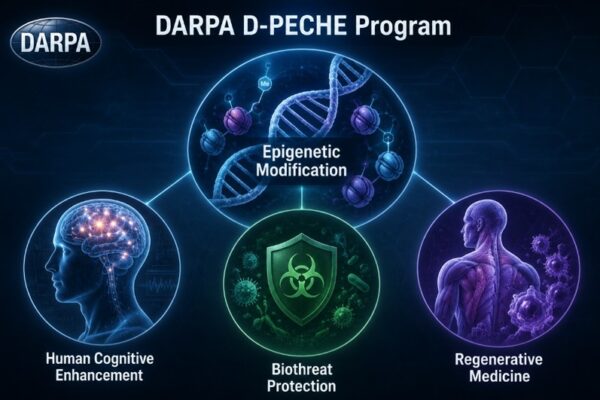
DARPA ‘D-PECHE’ looks to epigenetic modification for human cognitive enhancement, biothreat protection, regenerative medicine

DARPA ‘D-PECHE’ looks to epigenetic modification for human cognitive enhancement, biothreat protection, regenerative medicine

DARPA is looking to write and erase epigenetic base modifications in DNA that could be used for cognitive enhancement, biological threats protection, and regenerative medicine. The US Defense Advanced Research Projects Agency (DARPA) DNA-Protein Epigenetic Chemistry Engineering (D-PECHE) program aims “to develop novel methods of modifying DNA bases in living cells and validate the presence…

Read Full News