





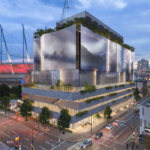
The government of Canada and Telus announced on Monday plans to advance three AI factory projects in British Columbia. The company says the centres could generate a potential $9 billion in economic activity.
The Telus project “reflects the kind of ambitious infrastructure we need as a country.”
AI Minister Evan Solomon.
At Telus Gardens, the telco company’s global headquarters in downtown Vancouver, Telus laid out plans for a “sovereign AI factory cluster” that would run primarily on renewable energy provided by BC Hydro. Projects include scaling Telus’s existing 215,000-square-foot data centre in Kamloops and building two additional AI factories in Vancouver.
An AI factory differs slightly from a traditional data centre. It specializes in operating across the AI lifecycle, beyond the storage and management provided by data centres, including training, tuning, and running AI models.
The proposed facilities include a 100,000-square-foot, repurposed facility in the Mount Pleasant neighbourhood, as well as a 400,000-square-foot development at 150 West Georgia—adjacent to Vancouver’s BC Place stadium. Both neighborhoods are densely populated, with the downtown area counting tens of thousands of residents and Mount Pleasant being home to more than 30,000 residents. BetaKit reached out to Telus to ask how the company plans on integrating the facilities into such densely populated neighbourhoods, but has not yet received a response.
The three projects are expected to generate around $9 billion in economic activity, create 1,000 jobs during the construction and development phase, and create 525 “permanent, high-skill operational jobs” when they’re up and running.
The announcement was delivered by Evan Solomon, Canada’s minister of AI and innovation, alongside Darren Entwistle, the longtime CEO of Telus. They were joined by members of the provincial government, including Taleeb Noormohamed, the MP for Vancouver-Granville, and Ravi Kahlon, the minister of jobs and economic growth. Vancouver mayor Ken Sim, and Bridgitte Anderson, the president and CEO of the Greater Vancouver Board of Trade, also delivered remarks.
RELATED: Telus opens inaugural Sovereign AI Factory in Rimouski
Telus’ existing KIDC Kamloops data centre holds up to 12,500 GPUs and is capable of generating up to 25 megawatts of power. Its M3 Vancouver facility will be of similar scope, with 13,000 GPUs planned and an output of 26 megawatts. Its downtown location, however, will scale significantly higher, housing more than 50,000 GPUs at a facility capable of generating up to 100 megawatts of power.
“They’re going to be sexy as hell,” Entwistle said, adding that the M3 facility is slated to open in the fourth quarter of 2026 and scale into 2028, and that the downtown location plans to come online in early 2029. According to documents provided by Telus, the downtown facility has secured the necessary municipal approval.
The three projects are the first to advance under the federal government’s enabling large-scale sovereign AI data centres initiative, a federal program announced earlier this year designed to build domestic AI compute infrastructure and reduce reliance on foreign-owned systems. Solomon said that program’s callout attracted 160 proposals that were assessed across a variety of criteria, including sovereignty, economic benefit, performance capabilities, energy considerations, readiness, project cost, and others.
“Telus’ project is the first one we are announcing publicly that we are moving ahead and advancing,” Solomon said. “It reflects the kind of ambitious infrastructure we need as a country.”
Both Solomon and Entwistle stressed the importance of these projects in expanding Canada’s sovereign capability.
The three projects are the first to advance under the federal government’s enabling large-scale sovereign AI data centres initiative.
“What does digital sovereignty look like to you?” Solomon asked during his remarks. “The truth is it looks like infrastructure … It looks like Canadian companies building things that will function under Canadian law, free from the coercion of others, used by Canadian researchers, Canadian innovators, Canadian businesses, and Canadian institutions. It looks like building, as the prime minister says, with steel, concrete, and code.”
All three projects will be Canadian-controlled, according to Telus, however the GPUs will be provided by Nvidia. Oversight, management, technical support, and incident response will all be “strictly handled by Canadian teams” according to Telus.
According to Telus, all three of the projects are planned to run on “98 percent renewable energy” sourced from BC Hydro.
Additionally, they will deploy closed-loop, direct-to-chip cooling systems to reduce environmental impact, and feed waste heat into district networks that the company says will offset power demands in Vancouver. They also claimed to be exploring ways to leverage Vancouver’s rainfall as a way to offset water demands. Data centres can consume significant amounts of water, with large facilities potentially using millions of gallons daily, according to the Environmental and Energy Study Institute.
Feature image courtesy Telus.
The post “Steel, concrete, and code”: Feds and Telus announce three AI data centres in BC first appeared on BetaKit.