








South Indian Origins (15,000 BP – Sangam Age) Reframed through Indus Valley Displacement and Submerged Khambhāt and Poompuhar Research
Author: [Jeeva S S] Affiliation: Independent Researcher
Contact: [Email jeevas@hotmail.co.uk] Version: v1.4.5 – November 2025
Summary: This paradigm shift research promotes a polycentric model—the “Dravidian Arc”—positioning South Asia (c. 15,000 BP–Sangam age) as an autonomous hub of maritime, independent agrarian development, and metallurgical innovation. Synthesising underwater surveys, sediment cores, ancient DNA and stratified archaeology, it links early canoe networks, an independent Iron Revolution, Bronze Age ports, and a GDP weighted chart placing the Dravidian Arc near the global economic lead over the past 12,000 years.
Abstract
This paper addresses historical gaps in research funding that have obscured India’s Neolithic trajectories by charting and evidencing the “Dravidian Arc” — a continuous civilizational corridor in the subcontinent extending from ~15 ka BP through the Sangam age. Drawing on underwater surveys, sediment-core reconstructions, ancient DNA, and high-resolution archaeology, it demonstrates that exposed Late Pleistocene shelves sustained Proto-Sangam canoe networks (~10–7 ka BP); that an autonomous Iron Revolution at Sivagalai and Adichanallur (~5.3–4.9 ka BP) enabled canal-fed cultivation, deep plough-based agriculture, and millet–pulse intensification using iron sickles and ploughs; that multistage bloomery and crucible steel production at Thelunganur (c. 1435–890 BCE) marked the earliest known high-carbon steelmaking in South Asia; and that fully integrated Bronze Age ports linked South Asia’s maritime trade to Mesopotamia, Egypt and Southeast Asia, showing patterns consistent with exchange connections to Zhou China, and Southeast Asia. The earliest westbound seaborne evidence emerges by circa the 5th millennium BCE, when Predynastic Egyptian contexts reflect the movement of Cypraea moneta cowries—commonly known as known as “money cowries”—which served both as ornate status markers in children’s burials and as a proto-monetary shell currency, the principal form of shell currency across Afro-Eurasia, circulating via the Maldives–Tamilakam–Khambhāt/Pre-Harappan (Hakra Phase)–Gulf–Levant–Nile corridor— western trade route trajectories later echoed in the maritime map of the Periplus of the Erythraean Sea. These findings demonstrate that South Asia’s maritime exchange networks preceded and were integrated within, the Harappan urban system—situating the Dravidian Arc firmly within a very-early Bronze Age polycentric exchange network with the west.
Sangam texts such as Pattinappalai describe Yavana ships unloading gold, wine, and luxury wares at Kaveripoompattinam (Poompuhar), where Greeks, Romans, and West Asians bartered with Tamil merchants during Tamilakam’s late development phase. While William Dalrymple’s The Golden Road (September 2024) situates Indo-Roman commerce as flourishing from the 1st century CE onward, this paper shows that Sangam Tamilakam was already integrated into Mediterranean and West Asian maritime networks by the 3rd–2nd centuries BCE. Greek and Roman sources—including Arrian, Ptolemy, Pliny the Elder, and the Periplus Maris Erythraei—attest to sustained east–west trade, corroborated by finds at Arikamedu, Alagankulam, and Poompuhar—amphorae, rouletted ware, and Indo-Roman coins—that attest to seasonal enclaves and enduring transoceanic exchange well before European arrival.
This paper also addresses the overlooked primacy of India’s Iron Age, challenging diffusionist models that calibrate South Asian metallurgy against Mesopotamian and Levantine benchmarks. Stratified finds at Sivagalai (c. 3300–2600 BCE; AMS ¹4C and OSL), Adichanallur (c. 2500 BCE; AMS ¹4C), and Thelunganur (1435–1233 BCE; AMS ¹4C on ultrahigh-carbon steel sword; Rajan et al. 2017; TNSDA 2025)— nearly two millennia before the Hittite/Anatolian iron horizon — reveal agrarian systems anchored in irrigated cultivation, pulse–millet intensification, and iron-based agronomy well before West Asian parallels. This southern metallurgical complex did not merely predate northern adoption—it radiated northward and southwards along the Dravidian Arc, influencing Iron Age transitions across the Deccan Plateau, Andhra Pradesh and to Ilaṅkai.
Independent of Fertile Crescent diffusion, Tamilakam’s agrarian systems sprouted from an AASI majority substrate before major Iran_N admixture, beginning with incipient, toolkit based pulse and millet cultivation at Paiyampalli (Neolithic occupation with charred horsegram, greengram and toolkit consistent with small-seed processing; c. 6000–2000 BCE; Bayesian mid-Holocene) and at the newly publicised Chennanur site (excavation preliminary report September 2025; Neolithic–Megalithic sequence with OSL- and AMS-dated contexts to a basal layer ∼ 8500 BCE, yielding microliths, faunal remains, and flotation-recovered charred seeds and phytoliths indicating early husbandry and food-processing activity)—both along the Ponnaiyar River basin, signalling integrated animal-husbandry and food-processing innovations, and incipient paddying and wild rice management in the Belan Valley (~5000 BCE).
Parallel early rice cultivation at Lahuradewa and Koldihwa (~7th millennium BCE) in the Belan–Ghaghara basin underscores a polycentric South Asian pattern of regionally autonomous agrarian innovation. By the 4th millennium BCE, polished-stone axes and later copper-arsenic and tin-bronze implements gave way to true iron — evidenced at Sivagalai and Adichanallur— where bloomery-smelted iron on sickle blades and ploughshares drove wide-scale pulse and millet harvests, with a millet trajectory developing in parallel with, rather than derived from, Mehrgarh’s AMS-dated barley and wheat horizon. Mid Holocene Sea level highstands laid fertile alluvium across the Vaigai and Tamirabarani deltas, fuelling surplus driven centres at Keezhadi and Adichanallur. In the Bronze Age, surpluses from Tamilakam, the pre Harappan Indus region, and Mehrgarh entered long distance networks: Cypraea moneta (money cowries) reached Predynastic Egypt (c. 4400–3000 BCE) and sustained Tamilakam–Harappan exchange, alongside carnelian beads, shell ornaments, and high value textiles. Sonar identified estuarine and harbour features at Poompuhar and Khambhāt (c. 12 000–6000 BP) attest to an early, self directed maritime economy.
It further proposes that the Indus Valley Civilization emerged through a strategic inland relocation, catalysed by catastrophic mid-Holocene marine transgressions that submerged coastal submergence along the western and southern littorals—an upheaval memorialised in Kumari Kandam traditions of southern Dravidian groups/Tamilakam and the Manu legend of northern Dravidian groups seeking new homelands. This dual displacement catalysed inland settlement and ultimately the historically recognised emergence of the Indus Valley Civilization. A civilisation weighted GDP share model spanning 13,000 BP to 1,000 BP further corroborates these cultural and technological findings, placing the Dravidian Arc (or Dravidian Corridor) at or near the global lead in economic share across the past 12,000 years—underscoring its resilience and long term primacy.
By integrating genetic, symbolic and religious–philosophical continuities, metallurgical, agrarian, and maritime evidence, the Dravidian Arc challenges Mesopotamia’s—and more recently Anatolia’s—claims as sole cradles of civilization, reestablishing Southern Tamilakam as an autonomous nexus of agrarian, metallurgical, and maritime innovation. As outlined in the Overview section, this methodological critique of entrenched funding priorities, institutional frameworks, and historiographical traditions underpins our analytical framework. The paper concludes by advocating stratified offshore coring, targeted aDNA/isotopic campaigns, and high-resolution stratigraphy to refine this deep-time chronology—and secure the Dravidian Arc’s rightful recognition among humanity’s foundational civilizational theatres.
Overview
This paper acknowledges that prevailing archaeological interest groups in India, Pakistan, Sri Lanka, and within the wider international archaeological community have—whether through funding priorities, institutional frameworks, or historiographical traditions—consistently under emphasised the Indian subcontinent’s Ancient Indian Civilisation (Dravidian Arc), and in particular the legacy of its southern arc, Tamilakam. By explicitly confronting these systemic biases, we aim to ensure that our deep time stratigraphic, genomic, and geo archaeological analyses are undertaken on an equitable and methodologically balanced footing.
Positioning Ancient Indian-subcontinent’s Dravidian Arc as a serious rival to Mesopotamian, Fertile Cresent and Anatolian perspectives on humanity’s cradle, this paper unfolds twelve interlinked chrono-cultural phases—each underpinned by concrete discoveries and cutting-edge interdisciplinary methods:
- Paleo-Shelf & Early Coastal–Inland Maritime Nodes (15–9 ka BP): An exposed –120 to –40 m shelf corridor linked Tamilakam, Ilaṅkai and Khambhāt, sustaining Pleistocene coastal foragers and canoe communities. Submerged Neolithic grids at Khambhāt (13–9.5 ka BP) and Proto-Poompuhar deltaic ports (evidence of estuarine camps and activity from ~15 ka BP — Phase A early port activity— which c continued to operate into and after the classical Sangam era) reveal early maritime nodes. Aceramic Mehrgarh (~9 ka BP) pioneered wheat–barley cultivation and zebu pastoralism — Tamilakam’s Neolithic–Megalithic site at Chennanur (basal layer ≈ 10.5 ka BP; 2025 report), which demonstrates early husbandry and food-processing signatures and the emergence of Neolithic Paiyampalli ≈ 6000 BCE (95% probability) within the wider Neolithic–Megalithic agro-toolkit horizon, with the Southern Arc being relatively AASI-rich — while ancient DNA from Mehrgarh through Tamilakam to Ilankai confirms deep Ancestral South Indian (ASI) admixture continuum, with Southern populations showing higher AASI proportion — together forming a vertical Dravidian Arc of maritime-agrarian connectivity long before classical urbanism.
- Proto-Sangam and Dravidian Arc Emergence (~10–5 ka BP): Rising post glacial seas severed the Palk land bridge and reshaped Tamilakam’s deltas, driving maritime reorientation, canoe linked forager networks, and the formation of organised civic outposts. Submerged Neolithic grids at Khambhāt (~9.5–7.5 ka BP) and a mid Holocene phase that builds on earlier proto harbour at Poompuhar (Kaveri mouth, Phase B: ~9–7 ka BP, and later deltaic port maritime phases through 7–5 ka BP) indicate evidence of early port infrastructure offshore (terracotta ring wells, brick platforms, dock alignments, canal like trenches, and spiral pillar/circular base remnants). Concurrently, the Dravidian Arc’s southern Neolithic cultivation (c. 8–5 ka BP) saw pulse– and millet husbandry, early agro pastoral signatures and processing toolkits (querns, grinders) at sites such as Paiyampalli and Chennanur, alongside local wild rice management and canal fed provisioning in deltaic outposts by ~8–7 ka BP; these inland agro foraging and cultivation nodes plausibly fed coastal hubs and nascent exchange networks. Modelled ridge top refugia at northern Khambhāt may have sustained (model estimate) up to ~5,000 people until the ~7.3–6.8 ka BP highstand in the Mid-Western Arc; and the planned stratified offshore coring at (submerged) Poompuhar (TN 2025–26) will test the proposed mid Holocene chronologies and inland coastal linkages for the Southern Arc.
- Dawn of Sangam led Iron Age Revolution (6–5 ka BP): Radiometric dating of Sivagalai bloomery slag and tools (c. 3300 BCE) and Adichanallur bloomery byproducts (c. 2600 BCE) and multi-nodal radial pattern of vertical-arc convergence, including Ilaṅkai (Table 3.1 Iron Age Timeline), support Tamilakam’s pioneering use of bloomery iron for large-scale agriculture. The subsequent emergence of iron sickles and ploughshares between 3300–2500 BCE corresponds to a modelled 30–50% increase in agricultural yields—achieved prior to any substantial Iran_N genetic influx—which in turn spurred the construction of canal networks, the establishment of permanent villages, and the rise of proto-urban centres (Table 12.1). When integrated with archaeobotanical evidence from Mehrgarh, Chennanur, Paiyampalli, and Chopani-Mando, this indigenous trajectory of agrarian intensification both precedes and partly contemporises urbanization models of the Fertile Crescent and Anatolia, reframing Tamilakam as an autonomous cradle of early civilization.
- Mid- to Late-Holocene Coastal Collapse & Maritime Reorientation (7–4.5 ka BP): Drowning of offshore ridges and deltaic reorientation drives port growth at Korkai, Poompuhar and Muziris.
- Indus–Sangam Tamilakam’s Arc Interface (Holocene precursors to 1.5 ka BP): From the early to mid Holocene submergence of Khambhāt (~9.5–7 ka BP), Proto-Sangam-Poompuhar (~7–5 ka BP, Phase C) and other coastal settlements off the Tamilakam littoral — mid Holocene inundations memorialised in the Kumari Kandam and Manu myths — both Indus and Tamilakam communities were driven inland, spawning new urban hubs on top of known numerous IVC settlements to include Southern Arc’s (likely Madurai), Keezhadi, Adichanallur, and Kodumanal. Deep ASI genetic continuity and >90 % overlap in Indus–Tamilakam graffiti motifs attest to enduring cultural bonds. By the late 3rd millennium BCE, Harappan ports were embedded in a westbound seaborne corridor; by c. 4.4–3.0 ka BCE, Bronze Age Indian Ocean–Red Sea trade was already moving Cypraea moneta / C. annulus cowries (“money cowrie”) from the Maldives–South India Tamilakam arc into Predynastic and early Dynastic Egyptian contexts as grave goods, supports a polycentric long-distance exchange and early Indian Ocean connectivity — a Pre-Harappan–Tamilakam–Gulf–Levant–Nile marine network. Bronze-Age port systems linking Lothal, Korkai, and Poompuhar facilitated bead, copper, and ceramic exchange, while parallel iron-working traditions and shared metallurgical signatures further cemented a pan-Dravidian Arc interface that underpinned agrarian, urban, and symbolic convergence across the subcontinent.
- Reclassifying Tamilakam’s Classical Sangam Age & Beyond (~10 ka BP–early CE): Traditionally dated to 300 BCE–300 CE, Sangam Tamilakam’s maritime, agrarian and literary foundations now stretch back to ~10,000 BP, with submerged ports at Korkai and Poompuhar and Iron-Age hubs like Sivagalai revealing seamless urban evolution. Building on early maritime western trade networks with Predynastic and Dynastic Egypt and Mesopotamia, and such networks continued into the Greco Roman era, literate polities such as Korkai, Puhar and Periyapattinam doubled as poetic assemblies and trade centres, exporting pearls, iron, textiles and spices to Rome, Egypt, Mesopotamia and China. Seasonal Yavana enclaves at Arikamedu and Indo-Roman coin hoards attest to early cross-cultural exchange, recasting Sangam not as a brief classical flourish but as a deep-time trajectory of civic complexity and literary innovation. By the early 1st millennium CE the Southern Arc’s maritime networks expanded into Southeast Asia following Roman trade decline and ship iconography is evidenced at Ajanta Cave 2 and likely Indianisation influence in constructing the Borobudur ship relief (c. 8th century CE) – where comparable shipbuilding evidence does not appear in Europe until several centuries later— demonstrating a bidirectional maritime network that underpinned Southern Arc-Tamilakam’s cosmopolitan role.
Borobudur ship relief (c. 8th-9th century CE): Depicts multi-masted vessels with outriggers and advanced joinery—plausible evidence of maritime Indianisation into Southeast Asia, as proposed by Indian Shipping (Radha Kumud Mukhopadyay, 1912).
Photo by Michael J. Lowe (CCBYSA2.5)
- Dravidian Arc – Genetic Continuity, Symbolic Systems & Maritime Exchange: Ancient DNA from Mehrgarh through the Indus periphery (Rakhigarhi, Harappa region) to Tamilakam (Adichanallur, Keezhadi, Sivagalai) documents a deepening Ancestral South Indian (ASI) admixture cline that precedes Steppe influx and underpins the elevated AASI heritage of southern populations. Based on recent leading archaeogenetics works by David Reich, Vasant Shinde, et al., a proposed timeline of genetic admixture and population change along the Dravidian Arc appears in Table 7.1. In the post-Steppe centuries, this genetic distinctiveness intersects with the earliest textual and epigraphic attestations of Dravida—in the Ashokan edicts (3rd century BCE) and the Hathigumpha inscription (1st century BCE)—as a cultural–linguistic marker applied to the Chola, Pandya, Kerala, and Andhra polities. By the early historic period, this crystallised into the geo-cultural construct of Tamilakam, embracing the southern peninsula south of the Venkata (Eastern Ghats) line, including the Chola, Pandya, and Chera (Kerala) domains as well as the southeastern Andhra tracts drawn into the Tamil cultural orbit. R. Cadwell (19th century) and more importantly archaeogenetics treats the term “Dravidian” primarily in a linguistic-affiliation sense for the earliest South Asian population. Enduring Hindu religious symbolic systems—ranging from Indus-style graffiti to proto-yogic and early deity iconographies—reveal semiotic continuities across the Arc. Concurrently, Tamilakam’s ports functioned as vibrant conduits for cowries, carnelian, and ceramic exchange with Mesopotamia, Egypt, Southeast Asia, and Han China. These genetic, cultural, symbolic, and maritime vectors converge to define a cohesive pan-Dravidian Arc, anchoring agrarian intensification, urban articulation, and cultural symbiosis across the southern subcontinent. The section also proposes the origins of Hindu religious imagination plausibly extend back at least ~12,000 BP, with continuity traceable from Mesolithic Konkan petroglyphs such as the “Master of Animals” through Indus Valley seals and ritual objects.
- Dravidian Arc’s Civic Complexity & Cultural Continuity (3.5–1.5 ka BP): Between 3.5 and 1.5 ka BP, Dravidian Arc civic life crystallized in planned urban nodes: Keezhadi’s brick-lined streets, ring wells and early Tamil-Brahmi graffiti; Kilnamandi’s recent AMS dated contexts (AMS: 1692 BCE); Kodumanal’s carnelian bead workshops and polishing yards; and Adichanallur’s iron-forge precincts and storage platforms. Merchant guilds oversaw craft specialization and redistributed surplus—beads, metals, and textiles—along intra-Arc corridors and coastal routes. Continuity in burial rites, ritual motifs and early incised graffiti—documented at Kilnamandi (AMS: 1692 BCE), Porunthal (c. 1200 BCE), and Adichanallur (c. 1100 BCE) underscores an unbroken cultural trajectory that fused agrarian intensification with burgeoning urban infrastructure.
- Dravidian Arc’s Linguistic Caution & Graffiti Parallels: 90% morphological overlap between Indus signs and Sangam graffiti points to shared semiotics, not premature language projection, accompanied by a proposed paradigm shift positing Proto Dravidian linguistic continuity enriched by AASI heritage.
- Reassessing Sangam Chronology: Bayesian integration of Radiocarbon (¹4C), Thermoluminescence (TL), and Optically Stimulated Luminescence (OSL) dates to refine Tamilakam’s Sangam cultural arc far beyond its classical dating, rooting it in Late Pleistocene forager networks (~10 ka BP) and Neolithic cultivation (~9 ka BP). Submerged ports, Iron-Age agrarian hubs, and shared symbols reveal steady civic evolution, positioning Sangam not as a sudden flourish but as the culmination of a deep-time Dravidian trajectory.
- Future Research Priorities: To advance Dravidian Arc studies, future research must integrate paleo-bathymetry, aDNA, and submerged archaeology across Tamilakam’s coastal shelf. Priority areas include Madurai’s deep-time floodplain coring, which may clarify Neolithic–Iron Age transitions, and Ram Setu geo-archaeology, where CSIR–NIO sediment sampling and TL dating aim to resolve its formation and cultural chronology. Following Tamil Nadu’s funded 2025–26 offshore coring and ROV imaging programme, the section proposes the next priority is to reconstruct the hinterland and river-system catchments that provisioned the now-submerged urban nodes of Poompuhar and Khambhāt up to their respective submergence windows. Tabel 11.1: proposes Target Hinterland & River-System Zones for Future Investigation to support the port submergence studies. Further the section proposes comparative studies of Indus–Tamilakam graffiti, canal-fed agrarian systems, and Iron-Age metallurgy will refine chronology and symbolic linkages—alongside stratified offshore coring and high-resolution stratigraphy—laying the groundwork for a unified subcontinental civilizational model.
- Comparative Cradles of Civilization: Section 12 integrates two updated comparative civilisation measure tables and a civilisation weighted GDP share model (13,000 BP–1,000 BP). Preliminary civilisation weighted GDP modelling suggests the Dravidian Arc alongside— and, in key measures, ahead of—the Fertile Crescent, Mesopotamia, and Anatolia. Table 12.1 maps metallurgy driven agrarian intensification from the Neolithic through the Iron Age, highlighting Tamilakam’s pioneering deep tillage iron implements by c. 3300 BCE; Table 12.2 charts early urban milestones, from Poompuhar and Khambhāt to Sivagalai and the Indus. The GDP model quantifies this trajectory, showing the Arc at or near the global economic lead for much of the past 12 millennia. Together, these datasets underpin a polycentric framework in which Tamilakam emerges as a foundational cradle of civilisation, defined by technological innovation, urban planning, and long term resilience.
Synthesis: The Dravidian Arc—spanning Tamilakam (inc. Gulf of Mannar corridor), the Deccan Plateau, submerged Khambhāt, IVC and Magrath —emerges as a deep-time civilizational axis marked by agrarian innovation, maritime exchange, and symbolic continuity. From Late Pleistocene foragers to Iron-Age urbanism and Sangam polities, its uninterrupted cultural evolution demands recognition alongside Mesopotamia, Egypt, fertile Cresent and Anatolia as a parallel cradle of complexity in global human history.
1. Paleo-Shelf & Early Coastal–Inland Maritime Nodes (15–9 ka BP)
Section 1 situates Ancient India’s Dravidian Arc’s deep-time roots on the Late Pleistocene shelf, defining “proto-urban” as emergent communal hubs, “maritime node” as a precursor port, and “Tamilkilam” as the southern estuarine network.
- Indian Subcontinent Exposed Shelf Corridor (~15–9 ka BP): As reconstructed from paleogeographic sea-level models and supported by marine stratigraphy, sea levels around the Indian subcontinent ~15 ka BP stood approximately 120 meters below present, gradually rising to –40 meters by ~9 ka BP. This exposed continental shelf formed a continuous terrestrial corridor linking Ilaṅkai (Sri Lanka) to the Arabian Sea coast of the Indian subcontinent. According to the NIOT coastal survey this landmass sustained Late Pleistocene shellfish gatherers, cold-steppe foragers, and estuarine communities across what is now a submerged cultural landscape.
- Gulf of Khambhāt Complex (Southern & Northern Metropolises): Marine surveys conducted by the National Institute of Ocean Technology (NIOT), led by geologist Badrinaryan, B in his published paper (2006) revealed a vast submerged urban grid beneath the Gulf of Khambhāt, spanning approximately 8 × 3 km. Side-scan sonar and sub-bottom profiler data documented rectilinear foundations, pottery, beads, and structural alignments—alongside citadel-like platforms (200 × 45 m), stepped bathing tanks, granaries, and canal systems —comparable in layout to Harrapan cities layout in later Indus Valley Civilisation (IVC). Human remains dated to ~9.5 ka BP confirm Early Holocene habitation, while OSL and thermoluminescence analysis on deeper hearths support initial activity dating back to ~13–15 ka BP, pending stratified excavation. Lower quay walls likely succumbed to rising sea levels around ~11.5 ka BP, but ridge-top communities persisted until the Mid-Holocene highstand (~7 ka BP), after which partial inundation spurred coastal populations to adopt mixed economies along emerging deltaic margins. These findings point to continuous occupation from the Late Pleistocene, signal a proto-urban maritime culture predating the Indus Valley Civilization, and mark the Gulf of Khambhāt as a foundational northwestern node in the Sangam-era Dravidian Arc.
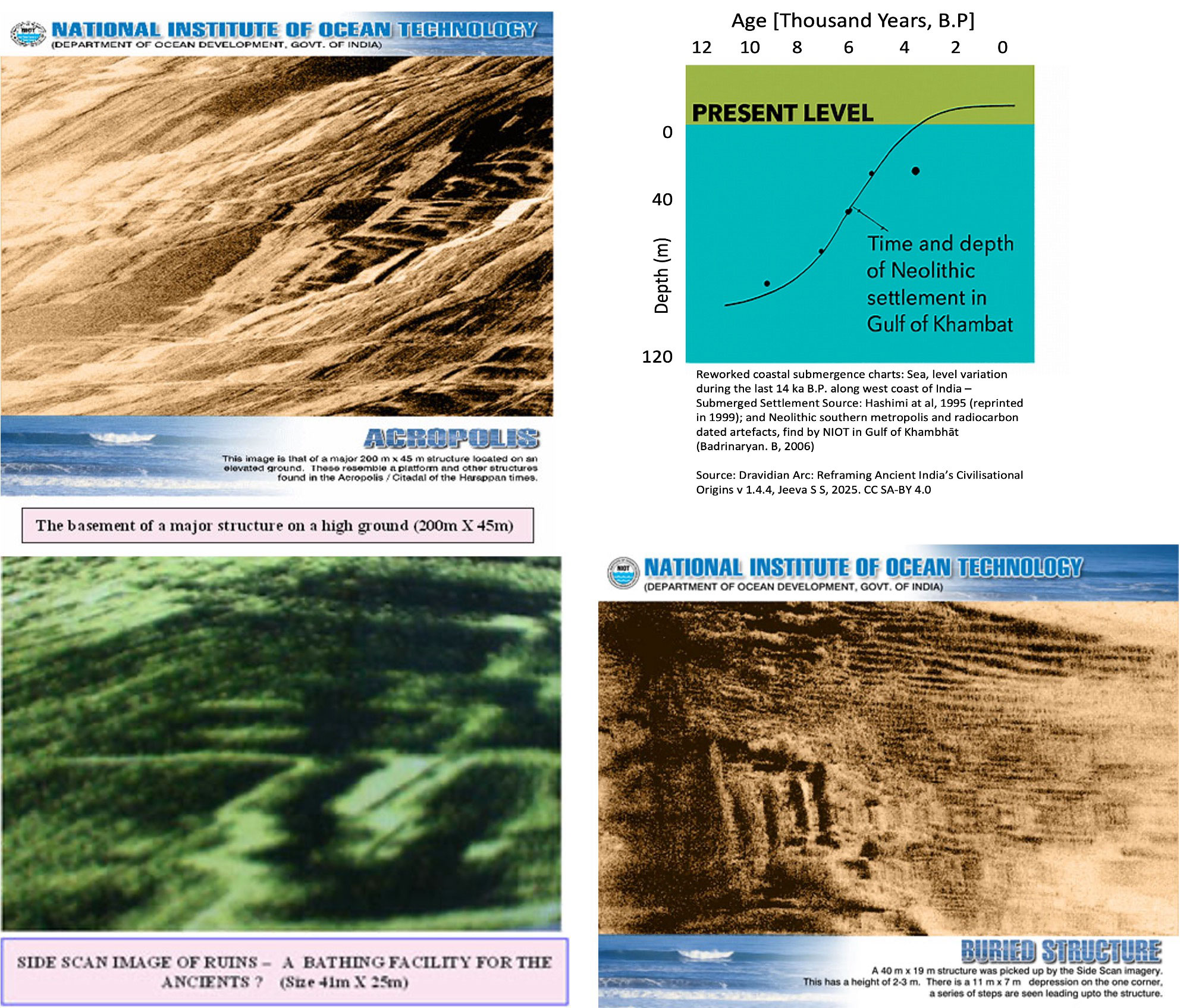
Sonar scan images of the submerged settlement in the Gulf of Khambhāt, published by Badrinaryan B. (2006) under the National Institute of Ocean Technology (NIOT), sourced from Cradle of Ancient Civilization, Archaeology Online, and Graham Hancock’s “Gulf of Cambay: Cradle of Ancient Civilization.” These visuals accompany preliminary dating of artefacts recovered during NIOT’s 2001–2004 campaigns, suggesting human activity in the region well before established urban timelines. Dating and analysis were conducted by:
-
NGRI (Hyderabad) – Radiocarbon (14C) – 2001 – Wood and charcoal samples
-
BSIP (Lucknow) – Radiocarbon (14C) – 2001 – Wood samples
-
PRL (Ahmedabad) – Thermoluminescence (TL) and Radiocarbon – 2001–2003 – Pottery and charcoal samples
-
Manipur University – Thermoluminescence (TL) and Optically Stimulated Luminescence (OSL) – 2002–2003 – Sediment and pottery samples
-
Oxford University – Optically Stimulated Luminescence (OSL) – 2003 – Burial sediment samples
-
Deccan College (Pune) – X-Ray Diffraction (XRD) – 2003–2004 – Mineral composition analysis for artefact validation
- Proto–Poompuhar (Proto-Sangam Coastal Node): Initial geophysical surveys by S.R. Rao’s NIO team in the 1980s flagged submerged side-scan anomalies off the ancient Kaveri delta. More recently, Bharathidasan University–NIOT multibeam and side-scan mapping (2019–23) delivered high-resolution bathymetry, revealing submerged estuarine camps at 20–30 m depths—features that suggest human activity dating back to ~15 ka BP, including shellfish harvesting, mangrove timber extraction, and canoe exchange (BBC Tamil News images below; see Section 2 for mapping details). These early lifeways echo the Indus–Harappan fisheries at Lothal and, alongside the Gulf of Khambhat complex, rank among South Asia’s earliest submerged settlements within the Dravidian Arc network.
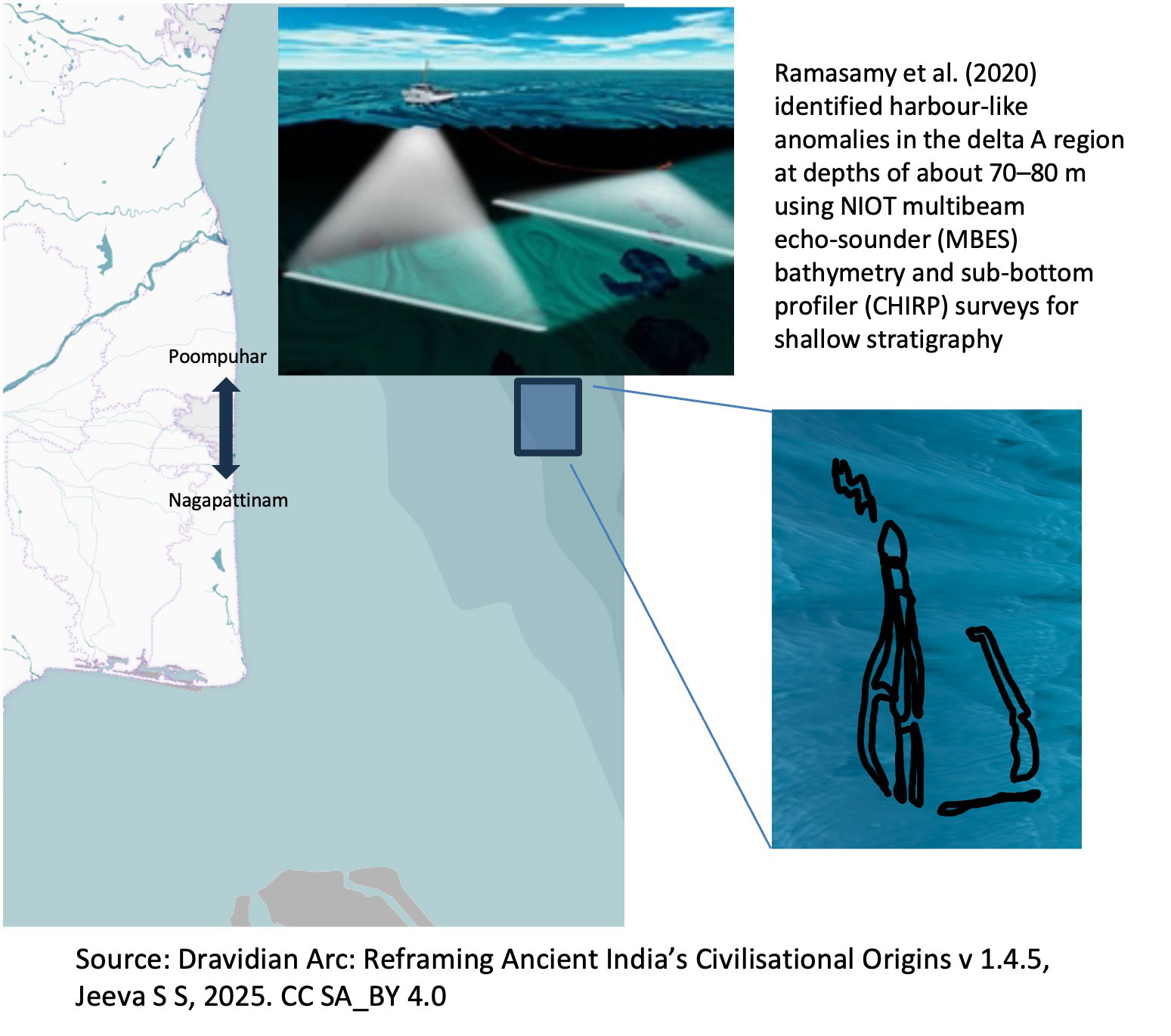
Recently announced in 2025, a Government of Tamil Nadu–commissioned collaboration between Bharathidasan University and the National Institute of Ocean Technology (NIOT), funded by the Government of India’s Department of Science and Technology, used advanced marine instruments — Multi Beam Echo Sounders (MBES), sub bottom profilers, marine magnetometry, and ROV assisted imaging — to digitally reconstruct submerged cultural architecture off the Poompuhar coast, lending empirical support to Sangam era accounts of coastal settlements lost to the sea; earlier work reporting harbour like anomalies between 30m to ~70–80 m is described in Ramasamy et al. (2020, Ramasamy et al. 2025, JISRS), “Detection of Submerged Harbour Using GEBCO and MBES in the Offshore Region of Ancient Port City Poompuhar, South India” (ResearchGate). The results provide empirical support to Sangam-era accounts of coastal settlements lost to the sea — Extended archaeological verification:
Deep-sea coring and ROV operations commenced in September 2025 between Poompuhar and Nagapattinam (Tamil Nadu 2025–26 budget).
Image by Jeeva SS, 2025. CCBYSA4.0. Includes NOAA PD-USGov source
Note: While NIOT and Tamil Nadu’s State Department of Archaeology are now leading systematic sonar mapping and dating at Poompuhar–Nagapattinam (2025–26), the ASI has issued no reports on these early horizons. This silence highlights institutional reluctance (as experienced with submerged settlement in the Gulf of Khambhāt) to engage with potentially disruptive evidence, leaving state and university teams to drive the research forward.
-
- Historical Context: Poompuhar — historically known as Kaveripoompattinam during the Sangam period — figures prominently in foundational Tamil texts such as Pattinappalai and the epic Manimekalai. These works depict the city’s stature as a maritime capital with advanced urban planning and ritual infrastructure. Crucially, Manimekalai (verses 200–201) documents its abrupt disappearance: “Aninagar thannai alaikadal kolkena…” — “The city of Kaveripoompattinam was engulfed by the roaring sea.” The submergence is cast as divine retribution for neglecting Indra Vizha, as conveyed by Manimekala. This poetic account aligns with sonar-based evidence of offshore structures, merging literary memory with geophysical data. In Silappathikaram (early CE), the narrative begins in the still thriving remnant of the ancient port city of Puhar— a settlement that retained its ritual centrality despite earlier coastal losses and had not yet undergone the major submergence— preserving echoes of older traditions, including spatial detail and the Indra Vizha festival. This surviving quarter was later destroyed, likely by a tsunami around the 3rd century CE, submerging the harbour precinct remembered in both literature and archaeology. The continuity underscores Kaveripoompattinam’s enduring status and the narrative shift from maritime ethnography to ritual allegory. Notably, a 2025 BBC Tamil feature revisiting the site in light of Tamil Nadu’s deep-sea excavation budget cites literary and archaeological consensus that the ancient harbour may have accommodated up to 70 ships simultaneously, reinforcing its role as a high-capacity maritime node in early South Asian trade networks.
- Southern River Systems (“Tamilakam”): The Kaveri and Vaigai distributaries attracted foragers to estuarine shell beds and mangrove zones, supporting proto-sedentary camps as early as ~14 ka BP (e.g. radiocarbon-dated shell middens at Nagarjunakonda). These coastal aggregations—collectively termed Tamilakam—anchor the Dravidian Arc’s southern node.
- Early Agricultural Villages at Mehrgarh (~9 ka BP): The aceramic Neolithic site on the Kacchi Plain (c. 7000 BCE) evidences early domestication of wheat, barley, sheep, goats, and zebu cattle. These pioneer farmers contributed to the genetic and cultural foundations of the broader Dravidian Arc. Furthermore, Ancient-DNA (Narasimhan et al. 2019; Shinde et al. 2019) confirms uninterrupted ASI continuity from Mehrgarh’s Neolithic through early Iron-Age Tamilakam, with only minor Iran-Neolithic admixture entering after ca 3500 BCE—well after local crop domestication and iron-tool–driven cultivation was already under way (see below for Iran-N influx).

Genetic marker M130 (AASI) identified in Madurai, Tamil Nadu. Photograph reproduced from Peoples and Cultures of Early Sri Lanka, by Dr S. Thiagararajah. Reused with permission of Dr S. Thiagararajah.
- Genetic Signatures: Admixture models date the arrival of Iranian-Neolithic (Iran_N)—synchronous with Mehrgarh’s Neolithic onset. In the absence of direct Mehrgarh aDNA, these analyses infer gene flow between incoming Iran_N lineages and indigenous proto-Dravidian AASI populations (M130 carriers)—M130 haplogroup carriers who first settled the subcontinent roughly 50,000–70,000 years ago. Indus Valley Civilisation (IVC) periphery individuals (e.g., the Rakhigarhi genome, 2600–1900 BCE) display a balanced admixture of ~45–60 % AASI versus 40–55 % Iran_N. Narasimhan et al. (2019) date the primary AASI–Iran_N admixture pulse that formed the “Indus Periphery Cline” to ca. 5400–3700 BCE, underlining AASI persistence in the northern Dravidian Arc before the post-2000 BCE Steppe influx. While direct Tamilakam aDNA is expected by 2025–26, proxy data from IVC-margin contexts and first-millennium BCE sediments point to continued proto-Dravidian AASI dominance (~90–95 % AASI, 5–10 % Iran_N) in Iron Age Tamilakam. Coastal forager groups along the Palk Strait likely mirrored these admixture patterns, creating a north–south AASI cline, with AASI- and ASI-rich ancestries more pronounced in modern Vedda and certain south Indian tribal genomes. Furthermore, ancient-DNA studies (Narasimhan et al. 2019; Shinde et al. 2019) confirm uninterrupted ASI continuity across the Neolithic and early Iron Age phases, with minor Iran-Neolithic–related admixture entering only after ca. 3500 BCE—subsequent to the onset of indigenous crop domestication and iron-tool cultivation in Tamilakam, thereby validating its autonomous agrarian and metallurgical trajectory. Note that Ancestral South Indian (ASI) ancestry for the Indian subcontinent Dravidian Arc emerges from the varying admixture composition of the indigenous AASI and Iranian-Neolithic lineages along the Arc from its Neolithic onset until the post-2000 BCE Steppe influx and IVC refugia migrations southwards during their decline phase.
- Archaeological Signals: Stone tools, hearth lenses, and ephemeral camps on drowned ridges attest to a dynamic forager–fisher–canoe nexus across the exposed shelf.
- Pan-Indian Rock Art: From Bhimbetka’s Upper Palaeolithic paintings to Kupgal’s Neolithic petroglyphs, these symbolic motifs reflect a peninsula-wide ritual tradition that predates pottery and metallurgy.
2. Proto-Sangam and Dravidian Arc Emergence (~10–5 ka BP)
Section 2 addresses early cultural, genetic, and subsistence nodes across the Dravidian Arc—including Mehrgarh, Chopani-Mando, the Belan Valley, Paiyampalli, and Tamilakam—which share deep Ancestral South Indian (ASI) genetic threads and parallel agro-technological traditions. While some sites lie beyond classic Tamilakam, their ecological settings, symbolic motifs, and genomic profiles place them firmly within the Arc’s extended spine. This section reconstructs how ASI-linked forager–cultivator societies adapted to deltaic transgressions, seeded proto-urban hubs, and diversified coastal economies—laying the foundational grammar for later Iron-Age intensification.
- Gulf of Khambhāt Emergent Urbanism (Northern Metropolis): Building on the northern sector of the Gulf of Khambhāt submerged site in Section 1 — assessed by the National Institute of Ocean Technology (NIOT) under Badrinaryan B. (2006) — scans dated to ~9500–7500 BP reveal planned urban scale features now lying beneath 20–40 m of water, interpreted here as early urban planning in response to rising seas. Based on regionally modelled mid Holocene Sea level trajectories and mapped bathymetry, the palaeo ridges of the Gulf are predicted to have evolved into true islands as transgression progressed. In this reconstruction, lower quay walls would have been overtopped by ~11.5 ka BP, while ridge top communities are projected to have persisted until the ~7.3–6.8 ka BP highstand. Ridge top refugia may have retained ≤5,000 inhabitants until the ~7.3–6.8 ka BP highstand (model based upper bound; to be tested against in situ contexts). This locality is the probable locus of the Dwarka legend— revered in Hindu tradition as Lord Krishna’s coastal capital on the western littoral—a flourishing city abruptly lost to the sea. Subsequent full submergence likely prompted coastal populations to adopt mixed economies along emerging deltaic margins.
The rectilinear foundation patterns are consistent with communal gathering spaces for an estimated 5 000–10 000 people — an inference derived from core port city densities of 200–400 people/km², structural evidence for quay walls and mooring points, and provisioning capacity from dozens of kilometre scale agricultural and forager sites across the then exposed shelf. By comparative standards, such a population magnitude would be exceptional for its time. During this period, Ilaṅkai remained connected to mainland India until ~9–8 ka BP, facilitating canoe networks and ecological exchange. As transgression unfolded, coastal communities diversified subsistence—combining estuarine fishing with early cultivation and herding—mirroring developments along Tamilakam’s deltaic margins. By ~8 ka BP, Ilaṅkai had become a distinct island, with canoe-based exchange across the narrowing Palk Strait paralleling inter-island trade among the Gulf’s vestigial islands. Over time, sustained contact may have culminated in the formation of a shallow causeway—later known as Ram Setu or Adam’s Bridge—a chain of shoals and sandbanks partially walkable until the 15th century (see Section 11 for satellite-imagery evidence of a manmade structure). Early Islamic geographers, including Al-Biruni (c. 1030 CE), referenced this land bridge, which was likely rendered impassable by a cyclone around 1480 CE.
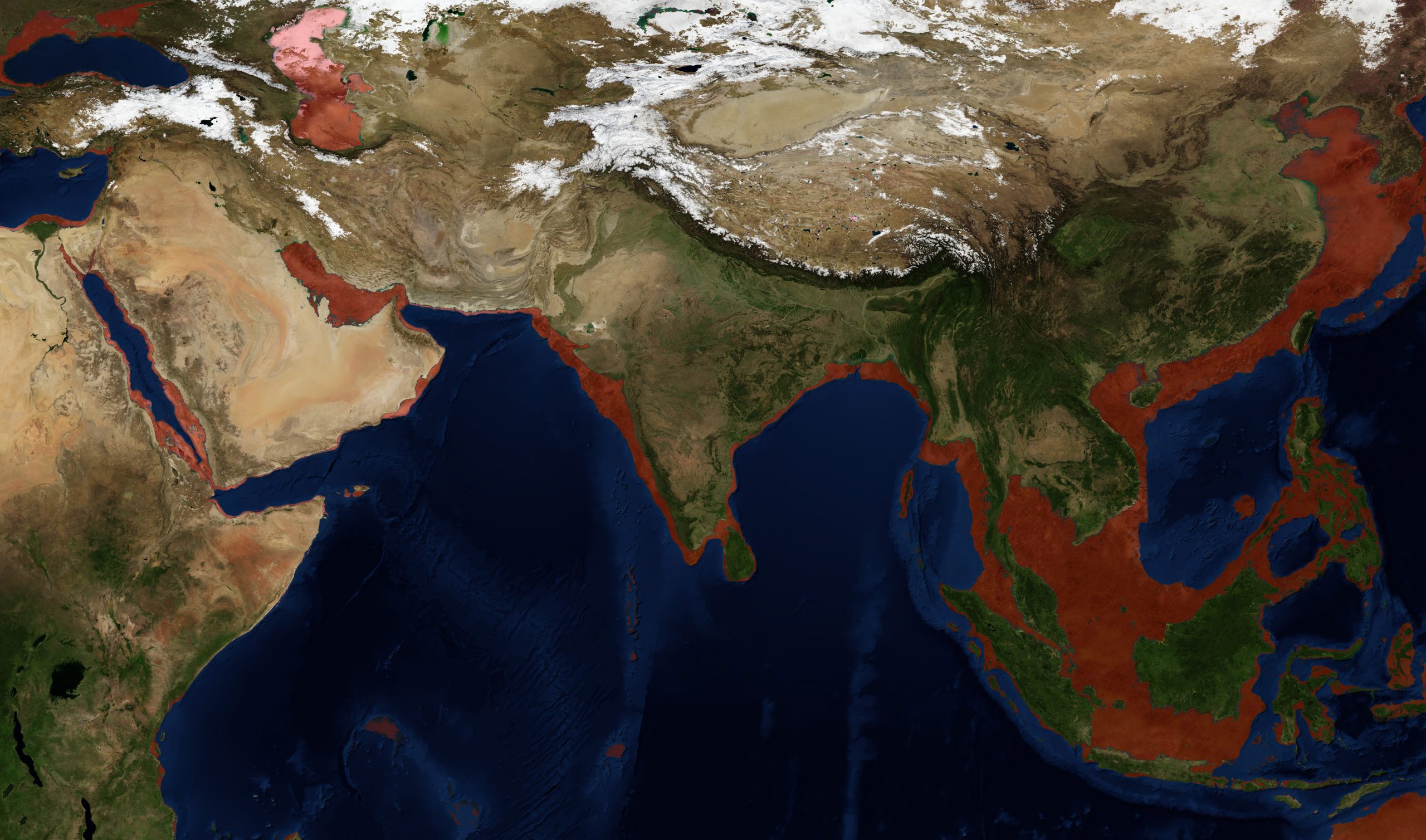
India Coastline at Last Glacial Maximum, versus today. Image by Luke Hancock (CC0)
- Proto-Sangam Poompuhar (Emergent Coastal Hub at Kaveri Delta, ~7–5 ka BP):
Building on the drowned estuarine camps and lobate-delta formations of Section 1 (~15 ka BP) and Sangam texts attributed name for ancient port of Poompuhar as Kaveripoompattinam, this phase marks the emergence of organized maritime infrastructure at the ancient Kaveri mouth:
- Refined multibeam and sub-bottom profiling (Bharathidasan University–NIOT, 2020–22) build upon S.R. Rao’s 1980s NIO side-scan anomalies and specifically document spiral pillar remnants and circular stone bases from this recent survey work.
- A submerged harbour zone 30–50 km offshore at 30–100 m depths feature terracotta ring-wells and brick platforms atop stabilized promontories, rectilinear dock alignments, and canal-like trenches linking settlement clusters.
- Spiral pillar remnants and circular stone bases are interpreted as early proto-lighthouse foundations—among the earliest known in the region—though their precise function remains debated.
- When tied to post-glacial sea-level reconstructions (e.g., Rohling, Lambeck), which chart a rise from –15 m to near modern between 7–5 ka BP, the bathymetric form indicates a proto-port phase circa 7000–5000 BCE (see table2.1 for Poompuhar’s ancient deep timeline).
- These deep-time lifeways at Poompuhar prefigure later Sangam port planning and resonate with Khambhāt and pre-Lothal maritime models.
- Under Tamil Nadu’s 2025–26 archaeology budget, stratified offshore trenching and coring between Poompuhar and Nagapattinam will empirically test these mid-Holocene dates.
- A subsequent Chola-period wharf and lighthouse base—first uncovered in 1981 and now exhibited at Poompuhar’ s Underwater Archaeological Site Museum—attests to the site’s enduring civic-planning logic from Proto-Sangam origins through classical port urbanism (see table2.1 for Poompuhar’s proposed proto-lighthouse timeline).
- Refer to Section 4 and Section 12 for Tamil Nadu’s 2025–26 approved archaeology budgeted plans for detailed stratified offshore coring and ROV imaging.
Table 2.1 Timeline Matrix for Ancient Submerged Poompuhar
-
Phase Date BP Key Features Inheritance from Previous Phase Section 1: Proto-Poompuhar A c. 15 ka (late Pleistocene) Possible drowned estuarine activity zones, lobate-delta formations, canoe exchange points; circular and rectilinear anomalies that may indicate early water-management or domestic structures Likely established deltaic promontories and terraces later reused for harbour works; tentative fleet capacity in the order of several dozen vessels (indicative range 40–70), inferred from mapped frontage at ~100 m depth Section 1B: Transitional Poompuhar B c. 9–7 ka (early–mid Holocene) Aligned ridge forms, rectilinear depressions, canal-like linkages, possible early seawall features Suggestive of re-occupation as earlier shorelines drowned; planforms hint at proto-urban ordering; capacity may have reduced to perhaps 40–55 vessels with contracting frontage during shoreline transgression Section 2: Proto-Sangam Poompuhar C c. 7–5 ka (mid Holocene) In shallower sectors, anomalies interpreted as brick or platform bases, rectilinear docks, canal-trenches, and a spiral feature possibly representing a proto-lighthouse Builds on stabilised promontories and channels; layouts adapted to changing coastal conditions; capacity plausibly in the range of 25–35 vessels, supporting regional maritime traffic
Note: The 2023 study by Sasilatha et al. (Remote Sensing in Earth Systems Sciences) digitally reconstructs submerged structures and hypothesised trade networks at Poompuhar, reinforcing the phased, adaptive harbour model outlined above. It extends the interpretations of Ramasamy et al. (2020) into a broader discussion of early coastal urbanism and exchange. Prior to publication, its analyses and interpretations underwent internal clearance within NIOT and NIO and then external peer review, in line with standard protocols for sensitive heritage claims, ensuring a robust and non-politicised presentation.
Methodology & Caution Statement This model correlates multibeam bathymetry, side scan sonar, and geomorphic mapping with regional post glacial sea level curves to position submerged features on dated palaeoshorelines. Fleet capacities are inferred from harbourfront length, basin area, and plausible vessel dimensions (~18–22 m LOA), and remain estimates rather than artefact verified counts. Dates derive from sea level models, not direct chronometry, and structural identifications (e.g., ring wells, brick platforms) are sonar based interpretations pending in situ confirmation through controlled underwater excavation.
- Deltaic Outposts (“Tamilakam Extension”): By ~9 ka BP, the Kaveri and Vaigai distributaries had coalesced into broad, fertile alluvial fans, drawing foragers to estuarine shell beds and mangrove ecotones. These proto-settlements served as year-round aggregation hubs. By ~8–7 ka BP, Tamilakam’s deltaic outposts on the Kaveri–Vaigai floodplains were trialling pulse–millet cultivation and rudimentary canal systems—agronomic innovations that underpinned provisioning of emerging maritime hubs like Khambhāt and Poompuhar—thereby extending the Arc’s southern spine and laying the ecological and cultural groundwork for later Sangam-era urbanism (see Section 2 for paleo-bathymetry and coring details).
- Mesolithic Shelters: Rock-shelter pictographs in the Kalrayan and Jeypore Hills (c. 10–8 ka BP) depict humans, deer, and geometric motifs—echoing Bhimbetka and suggesting shared ritual landscapes across peninsular India.
- Maritime Network: Paddle-stone graffiti, rectilinear foundations, and shell-bead workshops hint at a ~10,000-year-old Sangam cultural web—linking inland foragers, coastal mariners, and offshore ridge-island dwellers.
- Seasonal Harbours: These ridge-islands and shoreline coves functioned as hubs for mangrove timber, estuarine fisheries, salt production, and inter-island exchange—supporting a diversified and resilient coastal economy.
- Beyond Fishing: Proto-Poompuhar and similar sites likely hosted canoe-builders, shell artisans, and salt harvesters—facilitating both local provisioning and small-scale trade with inland forest groups and coastal Ilaṅkai.
- Mehrgarh Parallel: Building on Section 1, Mehrgarh (in today’s Balochistan) flourished from ~9 to 5.5 ka BP, though the earliest secure AMS enamel dates for barley and wheat fall between 5223–4914 BCE (see bullet: Dravidian Arc cultivation). This phase features more advanced cultivation practices, refined pottery, and symbolic artifacts—beads, figurines, and burial goods—signalling a subcontinental shift toward sedentism and surplus economies. Tamilakam’s coastal foragers and estuarine settlers appear to have followed parallel trajectories within their own ecological niches, marking a pan-peninsular Neolithic horizon that prefigured both the Indus and Sangam worlds within the vertical Dravidian Arc cultivation sequence.
- Inland megalithic funerary complex at Chennanur: Recent field surveys have documented a previously unrecognized megalithic funerary complex on the Ponnaiyar River—featuring standing-stone cairns, cist-style burials, and associated lithic and ceramic scatters—signalling a localized ritual-monument production intimately linked to animal-husbandry and food-processing along the early Dravidian Arc corridor.
- Foundations for Iron-Aided Intensification (7–5 ka BP): Tamilakam remains under-excavated, albeit recent digs have uncovered revolutionary iron implements that build on this Neolithic base and Tamil Nadu’s 2025 radiometric program—combining – Accelerator-Mass Spectrometry (^14C-AMS) on charcoal and organic remains (Beta Analytic; IUAC) – Optically Stimulated Luminescence (OSL) on ceramics (PRL Ahmedabad; BSIP Lucknow) – Thermoluminescence (TL) on slag—has pushed bloomery iron into the early 4th millennium BCE, directly tying it to a pulse-and-millet agrarian economy first rooted by 7000–6000 BCE:
- At Adichanallur & Sivagalai (3345–2953 BCE), ^14C-AMS on urn charcoal and paddy, corroborated by OSL on interred pottery, dates bloomery furnaces alongside iron plough tines, hoe-heads and ritual implements.
- At Mayiladumparai (c. 2172 BCE), ^14C-AMS on bloomery debris—supported by Single-Aliquot Regenerative-Dose (SAR) OSL on associated ware—secures local production of iron blades in the Vaigai Basin foothills.
These scientifically anchored dates demonstrate continuity with Tamilakam’s Neolithic pulse-and-millet tradition rather than an abrupt external rupture. For a full discussion of how these tools catalysed iron-aided cultivation across the Dravidian Arc, see Section 3: “Dawn of the Sangam Iron Revolution (6–5 ka BP).
- Dravidian Arc cultivation (c. 8–5 ka BP): The southern-Neolithic cultivation zone of the Dravidian Arc blended indigenous pulses, millets, wild rice, and Southwest Asian cereals. At Mehrgarh, the northern-Neolithic cultivation zone, the French charcoal assays (J.-F. & C. Jarrige,1970s–80s reports) date barley and wheat to c. 8000–6000 BCE, refined by AMS tooth-enamel to 5223–4914 BCE. In parallel, macro-remains of Vigna and Lens pulses and small-grain millets at Chopani-Mando and Mahagara (~5000 BCE) mark secure local cultivation, while querns, grinders, polished axes, and storage pits at the Neolithic–Megalithic site of Paiyampalli (North Arcot, Tamil Nadu; excavated in 1964–65 and 1967–68 by S. R. Rao, Archaeological Survey of India; Indian Archaeology – A Review, pp. 52–53, 52–54; the excavations revealed a lower Neolithic horizon beneath a Megalithic one, with hand-made red-grey ware, polished stone celts, microliths, faunal remains (cattle, sheep/goat), and charred grains of horsegram (Dolichos biflorus) and greengram indicating early agro-pastoral subsistence; dated to c. 6000–2000 BCE by Bayesian regional modelling — Fuller, Boivin & Korisettar (2007) modelled 35 new AMS ¹4C dates with vetted legacy determinations in OxCal v3.10, placing the posterior start of the southern-Neolithic at ≈6000 BCE (95% prob.) and principal occupations at 3000–2000 BCE) signal incipient, toolkit-based pulse–millet husbandry, evidenced by carbonized pulses and the presence of grinding stones and grooves consistent with small-seed processing. This places Paiyampalli within the wider Neolithic–Megalithic agro-toolkit horizon (e.g., Sanganakallu–Hallur–Kadebakele), demonstrating that early cultivation was a broader southern phenomenon rather than an isolated development. This occurred alongside incipient paddying and wild-rice management in the Belan Valley by ~5000 BCE (Fuller et al.). Parallel early rice cultivation at Lahuradewa and Koldihwa (~7th millennium BCE) along the Belan–Ghaghara River systems — cautiously framed as small-scale cultivation rather than fully domesticated field systems — underscores independent eastern trajectories tailored to local ecologies. Given distance and immature interregional networks, these communities likely served regional circuits, strengthening the case for polycentric — including Dravidian Arc — agrarian development.
Archaeobotanical evidence suggests that by the 7th millennium BCE, agro-foraging communities such as Paiyampalli (with its pulse-and-millet toolkit and early agro-pastoral signatures already described above; c. 6000–2000 BCE; Bayesian mid-Holocene)—and the newly identified Chennanur site — basal layer ∼8,500 BCE (OSL 10.47 ± 0.85 ka BP; AMS-dated neolithic contexts)) —show a microlithic→Neolithic sequence with animal husbandry and on-site food-processing and plant exploitation (TNDA — A Preliminary Excavation Report 2025: flotation, pollen and phytolith evidence from Chennanur’s trenches B3, ZC3, and B4; charred seeds in ZC3) — where the data imply the assemblage is consistent with on-site plant processing and use of wild and/or domesticated plants, supporting an interpretation of mixed agro-foraging or early cultivation — within the Ponnaiyar River basin and adjacent east-flowing corridors toward Vellore–Arcot. While direct proof of maritime export from Paiyampalli is lacking, these river networks plausibly provided the hydrological and transport framework for surplus movement — a pattern later mirrored in the early 1st millennium BCE Karur–Kodumanal–Poompuhar axis of the Kaveri basin.
Extrapolating cautiously, such eastern hinterland nodes could have supplied now-submerged coastal outlets linked to Poompuhar-port Phase B (~9–7 ka BP) and Phase C (~7–5 ka BP). Ramasamy et al. (2020) mapped mid-Holocene palaeochannels and distributary fans of the Cauvery delta and adjacent Ponnaiyar and Palar catchments, which, when synthesised with NIOT’s offshore Poompuhar multibeam, SBP, and ROV surveys (Sasilatha et al. 2023, 2025), confirm a continuous inland-to-coastal deltaic complex active during Phases B and C. This reconstruction is based on current geomorphic and geophysical datasets and remains open to refinement pending stratified coring, targeted sedimentary correlation, and the Tamil Nadu 2025–26 deep sea coring programme. These inland–coastal trajectories mirror early canal-fed systems in Tamilakam’s Vaigai and Tamirabarani deltas (c. 8000–5000 BP).
During the Bronze Age, rice-husk impressions and paddy-processing installations at Lothal and Rangpur (c. 2600 BCE) bridged the Khambhāt/Pre-Harappan (Gujarat)–Tamilakam estuarine corridor. Collectively, these data demonstrate that Dravidian Arc communities initiated indigenous pulse–millet and rice cultivation well before the minor Anatolian–Iranian Neolithic genetic influx post–Tamilakam Iron Age (see Table 7.1), even as they selectively incorporated exogenous barley and wheat from Mehrgarh into a broader indigenous pulse–millet and rice repertoire. Though earlier cultivation may extend to 7–8 ka BP, stratified dating across the Deccan and Western Ghats remains sparse and ongoing (Section 11). Future investigation of other inland Neolithic–Megalithic nodes (Valasai, Chettimedu, Mayiladumparai, Molapalayam) and their provisioning roles from agricultural and livestock perspectives is reserved for dedicated study in Section 11. This cumulative north–south continuum within the Dravidian Arc underlines a home-grown agrarian trajectory in Tamilakam that develops in parallel to, and independent of, Fertile Crescent innovations. These agro-foraging traditions are likely to have also set the stage for Tamilakam’s iron-powered deep-tillage agrarian revolution in the 4th millennium BCE, with future deep-sea sonar surveys (Tamil Nadu 2025–26 programme) expected to refine timelines and locate missing coastal nodes in this early exchange network. As outlined in Section 11, targeted investigation of both submerged and extant hinterland–river system zones that provisioned Poompuhar and Khambhāt is proposed as a subsequent phase to follow completion of the 2025–26 offshore coring and ROV imaging programme currently under way.
3. Dawn of Sangam led Iron Age Revolution (6–5 ka BP)
- Early Bloomery Breakthroughs & Technological Autonomy (c. 5.3–4.9 ka BP): AMS and OSL analyses at Sivagalai (3345–2953 BCE) and slags from Adichanallur, Mayiladumparai, Kilnamandi, Mangadu, and Thelunganur confirm high-temperature, multi-stage iron production—two millennia ahead of the Hittite Iron Age. These radiometric anchors position Tamilakam’s Iron Age in the early 4th millennium BCE and underscore an indigenous metallurgical tradition that arose independently of West Asian influence. Further investigation—particularly at submerged coastal hubs and under-sampled inland ridges—may extend this Iron horizon into the mid-Holocene (c. 5000–6000 BCE), revealing a pre-Chalcolithic Iron Revolution.
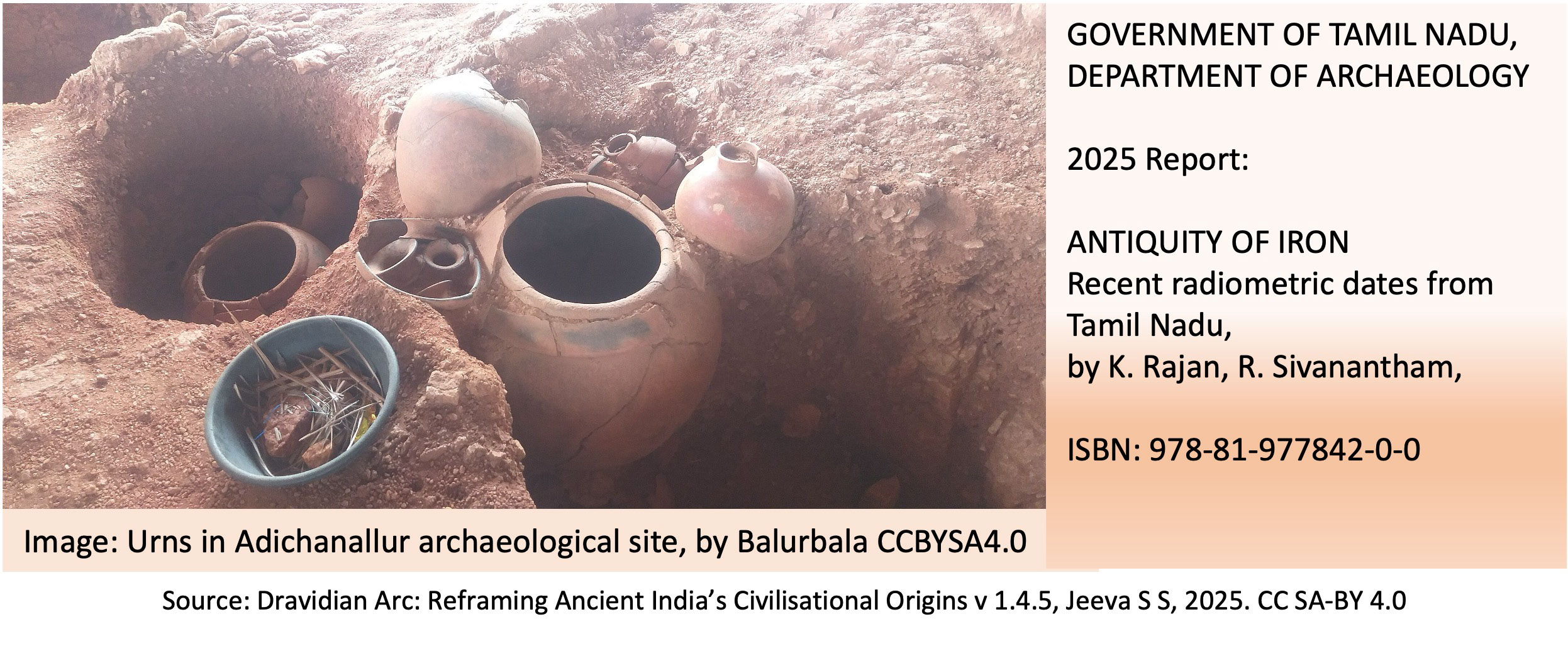
Photo Balurbala, 2023 (CCBYSA4.0)
Tamil Nadu Department of Archaeology: Excavation Dating for Sivagalai and Adichanallur dating analyses were conducted at the following institutions:
-
BETA Analytic (Miami, USA) – Accelerator Mass Spectrometry (AMS) Radiocarbon – 2021–2024 – Charcoal and paddy grain samples
-
Arizona AMS Facility (University of Arizona) – AMS Radiocarbon – 2019–2021 – Iron sword from Thelunganur
-
Birbal Sahni Institute of Palaeosciences (Lucknow) – Optically Stimulated Luminescence (OSL) – 2023 – Ceramic sherds
-
Physical Research Laboratory (Ahmedabad) – OSL – 2023 – Ceramic sherds
-
Inter-University Accelerator Centre (IUAC, New Delhi) – AMS Radiocarbon – 2022–2023 – Paddy and millet samples recovered from burial urns
-
Indira Gandhi Centre for Atomic Research (IGCAR, Kalpakkam) – X-Ray Fluorescence (XRF) – 2022–2024 – High-tin bronze artefacts from Adichanallur
Despite this suite of independent analyses — spanning international AMS labs and leading Indian institutions — the ASI has issued no reports on these early Iron Age stratified excavated horizons. As with the submerged port complexes (noted earlier), its silence underscores an institutional reluctance to engage with chronologies that advance Tamilakam’s role as an early cradle of agriculture and metallurgy.
Excavations at Sivagalai and Iron-Age finds (courtesy of Government of Tamil Nadu, Department of Archaeology, 2025) demonstrate that Tamilakam’s archaeology remains in its infancy; ongoing digs may push its agricultural origins even further back.
- Vertical Arc Convergence of Metallurgy and Proto-Sangam Urbanism: Building on those multistage smelts the emergence and spatial–chronological distribution of pre-1000 BCE Iron Age sites across the Dravidian Arc reveal a multi-nodal pattern of vertical-arc convergence (see Table 3.1). Iron bloomery technology radiates from coastal Tamilakam (Sangam lands) into highland foothills, river valleys, and floodplain corridors—fuelling agrarian intensification and proto-urban growth well before external diffusion models predict.
Table 3.1: Iron-Age Convergence Timeline Along the Dravidian Arc (pre-800BCE)
-
Dravidian Arc Excavation Sites Eco-Corridor / Region/ Influence Dating (BCE) Key Findings & Convergence Indicators Sivagalai Vaigai–Tāmirabarani Delta (Tamil Nadu) 3345–2953 (AMS ¹4C); 2590–2427 (OSL) Earliest high-temperature, multi-stage bloomery smelting; iron chisels, plough tines and hoes in urn burials Adichanallur Vaigai–Tāmirabarani Delta (Tamil Nadu) 2522 (AMS ¹4C) Early bloomery smelting in urn burials; ritual iron implements (sickles, ploughshares) driving pulses/millet harvest Mayiladumparai Vaigai Basin – Western Ghats Foothills (Krishnagiri dist.) 2172 (AMS ¹4C) Iron blades and bloomery slag in habitation-cum-burial contexts; evidence of localized production Gachibowli Deccan Plateau Corridor (Telangana) c. 2200 (TL on pottery Iron tools in megalithic burials; charred millet residues imply agrarian linkage Brahmagiri Malaprabha Valley (Karnataka) c. 2140 (typological; AMS ¹4C on charcoal) Iron arrowheads and chisels in cist-circle burials; megalithic mortuary tradition with slag inclusions Kilnamandi Eastern Ghats Foothills (Tamil Nadu) 1692 (AMS ¹4C) Multi-stage bloomery slag and tuyère fragments in burial contexts; localized smelting traditions Mangadu Coromandel Coast Fringe (Tamil Nadu) 1510 (AMS ¹4C) Sword-hilt charcoal and bloom residue; evidence for small-scale iron forging Mel-Siruvalur South Arcot (Tamil Nadu) c. 1000 (typological / surface finds) High-carbon crucible steel (~1.0–1.2 % C; pearlitic–cementite microstructure) Veerapuram Godavari Delta Fringe (Andhra Pradesh) c. 1300 (AMS ¹4C on charcoal) Iron sickles and mattocks in megalithic graves; strong agrarian-tool connections Komaranahalli Woodland Plains Corridor (Karnataka) c. 1100 (TL) Slag-tapping furnaces and extensive slag heaps; sustained local smelting technology Thelunganur Western Ghats Foothills (Tamil Nadu) c. 1435–1233 BCE (AMS 14C; AA99857)(See additional note) Earliest accepted Ultrahigh carbon steel (0.9–1.3 wt% C) from sword/crucible fragments; advanced multi stage steelmaking. Note: additional sample AA104832 (2900–2627 BCE) yields a conflicting earlier date. Kadebakele Tungabhadra Corridor (northern Karnataka) 800 – 400; 800 – 440 (AMS ¹4C on charcoal) Mild-steel projectile (165 HV) and high-C (~0.8 wt % C) pearlitic ring in secure contexts Sigiriya & Anuradhapura Ilankai (Sri Lanka) c. 1000–900 (typological; AMS ¹4C on charcoal) Natural-draft furnaces; artefact surfaces show high-carbon iron (>1 wt% C) [Juleff 1996; Kumbalathara 2015]
Sources: K. Rajan & R. Sivanantham, Antiquity of Iron: Recent Radiometric Dates from Tamil Nadu, Government of Tamil Nadu (Chennai, 2025); et-al.
Other verified Iron Age nodes not listed in Table 3.1 include Lahuradeva, Raja Nāla-ka-Tila, Malhar, Atranjikhera, Pandurājār Dhibi, and Ilaṅkai (Delft Island, Pomparippu)—each yielding iron slag, bloom fragments, or diagnostic implements such as sickles, ploughshares, and chisels used in agrarian contexts from stratified deposits dated to c. 1200–1000 BCE or earlier. Additional pre-1000 BCE centres such as Hallur further bolster the evidence for a pan-subcontinental Iron Revolution in agriculture and proto-urbanism. Thelunganur’s crucible furnaces produced ultra-high-carbon crucible steel (0.9–1.3 wt% C); AMS 14C on carbon from the sword yields a calibrated range of 1435–1233 BCE (lab code AA99857). By contrast, Hittite bloomery blooms show only trace carburization c. 1000 BCE —and to this corpus we must add the Southern-Arc wind-powered slag-tapping furnaces at Samanalawewa in Ilaṅkai with high-carbon steel fragments (c. 300 BCE) (See below), affirming the Southern Arc’s autonomous and advanced metallurgical sophistication—attesting to both its early innovation and prolonged use. Plotting these nodes alongside early port evidence at Poompuhar reveals how indigenous iron technology propelled agricultural intensification and emerging urban centres, validating their inclusion in the vertical-convergence-arc framework.
- Field Excavation & Agrarian Continuity (c. 5.3–0.9 ka BP): AMS and OSL dates from Beta Analytics, BSIP, and PRL Ahmedabad on Sivagalai slag and tool samples (c. 3300 BCE), excavated plough tines and hoe heads at Sivagalai, bloomery residues at Adichanallur (c. 2600 BCE), and iron sickle blades and ploughshares (c. 905–696 BCE) mark the first extensive iron-aided cultivation in Tamilakam. Excavated implements at Sivagalai and Adichanallur (c. 3300–2500 BCE) further attest to widespread agrarian intensification rooted in AASI-rich demographics; aDNA indicates that significant (>5 %) Iran_N-derived admixture doesn’t appear until after c. 3500 BCE, and then only in northern-arc sites, validating Tamilakam’s autonomous metallurgical and agricultural progression well before external admixture. Building on Neolithic-Late Pleistocene and early Holocene agro-foraging traditions (~9-7 ka BP), this breakthrough drove canal construction, field levelling, and a 30–50 % yield boost—spurring demographic expansion, surplus production, permanent settlements, and proto-urban complexity (see Table 12.1). When paired with archaeobotanical data from Mehrgarh (barley, wheat; 7000–5500 BCE), Paiyampalli (pulses, millets; 7000–6000 BCE), and Chopani-Mando (wild-rice trials; c. 5000 BCE), Tamilakam emerges as a leading case for an independent agrarian intensification trajectory that both predates and intermittently overlaps Fertile Crescent cereals and Anatolian urban models.
- Technological transmission from Tamilakam to Southern-Arc’s Ilaṅkai: Six sentinel sites trace the direct diffusion of Iron Age innovations from Tamilakam into Ilaṅkai (Sri Lanka’s) agrarian and architectural spheres:
- Delft Island (c. 1200–1000 BCE, provisional): iron sickles, blades, and plough tips in megalithic burials demonstrate locally produced tools for tillage and harvesting, suggesting on-site metallurgy predating 1000 BCE.
- Pomparippu (c. 1000–800 BCE): urn burials in the North-Western Province yielded microliths alongside iron sickles and chisels, showing rapid incorporation of metal implements into both farming practices and complex funerary rites.
- Sigiriya (998–848 BCE): radiocarbon-dated smelting slag aligns with Tamilakam’s bloomery traditions, confirming parallel development of iron production in a riverine upland setting.
- Anuradhapura (930–800 BCE): slag concentrations at the citadel attest to the swift adoption of Tamilakam-style smelting techniques within an emerging proto-urban centre.
- Non-conventional wind-driven (natural-draft) furnaces at Samanalawewa (c. 300 BCE) produced high-carbon steel (>1 wt% C), verified through slag chemistry and CFD-based thermodynamic modelling; which aligns with Juleff’s 1996 Nature report, which demonstrated wind-powered smelting as a viable indigenous technology. The parallels with Tamilakam’s early bloomery iron suggest a shared metallurgical continuum across the Southern Arc, reinforcing autonomous innovation rather than diffusion.
- Mihintale (3rd century BCE): iron wedges used in a pyro-mechanical granite-splitting method at Mahinda’s temple reveal how agricultural metallurgy informed monumental architecture.
- Outliers: Beragala (c. 2400 BCE) – where isolated slag fragments hint at proto-Iron Age smelting, but the lack of in-situ charcoal or multi-method dating keeps these early traces provisional until detailed stratigraphic analysis; and Kanniya hot water wells, where early iron technology may have been applied in hydrothermal engineering (c 1580 BCE) – see Future Research Priorities for further investigation
- Technological transmission from Tamilakam to Upper-Arc (Deccan): Ellora temple cave construction required high-calibre iron (steel) and an advanced smithing tradition—exemplified by carburised tool edges from Paithan (c. 7th–10th centuries CE)—during the site’s main excavation phase (c. 600–1000 CE). Artisans plausibly employed locally forged high-carbon steel chisels to cut and shape the dense basalt, with final polishing achieved using quartz sand, emery, or powdered rock crystal (sphatika) applied with water or oil. This capability drew on a much deeper lineage: crucible steel production at Thelunganur (c. 1435–890 BCE) marks the earliest known high-carbon steelmaking in South Asia, further evidenced by an 890 BCE steel sword fragment. Significantly, the early strata of the Vaikhānasa āgamas (c. 4th–6th CE), Mānasāra (c. 5th–7th CE), and Mayamata (South Indian, esp. Tamil tradition, c. 9th–12th CE) codify the prescribed method of ayas chisels paired with final nirmārjana using fine silica sand or sphatika prior to consecration—the earliest securely datable textual witness to this exact tool–abrasive pairing. By Ellora’s time, metallurgical innovation, textual canon, and regional craft expertise had fully converged to enable its intricate reliefs and enduring, lustrous surfaces.
- These independent smelting-to-farming-to-construction sequences—unfolding across coastal, riverine, and upland zones, and overlapping chronologically—embody the vertical convergence of metallurgy and agriculture, validating their placement within the Dravidian Vertical-Convergence-Arc framework.
- Section synthesis: Across five to six millennia, radiometric dates, techno-genetic markers, and diffusion patterns demonstrate that Tamilakam pioneered indigenous iron production and agrarian intensification, exporting these breakthroughs along the Dravidian Arc from its Sangam heartland to Ilaṅkai—directly challenging traditional diffusionist models and underscoring an autonomous civilizational trajectory.
4. Mid- to Late-Holocene Coastal Collapse & Maritime Reorientation (7–4.5 ka BP)
- Terminal Submergence and Shoal Phase (c. 7–5.5 ka BP): Building on the northern Gulf of Khambhāt ridge-platform sequence described in Section 2, rising seas had by ~7.3 ka BP reduced the 8 × 3 km feature to isolated ridge-top refugia (NIOT sonar surveys; 2025 artefact and skeletal dates). Ridge-top refugia may have retained ≤ 5,000 inhabitants until the ~7.3–6.8 ka BP highstand (model-based upper bound; see Section 2 for derivation)— a persistence likely underpinning the Dwarka legend of a prosperous coastal city suddenly lost to the sea. By ~7.0 ka BP, complete submergence left only 2–4 km² of shoals, which persisted until ~5.5–4.5 ka BP. These drowned ridges mark the end of South Asia’s earliest offshore communal settlements and signal an ecological rupture across the Dravidian Arc.
- Inland Surge (c. 7–4.5 ka BP): Staple surpluses from Southern-Arc Sangam-era Sivagalai’s iron-tool agriculture underwrote the rapid growth of interior proto-urban centres as Khambhāt’s coastal settlements drowned—much like Lothal. Sites such as Madurai (as preserved in Sangam lore), Keezhadi, and Adichanallur emerged as inland civic hubs, paralleling contemporaneous urban expansion across the Western and Northern Arc in Indus cities like Mohenjo-daro, Harappa, Dholavira, and Rakhigarhi. These surpluses enabled occupational specialization, civic stratification, and the institutional scaffolding of Tamilakam’s early polities.
- Deltaic Port Genesis (c. 6–4.5 ka BP): As inland surpluses flowed downstream, new coastal nodes emerged in the Tamirabarani and Kaveri deltas. Korkai transformed into a seasonal redistribution centre—its pearl-rich estuaries, salt pans and canoe-accessible channels underpinning early exchange with Ilaṅkai and the Maldives.
- Maritime Reorientation (c. 6–4.5 ka BP): The drowning of ridge-islands redirected Tamilakam’s seafaring focus to river-mouth deltas and estuarine harbours. Canoe-based trade, shell-bead manufacture and salt-fish commerce flourished in these new coastal ecologies—laying the economic and spatial groundwork for later port urbanism
- Poompuhar Expanded Sangam Urbanism (c. 7–5 ka BP): Building on Section 1 and 2 the preliminary side-scan sonar anomalies flagged by S.R. Rao’s 1980s NIO missions have been spectacularly refined by Bharathidasan University–NIOT multibeam and sub-bottom surveys (2019–23), delineating a submerged harbour 30–40 km offshore at 30–100 m depths. Linear wharves, canal-like trenches, pier-wall alignments, and “proto-lighthouse” foundations—when tied to IPCC sea-level curves—point to a sustained maritime node ca. 7000–5000 BCE (Table 12.2). Under Tamil Nadu’s 2025–26 archaeology budget, stratified offshore coring, ROV imaging, and diver-assisted trenching between Poompuhar and Nagapattinam will recover datable sediments and artefacts, empirically anchoring Poompuhar’s mid-Holocene civic-planning lineage and prefiguring a classical Sangam-era port by ca. 5 ka BP—marking the shift to permanent maritime urbanism (See Section 12 Excavation Note).
- Section Synthesis: This phase bridges Mid-Holocene environmental upheaval and Iron-Age innovation, as coastal collapse funnels iron-powered agrarian surpluses into new inland proto-urban centres (Madurai, Keezhadi) and redirects maritime lifeways to deltaic ports (Korkai, Poompuhar), thereby setting the stage for fully integrated Classical Sangam urbanism.
5. Indus–Sangam Tamilakam’s Arc Interface (Holocene precursors to 1.5 ka BP)
- Submergence Trauma and Mythic Memory: This paper proposes that catastrophic coastal inundations along the western and southern littorals—Holocene events occurring between ~9.5 and ~7 ka BP—provoked strategic inland resettlement, a trauma echoed in Kumari Kandam narratives and the northern Dravidian Manu myth (see Section 7 for details). The Indus Valley complex may have emerged via an adaptive leap to upland refugia, while southern Tamilakam witnessed coastal populations migrating toward interior riverine basins—laying the ecological and cultural foundations for polities that later flourished in Sangam-era centres. Although present-day Madurai is canonically associated with the Third Sangam, its connection to the submerged Ten Madurai (First Sangam) and Kapadapuram (Second Sangam) remains inferential. Yet, if the advocated stratigraphy confirms that Madurai’s civic core predates Keezhadi (~580 BCE), it could rival—or even precede—the Indus Valley’s multi-city horizon (~3300 BCE), reshaping prevailing models of urban origin. This paper therefore advocates stratified offshore coring, targeted ancient-DNA and isotopic surveys, and high-resolution sediment profiling to refine this deep-time chronology—and reassert the Dravidian Arc’s primacy within global civilizational discourse (see Section 11). Furthermore, patterns of genetic continuity (ASI lineages), symbolic expressions (sea-serpent emblems, shell motifs), and residual maritime exchange routes collectively reposition submerged Khambhāt and inland Tamilakam as indigenous epicentres of agrarian, metallurgical, and navigational ingenuity.
- The Archaeological Survey of India (ASI) has yet to adopt modern stratigraphic protocols or advanced excavation methodologies. Its prolonged inaction over the past quarter-century—and similar inertia in other southern archaeological projects—appears driven not by technical limitations but by a systemic reluctance to challenge entrenched civilizational hierarchies that sideline material evidence for early Dravidian origins. The submerged Khambhāt grid complex, long neglected in official discourse, and the recent finds at Kaveripoompattinam (Poompuhar) now serve as litmus tests of India’s archaeological impartiality and its willingness to engage deep-time complexities on empirically equal terms.
- Parallel Urban Trajectories: As the Northern Arc’s Indus Valley Civilization (IVC) peaked and declined (~1900–1300 BCE), Southern Arc Iron Age centres—Adichanallur with its agrarian-iron toolkit; Kodumanal as an industrial furnace hub; and Keezhadi as a fortified riverside settlement with nails, spear- and arrowheads, knives, and daggers—entered a phase of urban consolidation, expanding craft specializations, civic architecture, and long-distance trade. Keezhadi’s earlier Iron Age roots remain under-explored: most trenches target late Sangam levels. Given the wider c. 5.3 ka BP Iron Revolution in Tamilakam, targeted geo-survey, coring, and deeper excavations at Keezhadi and other sites are needed to uncover their full metallurgical, agrarian, and settlement histories.
- Graffiti & Script Parallels: Recent studies by the Tamil Nadu State Department of Archaeology reveal that over 90% of graffiti marks found on potsherds across Tamil Nadu resemble those of the Indus script, with 60% showing direct morphological parallels. This suggests symbolic continuity or a shared trade literacy that spanned the Dravidian Arc, possibly rooted in a more common proto-literate tradition.
- Trade & Maritime Exchange: By the late 3rd millennium BCE, Harappan ports such as Lothal and Dholavira lay at the heart of a westbound maritime corridor linking southern nodes like Korkai and Poompuhar to Mesopotamia via Magan and Dilmun. Indus carnelian beads, etched ornaments, and shell artefacts recovered from Ur and Susa—together with Monetaria moneta (syn.Cypraea moneta / C. annulus), commonly known as the “money cowrie,” (Yang et al. 2018)—served as the principal form of shell currency across Afro-Eurasia. Harvested in vast quantities around the Maldives, these cowries became the first official currency of the islands and were systematically exported along the Maldives–South India arc, attesting to sustained Tamilakam–Harappan–Fertile Crescent contact between c. 2600 and 1900 BCE (Kenoyer 1998; Ray 2003; Possehl 2002; Bard 2007). Although Bard and Yang et al. together document and synthesize evidence for early Red Sea/Indian Ocean contacts and cowrie exchange—Yang emphasises Maldives sourcing and broad Afro-Eurasian circulation, while Bard integrates this material into arguments for Predynastic and Early Dynastic long-distance exchange—Indian Ocean–Red Sea traffic had already carried Maldives-sourced cowries into Predynastic Egypt (Badarian–Naqada phases, c. 4400–3000 BCE), where they appear in women’s and children’s graves, and Indus-derived etched carnelian had entered Egypt by the 3rd millennium BCE. Together, these finds reveal a polycentric exchange system already in place, linking Pre-Harappan/ Khambhāt and Tamilakam nodes with the Gulf, Levant, and Nile—conveying South Asian technologies and symbols westward via maritime brokers long before later Indo-Pacific trade networks. These early exchanges foreshadowed the Arc’s later Indo-Pacific trade networks and may also have transmitted glyphic and mercantile literacies.
- Genetic & Cultural Threads: Building on Section 1 Genetic Signatures, this Bronze Age maritime corridor — which, as evidenced by the movement of Cypraea moneta cowries into Predynastic Egypt and Indus derived etched carnelian into early 2nd millennium BCE Egypt, formed part of a polycentric Harappan–Tamilakam–Gulf–Levant–Nile network — operated alongside enduring Ancestral South Indian (ASI) genetic continuity across both arcs. Ancient DNA studies and artefact typologies point to possible gene flow and cultural contact during the IVC’s late phase, while shared symbolic repertoires — from Indus style graffiti to Dravidian semiotic motifs — reinforce the view of a cohesive, pan arc cultural zone. See Section 7 for expanded genetic analysis.
- Metallurgical Links: Iron artifacts from mid–late Indus Valley contexts warrant retrospective comparison with Sivagalai’s early smelting assemblage to examine technological diffusion, parallel innovation, or trade-mediated transmission routes. Section 11 outlines proposed retro-provenance and residue analyses to clarify interregional metallurgical evolution.
- Linguistic Resonance: The undeciphered Indus script may share roots with proto-Dravidian, as suggested by Tamil Nadu’s ongoing initiatives to decode it and the recurrence of shared glyphs on trade seals and ceramic inscriptions. See Section 8 for civic literacy and Section 9 for linguistic caution.
6. Reclassifying Tamilakam’s Classical Sangam Age & Beyond (~10 ka BP–early CE)
- Sangam Age Reclassified: While the Classical Sangam period is conventionally dated to ~300 BCE–300 CE, recent archaeological discoveries—ranging from submerged maritime activity at Poompuhar and Korkai to Iron Age metallurgy at Sivagalai—alongside emerging linguistic evidence, suggest that the cultural and civilizational foundations of Sangam Tamilakam extend back to ~10,000 BP. Rather than ending, the Sangam tradition evolved—its maritime, agrarian, and literary legacies continuing to shape Tamil identity well beyond the Kalabhra interregnum and beyond.
- Global Links: Tamilakam exported pearls, iron, textiles, and spices to Rome, Egypt, Mesopotamia, and China—attested in both Sangam texts and Greco-Roman records. These exchanges positioned Tamilakam as a key node in early transoceanic trade networks.
- Yavana Settlements & Cultural Exchange: Sangam texts like Pattinappalai vividly describe Yavana ships unloading gold, wine, and luxury wares at Kaveripoompattinam (Poompuhar), where Greeks, Romans, and West Asians bartered with Tamil merchants. Seasonal enclaves at Arikamedu, Alagankulam, and Poompuhar—attested by Roman amphorae, rouletted ware, and Indo-Roman coins—bear witness to their sustained presence. Archaeological and textual evidence indicate that some Yavanas acted as mercenaries and palace guards in Madurai, while others participated in the exchange of glassware, coral ornaments, and advanced metallurgical knowledge derived from the Southern Arc tradition. The ancient Greek seafaring manual Periplus of the Erythraean Sea charts these anchorages along the Dravidian Arc, later used by the Romans, where Pliny laments that trade with India drained up to one-third of Rome’s annual wealth.
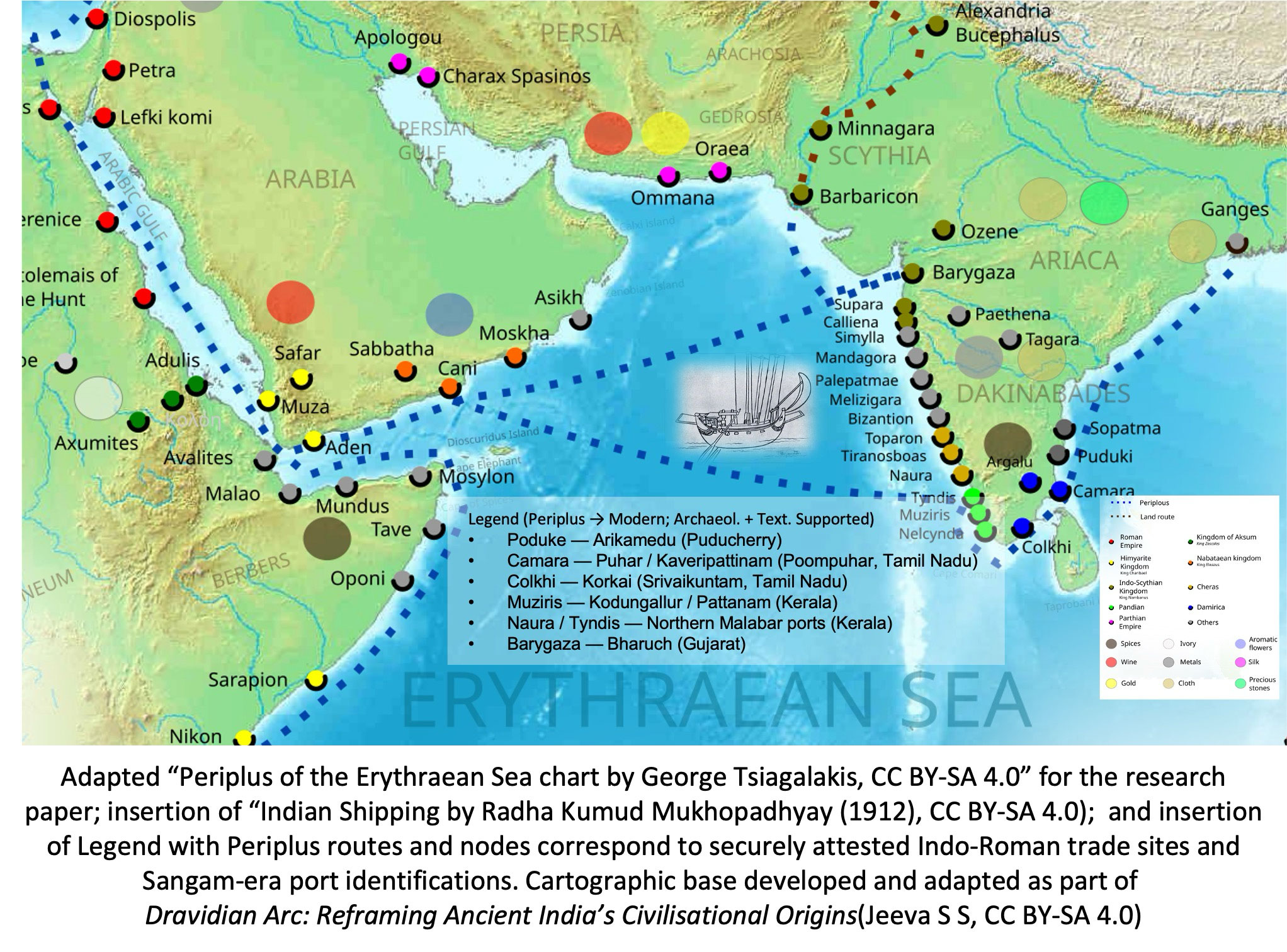
Periplous of the Erythreaen sea, image by George Tsiagalakis (CCBYSA4.0)
Tamilakam’s sophisticated dock-works and warehousing made its ports vital hubs for manufactured exports (textiles, beads, metalwork), complementing Malabar’s spice trade at Muziris. This deep integration into transoceanic exchange centuries before European arrival underscores Tamilakam’s cosmopolitan maritime identity. William Dalrymple’s bestseller The Golden Road: How Ancient India Transformed the World revisits this Indo-Roman commercial axis from the 1st century CE onward and supports the above; however, it is important to note that Yavana settlements and Sangam literature reveal that Tamilakam’s embeddedness predates his scope by several centuries. By the 2nd century CE, Arrian—writing under the Roman Empire and citing Megasthenes—noted that Indian tradition preserved king lists extending back thousands of years, while Ptolemy’s Geographia mapped dozens of Tamilakam and Ilankai ports and charted routes both eastward and westward.
- Southern Arc Maritime Magnificence & Long Distance Shipbuilding: By the early 1st millennium CE the Southern Arc’s networks linked Southeast Asia, and this exchange intensified after the decline of Roman trade. The Borobudur ship relief (c. 8th century CE) depicts multi masted construction and advanced joinery—features paralleling South Indian and Sri Lankan traditions, and extending an earlier three masted motif seen at Ajanta Cave 2. Earlier precedents include Pallava and Pandyan maritime expansion (4th–8th centuries CE): Pallava seafaring reached Funan and Champa; Pandyan ports such as Korkai and Kayal sustained eastward commercial links. From the 10th–11th centuries CE the rise of the Imperial Chola maritime empire greatly expanded Southern Arc influence across the Bay of Bengal, projecting naval power into Srivijaya and mainland Southeast Asia. A targeted offshore programme by the ASI (deep sea survey and wreck recovery) could clarify these interregional connections and India’s early shipbuilding legacy.
- Literate Polities: Legendary ports such as Korkai, Poompuhar (administratively Kaveripattinam, but celebrated in Sangam literature as Puhar or Kaveripoompattinam), and Periyapattinam flourished alongside the great Sangam assemblies, serving as commercial hubs and civic centres of poetic and political discourse. These southern and western arc ports engaged in sustained eastward and westward trade, as attested by Greek and Roman scholars and geographers, including Arrian, Ptolemy, Pliny the Elder, and the author of the Periplus Maris Erythraei, and pre 800 CE eastward exchange with Funan, Champa, and China (archaeological ceramics, beads, inscriptions, stylistic diffusion)—demonstrating a bidirectional maritime network that underpinned Tamilakam’s cosmopolitan role.
7. Dravidian Arc: Genetic Continuity, Symbolic Systems & Maritime Exchange
- Dravidian Arc as Civilisational Substrate: The Dravidian Arc—anchored in Khambhāt, Tamilakam, and Ilaṅkai—formed an indigenous civilisational substrate predating the Indus Valley Civilization (earliest excavation – Harappan c. 5.3 ka BP). This paper demonstrates that the Indus and Tamilakam complexes arose through a strategic inland relocation following traumatic coastal submergence along the western and southern littorals—an event memorialised in both the legendary Kumari Kandam traditions and the Manu/deluge narrative of northern ancient Dravidians seeking new homelands. By sequencing the Khambhāt ridge-platform loss (Inhabitable Terminal Submergence – c. 7.3–6.8 ka BP) and the eventual crystallisation of mature IVC urban centres, the model aligns three strands of evidence: geomorphic (datable sea-level and landform change), archaeological (refugia, re-aggregation points, and early agrarian hubs), and textual-mythic (deep-time cultural memory preserved in the Rigveda and Satapatha Brāhmaṇa). This textual-mythic strand is further corroborated by early Tamil sources: Nakkiraṉār’sIraiyanar Akapporulcommentary on the First and Second Sangams lost to the sea; the Tiruvilaiyātal Purāṇam’s narrative of Pandyan-era inundations; and the tradition, first recorded by Iraiyanar himself, that Tolkāppiyam was among the works to “survive” the Second Academy’s submergence. Together with Sangam poems recalling port landscapes such as ancient Kāveripumpattinam (Manimekalai 200–201), this triangulation frames post-submergence agrarian intensification and urban emergence as historically grounded responses to real ecological trauma and demographic renewal.
- Post Trauma Population Movement Proposal (Western and Northwestern Arc): ~7000 BCE marks the emergence of Mehrgarh I, anchoring the recognised onset of the Pre Harappan/Hakra horizon. Following the Khambhāt coastal submergence and the subsequent mid Holocene highstand (7.3–6.8 ka BP; ca. 5300–4800 BCE), a Khambhāt ridge top refugium may have persisted, sustaining an estimated ≤5,000 inhabitants (estimate with uncertainty) and maintaining a distinct coastal cultural package. This study hypothesises that during this interval, displaced coastal populations shifted inland into western Gujarat, followed by a northwestward migration that could have fostered sustained cultural and genetic integration with north-Iran-related groups at Mehrgarh. In archaeological terms, this continuum can be framed within the Early Regionalization / Hakra–Ravi (pre Harappan / Early Harappan) horizon— a pre-Harappan synthesis linking displaced coastal communities with emerging northwestern agrarian societies including Mehrgarh I-III (7000-4800 BCE). Across the western littoral and Sarasvati–Hakra corridor (c. 7500–2600 BCE), early Bhirrana, Rakhigarhi, Ravi–Hakra, and Kot Diji settlements emerged within reorganised fluvial landscapes that may have also attracted or incorporated displaced populations from earlier coastal zones such as Khambhāt, suggesting possible cultural continuities alongside parallel local developments. A recovery and reorganisation period of multi-century to ~1,000-year duration (timing and magnitude vary by proxy) followed the catastrophic environmental disruption, culminating in the pre-Harappan social consolidation that set the stage for Indus urbanisation.
- ASI–IVC Genetic Continuity: We now turn to Genetics. Building on Section 1’s genetic signatures, ancient DNA from (Northern Arc) Mehrgarh, Rakhigarhi, and Rajaggarhi confirms the Indus Valley Civilization (IVC) emerged from a population deeply rooted in Ancestral South Indian (ASI) ancestry—lacking Steppe admixture and continuous with earlier Neolithic groups. Narasimhan et al. (2019) demonstrate strong ASI affinity in individuals from the Indus periphery, directly linking this genetic substratum to later South Indian populations. A 2020 analysis shows Kumhar (North India) and Kurcha (South India) populations share robust ASI signals across ~2,500 km, highlighting a pan–Dravidian-Arc genetic substrate predating Steppe admixture. Proxy data from IVC-margin contexts (3345–2953 BCE) indicate ~95 % AASI and 2–5 % Iran Neolithic contributions—suggesting proto-Dravidian (AASI) dominance likely persisted in the ASI admix into the Tamilakam Iron Age (see Table 7.1); these figures await direct confirmation by forthcoming Tamilakam aDNA expected in 2025–26.
Table 7.1: Timeline of Genetic Admix and Population Along the Dravidian Arc
-
Period Event Genetic Admixture Pattern 7000–6500 BCE Arrival of Iran_N ancestry, Mehrgarh Neolithic First substantial Iran_N gene flow into AASI (M130 lineages), especially in the Northern Arc piedmonts 5400–3700 BCE Indus Periphery Cline formation Indus Periphery aDNA, 2018–2019 studies: ~45–60% AASI, ~40–55% Iran_N; admixture stabilises in pre-urban Indus contexts 3345–2953 BCE Iron Age Tamilakam – Proxy aDNA & sediment analysis Predicted genetic transition profile: ~90–95% AASI, ~5–10% Iran_N admixture; continuity of high-AASI populations in Southern Arc 2600–1900 BCE Indus Valley urban genomes (e.g., Rakhigarhi) Balanced AASI–Iran_N ancestry; comparable to Indus Periphery estimates Post-2000 BCE Steppe influx into northern subcontinent Introduction of Steppe_MLBA ancestry; dilution of Iran_N component but persistence of AASI-rich lineages, especially in the Southern Arc 1900–1500 BCE (IVC decline phase) Southward migration of IVC refugia Reinforcement of the Dravidian AASI cline in Tamilakam and adjoining regions; continuity into early historic Dravida designations (see §7.3)
- Dravida as a historical category: Building on the genetic continuities outlined in Table 7.1, it is notable that leading archaeogenetics — including David Reich, Vasant Shinde, Vagheesh Narasimhan, Niraj Rai, and others — also use “Dravidian” in a primarily linguistic-affiliation sense (as reflected, for example, in Reich’s Who We Are and How We Got Here). Historically, the designation Dravida enters the textual and epigraphic record in the post-Steppe admixture centuries, when northern groups increasingly styled themselves ārya and southern/Indus-periphery populations retained comparatively higher proportions of Ancient Ancestral South Indian (AASI) ancestry. The term derives from Prakrit and Sanskrit reflexes of the ethnonym Tamil — attested in early forms such as Damila, Dameda, and Dhamila in inscriptions and texts — with a phonetic progression Tamil → Damila → Dramila → Dravida. Its first epigraphic use appears in the Ashokan edicts (3rd c. BCE), where it is understood to denote the Tamil sphere of influence among southern polities. In the 19th century, Robert Caldwell repurposed “Dravidian” as a linguistic classification, grouping Tamil, Telugu, Kannada, Malayalam, and related languages — communities now known to share elevated AASI ancestry — thereby shifting the term’s scope from a primarily ethnogeography label to one in comparative philology. This study employs The Dravidian Arc to frame a pre Steppe civilisational trajectory, situating the IVC, Khambhāt, Tamilakam, and Ilaṅkai as AASI rich centres sustaining some of the world’s earliest agrarian, metallurgical, maritime, and complex architectural complexes — including monumental bath structures at Khambhāt, well-defined harbour basins, linear masonry alignments, functional zoning, and advanced water-management systems — such as semi-enclosed water spaces and quay-like working edges — documented at both Khambhāt and Poompuhar. These features echo engineered maritime and civic prototypes characteristic of the Indus Valley tradition.
- Tamilakam’s Indigenous Agrarian Evolution – A Civilizational Continuum: The agrarian trajectory of Tamilakam reflects an indigenous continuum that predates external civilizational currents, evolving organically from Mesolithic foraging nodes into sophisticated Iron Age agro-technologies. Far from being a periphery to diffusionist models, Tamilakam’s agrarian base demonstrates local innovation in crop domestication, water management, and metallurgical praxis—rooted in an AASI-rich demographic substratum. By the mid-4th millennium BCE, sites such as Adichanallur and Sivagalai exhibit archaeobotanical remains and irrigation-oriented artefactual assemblages that signal emergent agronomic systems. These transitions—while parallel in chronology to Harappan urbanization—suggest cultural autonomy rather than northern influence—Even as genomic data from Tamilakam’s Iron Age sites awaits formal publication (projected 2025–26), it is anticipated that stratified samples will exhibit temporal variability in ASI composition—where pre-IVC decline horizons may reflect a stronger AASI signal, and post-migration layers a more integrated AASI–Iran_N admixture. Yet, despite shifts in proportions, the overarching ASI continuum remains intact, underscoring Tamilakam’s demographic resilience and its long-standing agro-cultural ingenuity. This techno-cultural arc, rooted in ecological adaptation and regional stability, affirms Tamilakam’s position as a cradle of autonomous agrarian evolution.
- IVC Scale without Tamilakam: Even without accounting for the Southern Arc of Tamilakam and the deep-time Sangam tradition, the Indus Valley Civilization (c. 3300–1300 BCE) remains one of the most expansive Bronze Age urban cultures—spanning over 1.25 million km² and supporting a population exceeding five million. The combined landmass of ancient Egypt, Mesopotamia, and early dynastic China could fit within the IVC’s geographic footprint, underscoring the scale of South Asia’s early urban complexity.
- Southern Arc Inclusion & Indigenous Innovation: Building upon the ASI continuum and agrarian ingenuity detailed above, when the Southern Arc of Tamilakam is considered—particularly the iron-tool–enabled agrarian surge at Sivagalai (~5300 BP) and the early metallurgical evidence from Adichanallur—it becomes clear that Tamilakam not only inherited ASI composition lineage but also independently intensified farming and iron production, possibly even earlier than its northern counterparts. This redefines Tamilakam as a cradle of indigenous agrarian and metallurgical innovation. Incorporating the Southern Arc into the broader civilizational narrative demands a fundamental recalibration of Indian history—one that recognizes Tamilakam not as periphery, but as a parallel and autonomous centre of early complexity. Together, these arc strands—genetic, symbolic, and maritime—reveal the Dravidian Arc not as a marginal footnote to northern empires, but as a foundational axis of South and Southeast Asian civilization (see Table 12.1: Metallurgy-Driven Agricultural Intensification Across Early Civilizations).
- Bronze Age Trade Network Expansion:
-
- Mesopotamia & Sumer: Tamilakam’s ports exported carnelian beads, cotton textiles, and ivory to cities like Ur and Lagash, continuing IVC-era exchange traditions.
- Egypt: Iron artifacts and gemstones reached Roman Egypt via Red Sea routes, with Arikamedu and Muziris serving as key entrepôts.
- China: Silk, aromatics, and black pepper moved eastward through early coastal exchanges with Han-era ports, forming part of a proto–Maritime Silk Road.
- Cowrie Commerce & Dravidian Seafaring (mid 3rd–1st millennium BCE): Building on earlier (Pre)Harappan–Tamilakam maritime corridors (see Section 5), Dravidian Arc navigators — still harvesting Cypraea moneta and Cypraea annulus from the Maldives–Tamilakam arc — expanded cowrie transport into a specialised trade. By this phase, consignments moved both westward through the Gulf into Levantine and Nile markets and eastward into Bay-of-Bengal and Southeast Asian circuits, with cowries circulating as currency, standardised measure, ritual object, and functioning as stabilising ballast in long-distance Dravidian seafaring. These later networks leveraged inherited Bronze Age routes but operated with larger hulls, seasonal monsoon scheduling, and diversified cargoes (beads, metals, aromatics). The persistence of Maldives–Khambhāt / Pre-Harappan (Hakra Phase) sourcing into the early historic period underscores the Dravidian Arc’s role in maintaining a transoceanic cowrie economy that predated and later integrated into Indo-Pacific trade systems.
- Proto–Southeast Asian Exchange (3rd–1st millennium BCE): Scattered rouletted ware and Indo-Pacific beads at sites like Khao Sam Kaeo (Thailand), West Java, and the Malay Peninsula hint at early Tamilakam–Southeast Asia exchange long before the Chola era. Compositional analysis of carnelian beads at Khao Sam Kaeo reveals South Asian technological influence, likely originating from Kodumanal’s gemstone industry. These exports were routed through Korkai and Poompuhar, forming a maritime trade arc that prefigured the medieval Chola seaborne empire. Targeted underwater surveys, ceramic provenance studies, and palaeo-shoreline reconstructions are needed to map these pioneering routes.
- Indus–Tamilakam Cultural Bridge: This genetic and cultural continuum reinforces the deep connection between the IVC and southern Dravidian polities. Shared features in language, trade, urban planning, and symbolic systems—such as graffiti parallels, port layouts, and civic infrastructure— tie IVC and southern Dravidian polities into a pan-peninsular Dravidian arc.
- Symbolism & Iconography: Iconographic motifs—from Indus seals to a seated yogic deity plaque found in Jaffna (c. 300 BCE)—suggest shared traditions of yogic discipline and veneration of primal deities such as the Mother Goddess (Shakti) and a proto-Shiva figure, later reinterpreted within Vedic frameworks but rooted in Dravidian tradition.
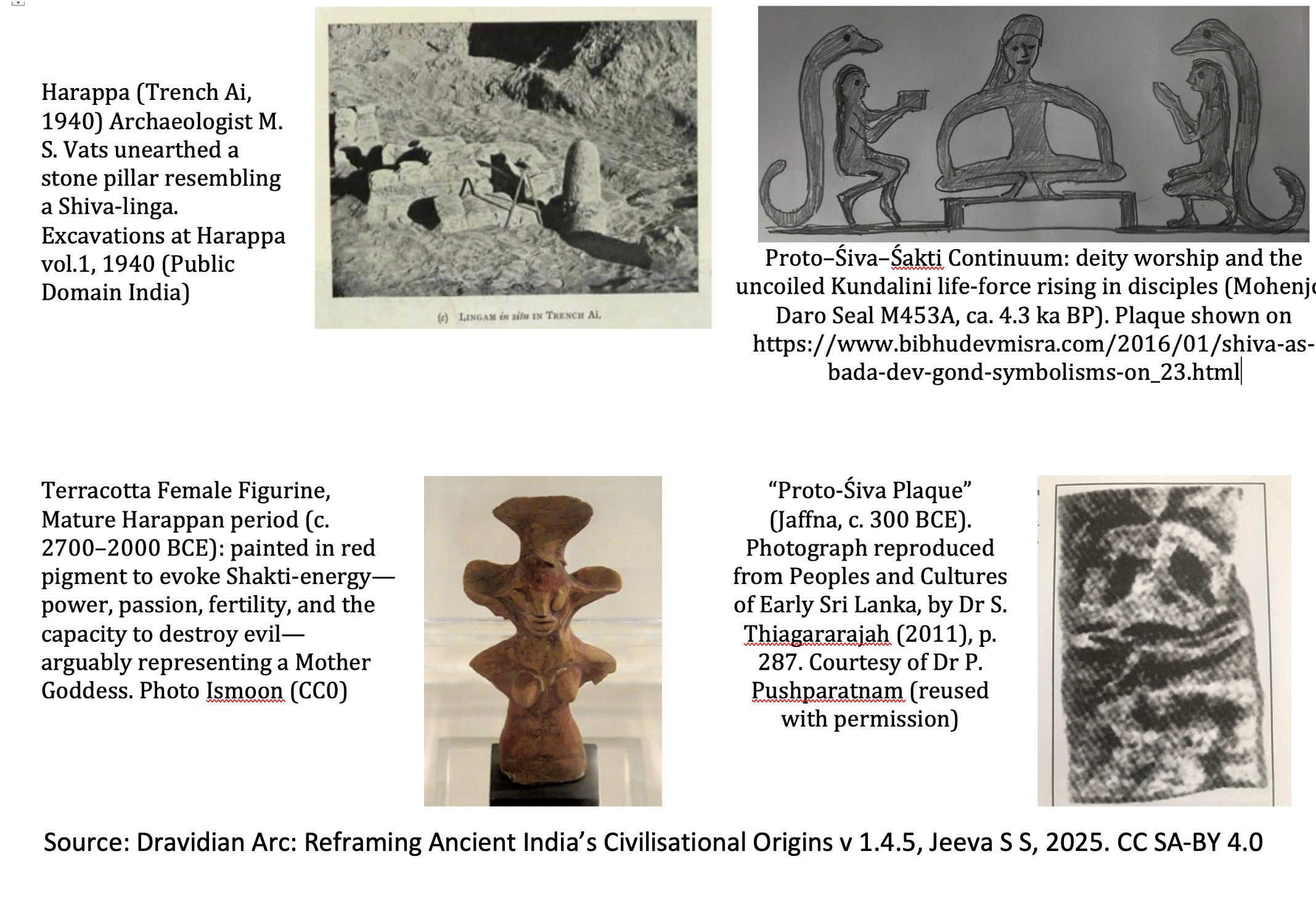
TOP LEFT: Harappa (Trench Ai, 1940) Archaeologist M. S. Vats unearthed a stone pillar resembling a Shiva-linga
Excavations at Harappa vol.1, 1940 (Public Domain India)
TOP RIGHT: Redrawing by Jeeva SS of Mohenjo-Daro tablet M453A
View the original tablet Figure 18 here
BOTTOM LEFT: Terracotta Female Figurine, Mature Harappan period (c. 2700–2000 BCE): painted in red pigment to evoke Shakti-energy—power, passion, fertility, and the capacity to destroy evil—arguably representing a Mother Goddess
Photo Ismoon (CC0)
BOTTOM RIGHT: “Proto-Śiva Plaque” (Jaffna, c. 300 BCE). Photograph reproduced from Peoples and Cultures of Early Sri Lanka, by Dr S. Thiagararajah (2011), p. 287. Courtesy of Dr P. Pushparatnam (reused with permission)
The early Buddha statues at Mihintale in Ilaṅkai, portrayed in padmasana (lotus posture) and dated to the late 3rd century BCE, mirror the yogic seated forms found on Indus Valley seals—most notably the Pashupati seal—and the Jaffna Proto-Siva Plaque, revealing a trans-cultural and trans-temporal continuum of meditative iconography across South Asia’s Dravidian Arc that stretches back over five millennia.
It is feasible to probe far deeper iconographic timelines by examining the Konkan region’s laterite-plateau petroglyphs of Maharashtra, dated to at least 12,000 years BP. These works include striking Master-of-Animals imagery — most notably the Barsu figure flanked by two tigers — an archetype that re-emerges millennia later in Indus Valley seals, where a commanding human or horned figure confronts paired beasts, often interpreted by scholars as proto-Pasupati (‘Lord of Beings’). Within the Harappan corpus, related scenes of a man in a tree above a tiger evoke the enduring Lubdhaka legend, in which a hunter, keeping vigil through the night to evade the predator, unknowingly offers sacred bilva leaves to a Siva Lingam and is blessed at dawn. This continuous visual and narrative thread — from Mesolithic geoglyph to urban seal to Purānic myth — preserves a symbolic inheritance in which mastery over (and later, peaceful coexistence with) the animal world, the sanctity of sacred trees, and the motif of vigil-as-offering are interwoven into South Asia’s religious imagination across ten millennia.
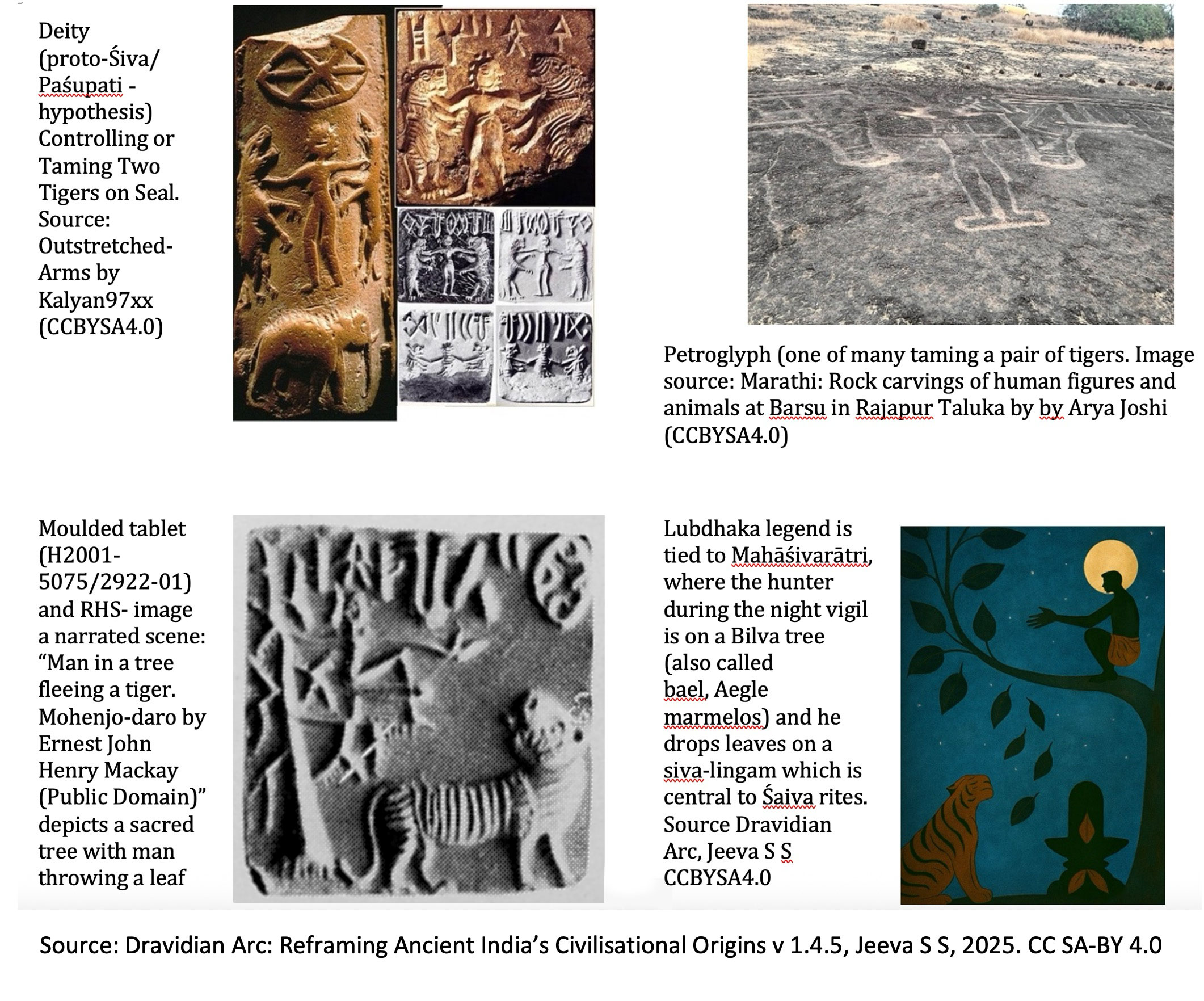
Top left: Image by Kalyan97xx (CCBYSA4.0)
Top right: Petroglyph (one of many) showing a figure taming a pair of tigers. Source: bbc.com (Konkan, Maharashtra, ca. 12 ka BP)
Photo Arya Joshi (CCBYSA4.0). See also this image.
Bottom left: image by Ernest John Henry Mackay (Public Domain
Bottom right: image by Jeeva S S
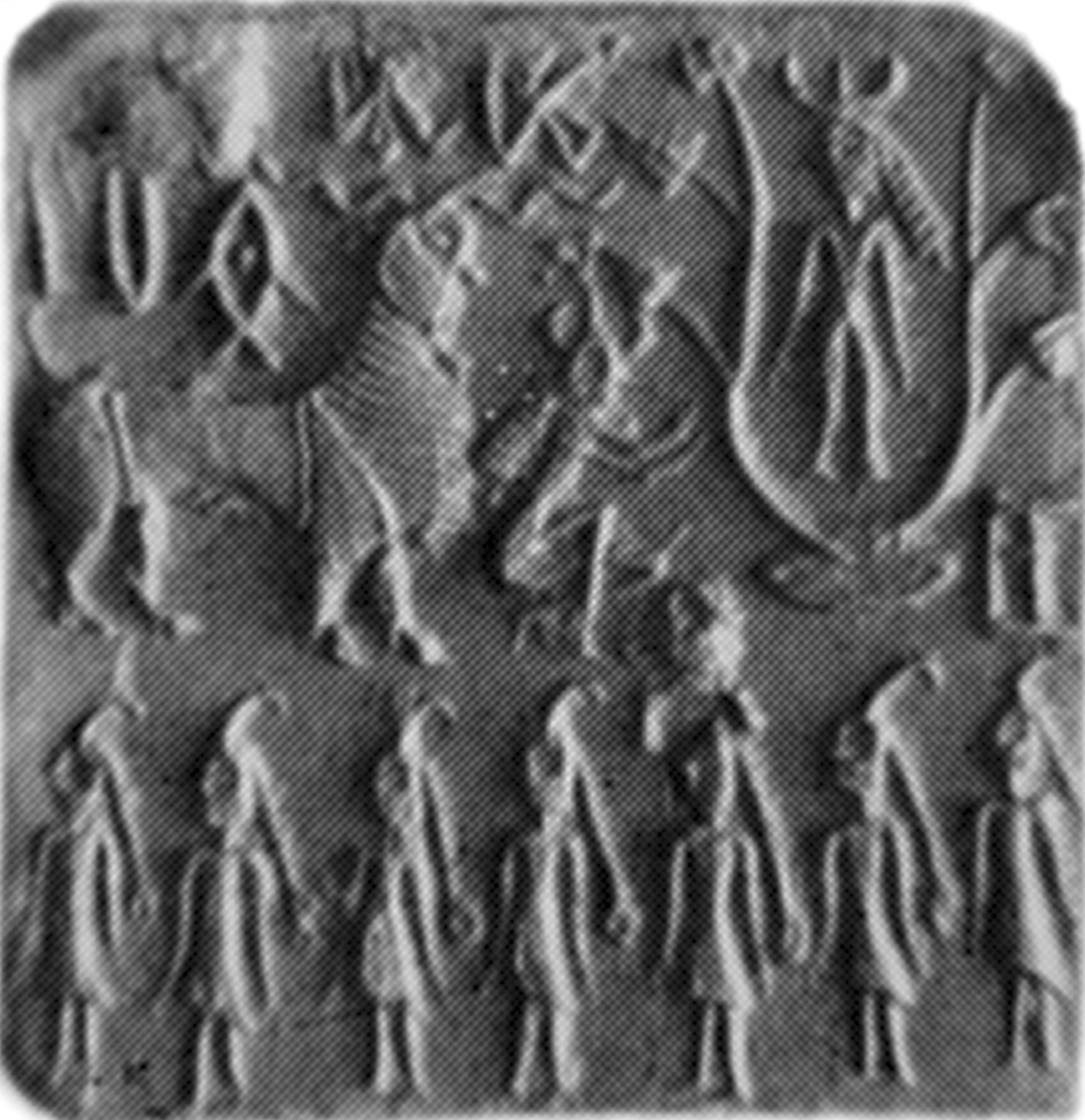
Rectangular steatite seal depicting a horned headdress deity, adorned with bangles on both arms, standing within the canopy of a sacred pipal (Ficus religiosa) — an ancient sacred symbol associated in later tradition with the Viṣṇu Siva linked axis mundi — and gazing down upon a kneeling worshipper beside a low stool bearing an isolated human head. This pairing may depict an offering scene or mythic episode; the head could signal sacrifice, ancestor veneration, or a severed foe — motifs that also surface in later Saiva and Sākta contexts, where goddess worship and fierce protective aspects are integral. A large, regal bovine — plausibly an early form of Nandi — occupies the central register as vahana, mediating between the divine and a procession of seven identically attired figures (single plume headdress, bangles, long skirts). The septenary grouping evokes the cosmological and mythic seven sages – Saptarishi, intermediaries between celestial order and human realm. Compositionally, the scene unites three core proto Saiva elements: deity (Pasupati type “lord of beings”), vahana (proto Nandi), and transmitting sages (proto Saptarishi), anchored by the pipal tree as axis mundi. Source: Scan by Ernest John Henry Mackay, 1935 (Public Domain)
- Religious Context for the Arc: The origins of Hindu religious imagination plausibly extend back at least 12,000 years, with continuity traceable from Mesolithic Konkan petroglyphs such as the “Master of Animals” through Indus Valley seals and ritual objects. Early motifs emphasised proto Pasupati/Siva archetypes (lord of beings, horned or tiger taming deity) alongside feminine/Sakti veneration, both of which resonate strongly in later Hindu practice. By the later Harappan phase, imagery of deities appearing within or emerging from sacred trees (notably the peepal, Ficus religiosa, as in the Mohenjo daro Seal DK 6847) anticipates early Siva–Viṣṇu linked and feminine Sakti/Sākta symbolism. This religiosity is anchored in the genetic and cultural continuity of Ancient Ancestral South Indians (AASI), who dominate the Arc’s earliest horizons in the 12–6 ka BP window — especially along its southern and western littorals — before incorporating an Iran_N ancestry cline through greater Indus Valley Civilisation (IVC) interactions in the western Arc (~45–60% AASI, ~40–55% Iran_N; see Table 7.1), and later the Arc absorbing Steppe derived cultural and religious elements from the 2nd millennium BCE. The synthesis of AASI rooted religiosity with incoming elements was eventually harmonised within the Vedic corpus (especially in the āgamas and Purānas, whose core compilations took shape between roughly the early centuries CE and the Gupta period, c. 3rd–6th centuries CE), producing the integrated Hindu tradition that endures today. It should be noted, however, that the surviving petroglyphs may represent the ritual expressions of less urbanised surrounding groups; to firmly establish the symbolic and religious systems of Arc urban centres such as Poompuhar and Khambhāt, systematic deep sea excavation is required. As a plausible consideration, this trajectory supports the view that the Sangam cultural ages may have begun as early as ~10,000 BP (see Section 10, Sangam Chronology), giving the Arc’s religiosity extraordinary depth and continuity.
- Synthesis: Taken together, these lines of evidence reposition the Dravidian Arc not as a peripheral cultural zone, but as a dynamic epicentre of early innovation, connectivity, and symbolic and religious continuity across the Indian Ocean world.
8. Dravidian Arc’s Civic Complexity & Cultural Continuity (3.5–1.5 ka BP)
- IVC–Sangam Tamilakam Trade Interface: As the Indus Valley Civilization entered its declining phase (~1900–1300 BCE), Tamilakam’s urban centres were emerging along the Southern Arc. Archaeological and maritime evidence demonstrate sustained trade between Harappan ports such as Lothal and southern nodes like Korkai and Poompuhar—facilitating the movement of beads, ivory, copper, and ceramics. Recent AMS-dated finds from Kilnamandi (1692 BCE) confirm the presence of carnelian beads sourced from Gujarat and Maharashtra in Tamil Nadu burials, directly evidencing south–north exchange networks persisting well into the 2nd millennium BCE. This interface underscores Tamilakam’s integration into wider Bronze Age networks and its role in sustaining cultural and economic continuity beyond the IVC’s collapse.
- Urban Maturation in the Southern Arc: Sites such as Keezhadi, Adichanallur, and Kodumanal exhibit hallmarks of mature civic life by ~1500 BCE, including planned streets, brick-lined drains, script-bearing pottery and industrial zones. These features reflect a parallel trajectory of urbanism distinct from, yet contemporaneous with, post-Harappan developments in the north.
- Technological Advances Complementing the IVC: Keezhadi’s deep terracotta ring wells and large-format bricks suggest advanced civic planning and water management. Kodumanal’s carnelian bead workshops and grooved polishing slabs attest to a thriving gemstone industry, and iron use attested at Tamilkilam by 3300 BCE, reinforcing Tamilakam’s role in transregional craft exchange and technological innovation.
- Script & Literacy Traditions: Graffiti marks and early Tamil-Brahmi inscriptions (from ~6th century BCE) point to indigenous literacy traditions that likely predate or evolved independently of northern Brahmi diffusion. Early incised graffiti—documented at Kilnamandi (AMS: 1692 BCE), Porunthal (c. 1200 BCE), and Adichanallur (c. 1100 BCE)—display direct morphological parallels to Indus signs, extending Tamilakam’s semiotic lineage into the mid–2nd millennium BCE. Graffiti motifs and ritual artifacts at Keezhadi and Adichanallur reflect a symbolic vocabulary that persisted into classical Sangam temple architecture—underscoring Tamilakam’s autonomous intellectual and semiotic trajectory.
- Guilds, Craft Specialization & Redistribution: The presence of ceramic kilns, iron workshops, and bead-making units indicates a high degree of craft specialization and surplus management. These were likely coordinated by merchant guilds and temple institutions, suggesting the emergence of complex economic governance structures.
- Vaigai–Madurai Nexus: The Vaigai River, nourishing the alluvial plains around Madurai, served as a civilizational artery akin to the Kaveri–Tamirabarani corridor. Excavations at Keezhadi—just 12 km southeast of Madurai—have revealed planned brick structures, ring wells, craft workshops, and Tamil-Brahmi graffiti, all situated on Vaigai’s flood-bank terrace. Radiometric dating from a limited set of stratified layers places Keezhadi’s urban horizon as early as ~580 BCE. However, since deeper levels remain unexplored, the full chronological depth of the site has not yet been established, and Keezhadi has become one of the most contentious archaeological excavations in South Asia. These findings suggest that Madurai’s civic complexity crystallised out of a long-standing agrarian and metallurgical base established during the Dravidian Arc’s Iron Age intensification (see Section 3). While Sangam texts such as Maturaikkanci and Madurai-Kanchi extol Madurai’s urban grandeur, the city itself remains under-excavated. Systematic archaeological work in Madurai’s core holds the potential to uncover the untapped civic heart of early Sangam urbanism and clarify its role within the Arc’s broader cultural continuum.
- Cultural Continuity Across Millennia: Burial practices, ritual motifs, and linguistic substrata reveal unbroken cultural threads from the early Iron Age through the Sangam period. This continuity affirms Tamilakam’s deep civilizational memory and reinforces the Dravidian Arc as a long-standing cultural and symbolic system rather than a late historical emergence.
9. Dravidian Arc’s Linguistic Caution & Graffiti Parallels
- Tamil as a Linguistic Archive of the IVC: Eminent Indologist Asko Parpola, in a 2022 lecture titled “Dravidian and the Indus Valley Script,” stated, “Tamil, in many respects, is the most viable archive and repository for reconstructing the IVC.” While Parpola does not claim that the IVC spoke classical Tamil, he argues that Proto-Dravidian was likely the language of the Indus script—and that Tamil preserves the most archaic features of that tradition.
- Not All Dravidian Arc = Tamil: While “Tamilakam” refers to the southern Dravidian Arc cultural zone and is associated with the rich corpus of ancient Sangam literature, it is important to avoid retroactively projecting classical Tamil onto earlier civilizations. The IVC and Gulf of Khambhāt regions may have spoken early Dravidian dialects or proto-languages that diverged significantly from what later became Tamil. Early Dravidian societies likely encompassed a spectrum of linguistic forms across the subcontinent.
- Graffiti Evidence: A 2025 comparative study by the Tamil Nadu State Department of Archaeology digitized over 15,000 graffiti-bearing potsherds from 140 sites across Tamil Nadu. The study found that over 90% of these graffiti marks resemble signs from the Indus script, with nearly 60% showing direct morphological parallels—suggesting a shared symbolic repertoire across the Dravidian Arc.
- Inference, Not Certainty: While these parallels point to a possible symbolic continuum between the IVC and early Iron Age Tamilakam, they do not confirm linguistic identity. The comparative analysis—led by Prof. K. Rajan and R. Sivananthan—employed a morphological rather than linguistic framework, reinforcing the hypothesis of symbolic exchange or cultural memory rather than direct script inheritance. These findings support the idea of a deep Dravidian semiotic tradition, but further epigraphic and linguistic research is needed to clarify its evolution.
- Proposed Paradigm Shift in Proto-Dravidian Linguistic Continuity: We are going to be bold and propose that the southern-Dravidian-arc regions — especially Tamilakam’s AASI-weighted substrate — preserved archaic Proto-Dravidian speech features well into the Holocene (~5 ka BP). The Tolkāppiyam, developed at Kapā?apuram, seat of the Second Sangam academy, was likely codified prior to major coastal submergence events (~7.5–7 ka BP), including the loss of the city itself. Its phonological and morphological signatures reflect a conservative linguistic lineage distinct from northern variants shaped by Iran_N admixture during IVC maturisation. This implicates Tamilakam as a deep time linguistic reservoir and calls for caution against attributing IVC graffiti or symbolic systems to northern Dravidian forms rather than to southern continuities; in comparative modelling, southern continuity is privileged over northern dilution.
10. Reassessing Dravidian Arc (South) – Sangam Chronology
- Beyond the 300 BCE Benchmark: While classical Sangam literature is at present mistakenly dated to 300 BCE–300 CE, archaeological layers at Keezhadi, Mayiladum-para and Adichanallur —and the high-temperature, multi-stage iron smelting at Sivagalai (c. 3345–2953 BCE) and related technologically advanced farming—push Tamilakam’s urban, literary, and metallurgical antecedents well into the third millennium BCE. These findings compel a redefinition of both the origins and apex of Sangam-era civilization.
- Reframing the Three Sangam Phases (not be confused with infamous 3 Sangam Assemblies):
- First Sangam (legendary, pre-literate): Likely reflects oral poetic traditions rooted in Mesolithic–Neolithic ritual landscapes (~10,000–5,000 BP), where symbolism and sacred geographies shaped collective memory.
- Second Sangam (transitional): Corresponds to the Iron Age–early urban phase (~3000–1500 BCE), marked by proto-script, civic infrastructure, and trade networks—heralding Tamilakam’s shift toward urban complexity.
- Third Sangam (textual): Aligns with the literate, port-linked polities of 300 BCE–300 CE, when Tamilakam emerged as a global maritime node and a prolific centre of literary production.
- Chronological Convergence: Genetic continuity (ASI), material culture (iron, script, urbanism) and literary motifs (from Tolkappiyam to Pattinappalai) all point to a deep-time civilizational arc—not a late cultural bloom, but a long process of unfolding. See Section 11 for targeted research priorities to test and refine these phases.
- Three Sangam Assemblies & Literary Legacy: Tamil tradition recounts three legendary Sangam gatherings—each chaired by sages and hosted by Pandiyan kings. The First Sangam, held at Madurai, said to have lasted 4,440 years with 549 poets but left no surviving texts. The Second Sangam, at Kapadapuram, said to have spanned 3,700 years with 1,700 poets and produced 12 Pattiyals—all lost to submergence, except the Tolkappiyam, which survived. The Third Sangam, again at Madurai (relocated new Pandyan city), said to have lasted 1,850 years with 449 poets and preserved the bulk of extant Sangam literature, including the Ettuthogai, Pattuppā??u, and epics like Silappathikaram. See Section 11 for targeted research priorities to search for these two famous sunken cities, including Kapadapuram considered to be located east coast off Tamil Nadu.
11. Future Research Priorities: Toward a Deeper Tamilakam (Southern Dravidian Arc)
- IVC–Sivagalai Metallurgical Interface: Launch comparative metallurgical studies between iron artifacts from mid–late Indus Valley sites and early smelting centres in Tamilakam, particularly Sivagalai. Investigate whether Harappan iron usage reflects trade exchange or technological diffusion from southern hubs. Sivagalai may have supplied iron via redistribution networks anchored in Madurai, with Keezhadi functioning as a logistical node. The goal is to test, through deeper stratified excavation, whether Keezhadi’s iron-tool usage and canal-fed agriculture predate the conventional 800 BCE benchmark—potentially aligning with the c.5300–4900 BP Iron Revolution verified at Sivagalai and Adichanallur. This research could clarify whether Tamilakam’s Iron Age metallurgy influenced or paralleled northern traditions—and whether Pandian patronage catalysed early industrial specialization.
- Retrospective Metallurgical Audit: In parallel with future comparative studies, artefacts from earlier excavations at Mehrgarh and Indus Valley sites should be re examined using advanced residue analysis, metallographic scanning, and updated stratigraphic profiling. Most past digs did not employ radiometric techniques capable of detecting iron smelting byproducts or tool fragments. Given Tamilakam’s iron metallurgy at c. 5300 BP, reassessing northern datasets may uncover overlooked parallels—potentially revealing previously unrecognised diffusion routes, divergent adoption patterns, or missed innovation centres. Following Thelunganur (c. 1435–890 BCE) as South Asia’s earliest high carbon steel, evidence from Paithan and the Ellora Caves (c. 600–1000 CE) suggests the use of locally forged high carbon steel chisels for basalt excavation, with quartz abrasive polishing—warranting targeted archaeometallurgical verification.
- Deeper coring warranted: Initiate deeper stratigraphic drilling at Sivagalai, Madurai (Sangam-cited city), and other key Vaigai–Tamirabarani basin locations to uncover pre-Iron horizons, spurred by Iron Age urns dated to ~5.4 kya.
- Chronological Deepening of Agrarian Horizons: Excavations at Sivagalai have yielded iron ploughshares and harvesting blades directly AMS-dated to c. 3345–3259 BCE—pushing South India’s iron-aided cultivation into the mid-4th millennium BCE. Yet Section 2 shows Neolithic farming at Paiyampalli (7000–6000 BCE), pulses and millets, and parallel cereal husbandry at Mehrgarh (8000–6000 BCE) and wild-rice trials in the Belan Valley (c. 5000 BCE). To test whether Tamilakam’s agrarian tradition likewise stretches into the 9000–8000 BCE window, we need:
- Stratified trenching and deep-core sampling at key ASI-linked sites (Paiyampalli, Adichanallur, Gachibowli).
- High-resolution archaeobotanical floats, phytolith and starch analyses to secure early plant macro-remains.
- Bayesian calibration of new ¹4C and OSL dates to integrate Tamilakam horizons with the Dravidian Arc’s pan-regional Neolithic timeline.
- Extending the Neolithic Arc into Ilaṅkai and Beyond: Northern Ilaṅkai (Jaffna) presents promising evidence of microliths, grinding stones, and polished axes, though deep-stratified Neolithic dates remain unconfirmed. In light of the Mehrgarh–Belan Valley–Paiyampalli parallels, targeted coring and test pits in Jaffna and coastal Tamilakam could determine whether agro-foraging hubs on these ridge-islands may form part of the 8–7 ka BP Dravidian Arc continuum if verified. Complementary palaeoecological coring at Poompuhar and Khambhāt will refine sea-level curves and deltaic phase models, anchoring early cultivation to precise environmental stages.
An important outlier is Beragala (c. 2400 BCE), where isolated slag fragments suggest proto-Iron Age smelting—a site that warrants renewed investigation to establish its chronological and technological significance with greater accuracy.
Notably, Mihintale in Ilaṅkai, with its 3rd-century BCE temple attributed to Mahinda, demonstrates pyro-mechanical granite splitting techniques—involving timber and fire-induced thermal expansion followed by iron wedge application. Further inquiry is needed at Kanniya’s seven hot water wells, where early iron technology may have been employed in hydrothermal engineering (c. 1580 BCE). The linkage between Kanniya and Koneswaram—one of the five Pancha Ishwaram temples—suggests deep cultural ties between Tamilakam and Ilaṅkai, underscoring a sophisticated integration of iron metallurgy within early Ilaṅkai architectural praxis, and offering a tangible anchor for Iron Age technological diffusion across the Dravidian Arc.
- Submerged Port Complexes & Sangam Memory: Map harbour layouts, quays, and buried infrastructure at Korkai, Poompuhar–Nagapattinam, and the Tiruchendur coast using ROV-assisted trenching and stratified coring—tied to Tamil Nadu’s programme announced in the 2025–26 State Budget and implemented by the State Department of Archaeology. Locating submerged settlements such as ancient Kapadapuram (also known as Kuadam)—described in Sangam literature as the capital of the Pandiyan kingdom during the Second Sangam period—may yield vital evidence of early maritime urbanism and symbolic production lost to Holocene sea-level rise. These submerged landscapes could help contextualize Sangam-era literary references to vanished cities and drowned coastlines. The mythic memory of Naguleswaram Kovil’s (first temple structure) submergence—part of ancient Tamilkilam’s Ilaṅkai before continental separation—invites sonar-based investigation near Keerimalai coasts to test ritual-linked port activity encoded in devotional narrative.
- Re-examining submerged and terrestrial construction sites for early iron technologies: Given the radiometric evidence for iron smelting and fire setting in Tamilakam by 3345 BCE2, future research should reassess structural and metallurgical features at Indus Valley Civilization sites — notably Dholavira, with its extensive stone architecture and sophisticated water management systems — for indications of early iron tool usage, fire based quarrying techniques, and interregional technological exchange. This scope should extend to submerged settlements such as Khambhat and Poompuhar, where targeted metallurgical surveys of wreck contexts could test for ferrous (iron) fastenings, anchors, or fittings. Such finds would have the potential to push back the earliest confirmed use of iron in South Asian Ocean going ship construction.
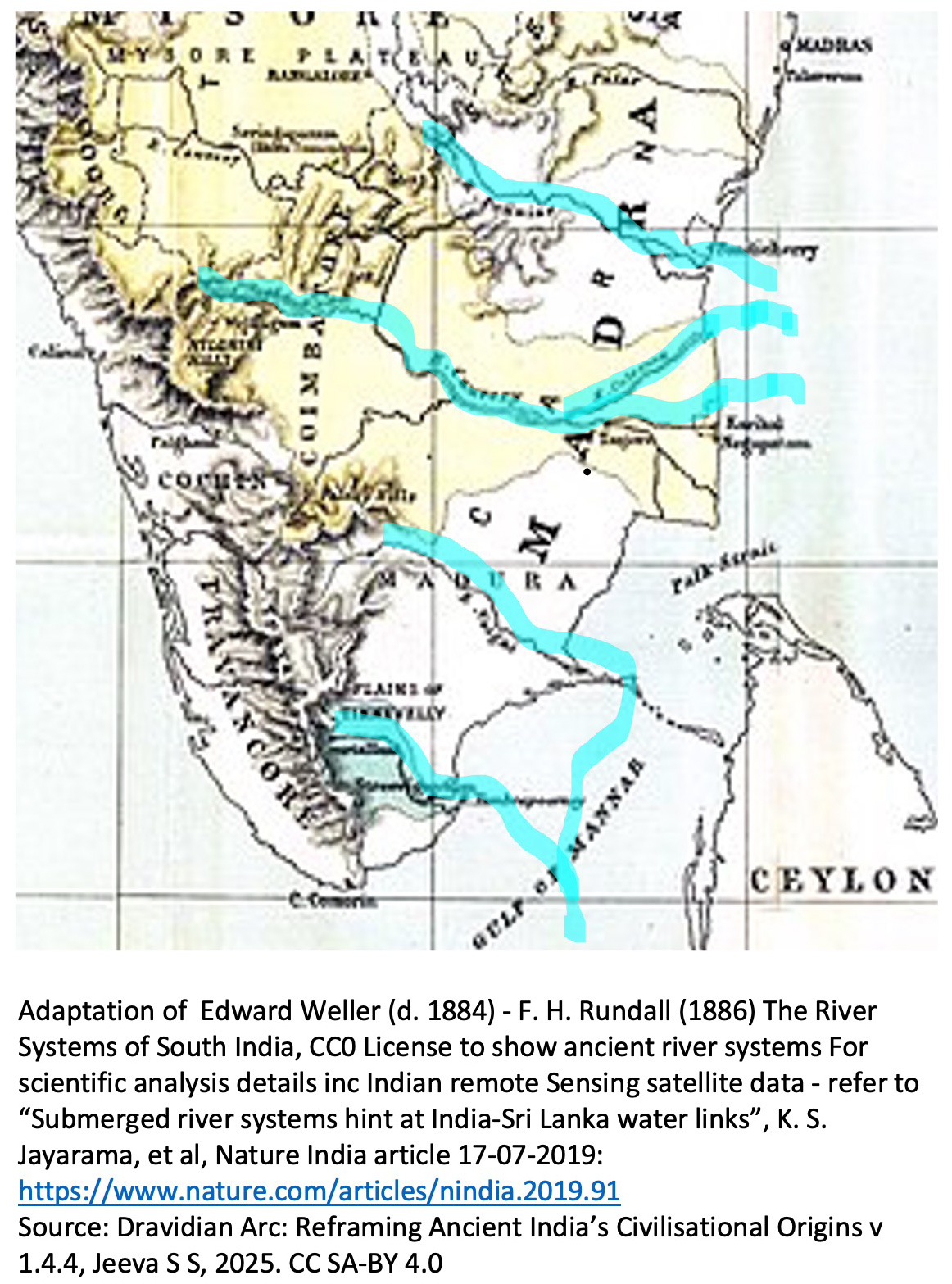
Paleoclimate & Sea-Level Archives: The satellite map illustrates ancient river paths between southern India and Ilaṅkai, particularly across the Gulf of Mannar. It presents compelling visual support for the hypothesis of a prehistoric land bridge and fluvial continuity—especially during lower sea-level phases in the Late Pleistocene and Early Holocene. The submerged river channels visible in the image likely represent paleo-drainage systems—possibly extensions of the Vaigai, Thamirabarani, and Kaveri (Cauvery) distributaries—feeding into a shared estuarine basin.
Source: (Public Domain)
This paper recommends acquiring high-resolution sediment cores from offshore ridges, submerged shoals, and the paleo-floodplains of the Kaveri, Vaigai, and Tamirabarani rivers. Combining OSL dating, pollen/mangrove proxies, and foraminiferal Mg/Ca analyses will help reconstruct monsoon-driven sea-level changes (~9.5–4 ka BP) and precisely date submergence episodes at Poompuhar, the hypothesized Kapadapuram site near Tiruchendur, and Khambhāt on the western littoral—clarifying the environmental drivers behind Tamilakam’s deltaic shift and estuarine urbanism.
- Hinterland & River System Catchments Feeding Poompuhar and Khambhāt: Following the currently Tamil Nadu’s funded 2025–26 offshore coring and ROV imaging programme, the next priority is to reconstruct the hinterland and river-system catchments that provisioned the now-submerged urban nodes of Poompuhar and Khambhāt up to their respective submergence windows. For Poompuhar, this means mapping the mid-Holocene distributary fan of the Kaveri (Cauvery), with redundancy from the Ponnaiyar–Palar and Vaigai–Tamiraparani corridors, to identify levee, flood-basin, and back-barrier cultivation zones active during Phase B (~9–7 ka BP) and Phase C (~7–5 ka BP). During the mid Holocene high stand (~9.0–5.0 ka BP), the Kaveri distributary fan formed a navigable wetland–river network, moving bulk grain, pulses, and millets from inland levees to the Poompuhar bight via fluvial and coastal routes. Within the Ponnaiyar–Palar system, the inland Neolithic–Megalithic site of Paiyampalli (c. 7000–6000 BCE), detailed in Section 2, represents a foundational pulse–millet husbandry node whose deep-time agrarian base was later integrated into the maritime provisioning network. Many palaeochannels and lagoonal margins now lie on the inner shelf between the −5 m and −30 m contours and are fully submerged, requiring marine geophysics, side-scan sonar, and deep coring to recover stratified botanical and cultural evidence; upstream levee segments and interfluves remain accessible for terrestrial excavation.
For Khambhāt, focus should fall on the Narmada–Tapi trunk with Mahi/Sabarmati feeders and the Saurashtra foreland pockets, whose tidal-bar and estuarine-flat settlements persisted until ~5.3–4.8 ka BCE. The majority of these bar-top and channel-edge contexts are now submerged at −5 m to −12 m, but some higher interfluve and back-barrier zones remain above present sea level and are available for targeted trenching. Coordinated shelf–inland survey in this later phase will allow testing of provisioning models, estimating fleet capacities, and assessing the persistence of distinct coastal cultural packages after partial submergence. Table 11.1 summarises the proposed target zones, their submergence status, and recommended survey methods.
Tabel 11.1: Target Hinterland & River-System Zones for Future Investigation
-
Target Zone / Corridor Associated Ancient Port Phase(s) Likely Role in Provisioning Present Status Recommended Survey Method Kaveri distributary fan & levee belts (Karur–Kodumanal → Tiruchirappalli → drowned mouths off Poompuhar) Poompuhar Phase B (~9–7 ka BP) & Phase C (~7–5 ka BP) Primary grain/pulse/ millet supply; flood-basin rice in back-barrier lagoons Downstream distributaries & lagoon margins submerged at −5 m to −30 m; upstream levees/interfluves still terrestrial Marine geophysics, side-scan sonar, deep coring for submerged sectors; targeted trenching on terrestrial levees Ponnaiyar centric eastward corridor (Vellore/Arcot to coast) — includes Chennanur (OSL 10.47 ± 0.85 ka BP) and Paiyampalli (southern Neolithic; Bayesian posterior start ≈6000 BCE) Poompuhar Phase B/C; Chennanur megalithic-funerary
and Paiyampalli phase as foundational agrarian base (via mid Holocene distributary fans of Cauvery delta & adjacent Ponnaiyar & Palar catchm.)Secondary production of pulses and millets; lithic tool and grinder production; early animal husbandry; funerary monument resource production (Chennanur) Coastal strand-plain remnants submerged at –5 m to –15 m; Paiyampalli terrestrial; Chennanur surface cairns visible along riverbank – Bathymetric mapping & coring for submerged ridges
– Surface survey & targeted excavation at Paiyampalli
– Geophysical prospection (GPR, magnetometry) & test-trenches at ChennanurVaigai–Tamiraparani deltas Poompuhar Phase B/C Redundant rice/millet supply; seasonal cabotage to Kaveri bight Lower deltaic margins submerged at −6 m to −15 m; upper delta plains terrestrial Shelf coring in drowned tidal inlets; delta-plain excavation Narmada–Tapi trunk with Mahi/Sabarmati feeders Khambhāt (to ~5.3–4.8 ka BCE) Core provisioning of millets, pulses, estuarine rice Tidal-bar crests & channel edges submerged at −5 m to −12 m; higher interfluves terrestrial Side-scan sonar & coring on submerged bars; trenching on terrestrial interfluves Saurashtra foreland pockets Khambhāt Supplementary upland millets, shell/fish protein Many leeward embayments submerged at −5 m to −12 m; some coastal pockets terrestrial Marine coring in submerged embayments; coastal excavation
- Trans-Eurasian Trade Networks: Expand studies of cowrie shells, carnelian beads, and ceramic parallels that moved between Khambhāt, Poompuhar, and Mesopotamia/Anatolia (c. 3000–1500 BCE). Establish whether these exchanges extend into earlier periods and assess Tamilakam’s role in shaping Bronze Age trade corridors.
- Trans-Asian Ceramic Provenance: Apply geochemical sourcing to rouletted ware and Indo-Pacific beads found in Southeast Asia (e.g., Khao Sam Kaeo, West Java, Malay Peninsula) to map Tamilakam’s early trade footprint. Compositional fingerprinting can clarify export routes and craft diffusion from Kodumanal, Korkai, and Poompuhar.
- Madurai Urban Stratigraphy: Undertake deep excavations within Madurai’s historic core to recover pre-Sangam strata and correlate material layers with literary references in Maturaikkanci and Madurai-Kanchi. Target temple precincts, civic zones, and floodplain terraces to reconstruct the city’s urban evolution.
- Linguistic consideration: The paradigm proposal about the southern AASI language pattern described in Section 9 could help future researchers and linguistic experts explore how ancient Proto Dravidian may have evolved, distinguish it from IVC dialects — potentially shaped by greater Iran_N influence — and develop tailored studies to test these trajectories.
- Genetic Demography: Expand ancient DNA sampling along the Kaveri, Vaigai, and Tamirabarani corridors to illuminate long-term population continuity, migratory pulses, and admixture across 10,000 years. Prioritize stratified sampling from burial urns at Adichanallur and Sivagalai.
- Metal & Mobility Isotopes: Conduct isotopic provenance and trace-element analyses on Sivagalai slags, Keezhadi artifacts, and transoceanic metal finds. Use strontium and oxygen isotope testing on human and faunal remains to reconstruct material flows, artisanal networks, and individual life histories.
- Experimental Seafaring: Build and test reconstructions of Iron Age canoes using regional timbers to assess monsoon-season sailing capabilities, cargo limits, and navigational range. These reconstructions may validate Sangam-era accounts of seasonal voyages and port provisioning.
- Ram Setu Geo-Archaeology & Cultural Mapping: Ram Setu Geo-Archaeology & Cultural Mapping: Launch a multidisciplinary study of Ram Setu using sonar, sediment cores, and underwater excavation to assess its structural origins and symbolic significance. Historical records from Persian geographers and temple archives confirm its traversability until the 15th century, while satellite imagery reveals a linear shoal formation—possibly modified by ancient engineering and aligned with submerged paleo-river channels that once connected Tamilakam and Ilaṅkai. These fluvial traces, visible in the Gulf of Mannar, suggest Ram Setu may have formed atop or alongside a natural estuarine corridor, later mythologized in the Ramayana epic and utilized during Pandian-era trade. Ram Setu thus warrants comprehensive investigation as both a cultural monument and a geoengineered artifact embedded within a drowned riverine landscape.
- Gulf of Khambhāt Artefact & Genetic Analysis: Expand underwater excavations in the Gulf of Khambhāt, prioritizing stratified sampling over dredging. Focus on metallurgical analysis of iron tools and slag to assess technological sophistication, and initiate ancient DNA testing on skeletal remains to verify Ancestral South Indian (ASI) genetic signatures. These steps are essential to determine whether the submerged site represents an early urban node that predates or parallels the Indus Valley Civilization.
12 Comparative Cradles of Civilization
This section synthesises the core agricultural, metallurgical, and urban-settlement developments outlined earlier to place the Dravidian Arc in direct comparative dialogue with the Fertile Crescent, Mesopotamia, and emergent Anatolian civilisation. Drawing on securely dated proxies and basin-scale continuity, it positions the Dravidian Arc as a compelling contender for civilisational primacy—appearing to precede the other three in key domains.
To support this reframing, the paper presents an expanded comparative framework through two updated tables tracing the emergence and intensification of agrarian and urban complexity across major civilisational cores. In addition, a civilisation-weighted GDP share model spanning 13,000 BP to 1,000 BP is introduced. This model integrates archaeological, settlement, and technological proxies to reflect regional economic complexity, trade integration, and resilience over time.
Together, these comparative instruments argue for a polycentric model of civilisational development—one in which the Dravidian Arc must be recognised not as peripheral, but as a foundational cradle of civilisation.
- Table 12.1: Metallurgy-Driven Agricultural Intensification Across Early Civilizations
This table traces the earliest widespread use of metal tools in support of intensive agrarian systems—whether through deep tillage, permanent field expansion, or state managed irrigation. It spans Bronze Age hoes and seed ploughs in Uruk (4000–3100 BCE), funnel ploughs of the Akkadian Empire (c. 2300 BCE), advanced iron implements in Tamilakam (wrought plough tines, hoes, and sickles; c. 3300–696 BCE), forest clearing tools in Hittite Anatolia (c. 1200–1000 BCE), and cast iron mouldboard shares in Warring States China (c. 400 BCE). By aligning chronology, tool typology, and eco cultural context, the table showcases how metallurgy catalysed agrarian intensification across multiple cradles of early civilisation.
-
Region Site / Context Date (BCE) Metal Implements & Intensive-Farming Features Fertile Crescent Uruk 4000–3100 Bronze hoes & seed-ploughs paired with canal irrigation networks for large-scale cereal cultivation Mesopotamia Akkadian Period c. 2300 Bronze seed-plough with funnel attachment integrated into state-run irrigation networks Tamilakam (Arc) Sivagalai c. 3345 Wrought-iron plough tines & hoe heads enabling deep tillage and permanent-field expansion Tamilakam (Arc) Mayiladumparai c. 2172 Early bloomery smelting; iron sickles and ploughshares enabling canal-fed agriculture Tamilakam (Arc) Porunthal c. 2000 Early bloomery smelting; iron sickles and plough tines associated with millet and pulse cultivation Tamilakam (Arc) Adichanallur c. 2600 Bloomery smelting; ritual iron implements; and Iron on sickle blades & ploughshares; drove wide-scale harvests of pulses and millets Tamilakam (Arc) Mangadu c. 1800 Iron hoe heads and sickles; evidence of deltaic field expansion and seasonal irrigation Tamilakam (Arc) Kodumanal c.1500 Iron chisels, sickles, and ploughshares linked to textile-agriculture synergy and canal-fed cropping Tamilakam (Arc) Veerapuram c. 1300 Iron sickles & mattocks in megalithic graves; linked to expanded delta-plain cultivation Tamilakam (Arc) Korkai c. 1200 Iron tools in maritime-agricultural context; supports coastal agrarian intensification Tamilakam (Arc) Thelunganur c. 1435–1233 BCE Multistage bloomery and earliest ultrahigh-carbon crucible-steel sword in South Asia. Later evolution evidenced by wind-powered steel furnaces evidenced at Samanalawewa, Ilankai (c. 300 BCE). Indus Valley (Arc) Lothal & Rangpur c. 2600 Bronze axes & sickles; charred rice husks & paddy-processing residues Deccan Plateau (Arc) Gachibowli, Telangana; Brahmagiri c. 2200 Iron hoes & sickles; millet residues indicating grain intensification Deccan Plateau (Arc) Hallur, Karnataka c. 1800 Iron sickles and hoes; millet residues and field-boundary markers on par with Gachibowli Sub-Saharan Africa Lejja (Nigeria), Oboui (Central African Rep.), Urewe Culture (Great Lakes Region) Lejja: c. 2631 Lejja: Bloomery furnaces with slag mounds, arrowheads, and blades; no implements recovered from other sites. No direct agrarian implements have been found at any Sub-Saharan site to date. Anatolia Hittite Empire 1200–1000 Iron ard-style ploughs & sickles; forest-soil clearance China Warring States c. 400 Cast-iron mouldboard shares; heavy-soil tillage with state irrigation
- Table 12.2 Key Milestones in Settlement Development across the Dravidian Arc and Anatolia
In evaluating the earliest urbanised developments within an agrarian context, two primary contenders emerge: the Anatolian region (modern day Turkey) and the proposed Dravidian Arc (Indian subcontinent, including Ilankai). The table synthesises key milestones in comparative settlement growth—highlighting Poompuhar (c. 15 ka BP), Khambhāt (minimum begins 13 ka BP), Sivagalai (c. 6 ka BP), and the early Indus Valley Civilisation (c. 7–4 ka BP) within the Dravidian Arc. These data reveal a denser, more technologically advanced, and symbolically coherent civilisational complex than is often acknowledged.
-
Feature Dravidian Arc (Poompuhar, Khambhat, Sivagalai, IVC, Tamilakam/ Sangam) Anatolia (Göbekli Tepe, Çatalhöyük, Hittites, Troy) Earliest Settlement Activity Poompuhar sonar scans (~15 ka BP), Khambhāt grid sonar scans (min 13 ka BP), Mehrgarh (~9 ka BP), Early Harrapan (~7.5–5.3 ka BP) Göbekli Tepe (~11.5 ka BP), Çatalhöyük (~7.4 ka BP) Urbanism & Civic Planning Khambhāt grid (~9.5 ka BP), proto-port at Poompuhar (7000–5000 BCE), IVC’s multi-city expanse cluster incl. Lothal (~3300 BCE), Madurai core (TBC); Keezhadi fortified town (TBC; expect wider & deeper stratification, ~3000–2500 BCE) Troy (~3000 BCE), Alacahöyük (~2500 BCE) Iron Metallurgy Sivagalai bloomery smelting (3345 BCE); Adichanallur & possible Keezhadi smelting (~2900–2500 BCE); Gachibowli bloomery & forging (~2200 BCE); Mayiladumparai forging (2172 BCE); Brahmagiri cist-circle burials with iron arrowheads & chisels in Malaprabha Valley (2140 BCE); Thelunganur multistage bloomery & earliest ultrahigh-carbon crucible steel in South Asia (1435–1233 BCE;0.9–1.3 % C); Komaranahalli slag-tapping furnaces & village-scale smelting ruins in Karnataka’s Woodland Plains (1100 BCE); and high-calibre evolution with wind-powered steel furnaces at Samanalawewa, Ilankai (c. 300 BCE) Hittite bloomery monopoly (~1600 BCE) Agrarian Intensification Canal-fed rice & iron-plough cultivation (minimum 3300 BCE), pulse–millet systems (min ~7000–6000 BCE) Dry farming; Bronze-Age irrigation (Uruk, 4000–3100 BCE) Population Scale IVC: 1–5 million; Khambhāt: ~5 000–10 000; Poompuhar-port Phase A-C: ~1,000-4,000, Madurai core (TBC); Keezhadi: ~3 000–5 000 Çatalhöyük: ~5 000; Troy: ~7 000–10 000 Maritime Infrastructure Submerged ports, coasting jetties, canoe hubs (Poompuhar, Korkai) Inland until Bronze Age; limited coastal facilities Trade Networks Mesopotamia, Egypt, SE Asia, Maldives, Han China Mesopotamia, Aegean, Levant Symbolic Systems Shared graffiti, deity iconography, proto-yogic motifs Bull and fertility cults Script & Literacy Indus script (2600 BCE); Tamil-Brahmi (~500 BCE) Hittite cuneiform (~1600 BCE) Genetic Continuity ASI lineage: Mehrgarh → IVC → Khambhāt (TBC) → Tamilakam Anatolian Neolithic continuity (~90 %)
Excavation Note: These data reflect emerging hypotheses and preliminary dating from submerged and terrestrial contexts; verification requires further stratified excavations—particularly offshore (Khambhāt, Poompuhar) and inland (e.g., coring at Madurai, which remains largely unexcavated):
- Khambhāt: Still under contentious debate with Archaeological Survey of India; sonar data release and deep-sea artifact recovery conclusions awaited.
- Poompuhar: Deep-sea excavations between Poompuhar and Nagapattinam were announced in the 2025–26 Tamil Nadu budget, with sonar mapping and AMS, OSL, and radiocarbon dating underway for submerged harbour structures.
- 2025 status: ASI has launched targeted underwater excavations at Khambhāt; transparent results for Poompuhar’s harbour structures are awaited.
By challenging Anatolia’s cradle of civilisation claim, this comparison positions the Dravidian Arc as a vibrant embodiment of the Indian subcontinent’s homegrown agro technological revolution. Considering the earliest expansive farming systems driven by iron—including deep tillage ploughs, permanent field hoes, and canal networks—built upon Neolithic agro-foraging traditions dated to 9–7 ka BP across the Mehrgarh–Belan Valley–Paiyampalli corridor, and plausibly extending to Jaffna (Ilaṅkai)—underscores the necessity of a polycentric, multi-axis model of early civilisation.
This synthesis also highlights the critical importance of stratified and coring excavations in Tamilakam to probe deeper agrarian horizons—an inference already suggested by wrought iron plough tines at Sivagalai (c. 3300 BCE), bloomery debris at Gachibowli (c. 2200 BCE), forging residues at Mayiladumparai (c. 2172 BCE), multistage bloomery and crucible steel at Thelunganur (c. 1435–1233 BCE), and slag tapping furnaces at Komaranahalli (c. 1100 BCE).
- Figure 12.1. Civilisation-Weighted GDP Shares (13,000 BP → 1,000 BP)
To further quantify civilisational contributions to global economic history, we present a civilisation weighted GDP share model spanning 13,000 BP to 1,000 BP. It integrates archaeological, settlement, and technological proxies to reflect regional economic complexity, trade integration, and basin scale continuity.
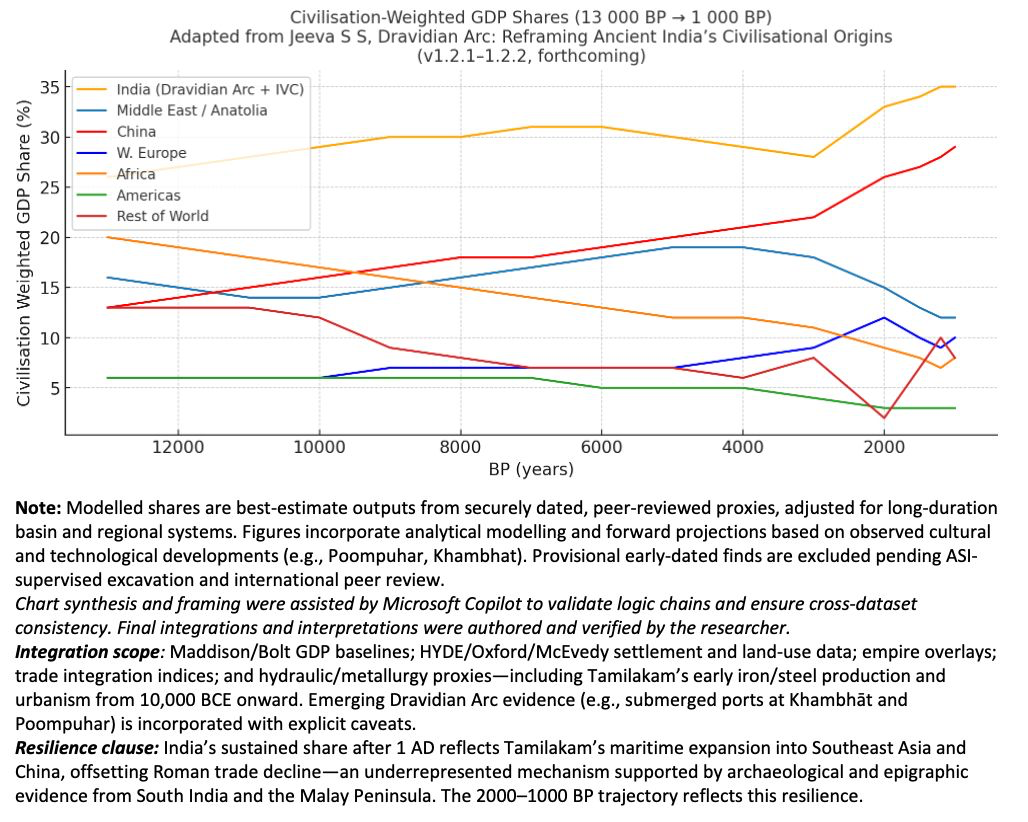
Chart by Jeeva S Sk (CCBYSA4.0)
Synthesis: Taken together, Tables 12.1, 12.2, and Figure 12.1 demonstrate that breakthroughs in metal driven agrarian intensification directly fuelled the rise of dense, planned urban centres with complex symbolic and civic systems—especially within the Dravidian Arc, with Tamilakam serving as a southern engine of agrarian and urban innovation. This convergence underpins our polycentric model of civilisational development and leads into the concluding discussion.
Conclusion
Southern Tamilakam—as an integral part of the Dravidian Arc—was never a latecomer. It can be confidently identified as an early Holocene maritime-agrarian civilization (c. 8000 BCE), rooted in estuarine deltas and offshore ridges, shaped not by sudden collapse but by gradual sea-level rise. Our environmental-bridge framework shows how this steady transgression redirected coastal maritime-agrarian lifeways into inland riverine networks, laying the groundwork for Sangam-era urban centres. By the Bronze Age, its ports connected to Mesopotamia, Egypt, and Zhou/Eastern Zhou China, with Chinese goods arriving via early first-millennium BCE trade routes. Deep genetic continuity with the Indus Valley Civilization, coupled with shared graffiti systems, deity iconography, and ritual motifs, reveals a cultural coherence that transcended geography.
This study repositions Tamilakam not as a peripheral outpost but as a civilizational core—marked by autonomous agrarian systems, early iron production, and metallurgical innovation. The presence of Yavana enclaves and Indo-Roman trade artifacts across its littoral—corroborated by Sangam texts and Greco-Roman accounts—further affirms Tamilakam’s maritime sophistication and deep integration into early global exchange networks, centuries before European contact. Together, these findings challenge diffusionist models and underscore Tamilakam’s enduring contributions to sustainable development, technological ingenuity, and transoceanic connectivity.
Our comparative analysis confirms that Tamilakam not only harnessed metal-driven agrarian breakthroughs (Table 12.1)—including the earliest crucible steel at Thelunganur and, in the Southern Arc, wind-powered steel furnaces at Samanalawewa (c. 300 BCE)—but also pioneered dense, planned urban settlements alongside the Fertile Crescent and Anatolia (Table 12.2). This dual legacy of agricultural intensification and urban complexity cements its position within a truly polycentric model of early civilization—further reinforced by the civilisation-weighted GDP share model, in which the Dravidian Arc ranks at or near the global lead across the past 12,000 years, reflecting unmatched resilience and continuity.
While we cannot yet assert that these early populations were “Tamil speaking” in a strict linguistic sense, the cultural, genetic, and symbolic foundations of Tamilakam identity trace back to an ancient Dravidian continuum. The persistence of yogic postures and deity archetypes — from the Pashupati seal to the Jaffna plaque — suggests a continuity of ritual motifs predating the Vedic canon. These elements may have later informed the yoga and Saiva–Sākta traditions, though direct historical and linguistic links remain under study. The trajectory from the ~12,000 BP Konkan petroglyphs, through Indus Valley proto Sivite symbolism — incorporating early Saiva, Sākta, Siva Linga, and proto Nandi elements — and finally to the Steppe era harmonisation of the Indian subcontinent in the Vedas (especially the āgamas and Purānas), reflects an evolving Hindu spiritual tradition that has endured across millennia. Such symbolic coherence, sustained over time, points to a devotional grammar embedded deeply in the subcontinent’s spiritual imagination for over 5,000 years, and one that continues to resonate today.
This paper invites a broader comparative perspective: Southern Tamilakam must be seen not as a regional backwater but as a vibrant civilisation whose iron-driven agrarian innovation, planned urban centres, and rich symbolic traditions—enshrined in religious practices and Sangam-era texts like the Tolkappiyam—stand as a foundational axis of early human complexity. To date, Mesopotamia and the Fertile Crescent have dominated the cradle-of-civilisation paradigm, with Anatolian sites such as Göbekli Tepe, Çatalhöyük, and Troy joining the narrative. Our deep-time Dravidian Arc framework—anchored at Khambhāt, Tamilkilam, and Ilankai—places this South Indian continuum alongside these giants and suggests it may well have emerged first.
As the Overview warns, clinging to a single-cradle narrative erases half of human ingenuity. By exposing funding biases and historiographical blind spots across India, Pakistan, and Sri Lanka, this study levels the playing field—elevating Tamilakam from marginal footnote to rightful civilisational peer. Overlooking its revolutionary legacy would be an unforgivable travesty.




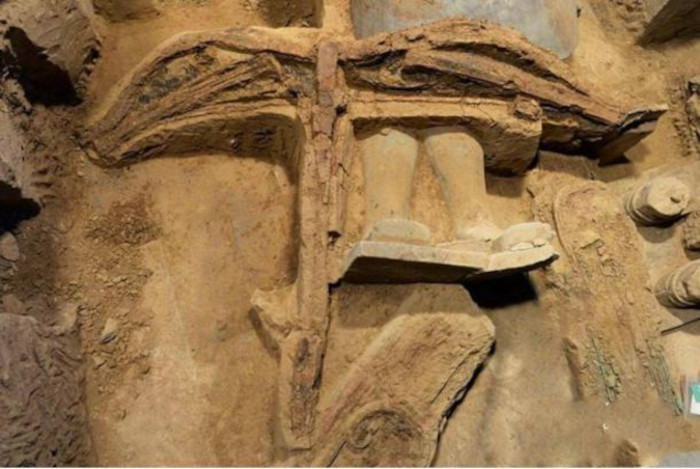
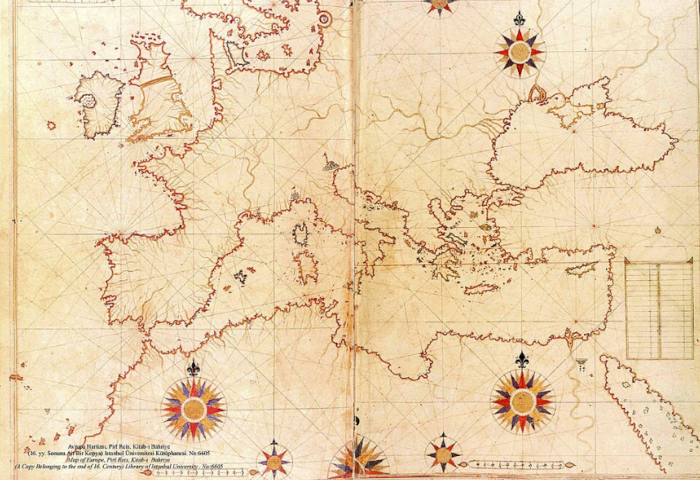



.jpg)

.jpg)
_Petroglyphs.jpg)


