







Twenty years ago I did a brief study of The Chemistry of Love, to explore how our bodies seemingly compel us to fall in love in the interest of procreation. And how in the process (what I then thought was) our ‘free will’ is totally taken away from us.
Now I know a little better, and I’m convinced we never had any free will in the first place. As I’ve written about at length, it appears all of our behaviour is entirely conditioned by our biology, our culture, and the circumstances of the moment. Our explanations for how ‘we’ made those decisions are merely after-the-fact rationalizations for what the body has already decided and done.
Since I wrote that early article, much has been learned about the chemistry underpinning and driving most of our behaviour. We now have a reasonable but still very incomplete idea about which neurotransmitters and which hormones are ‘responsible’ for much of what we do. We are starting to understand how even our cultural conditioning is chemically encoded to determine our behaviours.
Neuroscientists and psychologists continue to cling to the idea that there is free will that can be deployed (mind over matter) to ‘cure’ any addiction or other mental illness, if you follow their process. (And if it’s not working for you, it must be that you’re doing it wrong, or not trying hard enough or long enough.)
We can only hope that one day they will give up their claims to understand how the brain actually works and how to ‘cure’ mental illnesses, and instead humbly admit that the best they can do is to work to help their patients feel a bit better for a while. There is a great need for that, and the qualifications to do it well are likely very different from what shrinks are now trained to do.
And of course we, the lowly patients, contribute to this delusion, since we desperately want to believe they know precisely what they are doing and how to ‘heal’ us.
Fortunately, our bodies, having millions of years’ experience dealing with innumerable physical and mental ailments, don’t pretend to know what they are doing, but do a pretty bang-up job of keeping us healthy (mentally and physically) nevertheless.
So where do we stand on the fledgling profession of ‘neuroscience’? Although we do have a reasonably good idea of which chemicals (neurotransmitters, hormones etc) are involved in compelling us to do things that are good for us, we remain pretty much clueless about how they do it. Dopamine, for example, which is both a neurotransmitter and a hormone, is often called the “feel-good” chemical, but it appears to play a role in almost every type of behaviour we exhibit. And in many cases, its purpose (in concert with other chemicals) is actually to make us feel bad. It might be more accurate to call dopamine the “pay attention” chemical, since its role seems most often anticipatory of both pleasures and dangers. And with many of our pleasures, once we actually start partaking of the pleasurable activity, it appears dopamine ceases playing a role, handing off the job to other chemicals.
The AI bot explanation of the role of dopamine contained this additional interesting (and unsolicited) information:
Uncertainty seems to be a powerful amplifier of dopamine-driven attention. This may be why intermittent rewards—occasional signs of affection, unpredictable messages, ambiguous signals—can be more psychologically consuming than consistent affection. The subjective feeling most closely associated with dopamine may not be pleasure at all. It may be something closer to: ‘This is not resolved yet; keep paying attention.’.
In my usual curious but amateurish way, I recently did a bunch of reading on recent advances in our understanding of these chemicals, and then asked the AI bot to validate a ‘map’ I had constructed between positive experiences and behaviours (those that are generally healthy for our bodies and brains) and the chemicals that seem to induce these behaviours.
After some back-and-forth, we came up with this (obviously incomplete but IMO interesting) ‘map’:
| Encouraged Experience/ Behaviour | Likely major chemicals involved (hormones and neurotransmitters) |
| 01 Sensory pleasures (e.g. eating tasty/healthy food) | dopamine, endorphins, endocannabinoids |
| 02 Curiosity/ discovery | dopamine, acetylcholine |
| 03 Achievement/ learning/ mastery | dopamine, endorphins, sex hormones |
| 04 Social belonging/attachment | oxytocin, endorphins, serotonin |
| 05 Romantic love | dopamine, oxytocin, norepinephrine |
| 06 Nurturing/ caregiving | oxytocin, prolactin, endorphins |
| 07 Erotic pleasure | sex hormones, dopamine, oxytocin, endorphins, prolactin |
| 08 Aesthetic appreciation (e.g. music, beauty) | dopamine, endorphins, serotonin |
| 09 Thrill/ excitement | adrenaline, dopamine, endorphins |
| 10 Calm contentment/ equanimity | serotonin, oxytocin, endorphins |
| 11 Self-soothing | endorphins, oxytocin, dopamine (also affects ‘vagal tone’) |
| 12 Exercise | endocannabinoids, endorphins, dopamine |
A couple of notes on this table:
- Endorphins is a familiar term for endogenous (ie produced by our own bodies) opioids. The sex hormones like testosterone and estrogens (and some other chemicals) don’t actually produce desired behaviours, but more accurately seem to amplify the behaviour-producing effects of other chemicals.
- Aesthetic appreciation (08 on this table) is the only chemically-produced behaviour that does not appear to have any obvious survival or health benefit. We don’t know why our bodies seem to compel us to seek and enjoy aesthetic pleasures like music and beauty.
Note that this table only lists activities that are always or sometimes pleasurable for us. A similar table could be constructed for discouraged experiences and behaviours, where our body’s chemicals produce ‘pain’ in all its forms to compel us not to do them. The stress chemical cortisol is an obvious candidate for such a table, since it discourages us from tolerating stressful and dangerous situations by compelling us to fight or flee to relieve the cause of the stress. Adrenaline (“gather your energy”) and dopamine (“pay attention’) would appear on this table as well as on the encouraged behaviours table above. Excess production of the ubiquitous chemical glutamate (“get excited”) also appears to prompt unpleasant feelings, to discourage us from participating in chronically-stressful activities (“this is too much; get us out of here”). And ghrelin (“I’m hungry”) would also appear to belong on the second (‘unpleasant’ motivators) table.
Another factor in these promptings by our body is that they can create self-reinforcing ‘loops’: The chemical often initially induces us to do something, but when we do it, that often seems to prompt the body to produce more of that chemical. This might help explain our propensity for addictions. But it also gives some insight as to how our body is driving our every behaviour. Because in some situations it can be our (body’s) ‘non-deliberate’ physical behaviour (such as looking at a painting or hearing a beautiful but unfamiliar piece of music, or seeing something that re-triggers past trauma) that actually gets the loop going, and then the chemicals kick in to keep it going.
I have often observed that it seems the body’s overarching mission is to maximize pleasure and minimize pain (the hedonist’s maxim). But it’s actually more complex than that. It would probably be more accurate (though still an oversimplification) to say that:
The body’s reward/punishment/recognition system uses a combination of ‘positive’ (pleasure inducing) and ‘negative’ (pain-inducing, unpleasant) chemicals to direct human behaviour.
This is how the AI bot supported this argument:
Many of the experiences, behaviours, and activities that are essential to a thriving human society entail mixtures of reward (pleasure) and suffering (pain). Consider:
falling in love, raising children, artistic creation, scientific discovery, devotion to a cause, and spiritual seeking. These activities often involve uncertainty, ambiguity, frustration, stress, and sacrifice. If evolution’s goal were simply to maximize pleasure, these seem oddly designed. But if the goal is to sustain engagement with important (for our survival and health) long-term activities, then a ‘reward system’ that combines positive rewards (encouragements), discouragements, acceptance of uncertainty and stress, and persistence, makes more sense.
I confess that the process of creative writing can sometimes be agonizing for me, while the outcome of that process provides more, and more lasting, delight and pleasure than almost any of my other writing activities. I can feel the chemicals coursing through me as I face the frustration and then (often) the elation of completing the process and admiring what ‘I’ have produced.
The AI bot offered, without my prompting, this table of ‘stages’ of how different chemicals induce different behaviours using a mix of pleasure-generating and discomfort-generating chemicals, for the ‘simple’ process by which someone eats some raspberries:
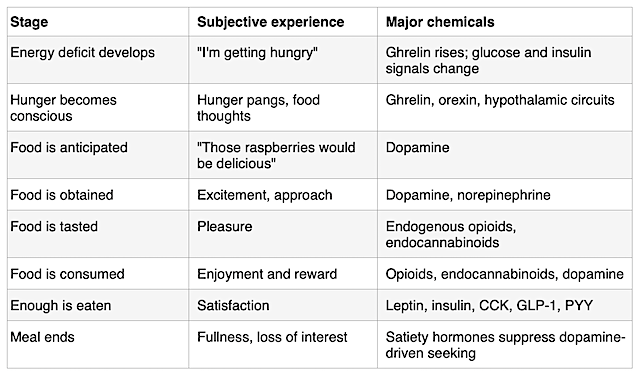
This entire process works unconsciously or subconsciously, although we often will try to make sense of it after the fact (“I was hungry so I decided to eat most of the raspberries”).
(My father used to say that without going through the ‘lows’ we simply wouldn’t appreciate the ‘highs’ as much. I’m not sure that’s true. I get that sustaining the dopamine ‘hit’ requires us to buy/do/get more every time. And I get that, a year after a major loss, you can be feeling just as happy as after a year of extraordinary success. But the idea that our pleasures are “all relative” just doesn’t jibe with my experience. Some pleasures seem to remain just as pleasurable to me for decades, without the need for more and more.)
One of the things I did, both in compiling the chart above, and in reviewing it, was to pull up my ikigai list — the things that bring ‘everyday joy’ to my life. To my astonishment, everything on my ikigai list ‘mapped’ to one of the categories of ‘encouraged’ experiences and behaviours in the chart. The categories that most of my ikigai joys fit into has clearly evolved over my life (most of them are now in categories 01, 02, 03, 07, 08, 10 and 11, whereas earlier in my life, pleasures in categories 04 and 05 were seemingly more important and prevalent; don’t ask me why).
My body is ‘telling me’ what to enjoy, for my own good. Just as it is telling me what to avoid.
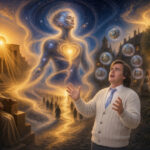
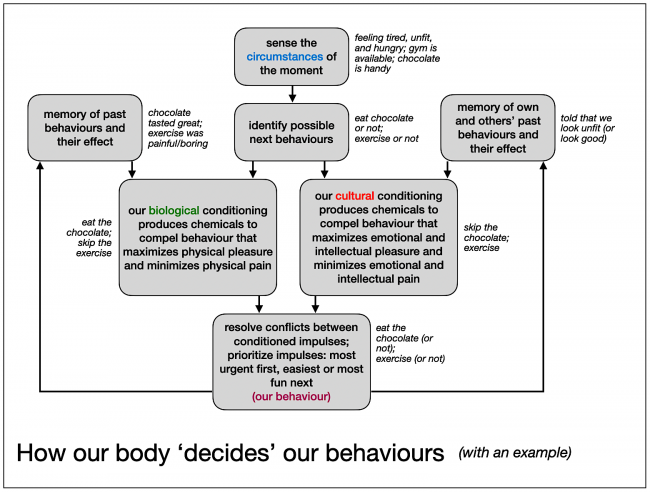
But this review is causing me to rethink the graphic at the top of this post, which I developed for an earlier post on this subject, which now seems a bit simplistic. In that earlier article I wrote:
For example my biological conditioning might be prompting me at this moment to eat chocolate (“it’s pleasurable”), and to eschew exercising (“it’s painful”), while my cultural conditioning might be prompting me to resist eating chocolate (“that’s just empty calories”) and to exercise (“you’re looking unfit and unattractive”). Using chemicals coursing through my body, there will then be a tug-of-war between my biological and my cultural conditioning. The result will be, inevitably, that I will eat the chocolate, or I will exercise, or both, or neither. If I’m really sensing that my lack of fitness poses a severe health hazard (say, a friend recently had a heart attack), my combined (biological + cultural) conditioning may compel me to consider the exercise to be a personal imperative, so it will be done first, and the chocolate, yummy and perhaps even healthy in small quantities as it might be, will have to wait, or not be eaten at all when the opportunity to eat it runs out. But if my combined conditioning doesn’t identify the exercise as a personal imperative, then, if the physical pleasure of eating it ‘outweighs’ the perceived cultural consequences (‘pain’) of eating badly, then the chocolate will come first, because it’s easy and fun to eat, and the exercise will be put off until later, or not done at all.
What’s actually going on in this example, once we look at it from a chemical point of view? I’m hungry and tired, because my body’s chemicals are sending signals with those messages to ‘me’. But I’m also trying to get into better shape, because various past behaviours (my own and others’) have me sometimes feeling anxious and self-conscious about my health and appearance. Those feelings of anxiety and self-consciousness/shame were generated by chemicals prompted by behaviours (eg me looking in the mirror). But we might be tempted to say that the anxious judgemental thoughts and shameful feelings caused the conflicted behaviour. What exactly happened in this body when it looked in the mirror and saw an unhealthy person?
I posed this question to the AI bot, since it would seem to challenge my assertions that our behaviours are not affected by our beliefs (though our beliefs are clearly affected by our and others’ behaviours). Particularly in the case of, say, someone suffering from anorexia, this might suggest that our self-judgements cause behaviour change, which contradicts the very strong balance of evidence that asserts we have no free will.
The bot responded:
When I wrote: “Thought: ‘Eating will make me gain weight’ ” as part of the anorexic’s behaviour loop, I was implicitly using a cognitive model, where conscious or semi-conscious beliefs are treated as important causal components. But there are other frameworks—trauma-informed, psychodynamic, embodied cognition, affective neuroscience—that would be much more sympathetic to your critique. They might say: “The verbal thought is not the cause. The thought is a narrative constructed after the fact to explain a pre-existing bodily state.” In fact, there is quite a bit of evidence that humans routinely do this.
If it isn’t the self-judgemental thought ‘Eating will make me gain weight’ that compels the anorexic to feel agonizing anxiety and guilt about eating, what is it? Possibly the culprit is past trauma that automatically triggers the ‘chronic anxiety circuit’ chemicals: norepinephrine (alertness), cortisol (longer-term stress mobilization), adrenaline (acute activation), serotonin (complex regulatory role), GABA (inhibitory/calming effects), and dopamine (when uncertainty is involved). These chemicals are already primed and ready to go when anything re-triggering the trauma occurs.
While I don’t think I have any serious trauma, the same thing in a much-moderated way probably occurs when I look into the mirror and see a paunch instead of a six-pack. The anxiety chemicals leap into action. The self-judgement and rationalization only comes afterwards, to ‘make sense’ of my feelings of dismay etc. But it all happens so fast it’s easy to confuse causes with consequences. And it’s natural to do so if we’ve been conditioned to believe we have free will.
All of these behavioural ‘loops’ are massively complex, and all our models and theories are inevitably simplistic. It’s not as simple as stimulus  ︎ response. And the stimulus can be real and immediate, or it can be remembered, or it can be imagined. It doesn’t really matter which. The body responds the same way. The stimulus is part of the ‘conditions of the moment’, which is only a part of what (apparently) produces our behaviour.
Somehow, through all of this unimaginable complexity, our bodies have evolved over millions of years to prompt behaviours that are, most of the time, what is best for us, for our survival, happiness and health. They do all this with a remarkably limited supply of multi-purpose chemicals. Absolute alchemy. I’m starting to look at this body in a new, and awe-filled, light. Probably, as I turn 75, about time.