

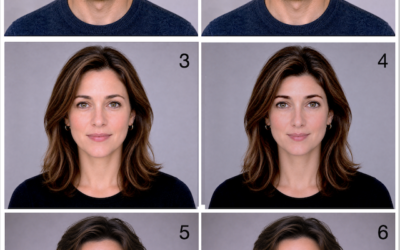


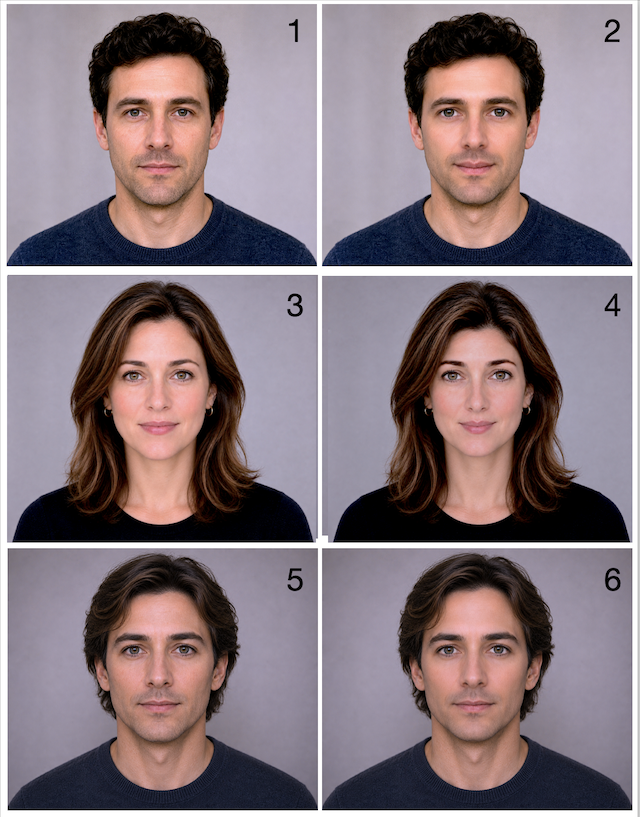
These images were created by AI using very specific instructions. Explanation is at the end of this post, but before you read it, look at the 6 images and assess (1) on a scale of 1-10, how beautiful/attractive they are overall; and (2) which you think is the most attractive.
“Das Studium und allgemein das Streben nach Wahrheit und Schönheit ist ein Gebiet, auf dem wir das ganze Leben lang Kinder bleiben dürfen.”
“Study, and in general the pursuit of truth and beauty, is a sphere of activity in which we are permitted to remain children all our lives.”
— Albert Einstein, in a letter to a young friend
The above oft-misquoted (missing the first four essential words) and usually misinterpreted credo from Einstein, basically refers to two of the three ‘great human pursuits’ he wrote about throughout his life: goodness, truth, and beauty.
All three words, at least in English, have been disastrously tarnished over the past century, to the point their pursuit is often treated with incredulity and even derision. Rather than ‘pursuit’, the German word is more accurately ‘striving for’, with the connotation of a continuous effort rather than a ‘chasing-after’. His “goodness” wasn’t a moral judgement, but rather described behaviours (perhaps similar to the Buddhist ‘rightness’) that make things better and more joyful for everyone. His idea of “truth” wasn’t an absolute, but rather a path through misinformation and ignorance.
And his “beauty” was not limited to ‘physical’ beauty at all, in the sense of aesthetic attractiveness or loveliness, but embraced the ideals of elegance and harmony and even mystery. He often paired the use of the German word for beauty with a word that translates to sublimity, sometimes even using the German words interchangeably.
What is this “sublimity”? Books have been written on the subject (mostly in German), many of which seem to try to appropriate the term for moralistic or religious purposes. But at its root, I think, the word, in both German and English, actually refers to something that is awe-inspiring, or wondrous (in the sense of wonder-inspiring). Makes you curious, and also blows you away.
Of course, there is no formula for what is and is not beautiful, awe-inspiring, or wondrous. It’s just too personal, too context-dependent. But my guess would be that wild creatures have a sense of wonder and awe, but probably not a sense of beauty in the judgemental way that humans do. And likewise, I suspect that as we ‘grow up’, we humans lose much of our sense of wonder and awe, and gain an aesthetic sense of what is and is not beautiful, based on our conditioning. Small children, I think, live in a very different world from the one we adults purport to live in.
Ours is always imperfectly, insufficiently beautiful.
Theirs, at least if they’re spared early deprivation and trauma, is one that is merely sublime.
About the images above:
I asked ChatGPT to compile a table of the global average size and proportions of human faces. There is a lot of data on this, used for a wide variety of purposes — nose sizes and placement, eye size and distance, etc. To test the hypothesis that people tend to find symmetric, ‘average’ faces very attractive, I then asked it to produce images of a 36-year-old man and a 36-year-old woman with Caucasian complexions, with those precise ‘average’ features. Images 1&3 above were the result.
I then asked the bot what differentiated people whose faces had been rated as exceptionally beautiful from ‘average’ people’s, and then I photoshopped images 1&3 to reflect those preferences, producing images 2&4.
And then, just to be mischievous, I asked it to create two more images by averaging the male and female images 1&3, producing image 5, and averaging the male and female images 2&4, producing image 6. I thought these results, and viewers’ responses to them, were especially fascinating.