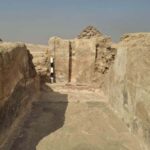



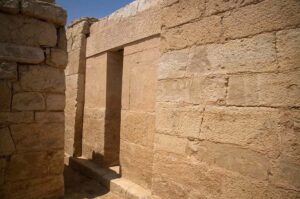



An important Egyptian tomb from the Fifth Dynasty of the Old Kingdom has been discovered in the Saqqara necropolis by a Spanish-Egyptian archaeological mission.
Josep Cervelló, an Egyptology professor at the Autonomous University of Barcelona, led the work, which was coordinated with the Egyptian Supreme Council of Antiquities to investigate the unique tomb in the Saqqara region southwest of Cairo.
The tomb did not belong to a Pharaoh, but was commissioned by a high-ranking official named Yunmen, who served during the reign of Djedkare Isesi. Strangely, the structure features two funerary chapels: one of which is dedicated to the Iti, Yunmen’s father, who held a lower rank than his son.
The discovery may offer a new context for the intersection of spirituality and social mobility in ancient Egypt.
Egyptian Tombs
We now see the Saqqara necropolis primarily as the remains of a dead culture, filled with long-forgotten tombs. While often portrayed as settings for horror stories, the Spanish-Egyptian archeological team viewed them differently, seeing them as places used by a vibrant community, where the living constantly came to leave offerings and work on funerary monuments.
The recent work is part of the continuing exploration of Egyptian sites discovered by archaeologists in the 19th century. To this day, archaeologists continue to seize on hints in the works of their forebears over a century ago to explore ancient Egypt’s impressive remains. Auguste Mariette, a French archaeologist, first discovered the site, identified as containing a large tomb complex, but no detailed exploration or documentation had been done.
Life In the Necropolis
Egyptian mastabas were a unique style of tomb, and in some ways were like modern cemeteries: they were frequently visited places where the lost were mourned and remembered. For this reason, the team was also very interested in the tomb complex’s topography, rather than just its beautiful decoration. They studied the tomb as an urban location, investigating how ancient people moved through it and whether they worshipped outdoors or inside.
Exploring the bustle of urban life in the necropolis netted the team their first indication of Yunmen’s tomb, alongside hints at two more located nearby. In follow-up excavations, the archaeologists are planning to explore the remaining pair.
Moving in Ancient Egyptian Society
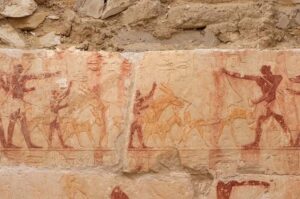
The tomb’s physical structure intrigues archaeologists, as it is a rare example of a building with two funerary chapels. Fortunately, the 4,400-year-old tomb is remarkably well preserved, with vibrant color and fine details observable in the wall reliefs. Archaeologists can still clearly make out tiny donkeys and other animals in the wall art. Elsewhere, some elements of the texts adorning the walls follow common formulas—yet even these are customized to the official role and personality of the owners.
Archaeologists interpreting the mastaba believe it reflects social advancement. Yunmen achieved a higher social status than his father, Iti. Yet on the journey to the afterlife, Iti was not forgotten; Yunmen ensured his father received a tomb of similar opulence, so the son’s prestige would apply retroactively to the father in death.
“We still need to fully examine it, but one possibility is that the official originally came from that outlying province, arrived at the court, and settled in Memphis—Egypt’s capital at the time—while his son became an official in the central state administration and was the one who built the tomb,” Cervelló said in a press release.
It remains to be seen what the other two mastabas identified by the team will reveal, whether they will provide more evidence for our traditional understanding of Egyptian culture or add more nuance to our view of these ancient people.
Ryan Whalen covers science and technology for The Debrief. He holds an MA in History and a Master of Library and Information Science with a certificate in Data Science. He can be contacted at ryan@thedebrief.org, and follow him on Twitter @mdntwvlf.