




This is #49 in a series of month-end reflections on the state of the world, and other things that come to mind, as I walk, hike, and explore in my local community.
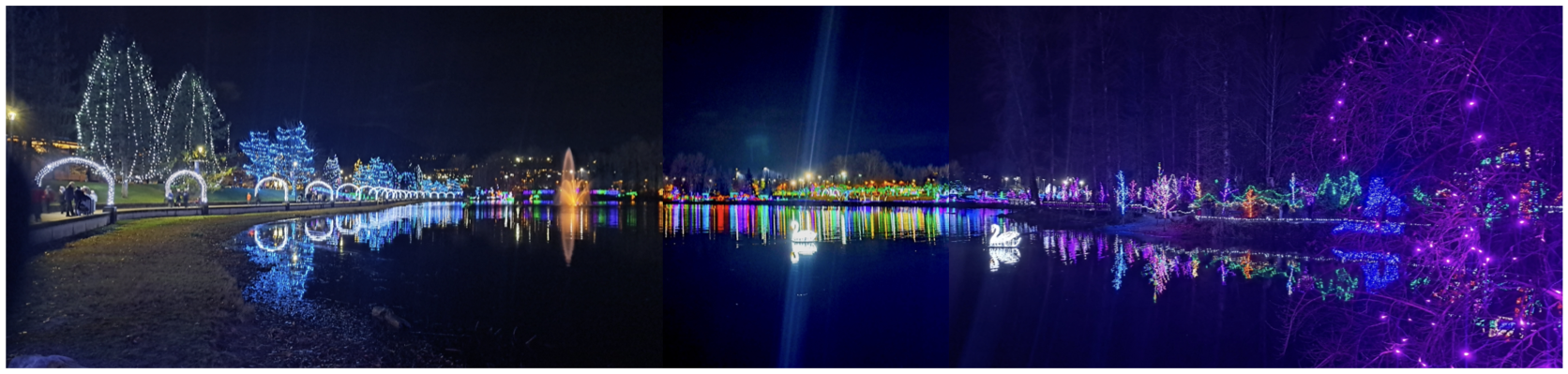
my stitched-together 180º panorama view of half the lights around our local lake; right click and open in new tab to see full-screen
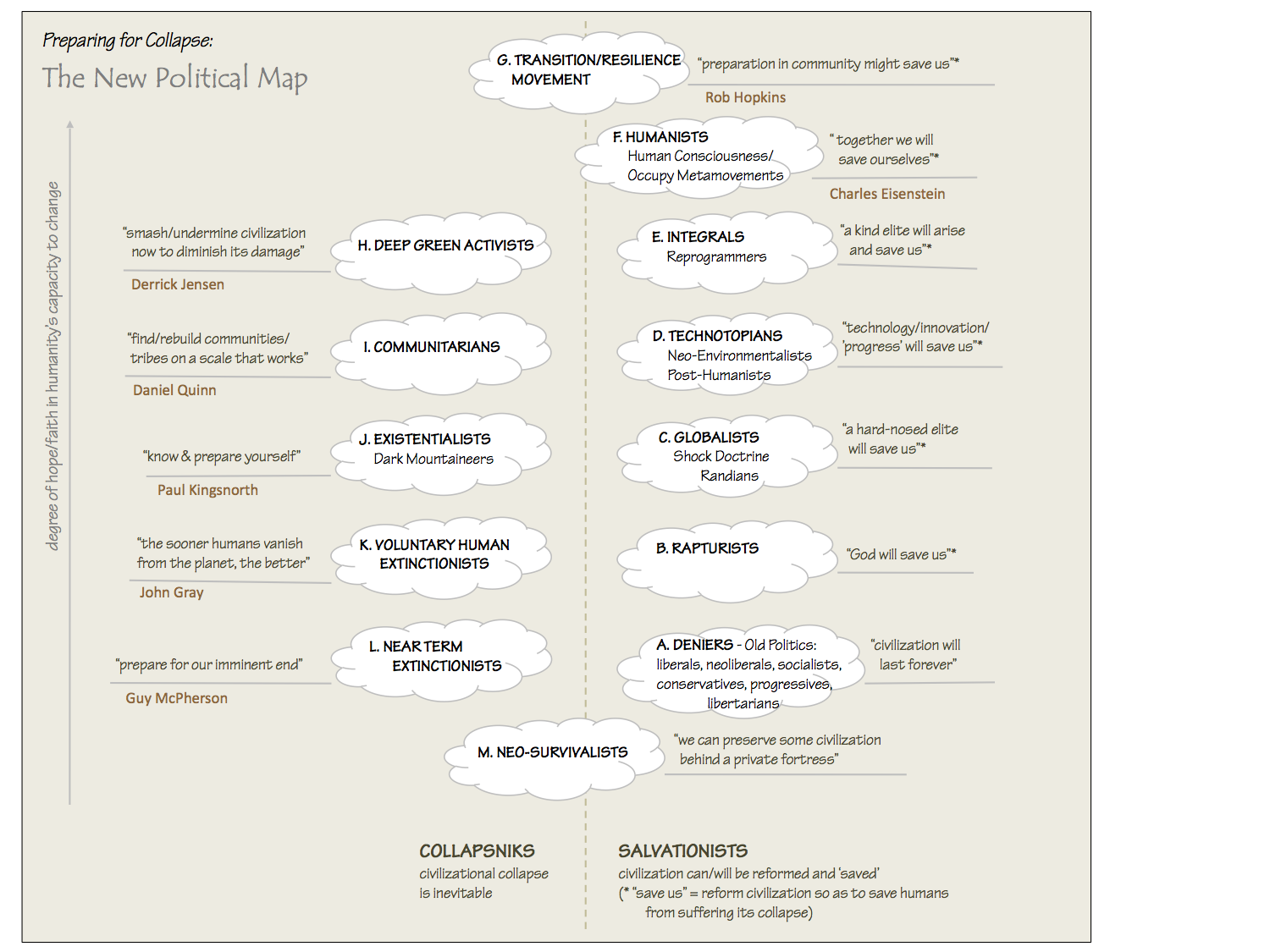
It’s hard not to be depressed, looking back at the past brutal year and ahead to the fraught one to come. Easy enough to find someone to blame, some ‘other’. Easy enough to say ‘I told you so’. Easy enough to shrug it off as being the inevitable trajectory of a species that seems far too smart for its own good, and for this planet’s good. Easy enough to say we have no free will, so it’s silly to fret about or lament or dread what’s done or what’s to come, since it’s the only thing that could have happened, or will happen. Easy enough to find any of thousands of popular salvationist groups who’ll tell you Everything Is Fine. (Or will be, once X takes control of things and “saves” us.)
The reason I describe our species’ history as a tragedy is that it seems pretty obviously an unavoidable disaster. Our species’ emergence was so novel, and it has produced so many absolutely wondrous things, that the fact it has now evolved to wreck the planet and inflict such untold misery on every species it shares Earth with, seems to me the very definition of tragedy. We’re like the child prodigy whose life ended quickly in addiction, violence, murder and suicide. We seemingly held such promise.
This is what I think about as I wander through my lovely sodden community in the early dark (“It’s 4pm. It’s already dark again. Who’re they ‘saving the daylight’ for?“) and the rain (local rivers flooded, water pooling everywhere), among the mostly very unhappy holiday shoppers.
Our beautiful world, full of people struggling to do their best, full of hope and anticipation, is now seemingly full of hate and rage at exactly the time we most need to trust each other and act together to cope with the enormous hardship and suffering that the accelerating collapse of our civilization is wreaking on all of us. I keep asking “What is the matter with us?” and simultaneously answering “There’s nothing wrong with us; we’re doing the best that we can.”
If civilization is indeed a “disease” it seems to infect us at a quite early age, and to set in more and more as we age. Do we ‘catch’ it from each other, or is it built into our bones, and our brains?
I’ve spent lots of time trying to understand the ‘whys’ and ‘hows’ of our emergence on our little planet, and our ruination of it — where we ‘went wrong’. I’ve theorized that it stemmed from the entanglement of our large brains, an evolutionary misstep that disconnected our innate sense of being part of everything, of all life on Earth, and consequently made us terrified of all the suddenly-separate ‘others’, and hence deranged us. Nothing to be done about that.
And yet. And yet…
As I wander around the lake with its million-light display, watching the ducks paddling around, the dogs sniffing everything, the delighted little kids staring in awe at the lights and displays, my dark winter blues are imbued with a growing sense of astonishment and wonder.
Ultimately, the reasons why and how we became what we’ve become as a species don’t matter. We can never know, and we can’t undo the process that made us who we are. We are the overseers and chroniclers of a world in the process of horrific, global, violent collapse. It will not help us to know how or why that came about, if we were even capable of comprehending that. I explore it simply because it seems to me to be a necessary part of chronicling this collapse, and that’s my self-assigned task in my final years of life. But I don’t pretend anything we ‘know’ could change anything. The hows and whys are all just stories, anyway.
I look at the staggering beauty all around me, and ask: Where does our perfectly reasonable sense of despair and fear and helpless rage come from? It comes, of course, entirely from inside our heads, where it is manufactured, in many ways, “to order” — to make sense of things as best as our brains are capable of, and also through our conditioning, as our cultural influences, both well-meant and malevolent, struggle with our biological imperatives, to determine what we do.
As much as I’d like to believe we can, in some ‘mind over matter’ process, quieten the Machine in Our Heads [This essay by Glenn Parton remains one of my all-time favourites; it’s part of John Zerzan’s monumental compilation Against Civilization], I’ve come to believe we are at the mercy of this endless buzz, and only in moments not of ‘our’ own choosing are we briefly liberated from our sense-making stories, and hence able to see the world as it actually is.
I’ll take those moments as they come.
I’m walking in the local park, around the lake, in the grey and the pouring rain. The adults seem miserable, the winds collapsing their umbrellas and soaking their clothes. But the children seem enchanted, and oblivious to the weather. One little girl is shouting excitedly to her parents “Let’s go see the secret door! It’s over there!” and running ahead along the path, urging them on. There is indeed a little miniature ‘hobbit door’, locked of course, in a hillock beside the path, bathed in soft light. There is probably nothing behind the door. Unless you have an imagination.
I crouch by the duck pond, where half the ducks are half-asleep (one eye open and one half of their brains alert), chortling quietly, while the other half of them dart around, turning upside down and digging in the shallow pond-bed for morsels. They seem quite intrigued by a relatively recent addition to the holiday light show on the lake — two wood-and-steel brightly-lit miniature pirate ships — but unfazed by everything else, including rambunctious kids and dogs:
I look at the water-speckled leaves of the trees and plants at the water’s edge, and marvel at the miracle of photosynthesis, which evolved, likely by sheer accident, 3.5Bya, and whose bacteria produced so much oxygen that it choked the atmosphere and caused a massive extinction event 1By later. It took another 1By (until just 1.5Bya) before chloroplasts evolved (apparently also by fortuitous accident) restabilizing the atmosphere, allowing fungi to evolve. But land plants took another 1By (until just 0.5Bya) to evolve — they’re newcomers, and there’s no clear consensus on how or why they evolved. So, strange as it might seem, sharks appeared on Earth before trees.
As I flee from the rain, headed towards the café, I almost bump into two people walking in opposite directions, being walked by their dogs. The dogs abruptly stop, tails wagging furiously, to greet each other, causing a minor pedestrian traffic jam at the street corner. The people involved look at each other rather helplessly and shrug, waiting as the dogs complete their greeting. I wonder whether the dogs have learned that this shrug is human body language for “OK get on with it we’ll wait for you”.
A moment later, I see two kids, a boy and a girl, deliberately splashing water on the sidewalks where it’s pooled. They wait patiently for the adults to pass, and then resume the play.
Inside, three young women are, quite obviously, flirting outrageously with the male barista. They are speaking Farsi, which I don’t understand. But they are also speaking a universal language that anyone can understand.
At one of the tables near me, two teenaged girls seated opposite each other are meticulously gluing tiny plastic coloured beads (called “drills” I am told), in precisely the same pattern, to the covers of two identical softcover romance novels. It’s the latest ‘friendship’ activity, they tell me. They draw the beads from a shared, sorted-by-colour plastic container with 60 compartments, each containing 1,000 beads. They glue them in tandem, one bead at a time, and chat and laugh and sip their lattes as they do.
On the way home, I listen to some of my favourite music on my headphones, including, these days, several of my ‘own’ songs. It’s not unusual nowadays to see me dancing and singing on my walks. It’s OK to be eccentric when you’re old. When my head is full of good music, there’s no room for those oppressive thoughts — regrets and nostalgia about the past, or dread and fears about the future. And people smile and nod when they see this old geezer happily shuffling along the street, sometimes grinning, and sometimes crying. And sometimes both at once.
What I am witnessing, it seems everywhere I turn today, at least when I am paying attention, is people having fun in the moment, freed at least briefly from the negative thoughts that weigh so heavily on most of us, or, in the cases of at least some of the littlest people and most of the wild creatures, un-afflicted by them. Free, at least for a few minutes, from all the thoughts that prevent us from just seeing, and just being, in the moment. All these thoughts are, after all, just stories, fictions. Shit we make up in our heads.
Because that’s how our culture conditions us, because we have the grey matter that permits it to do so. To keep us in line. To try to keep us safe, or to manipulate us, or to sell us something, or ‘for our own good’, or to keep us obedient to those with wealth and power. To perpetuate the human tragedy.
But that’s OK. The plot thickens. It’s just all unfolding the only way it could. Get ready. Here comes your cue!
It doesn’t have to have a happy ending to be a really, really good show.