







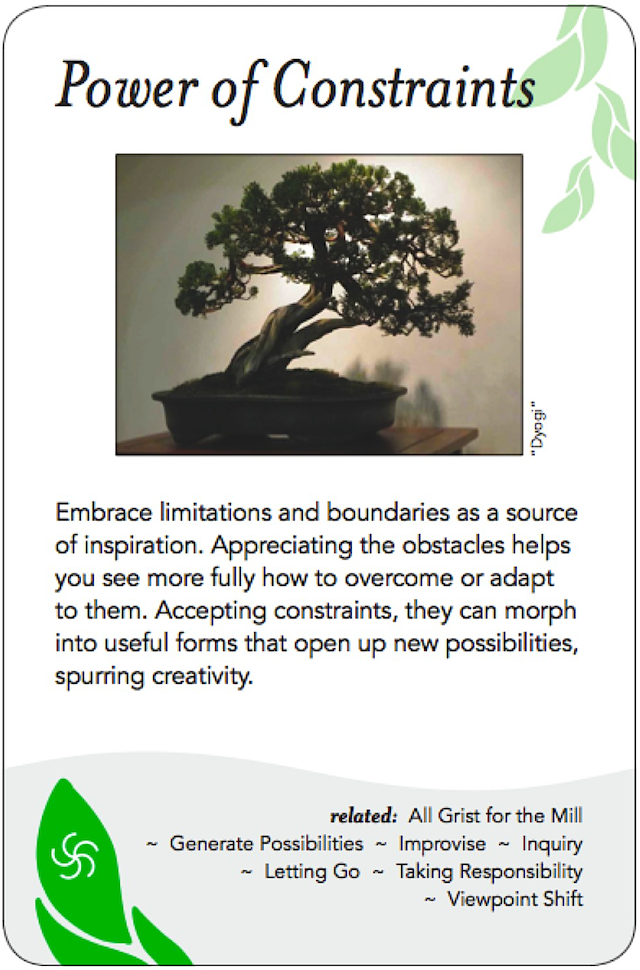
one of the pattern cards from the Group Works facilitation deck
Last evening I attended a PechaKucha style event in Port Moody, a community a short walking distance from where I live.
For those not familiar with PechaKucha-type events, it requires you to make your presentation precisely 20 slides long, with each slide lasting precisely 20 seconds — so the entire presentation is exactly 6:40 in length. You can of course choose your own slides, but you are encouraged to use few or no words on your slides (and definitely no charts), so that the audience listens to what you are saying instead of reading your slides.
This is an example of what is called the Power of Constraints — where less is necessarily more. Lots of people have suggested ways to prepare PK presentations that work within these challenging constraints, but I’ve found them all rather hackneyed and unimaginative. The magic of this method is that within the constraints of the structure, the presenter has complete freedom to improvise, to try things out, and to play. The best PK presentations I’ve seen follow no set pattern or structure.
The only measure of success, I think, is the number of Aha!s and Wow!s from the audience. You can inform, you can entertain, you can move, you can inspire, you can do whatever you want, as long as you engage the audience, keep their attention, and, as in any performance, leave them wanting more.
To me, the closest analogue I have found to a PK presentation is a song. In both, you have a short period of time (about five minutes) to capture and wow your audience. In a song, you likewise have the choice to inform, entertain, move, inspire, and/or otherwise engage your listeners, and the choice of many ‘genres’ of presentation to do so.
And also, both PK presentations and songs require you to appeal to the audience’s feelings more than their intellect. The best protest songs are light on facts and strong on images and powerful, memorable turns of phrase. The best songs don’t justify what happened in their story (if they even have a story) but instead convey how what happened made the singer feel.
TS Eliot famously said the same about poetry. Good writing, he insisted, has to appeal both to the emotions and the intellect. It has to provide us with some new idea or insight or possibility or perspective, some ‘aha’ that is suddenly recognized; and it must as well invite a sensory, evocative appreciation that transports us, ‘moves’ us. It must provide “some fresh understanding of the familiar, or the expression of something we have experienced but have no words for, which enlarges our consciousness or refines our sensibility”.
So, constrained to 6:40, about 750-1000 words depending on how fast you speak and how much time you want to leave listeners to absorb what you’re saying (and to look at your slide photographs), what do you do?
First thing, pretty obviously, is to select a topic that you know something about and care about. It will be pretty obvious if you don’t. And audiences will forgive a passionate, heartfelt, insightful presentation even if it’s delivered rather clumsily. (That’s basically the story of my public speaking life.)
And the second thing is to make sure you know what your essential message is. More than one essential message is usually too much for such a constrained presentation (or for a song for that matter). You don’t need to hammer your audience over the head with your message, but it should be clear in your own mind, and someone listening to you rehearse your presentation should have no doubt about that message.
I made this mistake with my own PK-style presentation a few years ago. I talked about the looming inevitability of our civilization’s collapse, and most people’s takeaway was that ‘we should learn to accept this rather than arguing against its inevitability’. I provocatively titled the presentation “Against Hope”. It went over quite well, but the real message was lost in my attempt to be informative, entertaining, and challenging. The real message was:
When you spend your whole life living in hope for a better future for yourself, your loved ones, and the world, you can end up living (often fretfully and distractedly) in that invented, fictional, imagined future, and largely cease to be present in the immediate, real world.
When I debriefed with people after the presentation, they told me: Wow, yeah — you should have said that.
I was first introduced to the idea of these presentations by Ivor Tymchak, whose own presentations, and those he’s helped others make, are almost invariably structured as stories with a personal, emotional impact. Most of last evening’s ten presentations were personal stories, and a couple of them were textbook examples of compelling story-telling with a (usually humble) succinct, message. Some useful take-away. Something to think about. Something to start doing. Someone or some group to connect with. A different way of doing things.
One of them was especially memorable for a simple line drawing of a woman standing facing a wall, her whole body leaning into it. A perfect depiction of despair. And a perfect metaphor for what so many women face in this patriarchal world. The image conveyed her message better than words, and reinforced what she was saying.
One of the presentations told the inspiring and up-and-down story of how the speaker turned an ethnic slur hurled at her in a local park (the park I often write about in these pages) during CoVid-19, into a celebratory Asian-Canadian multi-ethnic festival in that very park that now draws 40,000 people every year.
Another of the presentations showed a photo depicting the faces of two children with open-mouthed grins of unbridled joy, set against a background of horrific, crushing poverty in the speaker’s Philippine homeland.
The unspoken message at the end of the evening of presentations was, I think: What do you have to say? What is your message, right now, to the world? Something useful, personal, and engaging? Not an opinion. Not a rant. Not a teaching. Not an admonition. Not an explanation. Something much more than any of those things. Something that “enlarges our consciousness or refines our sensibility”.
It got me thinking about whether I might have both the passion and the capability to prepare such a presentation now, and, if so, what it might be about.
I write about 130 blog posts per year, with an average length of about 1600 words, just about a PK-length read. What if instead of just writing it, I made a video of me speaking it, with some photos in the background reflecting my feelings about the subject? I’m terrible at memorizing, and the thought of speaking into the camera without notes for six or seven minutes is intimidating. But I do have the advantage of being able to edit or retake what I produce, so maybe it would be worth it.
The big challenge for me, I think, would be deciding what I have to say that would merit that amount of work. And in the back of my mind, there’s a little voice suggesting to me that I really don’t have anything that’s that useful and that important and that personal to say.
And, if that little voice is right, is it perhaps telling me that it’s time for me to start doing something to change that, with the few healthy years I have left? Maybe that’s my real takeaway from last evening’s presentations.