









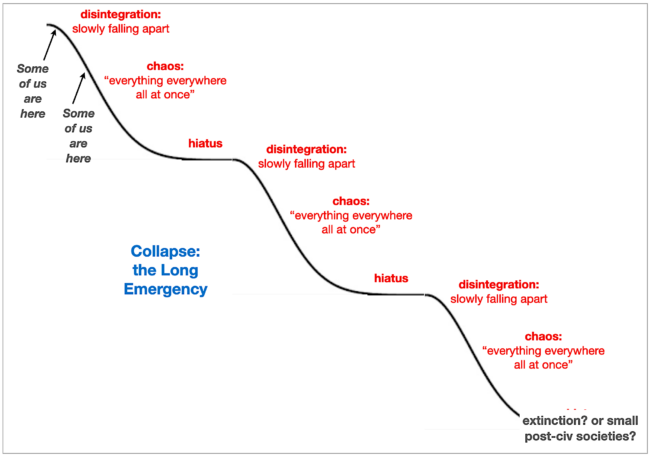
my own chart of collapse being a multi-stage, centuries-long phenomenon, with no ‘Hollywood’ moments or endings
There is a phenomenon in psychology called “creeping normality” which asserts that often changes occur so subtly and gradually that we don’t even notice them happening. And there’s a related phenomenon called “shifting baseline syndrome” by which what we think of as ‘normal’ shifts over time to accommodate these changes. These could both be considered forms of amnesia — we’ve simply forgotten how things used (even quite recently) to be.
These phenomena have catastrophic consequences. The collapse of the world’s fisheries has long been ignored, for example, because as fishers retired or died, no one was left to actively notice the degree of that collapse. This phenomenon is perhaps best exemplified by the (untrue but powerful) ‘boiling frog’ myth that Daniel Quinn made famous.
And these phenomena apply not only to the realities of life, but also to human behaviours: The normalization of deviance describes how behaviours once considered abhorrent and unacceptable, when practiced often and long enough, come to be accepted as ‘normal’. Undeclared wars, endemic political and corporate corruption, systematic lying and ubiquitous mainstream propaganda, and, well, just about anything that Trump does, are examples of this. It’s quite possible that genocide will soon join this list, as Trumpenyahu looks poised to destroy the ICC and ICJ, and hence the UN, to prevent any prosecution or even recognition of the Israeli/US genocide of the people of Palestine and neighbouring countries. With no one left to prosecute it, future generations may well come to consider the brutal and systematic extermination of another people as ‘normal’.
I’ve often used the chart above to depict the nature of (past and current) civilization collapses, which often proceed not only ‘gradually and then suddenly all at once’, but in recurring cycles and stages of slow decline, rapid decline, and then plateaux, until there is nothing left. But they occur so slowly that today we have already forgotten the extent to which the current collapse of our industrial civilization is already occurring. The earlier cycles are only dimly remembered.
In past great depressions, the use of the word ‘depression’ was only applied if and when the rate of decline was sudden enough that it even occurred to the citizens suffering through it that those times were not ‘normal’. The term was often applied only in hindsight.
And so it is today. When I started writing this blog 23 years ago, many of the things many have now come to accept as ‘normal’ were considered nearly unthinkable — and if we still thought the way we did then, the current ‘normal’ (including things like our response to pandemics and to genocides) would have been taken as evidence of the utter and catastrophic collapse of social, political, economic and natural order.
But thanks to creeping normality, the shifting baseline syndrome, the boiling frog phenomenon, and the normalization of deviance, as our civilization continues to fall apart, most of us may never use the word ‘collapse’ in the present tense.
COLLAPSE WATCH
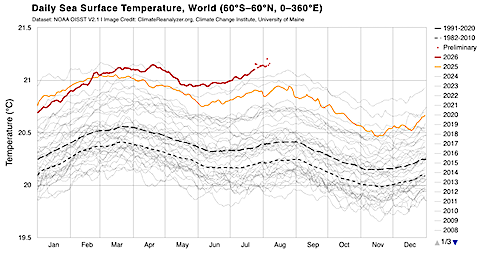
we’re in completely uncharted territory as the latest El Niño is just beginning to weigh in; chart from NOAA Climate Reanalyzer
Not a pretty picture: Seven charts that describe the current state of climate collapse, from UNEP. Thanks to Peter Frinton for the link.
The US Government prepares for political collapse: Political systems in most of the world are dysfunctional and falling apart. The Epstein Class is working to ensure they’re ready to put down the resultant revolution. More details in this paper. Great summary of the essential functions of a political state and the 15 ways they’re now failing.
We can’t help defending a system we identify with and depend on as ‘ours’: Derrick Jensen explains how we get caught unable to resist a system that we’ve taught is somehow ‘our’ system, our creation. From the “Why are things falling apart?” section of Tim Bennett’s astonishing 2007 documentary about collapse What a Way to Go: Life at the End of Empire. Thanks to Jonathan Cook for the link.
Adapting to collapse will only work at small local scale: Bill Rees reiterates the reasons why we’re not all going to do what we all “need to do” to cope with collapse.
This month in collapse: And, as usual, Erik Michaels summarizes the best of the past month’s writings about collapse. His recommended substack blogroll is also excellent.
Oh yeah, also record number of extreme heat events, global wildfires, and both land and ocean record-high average temperatures worldwide. Just your ordinary everyday multi-system collapse.
LIVING BETTER

from the memebrary
Ending clock changes: Despite massive efforts around the world to abolish the ridiculous changing of our clocks twice a year, global political inertia ensures nothing gets done about it. Trump is adamant to do it this year in the US, which pretty much guarantees it will fail again. Canada’s five westernmost provinces and territories seem determined to go it alone even if it does. Here’s the public health leaders’ scoop on which time we should choose to stick with all year round. It’s really only White Empire that still changes clocks anyway.
Navigating IP law: Cory explains why, when it comes to the complexities of intellectual property law, we’re usually far better off asking forgiveness than asking permission. In some cases asking permission actually self-incriminates you.
The limits of compassion: A short, compelling summary by Morris Berman of how far we should go to try to understand and forgive atrocity. Can we excuse Trump, the Israeli genociders, Hitler, the Epstein Class, and the rest of the world’s killers, war-mongers and abusers, because they think they’re doing what’s right, or they’re just sick, or they’re doing the only thing they can do given their conditioning? No simple answer here. Thanks to Paul Heft for the link.
Canadian petition calls for expulsion of US Ambassador to Canada: A massive petition to expel the hate-mongering ambassador who has supported US annexation of Canada, and interfered in Canadian domestic political affairs, will be taken up by Parliament in the fall.
POLITICS AND ECONOMICS AS USUAL

Israel/US bombs yet another Palestinian hospital and adjacent refugee camp at Al Aqsa, August 2026
Imperialism, Militarism & Fascism: Short takes:
- Trumpanyahu continues to threaten, bribe and intimidate the ICC and ICJ with sanctions and false accusations against the courts’ hardworking staff; the overtly-stated objective is to destroy both courts, and with them, the legitimacy of the entire UN. Four US Human Rights groups are trying to stop them.
- Vincent Bevins draws on a century of history to explain why mass movements against corruption, war-mongering, and corpocracy almost invariably fail. (It’s mostly about coherent, large-scale organization to replace it with something better.) Chilling summary of how the CIA has deployed the Jakarta Method globally to kill millions of progressives with impunity for over seventy years.
- Nigel Farage, facing corruption charges and ridiculed for the PR stunt of resigning his seat to run for reelection against a cartoon character, the only opposition candidate to run against him, is pretty well history. But there are lots of racist right-wingers in the UK ready to take his place in that angry, bitter, post-Brexit nation.
- As the Israeli fascists continue their campaign of extermination of Palestinians, the west continues to arm them, finance them, propagandize on their behalf, and otherwise sit idly by, doing nothing to stop the genocide. The ‘Gazafication’ of the West Bank is accelerating.
- Sadly, American troops, too stupid and too propagandized to realize they’re risking their lives for a needless and savage war for Greater Israel, are dying in that war, as the US regime cries crocodile tears.
- Newly declassified information how the British special intelligence forces brutally tortured and killed Afghanistan’s citizens “for fun” during the US/NATO war against that country.
- Interesting perspective from two reporters, who have to use pseudonyms to avoid government retaliation, describing the views of Bahrain’s majority-Shia citizens caught up in the US/Israeli war against Iran, as Bahrain’s Sunni government struggles to keep them silent and obedient as US bases and infrastructure there are battered.
- Three years after winning her case against Trump for sexual abuse and defamation, E Jean Carroll has finally received the $5M awarded in the lawsuit.
- After the blatantly corrupt FIFA’s (and Trump’s) gross misconduct in rigging the World Cup, the Global South has written them off in disgust.
- Environmental groups have filed suit to prevent Trump’s gutting of the US Endangered Species Act.
- Lunatic right-wing US Secretary of State Rubio has announced formation of a new version of the Cointelpro program like the one that launched the McCarthyist anti-leftist witch-hunts of the 1950s.
- Capital One bank has closed a mass of Trump-owned bank accounts for money-laundering. Apparently Trump is even too corrupt for corporate usurers.
- A report from an investigative journalist on horrific and deadly conditions inside ICE’s domestic concentration camps. And ICE is ‘pausing’ some traffic stops after yet more killings by its trigger-happy, undertrained, and incompetent brownshirts. And a pastor reports what a typical day is like for him in NJ under the tyranny of ICE thugs.
- And what a typical day is now like for a US government employee.
- A series of public disclosures reveals that the real Trumpanyahu/CIA objective in its recent extrajudicial killings and invasions is “regime collapse”, to create a vacuum so the US government and its allied corporate interests can seize the countries’ assets.
- Canada Corner:
- BC’s NDP government abandons the last of its environmental commitments, even naming a dam it opposed after its former premier
- Canada’s wimp-out government shows its Empire credentials, trying to strong-arm the UK into joining a bank specifically for increasing military expenditures
- The latest in Trump’s endless anti-Canadian tariffs might actually survive a US court challenge
- PM Carney’s former employer wants special deal to sell more electricity to the US
- Latest research and science confirms, yet again, it was not a f***n’ lab leak that caused CoVid-19
- Nate Bear explains the incompetence, the paranoia, the ignorance, and the outmoded thinking that allows Europe to continue to advocate insanely for war with Russia, support the massively corrupt and pro-fascist Ukraine government, and ignore the urgent needs of its own citizens and its failing economies.
- Oh, and some brilliant, cagey planning and maneuvering by China has dramatically reduced the impact of the Hormuz closure on most of the world, including the US, for some very interesting and complex reasons.
Propaganda, Censorship, Misinformation and Disinformation: Short takes:
- PEN America, created to protect journalists’ free speech rights, has again disgraced itself by issuing a pro-Zionist screed opposing the rights of Palestinians to be heard; its Chair resigned in disgust
- An author and journalist laments how decades of education of Global South leaders in western universities has resulted in a homogenization of thinking about politics and economics and ignorance of those countries’ own independent thinkers and the histories that prompted that locally-informed thinking
- A BBC reporter who gave media time to a demented Israeli ‘settler’ who called for the mass extermination of millions of Palestinians in a region of the West Bank, was unable to offer any more rebuttal than “that sounds like racism”, before continuing the interview
Corpocracy, Enshittification, and Unregulated Capitalism: Short takes:
- Half a million American and visiting students who were bilked by shady and fraudulent “private colleges” and ended up with massive unrepayable student debts, may finally be getting those debts ‘forgiven’
- How tech billionaires deliberately create shoddy products, ‘capture’ regulators, eliminate competition, and “rigorously challenge” giving customers any features and benefits at little or no cost, when there is an opportunity to charge more or defer those features until they can charge more for them
- How the ‘gig economy’s ‘work flexibility’ benefits corporate owners, not workers
- John Gruber has defined ‘dickovers’ as “panel, popovers, or curtains presented by a website or app, deliberately obscuring its own content to frustrate the user with an unwanted, unnecessary, mandatory interaction; e.g. asking the user to accept “cookies”, subscribe to a newsletter, install the website’s mobile app, agree to terms of service, or anything else that the user couldn’t give two shits about”. Cory explains how users can work around such ‘dickovers’ (step 1: stop using Chrome)
- China is avoiding the AI bubble by investing in smaller-scale, smarter, more energy-efficient AI models; they’ve achieved parity with AI tools at a tenth the cost. Thanks to Paul Heft for the link. Meanwhile, AI companies are already looking for ways to get the US taxpayer to bail them out when the bubble bursts.
- Cory explains what happens when intermediaries like Google and Amazon ignore the abuses, hacks and frauds occurring on their platforms because they’re just too big to care about dealing with them.
- The trillions in high-tech corporations’ debts that are hidden in ‘associated’ companies and not shown on their public companies’ balance sheets.
- And, in a far-ranging 45-minute interview, Cory explains that the real danger of AI isn’t job losses (they mostly won’t work and will have to be reversed), but rather the massive financial incentives that have created the AI bubble which will collapse the economy when it bursts.
Administrative Mismanagement & Incompetence: Short takes:
Power Abuse (the Patriciate/Epstein Class): Short takes:
- A judge reviewing the sexual assault case that convicted Canadian conservative billionaire Frank Stronach last month, has mysteriously and without explanation thrown out the conviction; in case you didn’t know that if you’re Epstein Class, the law does not apply to you
Dementia Watch: Short takes:
- Trump openly acknowledges that much of his support for Israel’s genocide has been in repayment for the Zionist mega-donor Adelsons’ massive gifts to his re-election campaign.
- Trump announced new tariffs against Canada for allowing wildfire smoke to “unnecessarily invade” the US
Department of Health Prevention: Short takes:
- Trump’s DOGE-initiated massive cuts to public health services and infrastructure, which have now been shown to have saved nothing, were used to redirect funding to the US military
- And how those cuts led directly to the massive outbreak of cyclosporiasis, aka “The Trump Trots”; the USDA has lost more than 20,000 food safety workers and investigators since the DOGE plague.
- Brain-worm RFK Jr issued another threat about vaccines, but so far the worst this might produce is enough autism lawsuits to bankrupt the US Dept of Health, and a law mandating the use of a non-existent set of separate vaccines instead of the combined MMR childhood vaccine. And, oh yes, please boycott the execrable Taylor Farms and all its disease-infected products.
- How vituperative anti-vaxx Republicans are scheming to imprison Anthony Fauci for invoking his 5th amendment rights because after Biden pre-emptively pardoned him, he supposedly has no legal basis for invoking this right; Joseph Heller would be proud.
FUN AND INSPIRATION
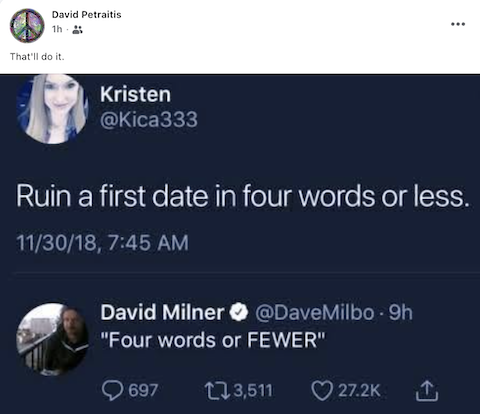
an oldie from the memebrary
Why “market prices” often make no sense: There are all kinds of explanations for why stock and commodity market prices defy logic, and how housing prices can be vastly higher than most residents could ever afford. But Art Berman (no relation to Morris, above) suggests these markets also exhibit the qualities of complex adaptive systems, invisibly incorporating information that the traders and pundits don’t know. Of course, the fact that ‘investors’ and speculators are often also ignorant, incompetent, and in denial of reality, is also a factor. Thanks to Paul Heft for the link.
Two reasons C-Pop/Mandopop is almost unknown in the west: One of the reasons is that Chinese musicians don’t need to navigate the hassles, denigration and corruption of the western music “industry” to become globally recognized stars. But this video suggests a second reason: That since Mandarin is a tonal language, it doesn’t lend itself to the normal rhythm and cadence of western (non-tonal) poetry and music. So international superstars like Jay Chou basically have to ‘half-mumble’ the words in their songs to sing western-style songs while avoiding sounding strange to Mandarin speakers!
You say all the words and you sing all the notes, but: Fellow Jerry’s Retreater Peter Kaminski has done an exhaustive research project analyzing how well AI performs writing exercises in different languages. He found that AI produces coherent sentences, and uses acceptable grammar, in most English and non-English writing. But stylistically in almost every language it comes across stylistically as wooden with ‘English-like’ structure and tone. Much of the problem, it seems, is that most of the data AI is “trained” on is in English. So AI just doesn’t know how to say something the way a Polish or Arabic speaker would say or write it, for example.
Too well written to be human: A problem related to the above is that, because of the mediocre quality of most English-language writing, programs designed to test whether something was written by AI are now pegging articles that were unusually well written by humans, as being AI, and even censoring or deleting them! Thanks to Paul Heft for the link.
A paean to continuous self-improvement: Caitlin Johnstone, in a departure from her usual writing, asserts that men need to work harder and strive continually to earn and sustain the love and respect of the women they love and care about, and eschew the Hollywood formula that it’s all about the initial spectacular public wooing and then it’s just happily ever after. Um, yes, but does it really have to be that hard?
The nature of reality, academically-speaking: Canadian Joe Bastarache is renowned for his short, layperson-friendly scientific insights on Facebook (example in Thoughts of the Month below). But his academic work is more impenetrable, I think solely because that’s what academe demands of researchers to sound smart and important. Here’s a long paper that basically argues that everything that exists (all-our-relations?) exists only by virtue of its relationships. Relationship comes first, and on that basis we ‘define’ ‘things’ by their relations. Thanks to Jae Mather for the link.
The moral paradox of extreme wealth: Two conflicting, intensely-reinforced conditioned messages inform our ‘moral’ beliefs: The first is the belief in fairness, justice, humaneness, and equality, and the second is the libertarian belief in personal freedoms and the right to live (relatively) free of unnecessary state-imposed restrictions. Put them together and you will end up paralyzed into inaction.
How social media provokes unwarranted fear and hate for profit: Barry Ferns looks at years of research of how attention-optimizing algorithms appeal directly to the amygdala by stoking fear and hatred against things that are utterly untrue or wildly misrepresented. And this is happening across the political spectrum. All to make money.
Research discovers huge tranche of neuroscience papers are just nonsense: Sabine explains how recent research basically debunked the validity of claims associating fMRI-measured increases in blood flow in areas of the brain with increased neuron activity in those areas, making as much as 40% of published neuroscience papers suspect. She also explains why papers across the whole field of psychology are likewise suspect, because the motive to publish papers outweighs the moral motive to acknowledge widely-known methodological and interpretational flaws in much of this research.
A woman’s co-working arrangement with a nest of wasps: They’re just sharing her office space for the season, each doing their own thing. Thanks to Siyavash Abdolrahimi for the link.
When despair overwhelms us: I’ve been reading Umair Haque’s critiques of the state of the world for nearly 20 years. His latest article reflects the darkness that I think can overtake a lot of people, especially humanists who have a basically positive view of intrinsic human nature, as the relentless and endless doom-scroll of atrocity, cruelty and stupidity makes us reconsider that humanist perspective. He concludes:
What makes me feel soul-sick is that the fire will die with us. That the average person is really willing to throw it all away, all five, ten, millennia of the sum total of human knowledge, just to have someone to hate, something to fuck, someone to kill, just for violence, greed, rage, death. And I don’t know how to bear that.
That’s the truth I can’t face. Maybe it’s the one you can’t face, either. I don’t know. I don’t think I have anything left to write about.
THOUGHTS OF THE MONTH
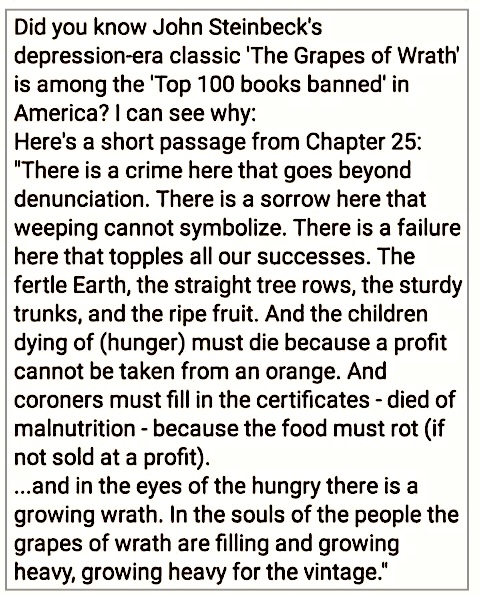
also from the memebrary; the book was written in 1939
From Joe Bastarache, from A Sense With No Object:
The fish moves through dark water inside a field of its own making, and what it knows of the world is how the world bends what it is projecting. There is no image, no sound, no object arriving from anywhere. There is only the shape of its own activity coming back altered, and the alteration is the information — the rock is never perceived, only the difference the rock makes. It is a strange kind of perceiving and it is the oldest one in the vertebrate line, and I do not think it is as unlike ours as it looks. We also learn what is there by finding out what will not give way, and we also would know nothing at all if nothing pushed back.
From Vincent Bevins, on the reasons despots press for “regime collapse” in foreign “interventions”:
The wholesale destruction of a society pushes down the costs of raw materials and labor. With no sovereign power, there are no barriers to extraction. Desperate people are easier to exploit. And there is no government left to be in alliance with your enemies or challenge your power.
From the late Tom Robbins, in an interview in Seattle in 2007:
Our lives are not as limited as we think they are; the world is a wonderfully weird place; consensual reality is significantly flawed; no institution can be trusted, but love does work; all things are possible; and we could all be happy and fulfilled if we only had the guts to be truly free and the wisdom to shrink our egos and quit taking ourselves so damn seriously.
From Loren Eiseley, in The Immense Journey:
Out of the choked Devonian waters emerged sight and sound and the music that rolls invisible through the composer’s brain. They are there still in the ooze along the tideline, though no one notices. The world is fixed, we say: fish in the sea, birds in the air. But in the mangrove swamps by the Niger, fish climb trees and ogle uneasy naturalists who try unsuccessfully to chase them back to the water. There are things down there still coming ashore.