

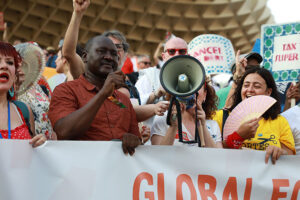







words on a T-shirt I saw recently; pretty much sums up what the pols and their media are trying to do to our minds, I think
Things can change. So Cory Doctorow reassures us:
[In] Thomas Piketty’s 2013 Capital in the 21st Century, [he introduced] the notion that any societal condition that endures beyond a generation becomes “eternal” in the popular consciousness… [This] is a vital observation about the human condition: as a species, we forget so much. Something that was commonplace a generation ago becomes unimaginable today, and vice versa… Things that seem eternal and innate to the human condition to you are apt to have been invented [not long] before you started to notice the world around you, and might seem utterly alien to your children. As Douglas Adams put it:
Anything that is in the world when you’re born is normal and ordinary and is just a natural part of the way the world works. Anything that’s invented between when you’re fifteen and thirty-five is new and exciting and revolutionary and you can probably get a career in it. Anything invented after you’re thirty-five is against the natural order of things.
What Cory seems to be saying is that even if the government of the day seems hopelessly awful and the situation seems utterly chaotic and collapsing, things can change in ways we can’t and daren’t imagine.
Of course, this is true. Everything may be determined, but nothing is predictable. Black swans come in a range of forms, from apocalyptic to rapturous. Circumstances change, in ways we can’t imagine or control, and they can change everything.
What I’m hearing a lot these days, from friends and contacts all over the world and across the political spectrum, is the weary assertion that anything would be an improvement over what we’re dealing with now. My sense is that that belief is often rooted in an ignorance of history, and/or in Cory’s observation that we forget so much.
Forgetting can be the essential ingredient in healing. And it can also be the essential ingredient in inaction, in complacency, in unwarranted hopefulness, and, too often, in enabling recurring cycles of error, and of tyranny.
COLLAPSE WATCH

El Niño is waking up and is forecast to return with a vengeance this summer, reaching full intensity in winter 2026-27; from NOAA via Severe Weather Europe
Rate of global warming increase is doubling: The latest analysis by James Hansen suggests that the global warming rate is accelerating and we will hit 2ºC of warming by the late 2030s (ie in a decade or so), and 6ºC of warming before the end of the century. If economic and political collapse haven’t completely undone our civilization by then, that will be more than enough to finish it off.
First, the economy: Tim Morgan explains again why it will be economic collapse that will precipitate the collapse of the rest of our civilization’s systems.
The return of El Niño: As the chart above illustrates El Niño is expected to return this summer and will probably make next winter, and both 2026 and 2027, the hottest on record.
Entering an era of “water bankruptcy”: Just one more sign there is now not enough (of any essentials for life) to go around, and the situation is rapidly worsening.
Detoxing from “hope porn”: The flowery “we can do this and we have to, for our childrens” absurd, unrealistic reassurances from people like Rebecca Solnit, Ezra Klein, a host of neoliberals, and even Greta Thunberg hold out false hope and pacify us into magical thinking, when the only effective activism now is climate realism. Thanks to Paul Heft for the links, and the one that follows.
How “recycling” plastic makes it worse: An entropy scientist explains the myth of the circular economy, and that much of our society’s environmental damage is essentially permanent.
Why the economy hasn’t crashed — yet: Hank Green provides his theory, and explains how this has made the economy horrifically unstable and vulnerable, created an unprecedented Ponzi bubble, led to unprecedented political and economic corruption, and radically redistributed wealth to the ultra-rich from everyone else, and then discusses it with economist Kyla Scanlon (whose blog I just added to my RSS feed).
LIVING BETTER

I have used this for years in just about all my creative writing — even in poetry and especially in dialogue; from the memebrary
Ways of Seeing: John Berger’s extraordinary 7-essay series produced for the BBC in 1972 on how we “see” western art and images, and how the misogynistic and capitalistic message of western art and now of graphic advertising has (not really) shifted since the Renaissance, is now on YouTube and the derivative book is online.
Secure your own mask first: Advice from Tod Maffin on dealing with the endless doom news cycle when you’re also dealing with substance addiction and/or emotional challenges.
Breaking free from the Big Tech Oligarchy: A step by step guide to switching to alternatives to Facebook, Google, Apple, Microsoft, Amazon, XTwitter, and the rest of the abusive gang. Thanks to Emily van Lidth de Jeude for the link.
A different kind of red hat: Opponents to ICE have taken to wearing red toques with a long history of anti-fascist resistance behind them.
How resistance to the ICE paramilitary looks on the ground: A reporter describes the endless hard work involved in alerting people to, and resisting, Trump’s domestic storm troopers. Thanks to Kavana Tree Bressen for the link.
POLITICS AND ECONOMICS AS USUAL

screencap from a video of a delivery robot steering around a homeless man; pretty much says it all; Google has now censored this video from YouTube but I found it here thanks to Caitlin’s post
“America is unraveling”: Under the mad king and an impotent opposition and crumbling judiciary, “there is no point fearing an American dystopia to come: It has already arrived and we live in it.” And “the American imperium [is] sliding into ever-accelerating decline—at home and abroad—and taking the Constitution and ordinary citizens down with it”. As ‘leaders’ mumble, a ragtag resistance emerges when there is no other choice: “Organized gangs of wine moms” take to the streets: “the messages flash by in the ever-expanding network of groups. Someone needs food, someone needs shelter, someone needs diapers, formula, someone needs a lawyer. And the ask is answered. For a moment, the need is met”.
...and threatening the rest of the world as it goes down: Trump declares economic war on the rest of the world (except Israel, its only remaining ally). The deranged, childlike missive of the king to all international heads of state. Danish MP Rasmus Jarlov says that if the US military invades Greenland, “it would be a war, and we would be fighting against each other.” Canada’s PM says Trump’s actions represent “the death of the rules-based order“. In China, Canadian ex-pat Daniel Dumbrill and US ex-pat Ben Norton explain what this means for the acceleration of multipolarity to fill the crumbling Empire’s void. At Davos, an incoherent rambling Trump and back-room talk and front-stage warnings from the rest of the world.
… and a different take from the astonished Global South: Indrajit says the “civil war” that Trump has unleashed within White Empire is great news for the Global South, and that Canada, Europe, and Australia have shown their true ‘Empire is fine as long as we’re benefiting from it’ stripes.
Imperialism, Militarism & Fascism: Short takes:
- Three Shots — a song for Renée Good (thanks to Brent Bolton for the link)
- Plurality of Americans want ICE completely abolished
- The abortive US “Board of Peace” — an “abomination” to replace the UN
- Bannon calls on ICE to “swarm” and intimidate voters at polls during midterm elections
- Bessent’s “economic statecraft” is just illegal economic warfare
- A new, thorough explanation of how the US dollar ‘system’ is used to sow global political and economic disorder (via Cory Doctorow)
- Oops, Sy: The usually-unimpeachable Sy Hersh gets it all wrong on Russia
- Is Türkiye playing both sides in the cold war between US-Israel and Iran?
- In case you’d forgotten, the genocide of Palestinians in Gaza and the West Bank continues unabated
- The US’ deliberately unnavigable, monstrously complex immigration process
- The atrocity of Canada’s publicly-funded “Catholic” hospitals denying constitutionally-guaranteed and humane MAID continues
- Canada’s white supremacy movement, encouraged by the country’s two main right-wing extremist parties, the Conservative and People’s parties, and largely dismissed by the media as a tiny fringe, has cynically tapped into and whipped up public fear and frustration, to the point this highly centralized, militarized, racist movement now poses a serious threat to Canadians, especially those of South Asian and First Nations ancestry. Just ask the reporters facing death threats and other dangers for trying to investigate them.
Propaganda, Censorship, Misinformation and Disinformation: Short takes:
- How Iranians and ex-pats are being led by the nose by US/CIA/Mossad propaganda
- The US openly admits they, with the CIA and Israel, are funding, planning, organizing, propagandizing, and fomenting the violence in the streets of Iran
- Yanis walks a fine line on the chaos in Iran
- While “the [US-Israeli] tag-team failed to overthrow the regime in Iran, it surely has not given up on that goal, and there is good reason to think that Israel and the US did not ‘win’ the 12-Day war”.
Corpocracy & Unregulated Capitalism: Short takes:
- Fascinating take on how Ireland exploited international tax loopholes for temporary prosperity, for better and for worse, and how it could be a model for global “de-enshittification”
- How grocery oligopolies use lease agreements to prevent local groceries from opening
- Canadian companies in billionaire Jim Pattison’s empire, and Canadian companies Hootsuite and Roshel, are getting pushback (but nothing more) for selling properties and weapons to ICE
- Billionaires are pulling out all the stops to defeat a proposed California wealth tax
- How stock buybacks enrich billionaires and impoverish everyone else
- Musk’s Starlink satellites have to make 400 “course corrections” a day to avoid collisions that could cascade and fill the atmosphere with debris that would make future space travel impossible
- The horrific state of predatory pricing in the sports and entertainment industries
- The fight against Trump’s lunacy has to include punishments for the corporate oligarchs egging him on (the article also has interesting advice on how Europe in particular could fight back by tanking the US stock market, divesting from US bonds, exploiting the Trump regime’s weak information security, and preparing to defend against and retaliate for US military attacks)
Administrative Mismanagement & Incompetence: Short takes (I could have included every link about Trump in this section):
- A brilliant spoof of the staggering incompetence of Ursula von der Leyen
- A lovely rant from Aurélien on how to ‘manage’ incompetent and mentally deficient ‘leaders’: “Mr Trump’s antics are not the fundamental problem: he is a natural consequence of a state machine that no longer functions.”
- When will Trump attack Iran?: “the enemy cannot know your plan, if you do not know your plan.”
- Gavin Newsom’s biggest problem is Gavin Newsom
- Could Trump be removed under the US 25th amendment before his mental illness causes disaster?
Department of Health Prevention: Short takes:
- Emails obtained under FOI releases reveal that RFK Jr lied under oath and to Congress about his trip to Samoa, where he was promoting his anti-vax conspiracy theories just before thousands fell ill from a huge measles outbreak there in which 83, mostly children, died. Congress shows no signs it is prepared to remove the lunatic from office before he does further damage. Democratic party leaders are opposed to the latest impeachment motion.
- 50 media articles criticizing RFK Jr’s disruptive anti-science interference in public health management in his first year as health secretary
FUN AND INSPIRATION

that’s the US Democrats for you — ignore the devastation and just foment righteous indignation until they get their turn back at the trough; Lee Camp is a comedian and an astute political commentator
What we mean by “science”: It isn’t theory or hypothesis. It’s something much more important. (Hank Green)
Why AI music (like Suno) is bad for musicians: Adam Neely gets it right, when it comes to the damage these tools, and the greedy corporate assholes behind them, will do to music professionals and the “industry”. But what he doesn’t acknowledge is that AI music is a wonderful tool for amateur musicians, a very useful learning tool, and enormous fun. Should we still ban it?
The making of the Beatles’ A Day In The Life (and Jimmy Webb’s Wichita Lineman): David Hartley provides a fascinating, step-by-step walkthrough of the process of collaborative musical genius that resulted in the Beatles’ masterpiece. And as an encore, here’s David’s explanation of the strange process that produced another masterful song, Jimmy Webb’s Wichita Lineman. Bonus: If you want to understand how well-crafted music can make you cry, check out David Bennett’s chord-by-chord analysis of the unusual and evocative structure of Jimmy Webb’s remarkable song. These are two examples of brilliantly, imaginatively composed, masterfully crafted, popular musical works, the types of works that no AI will ever be able to produce. And, sadly, the types of works that the oligarchic pop music “industry” almost never produces anymore.
THOUGHTS OF THE MONTH

cartoon by the incomparable Kansas-based cartoonist Grant Snider
From Arundhati Roy: War Talk
Our strategy should be not only to confront empire, but to lay siege to it. To deprive it of oxygen. To shame it. To mock it. With our art, our music, our literature, our stubbornness, our joy, our brilliance, our sheer relentlessness – and our ability to tell our own stories. Stories that are different from the ones we’re being brainwashed to believe.
From Robinson Jeffers: Shine, Perishing Republic:
While this America settles in the mould of its vulgarity, heavily thickening to empire,
And protest, only a bubble in the molten mass, pops and sighs out, and the mass hardens,
I sadly smiling remember that the flower fades to make fruit, the fruit rots to make earth.
Out of the mother; and through the spring exultances, ripeness and decadence; and home to the mother.
You making haste haste on decay: not blameworthy; life is good, be it stubbornly long or suddenly
A mortal splendor: meteors are not needed less than mountains: shine, perishing republic.
But for my children, I would have them keep their distance from the thickening center; corruption
Never has been compulsory, when the cities lie at the monster’s feet there are left the mountains.
And boys, be in nothing so moderate as in love of man, a clever servant, insufferable master.
There is the trap that catches noblest spirits, that caught – they say – God, when he walked on earth.
From Li-Young Lee: To Hold:
So we’re dust. In the meantime, my wife and I
make the bed. Holding opposite edges of the sheet,
we raise it, billowing, then pull it tight,
measuring by eye as it falls into alignment
between us. We tug, fold, tuck. And if I’m lucky,
she’ll remember a recent dream and tell me.
One day we’ll lie down and not get up.
One day, all we guard will be surrendered.
Until then, we’ll go on learning to recognize
what we love, and what it takes
to tend what isn’t for our having.
So often, fear has led me
to abandon what I know I must relinquish
in time. But for the moment,
I’ll listen to her dream,
and she to mine, our mutual hearing calling
more and more detail into the light
of a joint and fragile keeping.