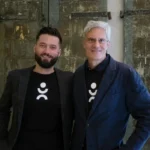





Montréal-based startup Onix has raised $5 million USD ($6.9 million CAD) for an app that offers a library of health and wellness advice, provided by AI versions of practitioners chosen by the company.
Onix announced on Wednesday that its pre-seed convertible note round was led by Los Angeles-based AlphaEdison, with participation from Kitchener-Waterloo’s Garage Capital, New York-based Ride Home Fund, United Talent Agency co-founder Jeremy Zimmer, and Jean-Sébastien Cournoyer, the co-founder of Montréal’s Real Ventures.
“We don’t want our users’ data. We don’t have a data bottleneck because our experts bring us all the data.”
Nicholas Nadeau, Onix
Founded in 2025 by exited founders David Bennahum and Nicholas Nadeau, Onix is a consumer-facing AI app focused on health and wellness advice, which the company calls personal intelligence. Users can pay to access chats with AI versions, or “onixes,” of health and wellness practitioners, from psychiatrists to former elite athletes and holistic nutritionists, who are working with the company.
Onix is betting that users will pay for always-on access to personalized advice that generative AI can provide, while keeping more control over their personal chat data than consumer AI apps like ChatGPT. However, Onix does not provide medical advice, Nadeau said, and the company says it has guardrails to avoid outputs that would stray into that territory.
Nadeau was previously the CTO of 1X—the maker of those Neo humanoid robots—and then data labelling company SmartOne, giving him a front-row seat to the datasets that large frontier labs were training their AI models on. Bennahum, a former contributing editor at WIRED and himself a serial entrepreneur, moved to Canada from the US in 2017 and met Nadeau through a mutual friend.
To the founders, Onix’s approach is the antithesis to the dominant model of big tech, where products are free, but rely on users providing vast, constant streams of data about themselves. Instead of training AI models on reams of data, the early-stage company works with wellness content creators who give permission for Onix to train chatbots on their work and advice.
RELATED: Kodeon acquires mental wellness app Breethe in largest acquisition to date
“We don’t want our users’ data,” Nadeau said in an interview with BetaKit. “We don’t have a data bottleneck because our experts bring us all the data.” Instead, health and wellness content creators—whose fields range from addiction recovery to longevity—are invited by Onix to join the platform and contribute their work in exchange for a revenue share determined by the number of users subscribing to their AI onixes.
The “experts,” whose credentials vary, help craft an AI version of themselves, using public appearances like podcast recordings, as well as unpublished works they share with Onix. Some of the available AI onixes include psychiatrist and author David Rabin, and family nurse practitioner Ashley Shrader. The wellness practitioners, who set the subscription fees, get 70 percent of subscription revenue from their AI chatbots while Onix takes 30 percent. AI onixes can be added into group chats with each other as well as with other humans, like friends and family, who have subscriptions.
In addition to the unique data model, Onix says it trains smaller models and prioritizes data privacy. Bennahum claimed that its inference costs are “one two hundredths” of a frontier model. All chat data is stored locally on users’ devices, and no conversation logs are kept. Since the small AI models are run locally, there is no mechanism for any data to make it back to a data centre, here or abroad, Bennahum said.
“In this climate, AI is the most disliked new technology ever polled, probably since atomic weapons.”David Bennahum, Onix
Bennahum is attuned to how widely AI is mistrusted by consumers right now. A 2025 poll found that 83 percent of Canadians had worries about AI and privacy; another poll in May found that 46 percent of Canadians have asked an AI chatbot for medical advice, though 40 percent believed it would make Canadian healthcare worse. “In this climate, AI is the most disliked new technology ever polled, probably since atomic weapons,” he said. “And I think rightfully so, given the abuse being committed by so many of these frontier companies.”
Onix’s stated focus on trust and data privacy is partly a response to that consumer sentiment. Building the company under Canadian privacy law, Bennahum added, has helped the brand.
“Brand Canada has a level of trust,” Bennahum said. “And we believe trust is at the centre of the future of AI.”
The 10-person company is hiring four more roles, mainly in GTM and sales, as it launches a paid model this week for individual users. The Onix app is available in early access for iOS users, and they hope to launch it more widely later this year.
Feature image courtesy Onix.
The post Onix raises $5 million USD to create AI library of health and wellness “experts” first appeared on BetaKit.