







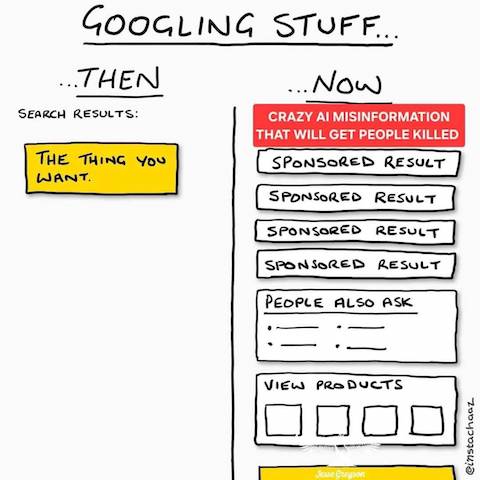
drawing by Chaz Hutton
Now that the internet has degenerated to a sad mishmash of spam, scam, propaganda, disinformation, useless ‘apps’, and commercial fraud, with a new overlay of AI slop, the question becomes how to best get what we used to get from the internet, through workarounds. Preferably before the stench of the internet’s rotting corpse gets too much worse.
Of course the tech bros and their billionaire buddies and corporate oligopolies have thrown everything they can in our paths to prevent this. Through the now thoroughly-documented process of enshittification, they suck us in and lock us down, making it almost impossible to escape their expensive rent-seeking flea market without also losing our links to friends, family and networks, and our held-hostage libraries and content. So what used to save us time, now consumes hours of wasted time navigating the junkyard of sites and apps littered with unwanted, deceptive, and totally fraudulent crap.
As someone both fascinated and appalled by AI, I wondered whether this new ‘tool’ might not just flood the pathetic remains of the internet with additional oceans of garbage, but also, just maybe, provide us with a way to work around it, to get what we want without having to actually go into it. Let the AI do the garbage-scouring for us.
The possibility for this started to become clear as AI quickly challenged, and then largely rendered obsolete, the enshittified search engines that served as our main ‘portals’ into the internet. Why use the ad-cluttered, disinformation-ridden, almost-unnavigable search engines satirized in the image above, when AI will (1) give us what we’re looking for much faster, more easily, and more accurately, and (2) cite the sources for its answers so we can check out AI’s veracity directly without having to search for it.
The big corporations and purveyors of disgusting and lying ‘marketing’ crap are absolutely terrified just of this development. The SEO vendors have slued furiously to abandon attempts to ‘influence’ (ie bias and misinform) search result rank, and are now developing tools that ‘optimize’ their corporate customers’ appearance in AI results. If we’re not careful, and fast, they’ll get away with that, and AI query results will quickly be enshittified to be as horrible as search engine results.
But, at least for the moment, the open-ended nature, and immense power, of AI tools might offer another opportunity.
| Suppose we developed ways to use AI to curate our networks and feeds and summarize them, with supporting links, so we completely avoid ads, clickbait, and misinformation — so they just deliver to us, ‘clean’, exactly what we want, and nothing else? |
So AI could maintain a personal, editable, categorized list of ‘trusted people’ and ‘trusted information sources’ for us, and use it as a filter for all our AI queries. So that if I asked the AI tool “What are my closest friends up to?”, or “What do my trusted sources say about the situation in Sudan (or about the subject of free will)?”, or even something subtler like “Any health issues among my family or friends?” or “What are my trusted sources, and my friends’ trusted sources, saying about whether multipolarity and the end of US hegemony, and the end of USD dominance, are actually happening, or are just wishful thinking?”
The AI could then scour the wasteland of social media, all the blogs, RSS feeds and other sources for us, and just give us what we’re looking for — in seconds. With links if we wanted more right from the ‘horse’s mouth’. Never again would we have to enter the polluted waters of Farcebook or XTwitter. Put your update on your own site, anywhere, and everyone who you want to find it, and who wants to find it, will find it.
To use an analogy, AI hence becomes our ‘shopper’ not just our ‘delivery service’. We don’t have to deal with the flyers, the salespeople, the ads and marketing hype, the mis- and disinformation, and all the clutter of online ‘billboards’ trying to sell us crap (products and ‘what you need to know’ lies). Our AI ‘shopper’ takes our list, asks clarifying questions if needed, navigates the horrors of the web, and returns to us with just what we want.
Or, to put it another way, we can re-disintermediate the internet (as it was originally designed to be) by using our own intermediary to sidestep all the rent-seekers, profit-seekers, and deceptive ‘marketers’ of everything standing in the way of, and all around, what we actually want to see.
Sabine Hossenfelder has a new video about the ‘dead internet’, explaining what’s happening as the internet becomes more and more focused on producing content for use by ‘machines’ (AI etc) and less and less focused on producing content for use by people.
I think the curation-and-re-disintermediation idea is an interesting possibility, but we should recognize that this will just be another skirmish in what is likely to be an extended war. Most (but not all) of the current AI tools are owned by rent- and profit-seeking private corporations, most of them desperately unprofitable and not long for this world if they can’t monetize their staggering investments. They are going to fight this with everything they have, including putting ads on and in AI responses, and restricting what we can ask ‘their’ AI agents to do for us that might restrict their buddies’ profits.
But this current crisis is the perfect metaphor for the collapse of our entire civilization. The internet has become increasingly dysfunctional and useless as it’s grown larger and more complicated and corrupted. If it’s not dead already, it soon will be. The question is, will we be able to salvage what’s useful in it, and ignore the graveyard of corporate and political and AI garbage and mountains of clutter? Or will we just walk away from it and leave it to rot?
It’s going to be interesting to watch.