








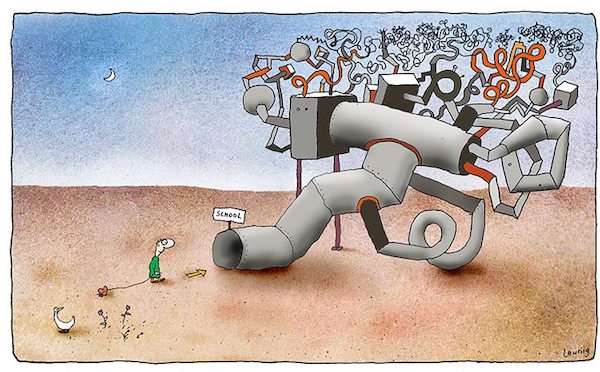
cartoon by the late Michael Leunig
There goes a chunk — the sick and aged along with the huge apparatus of doctors, social workers, hospitals, nursing homes, drug companies, and manufacturers of sophisticated medical equipment, which service their clients at enormous cost but don’t help them very much.
There go the college students along with the VPs, provosts, deans and professors who have not prepared them for life in a changing world after formal schooling is over. There go the high school and elementary school students, along with the parents, administrators and frustrated teachers who have turned the majority of schools into costly, stagnant and violent babysitting services.
There go the lawyers and their hapless clients in a dust cloud of the ten billion codes, rules and regulations that were produced to organize and control an increasingly intricate, unorganizable and uncontrollable society.
There go the economists with their worthless pretentious predictions and systems, along with the unemployed, the impoverished and the displaced who reaped the consequences of theories and schemes with faulty premises and indecent objectives. There go the engineers, designers and technologists, along with the people stuck with the deadly buildings, roads, power plants, dams and machinery that are the experts’ monuments.
There go the advertising hucksters with their consumer goods, and there go the consumers, consumed with their consumption. And there go the media pundits and pollsters, along with all those unfortunates who wasted precious time listening to them explain why the flywheel could never come apart, or tell how to patch it even while increasing its crazy rate of spin.
The most terrifying thing about this disintegration for a society that believes in prediction and control will be the randomness of its violent consequences. The chaotic violence will include not only desperate ruthless struggles over the wealth that remains, but the last great violation of nature. What will make it worse is that, at least at the beginning, it will take place under a cloud of denial and cynical reassurances.
— David Ehrenfeld, Beginning Again (1994)
My friend Paul Heft sent me a fascinating video about all the problems that have arisen in our current public education systems, and why none of them is the ‘fault’ of teachers. It’s an interview with C Derick Varn, a much-travelled poet, philosopher and educator well-versed in issues of pedagogy.
The problem (actually the predicament) is that all human-made systems, as we try to scale them to accommodate more people and more diverse needs, eventually become so complicated that they become unsustainable, and become first dysfunctional, then sclerotic, and finally collapse of their own weight. We see this in our political systems, in centralized economic and financial systems, in our transportation, education, ‘security’, health ‘care’, in large corporations, institutions, and ‘administrations’, and every other system that was designed, with the best of intentions, to effectively and efficiently provide public services and goods. Back in the days when we were citizens, not mere ‘consumers’.
In recent years these systems have been bandaged together, subject to innumerable management consultants’ “process improvement” processes, made even worse by being even more centralized, opportunistically “privatized”, offshored and outsourced to save money, and, most recently, automated, using “self-help” replacements for irreplaceable human functions, and technologies varying from canned videos to AI “assistants”. Each of these bandaid solutions has made these systems less functional, less effective, harder to navigate and maintain, and ultimately even more expensive. Most of these systems are now in various stages of sclerosis and collapse.
But it is not in our nature, or within our competence, to just let them collapse and to invest instead in new, small scale alternative systems that revisit and reflect the original needs that the collapsing systems were designed to meet. We just can’t admit that these broken systems cannot be “fixed”. We can’t admit that all this fantastically expensive infrastructure we’ve invested in over the years is ill-suited and mostly useless for what is needed now. We (mostly progressives) can’t admit that government no longer has the resources to continue to bandaid the broken systems, that these bandaid fixes increasingly don’t work, and that throwing more money at them won’t help. And we (mostly right-wingers) can’t admit that privatizing them usually makes them more bureaucratic and much more expensive, less responsive to real needs, and more dysfunctional as their goal becomes maximizing investor profit, not meeting needs.
This disastrous situation has resulted because all human-designed systems are inherently complicated (massively so). Like an automobile, they require tons of maintenance (more and more as they get larger and older), and inevitably break down and finally collapse when it becomes impossibly difficult to fix them reliably. Complicated, human-made systems have very little resilience or redundancy. They’re unintentionally built to fail, and these days they fail sooner and sooner. Not deliberately. That’s just the nature of complicated systems.
Nature, by contrast, has evolved organic complex systems. They have evolved over millions and billions of years of trial and error to be massively resilient and contain multiple levels of redundancy (eg the number of seeds a plant produces to reproduce itself). We humans are intellectually incapable of designing truly complex systems — we haven’t the millennia of acquired ‘knowledge’ to learn how to respond to the untold number of circumstances that such systems have evolved to respond to. And we don’t have the resources (material or financial) to actually construct such a system, even if we had the competency. And AI systems, like other human-designed systems, are inherently massively complicated (essentially digital and electromechanical). They are not complex, and will merely exacerbate all the problems of our collapsing human-made complicated systems, not ‘solve’ them.
The above-linked video is a perfect case in point of how massively-complicated systems reach the point at which they will inevitably collapse. It explains how our public education systems, despite tons of competent, earnest, diligent, dedicated teachers, are now in the advanced stages of collapse. They cannot be ‘rescued’ by privatization (that will just make things worse, as the atrocious ‘for-profit colleges’ have amply demonstrated), or by pouring more money into them to ‘reform’ them. These systems cannot be fixed. Like with a broken-down old car, we have to let them go, and find a new way to meet the needs they once served. But we are so utterly invested in them, financially, emotionally, structurally, and philosophically, that doing so is almost unthinkable. With all of civilization’s systems in collapse, we can’t afford to abandon them and create something new, for a start, even if we could figure out how to do so when these systems are inextricably linked to all of our civilization’s other teetering, increasingly dysfunctional systems.
The collapse is therefore inevitably going to be awful. As they inevitably fall apart, the most likely replacement for these systems, when we walk away from them, is nothing at all. When we realize that our public education systems have devolved, despite educators’ best efforts, to being merely useless and expensive baby-sitting services, they will simply be abandoned. Eventually, after our economic systems have all collapsed and cities and other useless constructions of our civilization have been abandoned, we will need to find effective ways to teach and learn and mentor the essential skills needed by post-civ societies. We can’t begin to predict or even imagine what those skills will be, since we don’t know where we will be and what will and won’t be available and needed when that time comes. Forget ‘designing’ them, as much as humans love to design stuff. They will evolve, driven by the local needs of the moment, not be designed and built.
Some of the key points Derick makes in this video that reinforce this grim reality:
- The decline in learning in public education is an international problem, especially in affluent nations. It’s not correlated with prevailing national education ‘principles’, or teacher quality, or education system budgets.
- It starts with students, their upbringing (less literate parents produce less literate children), their plummeting attention spans (from average 30 minutes in 1950 to average 2 minutes today), commensurate inability to concentrate and focus, declining cognitive and critical thinking ability, social fragmentation, lack of motivation, less participation in interactive learning experiences outside of school, and widespread distrust of everything students are told.
- Adults now have an average of a 7th-grade level of literacy, and a median 5th-grade level. That’s down two grades in just a generation.
- Because honest assessment of learning would produce massive ‘failure’ rates that would hopelessly clog the system, ‘passing’ standards have plummeted, all the way up through university, and even valedictorians now often lack the literacy skills once possessed by most graduates.
- This is worsened by growing admin bloat as systems get ever-larger, by increased use of heavily-marketed, ineffective and misused tech tools in the effort to cut costs, and by increasing diversion of funds to for-profit ‘private’ and religious schools.
- AI is increasingly being used and promoted as effective and cost-saving (when it’s not), especially to right-wingers who have been propagandized to distrust teachers. AI tends to flatter users, does not allow development of nuanced and critical thinking, reduces conversational and interactive learning, and is often deployed as a cheap teacher substitute for poor and marginalized students, while elite schools move back toward ‘analog’ teaching, increasing the chasm of stratification between elite students (who are also in much smaller classes that allow more individual attention) and everyone else.
- Political polarization is leading to ever more watered down curricula, book bans, and parent-imposed ‘opt outs’ of critical learning subjects, so that children are not exposed to any challenges to ‘established’ thinking.
If you buy his assessment of the current state of the system, it’s pretty obvious that privatization is not the answer, that simply throwing more money at the existing system is not the answer, and that the system cannot be ‘reformed’ by tinkering or even overhauling it. The problem is not with the schools or their curricula. The entire system is broken.
As with all the other collapsing systems, the ‘solution’ the rich and powerful are trying to sell us on (with some success) is to dismantle it (privatize it, undermine it, starve it), so the “government” can wash its hands of it, and all the problems it faces. (There’s a direct parallel in their ‘solution’ to the health care crisis.)
So the rich and powerful will be able to buy their children (and themselves) a quality education, quality health care, quality transportation, and all the other quality services and goods that were once available to almost everyone through functioning public systems.
As for the rest of us, when you’re on a sinking ship, it’s everyone for him/herself, dontcha know? In our land of unlimited opportunity, if you’re not rich and powerful and smart enough to avoid drowning, it must be your own fault.
Couldn’t be the system, could it?