









Abstract: Monitoring and tracking 3I/ATLAS, the Solar System’s third confirmed interstellar visitor, has been one of the most exciting challenges to science in recent years. Since its presence in our skies was first confirmed by the NASA-funded Asteroid Terrestrial-impact Last Alert System (ATLAS) telescope at Río Hurtado, Chile, on July 1, 2025, there has been debate over whether it is simply a very ancient comet or an alien spaceship. The present author has proposed a third alternative (see Collins 2025), with this being that 3I/ATLAS is a directed comet, a sentient lifeform displaying clear intelligent actions.
If correct, then are directed comets able to broadcast information that is meant to be received, translated and understood by intelligent life on planets such as our own? On that basis, we look at 3I/ATLAS’s light variability cycle of 16.16 hours (+/- 0.01 hours) and find that it is strangely synchronized with the Earth’s 24-hour rotational cycle. This reveals the apparent importance of a unit of time measurement equalling 144 seconds, a value utilised by at least three ancient civilizations. This exercise additionally highlights the apparent significance of the number 196, the lowest so-called Lychrel number, which may possess a cosmological significance similar to the fine structure constant.
Key words: 3I/ATLAS, 404:600 whole number ratio, 144 seconds, ancient time measuring systems, the number 196, Lychrel numbers, fine structure constant, fractals, plasma environments, sentient lifeforms.
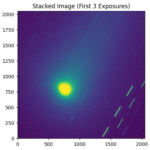
In July, a cycle of light variability of 16.16 hours (+/- 0.01 hours) was detected in connection with 3I/ATLAS (see Fig. 1). Initially, this was thought to have been caused by the rotation of an elliptical nucleus with an axis ratio of 0.8 (see Santana-Ros et al. 2025).
Observations of 3I/ATLAS since that time have made it clear that this interpretation of the comet’s light variability appears unconnected with the comet’s elliptical shape, as the changes are occurring as regular pulses emitted by the object’s diffuse coma. It has now been proposed that 3I/ATLAS’s periodic brightening is likely the result of jets being outgassed from localized ice pockets on the rotating nucleus, creating a kind of “heartbeat” (Loeb 2025b).
To date, no other detectable cycles have been reported in connection with 3I/ATLAS, making it difficult to determine whether its passage through the inner Solar System might contain interpretable data that could suggest a sentient nature.
With this knowledge, and assuming that there might indeed be intelligent data encoded into 3I/ATLAS’s journey, we will have to cast the net more widely to explore this possibility further. For this, we look at the relationship between the comet’s acknowledged 16.16-hour light variability cycle and the Earth’s solar day, which from one noon to the next is 24 hours in duration, this being equal to 1440 minutes or 86,400 seconds. (A sidereal day is 23 hours, 56 minutes and 4 seconds in length.2)
As a fraction, 16.16 hours becomes 16 4/25, showing that the entire value can be broken into 404 units, equalling 1/25th (i.e., 16/25th x 25 + 4/25th = 404/25th).
A false fraction totalling 404/25th suggests a time measurement equalling 1/25th of the original 16.16-hour light variability cycle, this amounting to 0.04 hours (404/0.04 = 16.16), that is 2 minutes, 24 seconds, or 144 seconds (16.16 x 60 x 60 = 58176 seconds/404 = 144 seconds).
The Earth’s daily rotation across the course of 24 hours is 600 of these same 144-second units of time measurement (i.e., 600 x 144 seconds = 86,400 seconds, that is 1440 minutes or 24 hours).
So whereas 3I/ATLAS’s light variability cycle of 16.16 hours consists of 404 units of 144 seconds the rotation of the Earth is 600 of these same units, showing that the whole-number ratio between these two cycles is 404:600, which can be reduced to 101:150.
A common year of 365 days is 8760 hours, that is 525,600 minutes or 31,536,000 seconds, which is 219,000 units of 144 seconds.3 From this, we find that 3I/ATLAS will complete 542 (actually 542.07920792) 16.16-hour cycles in one year.
As we see next, a unit of measure equalling 144 seconds features in the time keeping of at least three ancient civilizations well versed in astronomy and celestial cycles.
Ancient Chinese Timekeeping
In ancient China, 144 seconds was a unit of measuring time known as the minor kè (刻). The primary kè (大刻 or major kè) was 1/100th of a day (14 minutes and 24 seconds or 864 seconds), meaning it was equal to 6 minor kè (864/144 = 6).
The Mahāsāṃghika, translated into Chinese as the Móhēsēngzhī Lǜ (Taishō Tripiṭaka 1425. See Takakusu and Watanabe [1924] 1962), describes several units of time measurement, including a tánzhǐ (彈指), which is 7.2 seconds long, this being 1/30th of a minor kè of 144 seconds.
The text also describes a luóyù (羅豫), which is 2 minutes 24 seconds long, or 144 seconds, the same value as the minor kè. There is also the xūyú (須臾), which is 1⁄30th of a day or 48 minutes in duration; 48 minutes or 2880 seconds being equal to 20 minor kè or luóyù of 144 seconds.
Another ancient Chinese unit of measure was the gēng 更, literally meaning “rotation” or “watch,” which was 2 hours, 24 minutes in length or 144 minutes. This was the equivalent of 60 minor kè or luóyù of 144 seconds duration.
A minor kè of 144 seconds could be subdivided into ten parts, each 14.4 seconds in length. This was known as a fen (分) and was defined as 1⁄6000th of a day, which is 1/10th of 1/600th of a day composed of 600 minor kè. In some Chinese traditions, a fēn was not 1/6000th of a day, but 1/600th of a day, in other words, 144 seconds (See Fig. 1).
Figure 1. The ancient Chinese unit of measuring time known as a fen (分) shown in its relationship to the 24-hour day with 600 units per 1/10th of the day making 6000 in all. In some traditions the fen constituted 1/600th of a day, making each one 144 seconds in length. It is also worth noting that each internal angle of a 10-sided polygon is 144 degrees making 1440 degrees in total.
Hindu Timekeeping
In Hindu timekeeping, 144 seconds is the length of a kāla, and is associated with the process of dhyana, or meditation. According to yogic texts, holding the mind in unbroken focus on a single point for 12 seconds is defined as Dharana (concentration). Holding the mind on one thing for 12 Dharana, in other words, 144 seconds (12 x 12), enables the initiate to achieve a state of Dhyana.
If concentration is sustained for 12 times the duration of a Dhyana (that is, for 28 minutes and 48 seconds, or 1728 seconds), one can reach Samadhi, a state of higher enlightenment and absorption of the divine; 1728 seconds is equal to 12 kāla of 144 seconds.
In a separate system of Hindu timekeeping, a unit of measure called the Vighaṭi (also known as a vinādī) is equal to 24 seconds, meaning that 6 Vighaṭis would equal 1 kāla of 144 seconds.
A Ghaṭi (or Nadika) is 24 minutes or 1440 seconds, meaning that it is the equivalent of 10 kāla.
One Muhurta is 48 minutes or 2880 seconds in duration, the equivalent of 20 kāla.
Mayan Calendar
In the time keeping of the ancient Maya of Central America, 144,000 days (approximately 394 years) equalled one Baktun or Long Count; 144,000 days is 12,441,600,000 seconds or 86,400,000 units of 144 seconds.
1 Baktun was equivalent to 20 K’atun, each of 7200 days, meaning that each K’atun had a value of 648,000,000 seconds or 4,500,000 units of 144 seconds.
1 K’atun = 20 tun each of 360 days duration. This is 31,104,000 seconds, or 216,000 units of 144 seconds.
1 tun = 18 uinals of 20 days. This is 1,728,000 seconds or 12,000 units of 144 seconds.
1 uinal = 20 kin of one day in length, with this being 86,400 seconds or 600 units of 144 seconds.
The kin (day) was the minimum unit of time in the Maya’s primary calendrical systems, which is also found in inscriptions.
The fact that from China to South Asia across to Central America, we find timekeeping systems that all involve fractions, multiples or actual measures equalling 144 seconds, suggests a common root in the distant past, one whereby the day was split into 600 parts of 144 seconds. A breakdown of a day in this manner conforms with the Babylonian sexagesimal system of counting time, which is base-60. In this system, 600 is 10 x 60, which divides a 24-hour day into 10 equal parts, each 2.4 hours in duration, this being 144 minutes, 8640 seconds, or 60 units of 144 seconds. As previously mentioned, 2.4 hours is a traditional Chinese timekeeping unit called a gēng (更), which equals one-tenth of a day.
The fact that 404 of these same units, the equivalent of 16.16 hours, accurately records the light variability cycle of 3I/ATLAS is highly intriguing and could suggest a deliberate synchronization with the Earth’s 24-hour rotation cycle.
The equivalent of 16.16 hours in minutes is 969.6, which as a fraction can be written 969 3/5th or as a false fraction as 4848/5th. As an integer, 4848 can be broken down into units of 101, providing a unit of measure equalling 48/5th, that is, 9.6 minutes or 576 seconds, the equivalent of 4 x 144 seconds. There are precisely 54,750 of these units of 576 seconds in a common year, 101 in the rotational cycle of 3I/ATLAS and 150 in a 24-hour day. In Hindu yogic practices, holding the focus of the mind on marma-sthana, the name given to the vital energy points of the body, for a period of 576 seconds enables the initiate to enter the realm of pratyahara (Tigunait 2017, 256). A pratyahara is made up of 12 x 48 seconds, with 48 seconds being 1/3rd of 144 seconds.
Whether any of this is relevant to the numbers generated by the rotational cycle of 3I/ATLAS depends on whether it can be accepted that the object’s 16.16-hour light variability has a harmonic relationship with the Earth’s rotational cycle. If this really is the case, the question becomes whether or not some importance should be attached to the whole number ratio 101:150, reflecting the synchronization of both objects, or to its higher form of 404:600, implied by the employment of a unit of measure equalling 144 seconds.
The number 144, as well as multiples of this figure such as 144,000, feature heavily in ancient cosmological and mythological traditions from around the world, where it invariably relates to long-term time cycles associated with the movement of the Sun and Moon, along with eclipse cycles (see Collins 2017). A value of 144,000 also appears in the book of Revelation 7:4, where it says: “Then I heard the number of those who were sealed: 144,000 from all the tribes of Israel.”
Of course, 144 is 12 x 12. 144 is also the 12th number in the Fibonacci sequence.
In addition to this, 144 feet features in the measurements at Stonehenge and its relationship to nearby Durrington Walls, with it being the wavelength of a musical harmonic in the range of 7.815 Hz (Collins 2020). This is well within the infrasound range, something that has been recorded in connection with the interior acoustics of Stonehenge (for more on this, see Collins 2024).
The 196 Problem
Turning our attentions now to the whole number ratio of 404:600, we can see that by subtracting 404 from 600, we arrive at 196 (i.e., 600 – 404 = 196, or 404 + 196 = 600). (See Fig. 2.) This is a very important number in computational mathematics, where it is known as the 196-algorithm or the “196 problem,” since it is the best candidate for a so-called Lychrel number. This refers to a mathematical problem that computer programmers have been attempting to solve since the 1960s, which is to find the lowest integer that through a process of adding itself with its reverse form, then adding these together and doing the same, and so on so forth, you will eventually end up with a palindrome, that is a mirrored numbered like 11, 111, 121, 141, 212, 242, etc. It has been determined that 196 is likely the lowest valued integer that, no matter how many computations are made, does not become a palindrome.
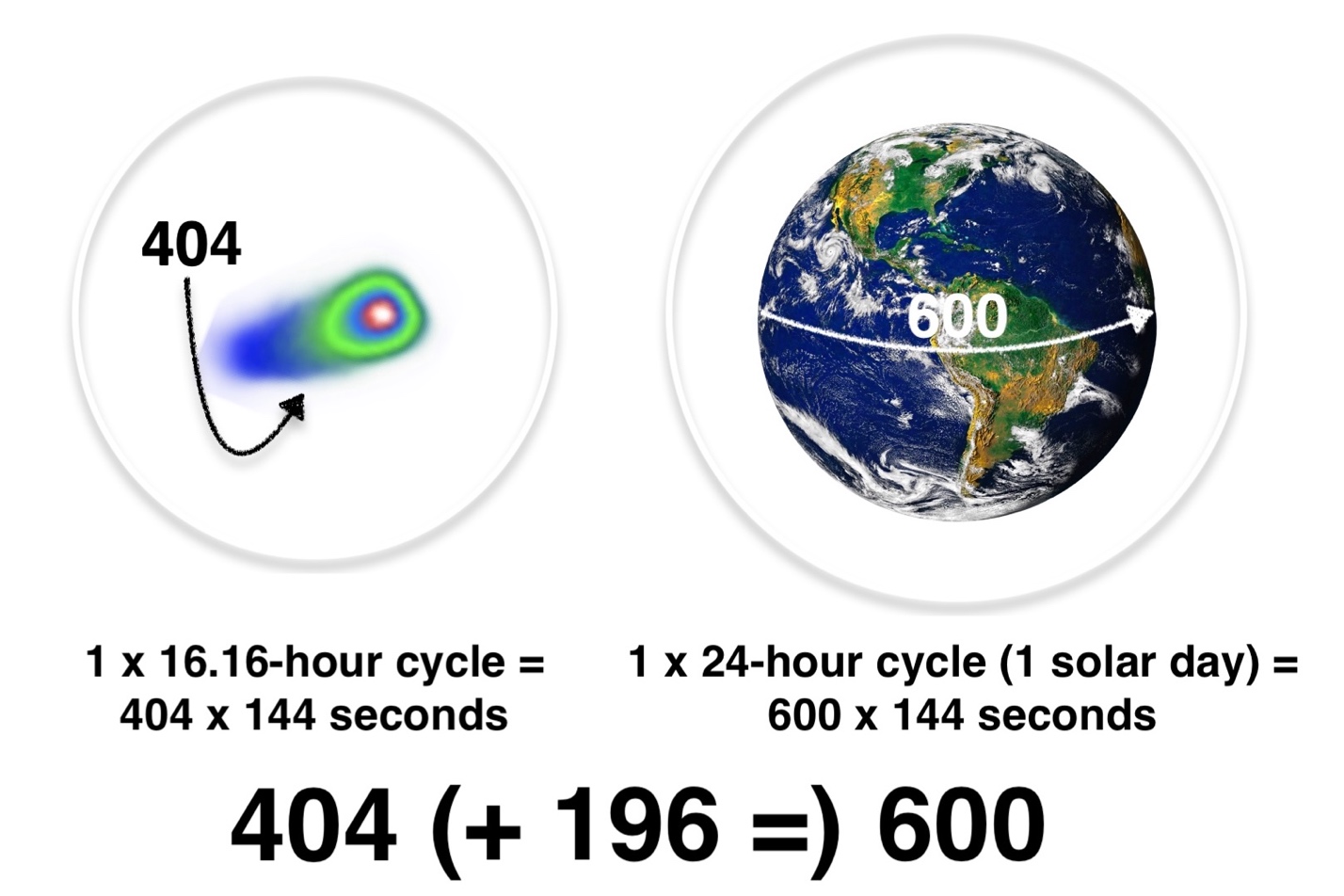
Figure 2. Left, 3I/ATLAS (credit: David Jewitt/Jane Luu/UCLA), and right, the Earth (credit: NASA/PD-USGov)
In 2011, a billion iterations were used by computer programmer and developer Romain Dolbeau to show that 196 still could not be made into a palindrome, and in doing so, this produced a number with 413,930,770 digits. Then, in February 2015, Dolbeau again attempted the same computation, this time reaching a billion digits without changing 196 into a palindrome (Dolbeau 2016).4 There are higher integers that are also suspected of never becoming palindromes, such as 295, 394, 493, 592, and, of course, 196’s reverse form, 691, but 196 remains the lowest potential Lychrel number.
The apparently unique status of the number 196 as a Lychrel number has aroused interest in it as perhaps having a cosmological significance similar to 137, or particularly its inverse form 1/137 (actually 1/137.035999), the value of the fine structure constant (α). (See Cherkashin 2023.) This refers to the determinable interaction between electromagnetism and photons of light.
Speculative theories regarding 196 suggest it could relate to the process of non-locality, whereby entangled particles are able to pass information instantaneously through a non-local medium thought to exist outside of physical reality. In other words, 196 becomes the glue that sustains the existence of non-local communications, allowing quantum exchanges to take place. Experiments have shown that when combined with the values of Phi and the Golden Ratio, 196 reveals more unique properties, including the ability to create fractals (Cherkashin 2023).
The number 196 is, as previously stated, generated through the difference between 3I/ATLAS’s light variability cycle and the Earth’s rotation cycle, this being 404 x 144 seconds and 600 x 144 seconds, respectively. So the fact that 404 + 196 = 600 is notable, especially since 404 is a palindrome, while 196 is a kind of anti-palindrome, in that it can never become one, certainly not in a base-10 counting system at least.
All this, of course, could simply be a series of unrelated coincidences. If this proves to be the case, then by all means treat the contents of this paper as a thought experiment in the manner that, in the future, we can search for intelligent mathematical data being broadcast by interstellar visitors. (See endnote “3I/ATLAS Update (December 17, 2025)” regarding a new rotational cycle detected in connection with 3I/ATLAS). That said, there are enough curiosities here for us to take a pause and look more closely into whether there is any real meaning in this information.
If there is, then the scientific community should be encouraged to monitor interstellar visitors for the potential of them not only being sentient, but also having the ability to convey intelligent signals by any number of means, whether this be through light variability, colour changes, radio broadcasts, cyclic synchronizations, or perhaps all of them. The subject is broached in the present author’s previous paper (Collins 2025), where it was proposed that 3I/ATLAS could be a sentient being with a nucleus that has been perfected across anything between 3 and 11 billion years. Its body has evolved in a way similar to how the human body has gradually evolved from its earliest ape-like ancestors as much as 6–9 million years ago.
Directed Comet
Through this process, 3I/ATLAS has arguably attained a sentience of a type previously unrecognised by science. Indeed, the many anomalies associated with 3I/ATLAS (see Loeb 2025a for a full resume of these anomalies) strongly hint that it is not a mundane comet but what might be described as a directed comet.
It seems most likely that during journeys through the interstellar medium, which could last as much as 10 million years before the next star system is reached, any consciousness or intelligence attached to an object like 3I/ATLAS would exist only in a cryogenic state, either within the depths of the core or beyond in a quantum non-local state of the sort proposed by theoretical physicist David Bohm back in the 1960s (see Pratt 1993).
Then, after entering a star system like our own, stellar winds and radiation from the star activate the coma, creating an ionospheric plasma environment. This allows the intelligence to rise up and occupy the plasma. Thereafter, the intelligence in question can direct the actions of the object and establish links with the star itself, prompting the star to release coronal mass ejections to boost its energy and stabilise its coma and nucleus. This will continue until the object leaves behind the influence of the star. Thereafter, the intelligence becomes dormant until the next time the comet enters a star system, when the whole process starts again.
If such intelligences do exist, then it seems unlikely they are acting without purpose, meaning that they have a set function that is implemented when they enter a star system. We can speculate that these missions will involve fine tuning the object’s course, spreading the building blocks of life (which have been found in 3I/ATLAS in the form of two organic molecules—methanol (CH3OH,) and hydrogen cyanide (HCN). See Roth et al. 2025), and communicating information to anyone with eyes to see or ears to listen. Such broadcasts might be both impersonal, similar to that of an aircraft transceiver, and more personal, in that they could be directed towards any intelligent life detected within the star system in question.
Cosmic Fractalization
If this is correct, then synchronising a light variability cycle with the rotational cycle of an inhabited planet like the Earth might indeed be possible, and with it could come very specific data of potential cosmological significance. Indeed, it could revolutionise our understanding of what is termed cosmic mathematics. This is the study of the universe’s structure, evolution and fundamental laws with particular reference to Vedic cosmological systems that see both long- and short-term time cycles in terms of a very specific fractalization process.
A perfect example of this fractalization process can be found in the Śrīmad-Bhāgavatam, also known as the Bhāgavata Purāṇa, accredited to Veda Vyāsa,5 a revered Hindu sage who authored eighteen Puranas as well as the epic work, the Mahābhārata. Here we read that the Year of Brahma, the creator god, is made up of a Day and Night of Brahma, which is 8,640,000,000 terrestrial years (67 x 144), of which one single Day or Night of Brahma is 4,320,000,000 terrestrial years (67 x 144). One Day or Night of Brahma is made up of 1000 Mahayugas, each of 4,320,000 years (35 x 144). One Mahayuga contains four yugas (or cycles): the Satya-yuga of 1,728,000 years (123 x 144); the Treta-yuga of 1,296,000 years (93 x 144), the Dvapara-yuga of 864,000 years (63 x 144), and the Kali-yuga of 432,000 years (33 x 144). Each yuga displays a gradually descending value based on the ratios 4:3 (1,728,000 to 1,296,000), 3:2 (1,296,000 to 864,000), and 2:1 (864,000 to 432,000).
Each of these time periods can be seen as fractals based on key cosmic numbers, including, of course, 144, meaning that the division of a day of 24 hours or a year of 365 days into units of time that are multiples, fractions or equal to 144 seconds are themselves simply part of a much greater fractalization process. Similar examples of whole systems of temporal fractalization based on the same cosmic numbers as those found in Vedic teachings are also to be found in surviving works from ancient Greece. For instance, a Platonic Great Year (based on a precessional year of approximately 25,800 years) is cited as 25,920 solar years, which is 180 x 144. Let’s also not forget that in the Mayan calendrical system, 144,000 days (roughly 394 years) equals one complete Baktun or Long Count cycle.
All this indicates that the use of 144 both in mundane timekeeping and also in long-term cosmic time cycles forms part of a universal system of cyclical activity that 3I/ATLAS has conformed to for some reason. Whether or not this is purely the result of the comet synchronising with the Earth’s rotational cycle, or whether it is because 3I/ATLAS is itself subject to the same cosmic mathematical principles, is open to debate at this time.
One final point to mention relates to the famous Wow! Signal picked up by the Ohio State University’s Big Ear telescope on August 15, 1977. This was a powerful burst of radio transmission lasting 72 seconds received at a frequency of 1420 MHZ, the all-important hydrogen line. The position from which the signal came from in the constellation of Sagittarius was within 9 degrees of where 3I/ATLAS is estimated to have been in August 1977, prompting Harvard theoretical physicist Avi Loeb to speculate that the signal could have originated from the comet (Loeb 2025c). If this was really the case, then the fact that the signal lasted for precisely 72 seconds should be noted as 72 is itself an important cosmic number relating to geocentric time cycles like precession. It is also exactly one-half of 144, showing that 72 forms part of the same cosmic fractalization process.
3I/ATLAS Update (December 17, 2025)
Just as this article goes to press, news comes of a second or revised cycle of activity recorded in connection with 3I/ATLAS (see Serra-Ricart et al, 2025 for the original study and Loeb 2025d for a full summary). It was obtained from monitoring the comet across 37 nights between July 2 and September 5, 2025, using the imaging capabilities of the Two-meter Twin Telescope (TTT) at the Teide Observatory in Tenerife, Canary Islands, Spain. On seven nights, it detected a faint high-latitude jet in the inner coma of 3I/ATLAS that remained at the same basic angle throughout these observations. This is seen to be caused by a precessional motion around the sky-projected spin axis of the nucleus, the first detection of its kind.
These observations imply a periodicity of 7.74 hours (+/- 0.35 hours), with a full nucleus rotation period of 15.48 hours (+/- 0.70), providing that the jet comes from a single active source near one of the poles. This new value is still within the parameters of the 16.16-hour (+/- 0.01 hour) light variability cycle cited in the article, which the authors of this new study suggest should now be replaced by this new estimate. Whether or not this is the case remains to be seen, although it is worth looking at the cyclical numerics behind a 15.48-hour rotation cycle to see whether it conforms to the proposed synchronization between 3I/ATLAS and the Earth’s 24-hour rotation cycle.
A rotation cycle of 15.48 hours is equal to 928 4/5th minutes or 55,728 seconds, which is 387 units of 144 seconds (55728/144 = 387). This tells us that this new periodicity does indeed synchronize with the Earth’s 24-hour light variability cycle, the whole number ratio between them being 387:600.
In mathematics, 387 is a composite number known for its prime factorization of 387 = 3² × 43, meaning that 15.48 hours can be divided into 43 units of 1296 seconds or 1296 units of 43 seconds. This seems significant since 1296 is an important cosmic number in the Vedic yuga cycles outlined above. In addition to this, 1296 is 3 x 432, with 432 being what some might describe as the key number in the cosmic fractalization process (see Collins 2017 for a full study of this number). What we can also determine from this exercise is that 55,728, the number of seconds in 15.48 hours, is 129 x 432, another eyebrow-raising realization.
The fact that this new periodicity of 3I/ATLAS, similar to 16.16 hours, resonates with the Earth’s rotational cycle only adds weight to the proposal that a form of cosmic fractalization, involving fractions and multiples of cosmic numbers such as 72, 144, 432 and 1296, is at play with respect to the comet’s rotational activity. I am sure further periodicities will eventually surface in connection with 3I/ATLAS, and when this happens, each one should be looked at to see whether it, too, might conform to this cosmological timekeeping process.
Notes and References
Cherkashin, Pavel. 2023. “196-algorithm, Cosmological Constant (Λ) and Non-local Communication Mathematical Universe #196.” Medium website (April 4, 2023).
Collins, Andrew. 2017. The Cygnus Key. Rochester, VT.: Inner Traditions/Bear & Co.
Collins, Andrew. 2020. “Durrington Shafts: Is Britain’s Largest Prehistoric Monument a Sonic Temple?” Ancient Origins website (July 7, 2020).
Collins, Andrew. 2024. “Stonehenge: A Universe in Stone.” Presentation given at the Glastonbury Symbosium in July 2024.
Collins, Andrew. 2025. “The Passer-by, or the Strange Case of 3I/ATLAS. Is it a plasma-based lifeform?” Graham Hancock website.
Dolbeau, Romain. 2016. “The p196 page.” The Dolbeau.name website (via Wayback Machine at https://web.archive.org/web/20161020091408/http://www.dolbeau.name/dolbeau/p196/p196.html).
Loeb, Avi. 2025a. “Anomalies of 3I/ATLAS, Organized by Likelihood.” Medium website (November 23, 2025).
Loeb, Avi. 2025b. “Are the Jets from 3I/ATLAS Pulsed Like a Heartbeat?” Medium website (November 30, 2025).
Loeb, Avi, 2025c. “Was the “Wow! Signal” Emitted from 3I/ATLAS?” Medium website (September 29, 2025).
Loeb, Avi. 2025d. “A 14th Anomaly of 3I/ATLAS: Alignment of Its Rotation Axis with the Sunward Direction at Large Distances.” Medium website (December 16, 2025).
Serra-Ricart, M. J. Licandro, and M. R. Alarcon. 2025. “Pre-perihelion detection of a wobbling high-latitude jet in the interstellar comet 3I/ATLAS.” Astronomy & Astrophysics manuscript no. aa58072-25corr (December 16, 2025).
Pratt, David. 1993. “David Bohm and the Implicate Order.” Sunrise magazine (February/March 1993).
Roth, Nathan X., et al. 2025. “CH3OH and HCN in Interstellar Comet 3I/ATLAS Mapped with the ALMA Atacama Compact Array: Distinct Outgassing Behaviors and a Remarkably High CH3OH/HCN Production Rate Ratio.” arXiv eprint arXiv:2511.20845.
Santana-Ros, T., et al. 2025. “Temporal evolution of the third interstellar comet 3I/ATLAS: Spin, color, spectra, and dust activity.” Astronomy Astrophysics 702, L3 (October 2025). https://doi.org/10.1051/0004-6361/202556717.
Vyasa, Veda. 2017. Śrīmad-Bhāgavatam (Bhāgavata Purāna). Bhaktivedanta VedaBase website.
Takakusu, Junjirō, and Kaigyoku Watanabe (eds.) [1924] 1962. The Taisho shinshu daizokyo (100 volumes) (first ed.). Tokyo, Japan: Taisho shinshu daizokyo kanko kai.
Tigunait, Pandit Rajmani. 2017. The Practice of the Yoga Sutra: Sadhana Pada. Honesdale: Penn: Himalayan Institute Press.
1 Private researcher email: andrewcollins.author@gmail.com
2 A sidereal day is shorter than a mean solar day because as the Earth rotates on its axis, it is also orbiting the Sun, which means that after one full 360° rotation relative to distant stars the planet has shifted slightly along its orbit. It needs then to rotate just a bit farther (approximately 4 minutes in time) to bring the Sun back to the same position in the sky, creating a longer solar day.
3 These figures are based on the solar year of 365 days. In the Julian calendar an average length of a year is 8,766 hours, which is 365.25 days (365.25 days x 24 hours/day = 8,766 hours). This is employed in time keeping because a solar year has 8,760 hours (365 days), while a leap year has 8,784 hours (366 days), so a 365.25-day year smooths out the difference over four years. I tried comparing the Julian year with 3I/ATLAS’s light variability cycle and there was no match, meaning that it synchronizes only with the solar year of 365 days.
4 See also the “196 and other Lychrel Numbers” website for more information on this subject.
5 See Vyasa 2017, verse SB 3.11.19. Other systems of yugas do exist within ancient Indian literature.
Thanks go out to Richard Ward, Nick Davies, Adam Crowl, Graham Hancock and Leila Hancock.