











Abstract: 3I/ATLAS, the third interstellar visitor to visit our neighbourhood, after 1I/’Oumuamua in 2016 and 2I/Borisov in 2019, is behaving even more weirdly than its predecessors. It has displayed a number of puzzling characteristics previously unseen in connection with the appearance of comets. Astronomers attribute these anomalies to the extremely ancient nature of this object, while Avi Loeb of Harvard University and his supporters advise caution, suggesting that 3I/Atlas could be alien tech. We look at these strange anomalies, which include 3I/ATLAS absorbing a Coronal Mass Ejection (CME), and propose that it is, on the one hand, natural, while on the other, an intelligent, plasma-based lifeform.
Key words: 3I/ATLAS, interstellar visitor, panpsychism, CMEs, nucleus, coma, plasma, nickel, quantum entanglement, David Bohm, Implicate Order, Mars, The Wow! Signal.
The strange behaviour of 3I/ATLAS since it was first recorded entering the inner Solar System by the NASA-funded Asteroid Terrestrial-impact Last Alert System (ATLAS) telescope at Río Hurtado, Chile, on July 1, 20251 sets it apart from the previous two interstellar objects spotted in our skies over the past decade. Its hyperbolic trajectory coinciding with the path of the planets, its scheduled rendezvous with three of them, its curious anti-tail, its strange composition, and the unique polarization of light within its coma, all tell us we are dealing with an object not entirely understood by science.
While to some, 3I/ATLAS is simply a weird-acting exo-comet of unusual composition, others, like Dr Avi Loeb of Harvard University, propose that we should consider the possibility that it is an example of alien technology.2 Indeed, on Loeb’s newly rolled-out Loeb Scale, where zero is a natural comet and ten is an unquestionable alien spacecraft of potential danger to life on Earth, 3I/ATLAS is at four. 1I/’Oumuamua, the first interstellar visitor from 2016, is also at four on the Loeb Scale, while 2I/Borisov, the second interstellar from 2019, is at zero on the scale.3
Is 3I/ATLAS simply a weird exo-comet of purely natural origin, or should we seriously consider it alien tech? What if there is a third route? What if 3I/ATLAS can be described as a half-and-half, in other words, a natural comet that is also a non-biological lifeform?
Such a view is supported by the theory of panpsychism, a philosophical concept arguing that everything in the universe, including stars and planets, has its own consciousness.4 Indeed, this is the opinion of biologist Rupert Sheldrake, who writes that the Sun and even perhaps the supermassive black hole at the centre of the Milky Way galaxy could be sentient beings.5 Can this list also include exo-comets like 3I/ATLAS?
In some ancient cultures, comets were seen as evidence of the presence in our skies of supernatural tricksters such as the wolf and fox. Comets were most often deemed omens of ill luck, and even of impending doom (see fig. 1).6 This shows us that in the past, celestial visitors like comets were considered lifeforms in their own right, something that is likely to have been the case since the Paleolithic age.
Figure 1. Woodcut from 1668 showing a comet that appeared in the fourth century CE as a harbinger of doom and destruction. From the Theatrum Cometicum by Stanislaus Lubienietski. (Public domain via solarviews).
Strange Anomalies
Among the strange anomalies reported in connection with 3I/ATLAS is the fact that it entered the inner Solar System at extremely high speed on a low retrograde path within 5 degrees of the ecliptic plane (also known as the orbital plane). This is the flat, disk-like path taken by the planets as they revolve around the Sun. A specific trajectory like this allows 3I/ATLAS to make close passes of three planets—Mars, Venus, and Jupiter (although not the Earth)—an extraordinary achievement that, if planned, would have required precision timing (see fig. 2).7
Figure 2. Hyperbolic trajectory through the inner Solar System of 3I/ATLAS. Credit: CSS, D. Rankin (CCBYSA4.0)
Another anomaly concerns 3I/ATLAS’s anti-tail, which points towards and not away from the Sun.8 A comet’s rear tail is created when solar radiation and wind ionizes the gas escaping from the comet’s nucleus in a process known as sublimation, whereby ice, sandy rock, and dust are made to outgas from its rocky icy nucleus (see fig. 3).
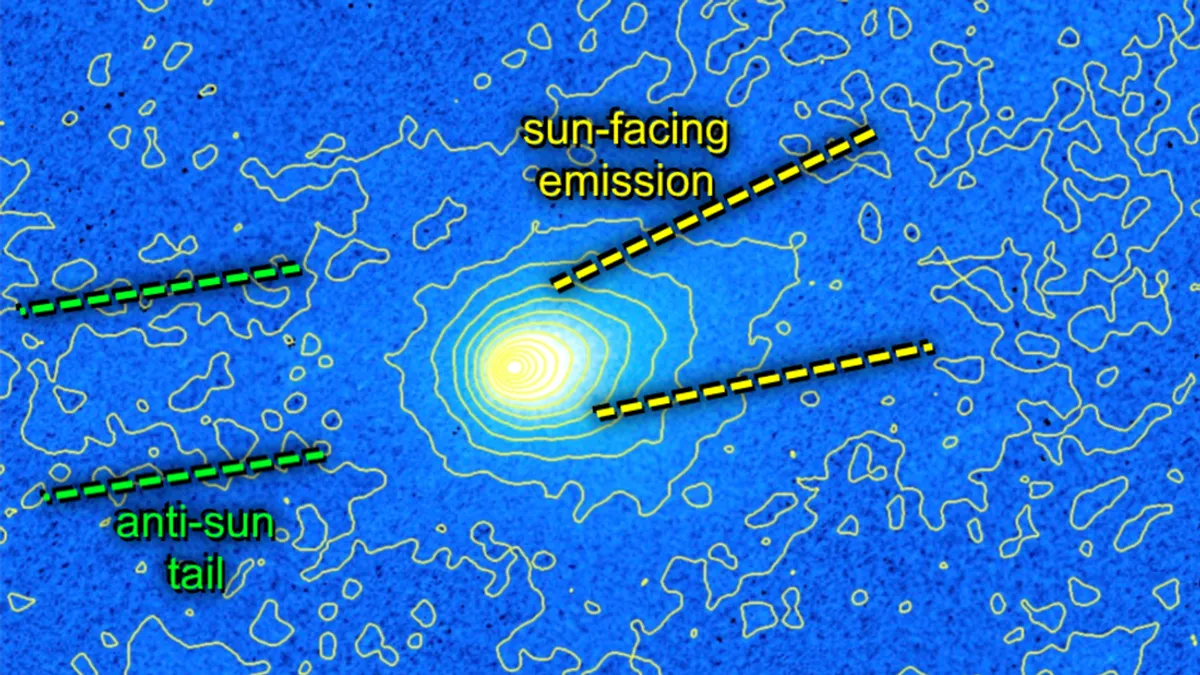
Figure 3. 3I/ATLAS imaged by the Hubble Space Telescope on July 21, 2025 showing its anti-tail, which faces towards the Sun. Image credit: David Jewitt et al, 2025/(CC BY-SA 4.0)
3I/ATLAS’s anti-tail is explained as normal by astronomers. Due to the directional flow of the solar wind, most of the dust grains released from the object’s surface come from its front end. The larger ones will congregate there due to the fact that they are too big to be pushed back by solar radiation, hence the anti-tail. Smaller particles of dust are easily pushed away from the Sun to create a more conventional tail. This might be so; however, in the case of 3I/ATLAS, all that was observed prior to its disappearance behind the Sun in early October 2025 was an anti-tail. No substantial trailing tail was seen, suggesting that its chemical composition is highly unusual.
Hit by the Sun
Adding still further to the mystery of 3I/ATLAS is the fact that on September 24/25, 2025, the object was struck by a coronal mass ejection (CME), an intense burst of plasma and accompanying magnetic fields travelling at supersonic speeds. This had been ejected by the Sun days earlier during an unusual round of solar storms that included the emission of massive solar flares.9
Instead, however, of causing perturbations within the comet’s coma, 3I/ATLAS simply absorbed these powerful energies and continued its journey, seemingly unaffected.
This violent act on behalf of the Sun almost seemed purposeful. One might even suggest its irregular solar storms were in response to 3I/ATLAS’s proximity, with the CME either to push it away or, more incredibly, to provide it with a source of energy and power.
How might we better understand this strange incident?
Sustaining a journey through the cosmos, which began perhaps billions of years ago, would, on occasion, require some kind of external stimulus to ensure a constant linear momentum. In the case of 3I/ATLAS, its incredible speed—faster than any comet ever observed—is estimated to be in the range of 210,000 km/h (130,000 mph),10 although this was predicted to increase the closer it got to the Sun.
Is it possible that exo-comets can replenish their energy by entering star systems on a hyperbolic trajectory at extremely high speeds to ensure an encounter with the host star? Can that host star respond by sending out a CME to meet the incoming object?
The importance of what happened when the CME hit 3I/ATLAS does require some context. First, it is important to remember that the closer a comet gets to the Sun, the more solar radiation and wind are going to make dust and gas escape from the comet’s nucleus. Such extreme conditions cause the separation of atoms into positive and negative ions in a process known as ionization. This in turn creates a strong plasma environment that surrounds the nucleus with a powerful, self-generated magnetic field (a comet’s rear tail is itself made of ionized gas).
A comet’s plasma coma can develop gyroscopic stability and with it a constant angular momentum attached to its rotational pattern.11 In 3I/ATLAS’s case, it appears to be rotating with a periodicity of 16.16 hours (+/- 0.01 hours) or approximately 16 hours, 10 minutes.12
The manner a CME affects a comet depends on whether or not it has gyroscopic stability. If it doesn’t, then a CME could seriously destabilise the coma, while at the same time disrupting its angular momentum and even separating it from its ion tail. A comet displaying gyroscopic stability, on the other hand, while being temporarily compressed by a CME, will quite substantially alter its dynamics. How exactly, though, remains unclear.
If 3I/ATLAS is a sentient being, then it would appear to have perfected a way of generating a very powerful, plasma-based coma that helps sustain its magnetic sheath, making it more impervious to the effects of solar radiation. This enables it to safely approach stars and draw energy from them in a manner that might be compared to an electric vehicle recharging at a charging station, which, in the case of 3I/ATLAS, happened to be the Sun.
Is there something going on between these two celestial bodies—some kind of mutual cooperation like two entangled beings working together as a single shared mind? The concept of panpsychism and Rupert Sheldrake’s hypothesis suggesting that the Sun is a sentient being both support this conclusion, while evidence of quantum entanglement between two different bodies has been shown to exist not only in the microcosmic quantum world, but also in the macrocosmic world in which we live.13
Exploring the Coma
There is something strange about how 3I/ATLAS is polarizing light, this being the manner in which light, as a wave of oscillating electric and magnetic fields, reflects off an object. Its oscillations will be aligned in a certain direction in a process known as polarization. In the case of 3I/ATLAS, its polarization of light is unusually deep and narrow (reaching a minimum of -2.7% at a phase angle of about 7 degrees and a low inversion angle of 17 degrees). Such behaviour is not usually recorded in connection with comets, making it clear that 3I/ATLAS’s coma is formed from a unique mixture of chemical compounds with relatively low reflectivity.
3I/ATLAS’s coma also contains large amounts of water released from the dust it contains. This was visible as far out as 3.5 to 4 astronomical units (AU) from the Sun (an AU is calculated as the distance between Earth and the Sun). This was much earlier than could ever have been predicted, since 3I/ATLAS would not have been strongly affected by solar radiation at this time.14
What we also know about 3I/ATLAS’s coma is that it contains enormous amounts of carbon dioxide (CO2) (see fig. 4). This was the finding of the James Webb Space Telescope (JWST),15 as well as SPHEREx—short for “Spectro-Photometer for the History of the Universe, Epoch of Reionization and Ices Explorer.” One study puts the ratio of CO2 to water (H2O) at 8:1, which is unprecedented.16
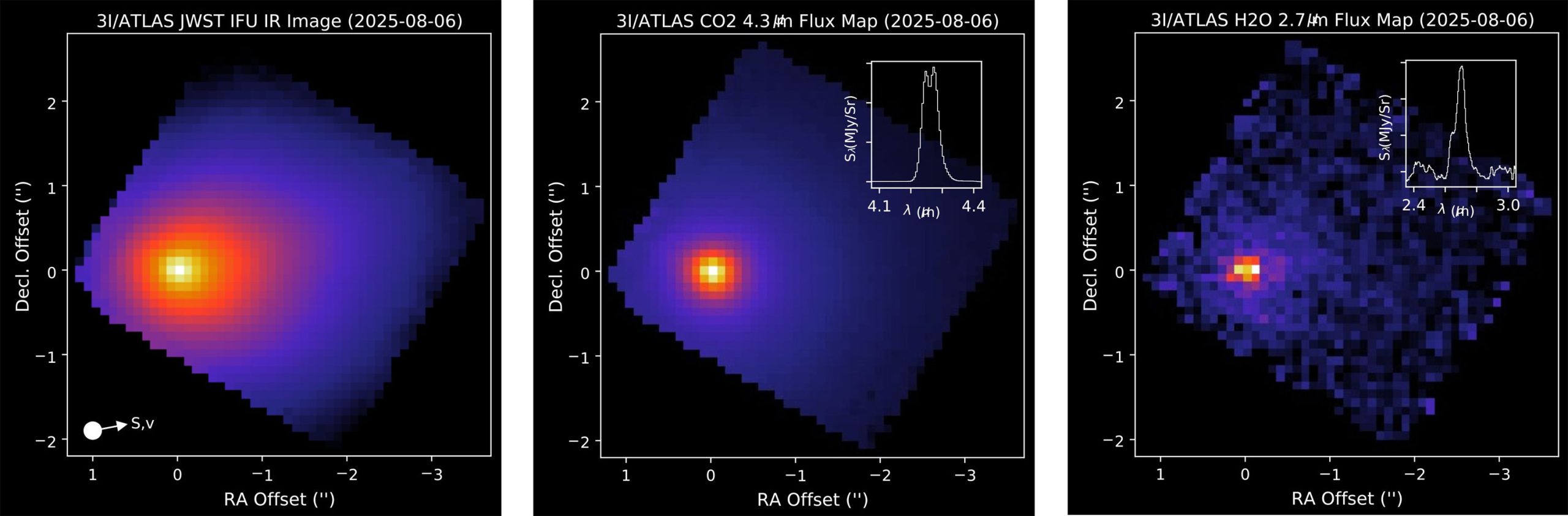
Figure 4. 3I/ATLAS imaged by the James Webb Space Telescope on 6 August 2025. On the left, we see its extended coma, while on the right are two images showing how the coma’s brightness changes depending on the wavelength of light. This is due to infrared light emission by the comet’s rotation as well as the vibration of gas molecules in the coma. The central image shows 3I/ATLAS’s dioxide emission, with the right image showing water vapor emission. Credit: NASA/James Webb Space Telescope (PD-USGov)
The Power of Nickel
Adding to the unusual nature of the coma is the fact that astronomers using the European Southern Observatory’s Very Large Telescope in Chile have detected an extremely high nickel-to-iron ratio in its composition.17 The presence of nickel in this manner is odd in itself since it is not normally found without iron. The two are created together in dying stars and expelled into the interstellar medium during supernova events. Both metals are the principal components of planetary cores such as our own. They also make up the cores of asteroids and comets, as well as most meteorites.
On Earth, nickel is found on its own only after being separated from iron using industrial processes. Nickel is, of course, the main component of Nickel-Cadmium batteries, this being due to its highly conductive properties. Chemical reactions taking place inside the battery produce a continuous flow of electrons (that is, electricity), providing constant voltage during its useful life.
With an estimated size of anything up to 5.6 kilometres or 3.5 miles (that is, roughly the size of Manhattan Island) and a proposed weight in the region of 33 billion tonnes,18 3I/ATLAS’s heavy nickel-based nucleus19 likely produces a gravitational field able to hold together its plasma-based coma and magnetic field. All this emphasises the complex nature of 3I/ATLAS’s coma (see fig. 5), which we now know formed very early in its rendezvous with the Solar System.20
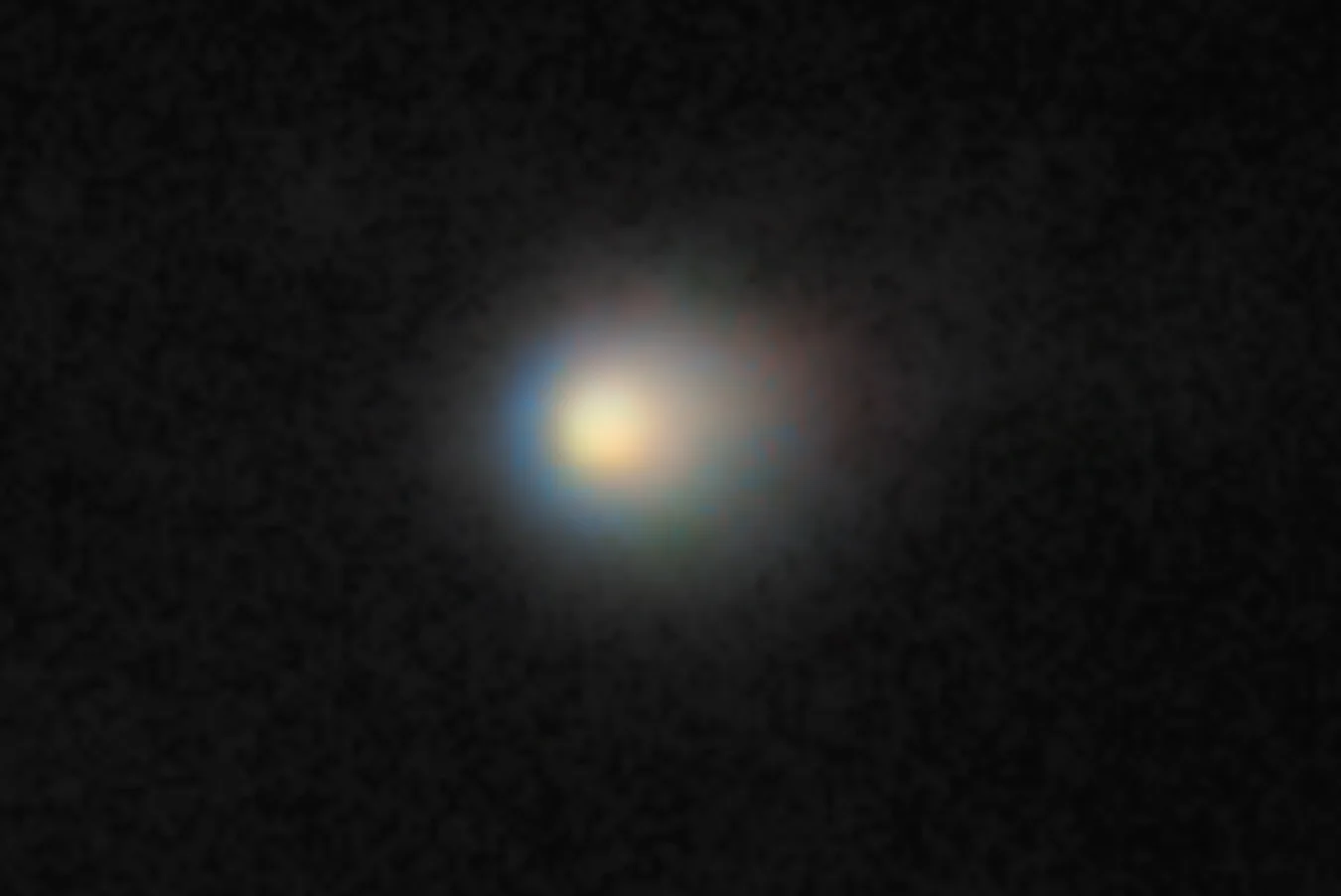
Figure 5. Image of 3I/Atlas from the Gemini North telescope showing its coma. Image credit: International Gemini Observatory/NOIRLab/NSF/AURA/K. Meech (IfA/U. Hawaii) Image Processing: Jen Miller & Mahdi Zamani (NSF NOIRLab) (CCBY4.0)
Another important factor stemming from the nickel content of the coma is the suspicion that its nucleus contains high levels of nickel tetracarbonyl (Ni(CO)4).21 This is a highly volatile and extremely toxic liquid. With the introduction of ionization, however, it easily decomposes into a pure form of nickel or nickel-containing compounds at a very low temperature.
Like its CO2 content, 3I/ATLAS’s nickel component was escaping from its icy core much earlier than any normal comet. Once it comes under the more direct influence of solar radiation, iron also begins to be released into the coma. This has now been observed, adding weight to the supposition that nickel tetracarbonyl is a principal source of its nickel content since the comet’s iron is probably bound up in a ferrous-based carbonyl known as iron pentacarbonyl (Fe(CO2)5).22 This only begins to release its iron at a much higher temperature than the nickel liberated from nickel tetracarbonyl. This began to occur as 3I/Atlas approached the Sun, explaining why initially only nickel was seen in the coma. That said, the extremely high content of nickel within the coma prior to the appearance of iron is extraordinarily rare in comets.
The Properties of Plasma
Nickel, carbon dioxide, as well as cyanide, which is also present in large amounts in the coma of 3I/ATLAS,23 are all key components in the generation of plasma, and plasma, as we see, is the key to understanding 3I/ATLAS’s sentient nature.
In the laboratory, plasma fields and plasmoids (plasma constructs held together by self-generated magnetic fields—see fig. 6) have been known to display what can only be described as sentience. This unique characteristic of plasma was first observed in the 1960s by American scientist and theoretical physicist David Bohm FRS (1917-1992), who worked extensively with plasma in the laboratory. (Plasma was first identified in the laboratory by English chemist and physicist Sir William Crookes (1832–1919). He named it “radiant matter” after seeing the intense glow it emitted during experiments.)

Figure 6. Plasma generated inside a nucleur fusion device called a tokamak that uses powerful magnetic fields to confine superheated plasma. Image credit: Culham Centre for Fusion Energy (CCBYSA3.0)
Bohm (shown in fig. 7) theorised that once an environment of plasma had been created, a “proto-intelligence” would emerge from a deeper level of existence to occupy this unique environment.24
Once the plasma ceases to exist (that is, when the positive and negative ions slow down enough to return to their original atomic states), the proto-intelligence returns to the Implicate Order.
So, despite outwardly appearing as simply a weird-acting exo-comet, 3I/ATLAS could very well be an individualised consciousness, a lifeform in its own right, brought into manifestation through the early creation of a complex coma held in place by its plasma sheath.
Such intelligences would presumably go dormant during a comet’s immensely long journeys between stars, either by assuming a state of statis or, more likely, by returning to Bohm’s proposed Implicate Order prior to reanimation when entering another star system.

Figure 7. American scientist and theoretical physicist David Bohm FRS (1917-1992). (Copyright free)
Alien Life, But Not As We Know It
People naturally assume that extraterrestrial intelligences, if they exist, will for the most part be anthropomorphic in nature. In other words, they will possess human-like bodies and will have evolved in a manner similar to that of humanity (see fig. 8). In addition to this, extraterrestrial biological entities, it is assumed, would probably have developed civilizations like ours and have the ability to travel between stars in suitably advanced spaceships.

Figure 8. Artist’s impression of an Arcturian from the Arcturus star system, showing the manner humanity typically envisages aliens as humanoid in form. Image credit: Arcturiinfo/CC BY-SA 3.0
These are elegant ideas, which may well have some truth to them. What they fail to address, however, is the possibility that life out there in the universe could be wholly unlike ourselves. 3I/ATLAS’s nucleus appears to be egg-shaped, judging from the composite image of the object taken by the Two-meter Twin Telescope 3 (TTT3), located at the Teide Observatory in the Canary Islands, Spain, on August 2/3, 2025.25
Surrounding it is its plasma sheath, within which the object’s consciousness probably resides. Whether or not it retains this form following perihelion, its closest approach to the Sun, which took place on October 29, 2025, is another matter (see fig. 9 for 3I/Atlas’s predicted path through the Solar System). Maybe it will. Maybe it won’t. We will just have to wait and see. The point to be made here is that if this object does prove to be a non-biological sentient being, then it is completely unlike anything we could ever have imagined in terms of extraterrestrial life. This suggests that its manner of existence as a conscious entity would have been almost impossible to predict in advance.

Figure 9. The predicted retrograde path of 3I/ATLAS through the Solar System, very close to the ecliptic, the path of the Sun. Its position is shown in 10-day intervals marked by red points with anticipated dates in yellow. Note its entry into the inner Solar System in the constellation of Sagittarius (close to Galactic Centre), following its first identification as an interstellar visitor on July 2, 2025, and its predicted exit of the inner Solar System in March 2026 as it exits the constellation of Gemini. Both asterisms were anciently seen as sky portals where human souls either entered or exited this world (see Postscript). Image credit: Thunkii/CC BY 4.0.
Our views on cosmic life must be expanded to embrace new ideas, especially now as we consider the composition and actions of interstellar visitors. These will unquestionably be reported with growing frequency as long-range telescopes, both on the ground and in the skies, become better able to detect the presence of cosmic objects passing through our Solar System.
The Quantum Realm
When 3I/ATLAS finally breaks up, its own individual consciousness will, perhaps, reintegrate with Bohm’s Implicate Order, a realm his longtime colleague and occasionally collaborator, the British physicist and professor emeritus of the University of London Basil Hiley (1935–2025), referred to as the “pre-space.”26
In physics today, this realm is more commonly known as the quantum field, although there seems little question that ancient cultures and indigenous peoples worldwide knew it under an assortment of names, including the cosmic ocean and the primeval void. In Hinduism and also in Buddhism, for instance, this non-local realm is referred to as the Ākāśa (meaning “ether” or “sky”), while in Taoism the undifferentiated state from which all things emerge is known as the wuji, meaning “limitless,” in reference to the concept of infinity.
In some ancient cultures and religions, this primordial void was inhabited by sentient beings whose actions were responsible for creating the material universe. Examples are the Ogdoad, the eight primordial beings of ancient Egyptian religion. After manifesting within the primordial darkness or cosmic waters of Nun, they were able to bring forth a cosmic egg that exploded to become the starry firmament and the earth below. Then there is the Tahitian god Ta’aroa (Hawaiian Kanaloa), a supreme being in the form of an octopus. He dwelt in an egg-like shell contained within a void of darkness, which then split apart to form the physical universe.27
It is through this non-local realm of pre-space that quantum entanglement is thought to occur. We are not talking here about single twinned particles, but an endless sea of entangled particles forming quantum networks through which all thought and consciousness is conveyed. Such ideas are behind the transformation of the Hindu principle of the Ākāśa into its more Westernised equivalent known as the Akashic Records. This was a concept developed in the nineteenth century by members of the Theosophical Society, such as its founder, Helena Blavatsky (1831–1891), and popularised in the twentieth century by the American psychic Edgar Cayce (1877–1945). He believed he could access the information contained in this vast cosmic library after entering trance states.
The Akashic Records are considered a repository of all of humanity’s knowledge and experience, past and present, something accessible through mental sympathy. Clearly, such ideas can be seen as predicting the modern-day concept of quantum entanglement, which some science writers now believe could be the answer to everything from telepathy to mind over matter.28
Entanglement might also explain the coming into being of lifeforms that have the ability to exist as an individualised consciousness both within manifested plasma environments and also beyond them in Hiley’s pre-space, Bohm’s Implicate Order, or indeed the Ākāśa of the Hindus and Buddhists.
Such ideas, which remain unproven, might help explain 3I/ATLAS’s own proposed consciousness, along, perhaps, with its synergetic relationship to the Sun and the seemingly intelligent manner it is passing through the Solar System.
Casual Passer-by or Purposeful Fly-by?
The question then becomes, if 3I/ATLAS really is a very ancient cosmic being then what is it doing in this Solar System? Does it have a purpose? Or is this just a random visitation without any kind of profound meaning to humanity?
This is a difficult question, and one, of course, that might never be answered.
What we can say is that 3I/ATLAS is a passerby on an incredible journey. It originated in the constellation of Sagittarius and may have come from the galaxy’s “thin disk” or “thick disk,” regions of older stars orbiting above and below the main galactic plane.29 If this is correct, it means that 3I/ATLAS could be as much as 7 billion years old, which would make it as much as 2.4 billion years older than the Solar System. Other estimates suggest it is between 3 and 11 billion years old,30 adding weight to the idea that it is probably the oldest interstellar visitor ever knowingly observed by humanity.
It was from this same area of sky that on August 15, 1977, the Ohio State University’s Big Ear telescope received the Wow! Signal (see fig. 10). This was a powerful burst of radio transmission lasting up to 72 seconds that was received at 1420 MHZ, the frequency corresponding to the hydrogen line, the vibrational state of hydrogen. As the most abundant element in the universe, any sufficiently-advanced extraterrestrial civilization that wishes to broadcast a radio signal to initiate contact with other intelligent lifeforms would very likely use this frequency, which is the reason why, even today, it is set aside for this eventuality.

Figure 10. The computer printout recording the powerful radio transmission received by the Big Ear telescope in Ohio on August 14, 1977. Its remarkable strength is shown by the ringed sequence of numbers and letters, which read “6EQUJ5.” Next to them, SETI astronomer Jerry P. Ehman had written “Wow!” giving the signal its name. Image credit: Big Ear Radio Observatory and North American AstroPhysical Observatory (NAAPO)/Public Domain
Despite many attempts across the years to debunk the Wow! Signal, it remains unexplained. Avi Loeb’s recent proposal31 that it might have originated from 3I/ATLAS, whose current trajectory suggests that at the time, in August 1977, it was within 9 degrees of where the signal originated in the constellation of Sagittarius, is an intriguing possibility.
Can we really imagine 3I/ATLAS as not simply a weird-acting exo-comet, but as a stellar object that is, on the one hand, natural and on the other a lifeform displaying intelligent, pre-planned actions? If so, then might it attempt to send a signal or message in a manner similar to the Wow! Signal? The first place to look for any such signal would be in any fluctuations or changes in the comet’s extreme negative polarization. This could contain mathematical information in the form of numerical sequences exhibiting regular patterns that could in no way be interpreted as purely random. If correct, then what might this information convey? Could it reflect the frequency of hydrogen? Or maybe it would contain information regarding chemical or organic compounds responsible for the creation of life in the universe? It is all possible, and might already be there in the data received before 3I/ATLAS reached perihelion. All it requires is for the scientific community to retain an open mind and consider seriously these propositions.
Until it passes out of range of our best telescopes sometime in 2026, there seems little question that 3I/ATLAS will continue to reveal weird characteristics, something that can only add to the conclusion that it is not quite what we thought it was when first detected passing through our local neighbourhood back in July 2025.
Postscript—November 2025
3I/ATLAS has now passed perihelion, its closest approach to the Sun, and will soon be observable again from Earth. When this happens every large telescope in the world will no doubt be trained in its direction, bringing us new information and data. Three baffling developments occurred during its perihelion amid further reports of unusual solar activity and more coronal mass ejections (CMEs) seen heading its way (see here). Firstly, 3I/ATLAS brightened considerably as it approached perihelion on October 29, once more showing that it is benefitting from the power and energy offered by CMEs. Secondly, around the same time, 3I/ATLAS displayed an unusual manoeuvre described by NASA’s Jet Propulsion Laboratory (JPL) as a “non-gravitational acceleration,” that is, one not directly linked to the gravitational pull of the Sun (see here).
Thirdly, and lastly, 3I/ATLAS turned bright blue! This change in colour reflects the ionization of chemical compounds that are causing its plasma-based coma to glow blue. Normally, a comet would be expected to turn red during perihelion due to the heating up of dust particles in its coma. This should have happened to 3I/ATLAS, especially since it passed within just 210 million kilometres (130.5 million miles or 1.4 astronomical units) of the Sun (see here).
What’s causing this blue colouration is presently unknown, although one likely culprit is the presence of cyanogen ((CN)2 or CN2N2), a chemical compound of cyanide, which glows blue to blue-violet when ionized. This has already been recorded in connection with 3I/ATLAS’s coma. Ionized Carbon monoxide (C+) is another possibility, since this too glows blue when ionized.
One additional fact about 3I/ATLAS is just how close it is following the ecliptic, the path taken by the Sun through the 12 signs of the zodiac during the course of a year. It is doing this in a retrograde manner, meaning that it is moving in the opposite direction to the Sun. When 3I/ATLAS was first recorded as an interstellar visitor on July 2, 2025 it was in the constellation of Sagittarius, the Archer, and when it exits the inner solar system in March it will be in the sign of Gemini, the Twins (see fig. 9), it having crossed through seven zodiacal constellations in all (eight if you count Ophiuchus, the so-called thirteenth sign of the zodiac). Both its point of entry onto the ecliptic in Sagittarius and its point of exit in Gemini are at opposite ends of the Milky Way. These two constellations were anciently seen as sky portals, used, respectively, by new souls entering incarnation and by the souls of the deceased exiting this world; each gate acting as the cosmic counterbalance to the other. This very precise route taken by the comet is remarkable and should raise a few eyebrows among astrologers!
All this increases the high strangeness associated with 3I/ATLAS, and I am confident there will be further surprises in store during the coming months. Astronomers, of course, keep insisting it is nothing more than an odd-acting comet, while Harvard professor Avi Loeb and others continue to warn that it could be alien tech. There seems to be no middle ground, so my proposal that the object is a half and half, in other words, a natural comet of unique design and composition that is also a sentient being, a lifeform in its own right, seems a good compromise. It might even help explain the object’s odd behaviour and peculiar characteristics.
For all the latest news on 3I/ATLAS, I recommend following Avi Loeb’s regular articles on the Medium social publishing platform (see here).
Watch this informative video by Andrew Collins explaining his suggestion that 3I/ATLAS is a plasma-based cosmic lifeform.
Andrew Collins (@andrew_collins_author) is a science and history writer and the author of over 15 books. He lives in Leigh-on-Sea in the English county Essex. His website is andrewcollins.com.
Andrew would like to thank Richard Ward for his valuable insights into the fascinating topic of 3I/Atlas, and Adam Crowl, Helena Reznor, Debbie Cartwright, and Yvan Cartwright for their helpful comments and suggestions. Thanks also go out to Graham Hancock and Leila Hancock for the publication of this article.
Notes and References
1. Bolin, Bryce, et al. 2025. “Interstellar comet 3I/ATLAS: discovery and physical description.” Monthly Notices of the Royal Astronomical Society: Letters 542, no. 1: L139–L143.
2. Loeb, Avi. 2025. “A Recap of the Anomalies of 3I/ATLAS on the Day of Its Closest Approach to Mars.” Medium website (October 3, 2025).
3. Eldadi, Omer, Gershon Tenenbaum and Abraham Loeb. 2025. “The Loeb Scale: Astronomical Classification of Interstellar Objects.” arXiv:2508.09167.
4. Matloff, Gregory. 2020. “Panpsychism as an Observational Science.” Journal of Consciousness Exploration & Research 11, no 5 (August 2020): 468–486.
5. Sheldrake, Rupert. 2021. “Is the Sun Conscious.” Journal of Consciousness Studies 28,
no. 3–4: 8–28.
6. See, for instance, Collins, Andrew. 2014. Göbekli Tepe: Genesis of the Gods. Rochester: Vt: Inner Traditons/Bear & Co, chs. 12–14, and Goldman, Noah. 2020. “Comets in Ancient Cultures.” Deep Impact website.
7. Hibberd, Adam, Adam Crowl, and Abraham Loeb. 2025. “Is the Interstellar Object 3I/ATLAS Alien Technology?” arXiv:2507.12213v1 (July 16, 2025).
8. Howells, Kate. 2025. “What is comet 3I/ATLAS?” The Planet Society website (October 7, 2025).
9. Felton, James. 2025. “Interstellar Comet 3I/ATLAS Is About To Be Hit By A Coronal Mass Ejection. What Will Happen Next?” IFL Science website (September 25, 2025).
10. NASA Hubble Mission Team. 2025. “As NASA Missions Study Interstellar Comet, Hubble Makes Size Estimate.” NASA website (August 7, 2025).
11. Chiao, May. 2018. “Slow and growing slower.” Nature Astronomy 2, no. 111 (January 22, 2018). DOI: https://doi.org/10.1038/s41550-018-0389-0.
12. Santana-Ros, T., et al. 2025. “Temporal evolution of the third interstellar comet 3I/ATLAS: Spin, color, spectra, and dust activity.” Astronomy Astrophysics 702, L3 (October 2025). https://doi.org/10.1051/0004-6361/202556717.
13. Dumé, Isabelle. 2003. “Entanglement goes macroscopic.” Physics World website (September 03, 2003); Ornes, Stephen. 2019. “Quantum effects enter the macroworld.” Proceedings of the National Academy of Sciences 116, no. 45 (November 5, 2019): 22413–22417.
14. Xing, Zexi, Shawn Oset, John Noonan, and Dennis Bodewits. 2025. “Water Production Rates of the Interstellar Object 3I/ATLAS.” The Astrophysical Journal Letters 991, no. L50 (October 1, 2025): 1–8.
15. Cordiner, Martin A., et al. 2025. “JWST Detection of a Carbon-dioxide-dominated Gas Coma Surrounding Interstellar Object 3I/ATLAS.” The Astrophysical Journal Letters 991, no. L43 (October 1, 2025): 1–10.
16. Waldek, Stephanie. 2025. “The interstellar comet 3I/ATLAS is wrapped in carbon dioxide fog, NASA space telescope reveals.” Space.com website (September 4, 2025).
17. Loeb, Avi. 2025. “A Steeply-Rising Production of Cyanide and Nickel Without Iron in the Gas Plume Around 3I/ATLAS.” Medium website (August 28, 2025). See also Hutsemékers, Damien., et al. 2025. “Extreme NiI/FeI abundance ratio in the coma of the interstellar comet 3I/ATLAS” Astronomy & Astrophysics manuscript no. feni_3I (October 1, 2025). DOI: arXiv:2509.26053.
18. “As NASA Missions Study Interstellar Comet, Hubble Makes Size Estimate.” 2025. NASA website (August 7, 2025); Loeb, Avi. 2025. “A Recap of the Anomalies of 3I/ATLAS on the Day of Its Closest Approach to Mars.” Medium website (October 3, 2025).
19. Hrinko, Ivan. 2025. “Interstellar comet 3I/ATLAS causes controversy in the scientific community.” Universe Space Tech website (August 29, 2025).
20. Hutsemékers, Damien, et al. 2025. Extreme NiI/FeI abundance ratio in the coma of the interstellar comet 3I/ATLAS.” Astronomy & Astrophysics manuscript no. feni_3I (October 1, 2025).
21. Hoogendam, W.B. et al. 2025. “Spatial Profiles of 3I/ATLAS CN and Ni Outgassing from Keck/KCWI Integral Field Spectroscopy.” DOI: arXiv:2510.11779.
22. Hutsemékers, Damien, et al. 2025. Extreme NiI/FeI abundance ratio in the coma of the interstellar comet 3I/ATLAS.” Astronomy & Astrophysics manuscript no. feni_3I (October 1, 2025).
23. Hoogendam et al. 2025.
24. Pratt, David. 1993. “David Bohm and the Implicate Order.” Sunrise magazine (February/
March 1993).
25. See Loeb, Avi. 2025. “A Sunward Jet from 3I/ATLAS, Imaged by the Two-meter Twin Telescope.” Medium website (October 17, 2025).
26. Baron, Gerald R. “Pre-space and the participatory universe in the Bohm-Hiley theory.” Medium website (December 12, 2003).
27. Cotterell, Arthur. [1997] 2003. s.v. “Ta’aroa.” A Dictionary of World Mythology. Oxford: Oxford University Press. Online reference: Oxford Reference website.
28. Demir, Halil I. 2011. “Quantum Worlds from Entanglement to Telepathy.” The Fountain website (November 1, 2011).
29. Guo, Yiyang, et al. 2025. “Search for Past Stellar Encounters and the Origin of 3I/ATLAS.” arXiv:2509.03361 (September 3, 2025).
30. Tangermann, Victor. 2025. “The Interstellar Visitor Hurtling Toward the Center of Our Star System Is Unimaginably Ancient, Scientists Say.” Futurism website (July 10, 2025).
31. Loeb, Avi. 2025. “Was the ‘Wow! Signal’ Emitted from 3I/ATLAS?” Medium website (September 29, 2025).





.jpg)

