







One of the hardest things I’ve had to explain in support of my relatively new belief that we have absolutely no free will — ie that all our behaviour is entirely determined by our biological and cultural conditioning given the circumstances of the moment — is that this conditioning determines not only our behaviour but also our beliefs and worldview.
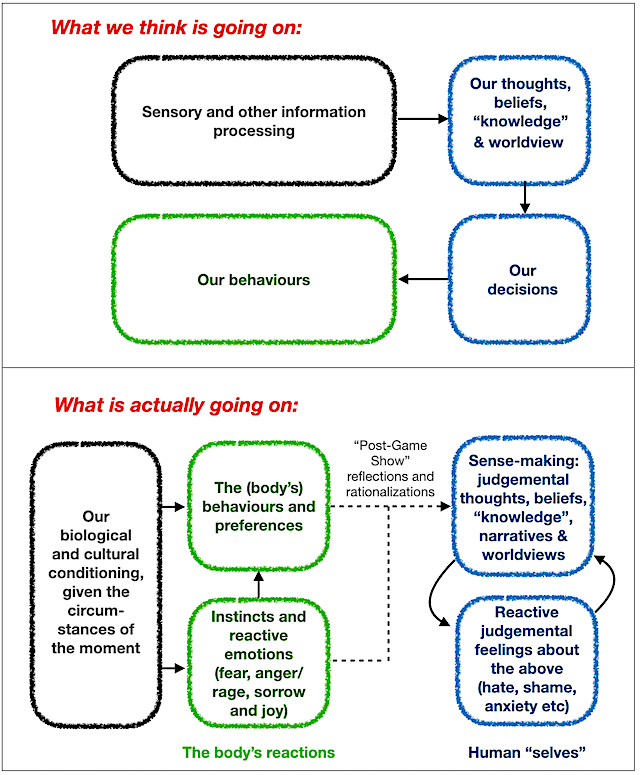
Even harder for us to accept is that our beliefs and worldview are conditioned in parallel with our behaviours — so that what we believe has absolutely no impact on our behaviour. I’ve written about this several times, and it’s captured in the chart above, and I won’t repeat myself here.
But recently I’ve had people ask me about how/whether ‘conditioning’ affects (1) what we think, conceive, and imagine, (2) what/how we feel, and (3) what we like and dislike (ie our preferences).
Thoughts and feelings, from what I understand about neuroscience, are essentially chemical reactions. To some extent they are self-reinforcing: When something is thought (eg “That was a thoughtless thing to say”), it tends to provoke an emotional response (eg “I feel ashamed”). And that painful emotional response will, in turn, lead us to ruminate on what it was about and what to “do” about it, completing the vicious cycle. This cycle is shown in the two blue boxes in the lower right of the chart above.
Non-dualists assert that, to this extent, thoughts and feelings are not ‘ours’. The chemical reactions that provoke them are just part of the body’s internal regulatory processes. To the extent these thoughts and feelings are judgemental, they reflect the incessant efforts of the human brain to ‘make sense’ of things.
So: For example, Trump does something, we judge it to be demented and nonsensical, and then we judgementally emotionally react (with anxiety, hatred, embarrassment). We can get tied up in knots over this. Our bodies will clench. But while our easily-fooled sense-making brain might conceive that this clenching is a behaviour stemming from hatred and/or anxiety, that is just our after-the-fact rationalization. Our bodies, like all animal bodies, clench in anger and in fear. It is these primal emotions that, I think, direct our body’s behaviour, not our judgemental emotions.
Another example: You’re walking at night on an annoying errand in a sketchy part of town. You’re anxious and angry, along with other uniquely human emotions, because of your judgement of what led to this trip and your imagining of what it might lead to. Now a dark, hooded figure looms into sight and yells at you incoherently. Now you’re angry and scared. Now you act. Once the danger has passed, you might well rationalize why the hooded figure made you angry and scared. The stress might cause you to hate hooded people in future, and to be more anxious in that neighbourhood in future, or to regret making that trip in the first place, depending on the circumstances of what happened. But that’s just a rationalization. Your rationale had nothing to do with your body’s action (which was probably, instinctively, to fight, flee, and/or freeze). The rationalization came afterwards, and did not cause your (body’s) behaviour.
This is just as true if we try to explain the west’s wars and genocides as it is for personal scary confrontations: We hate these atrocities and those we see as their perpetrators, and they fill us with anxiety and quite probably shame and other feelings as well. But while our judgements and feelings about them may drive us insane, they’re not what drives us to take action. It is the primal, universal, instinctive emotions of fear and anger that move us to act (or to not act, depending on how the fear hits us).
I know this is counterintuitive to accept, and perhaps even sounds preposterous. But thus far I’ve come up with no better theory that jibes with the evidence of how we behave every day, and how our behaviour seems so disconnected from what we think and feel it ‘should’ be, and from how we (afterwards) make sense of it, and often psychologically suffer accordingly.
So I guess my answer to my readers’ question about thoughts and feelings is that, yes, our conditioning and the circumstances of the moment determine what thoughts arise, and determine both our instinctive primal emotional reactions and our judgemental emotional reactions that stem from how we make sense of things. But only our instinctive primal emotional reactions affect what we actually do. Our judgemental emotional reactions are as useless as our judgemental sense-making. They affect nothing. Our sense-making may make us feel smarter. Our judgemental emotions just make us feel bad.
This is why I have started to assert that the emergence of the illusion of self and separation, which would seem to be unique to late-stage humans, was a maladaptation, a terrible evolutionary misstep that has made us all mentally ill, and filled our brains with impotent yet debilitating judgemental thoughts and feelings.
The third part of my readers’ questions — about preferences, what we ‘instinctively’ like and dislike, and how those preferences can change over time — is I think easier to answer. Like our emotions, our preferences come in two favours. Some of our preferences are embodied (preference for coffee vs tea; preference for certain physical features or certain ‘smells’ in a potential partner that may be entirely subconscious). They are physical, and our bodies alone ‘know’ the rationale for them. We have no say in them. We might come to have a ‘taste’ for certain foods, or physical features, due to exposure and association, but we have no say in that, either.
And some of our preferences are aesthetic rather than physically embodied. But even if we think we have developed a ‘refined’ taste in music or art, that is also just a rationalization. Our aesthetic preferences (and their changes over our lifetimes) are no more ‘our’ choices than our physical preferences. They are entirely conditioned, and all the intellectual rumination as to ‘why’ this music is ‘good’ and that music is ‘bad’ will not affect that conditioning.
We love to believe we make our own decisions, and understand why ‘we’ made them. But ‘we’ don’t make any decisions. We have no control or agency over what we do, what we believe, what we think, what we feel, or what we like and dislike. ‘We’ are just along for the ride, trying to make sense of it, and trying to convince ourselves it was our choice, and that it even makes sense. That’s the best and only thing we can do.
All our rationalizations are just a futile post-game show, like after a football game with supposedly expert ‘analysts’ and armchair quarterbacks second-guessing what should have been done and why. Changing nothing.
Why does any of my sense-making about this challenging subject matter? It doesn’t. But to the extent that it helps me to be a little more compassionate towards people, appreciating that they had no agency or choice over what they did, what they are doing, what they will do tomorrow, and what they think, and believe, and feel, and like and dislike, it seems to matter to me.
I guess that’s just how I’ve always been conditioned.