






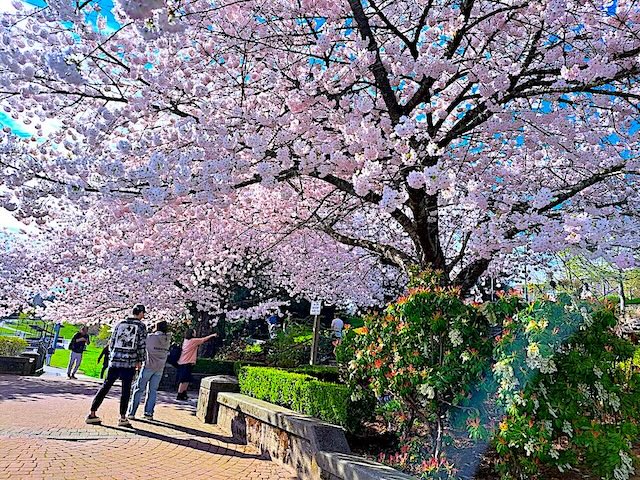
This is #52 in a series of month-end reflections on the state of the world, and other things that come to mind, as I walk, hike, and explore in my local community.
well I’m a stranger here on this place called Earth
and I was sent down here to discover the worth
of your little blue planet third from the Sun
c’mon and show me what you’ve done
we’ve got the aeroplane, we got the automobile,
we got skyscraping buildings made of glass and steel
we got synthetic food that nearly tastes real
and a little white pill that makes you feel
a whole lot better when you get out of bed
you take one in the morning for the long day ahead
we got everything everybody needs to survive
surely the good life has arrived
I think your atmosphere is hurting my eyes
and your concrete mountains are blacking out the skies
now I don’t say that you’ve been telling me lies
but why do I hear those children’s cries?
I’m a stranger here – I’m just looking around
I see the aeroplanes carrying the bombs
why you even found people to drop them on
you know you can’t keep what you take by force
but it’s only my first impression of course
I’m a stranger here
we got the rivers and the mountains and the valleys and the trees
we got the birds in the sky we got the fish in the sea
we got the…..
oh you crazy fools don’t you know you had it made?
you were living in paradise
but take it from one who knows
the gates of heaven can close
I only pray that you take my advice
because paradise won’t come twice
well I’m a stranger here on this place called Earth
and I was sent down here to discover the worth
of your little blue planet third from the Sun
I think I’ll go back home where I come from
— Five-Man Electrical Band — I’m a Stranger Here
. . . .
In the local park, two little kids, dressed to the nines as if they’re in a fashion photo shoot, are playing together while two sets of parents chat nearby. They are taking turns running up to and stomping furiously on a drainage grate set in the cement. Each assault on the grating is accompanied by the two of them shouting “Monster!” and then breaking out laughing. They carry on a running dialogue, presumably filling in the details of the story of the monster lurking underneath the grating.
. . . .
I feel like an alien, a stranger, walking in these parks and on these streets. An imposter, dressed in the garb of a reassuring, obedient, properly-conditioned citizen. The people I see, at least the adults, seem resigned to their lives, as if everything is alright. It’s amazing what people can seemingly get used to.
I don’t mean that as a criticism. We’re all doing our best. We do what we have to do, what we’ve been conditioned to do. If we hadn’t, we couldn’t live like this, in this horrifically overcrowded world of endless anxiety, precarity, animosity, intolerance, destruction, and distrust. Anthropologists say that if you put a bunch of any other species of primate in such proximity without autonomy, they would start to kill each other within hours. It’s taken millennia of exhaustive, intense conditioning to make us (able to) live this way.
Our predicament is not our fault. Thanks most likely to some unfortunate brain mutation that utterly changed how our species ‘sees’ the world, this was inevitable. Maybe after it all collapses, that mutation will recess and post-civ human societies will be peaceful, full of wonder, and reconnected to the rest of life on Earth.
If that were to happen, those societies and ours would surely be mutually unrecognizable.
. . . .
“And then…” says a little girl walking backwards alone the lake path, regaling three adults with a story she is apparently improvising in the moment. The adults laugh even before she continues the fanciful story, which is punctuated by delightful hand movements and a facial expression of sheer ‘performance’ joy and intensity. The plot doesn’t matter. It’s all about the story, and the performance.
. . . .
The kids are alright, it seems, at least for now, at least until they grow up and start to see the world through ‘civilized’ eyes. Despite their protestations and endless questions, they seem to just accept what is happening, as if that’s the only thing that could have happened. A little like wild creatures, they surely feel their sensations and emotions more intensely than we adults, perhaps because they are not filtered through a veil of judgement. Before they ‘learn’ to feel shame, regret, dread, envy, hatred… Before they start their next lives, trying endlessly to make sense of what cannot make sense.
I wander around among the mostly unhappy-looking adults in the park, wondering why so few of us are able to see just what a horror show we’ve seemingly, unintentionally created.
Of course, it doesn’t matter. Nothing can be done. Even harder to accept, nothing needs to be done, because nothing’s really happening. We just make up stories, but our stories are just like our money — just inventions, conceptions, conventions that are useful only because we agree that they are. Just shit our brains make up.
. . . .
I’m walking along the river path, and poised elegantly on a rock in the river is a great blue heron, watching carefully for salmon swimming by. I stop to watch, and the next three people who come by on the path also stop.
. . . .
What is it like to be a bird, I wonder, and how might this bird see (perceive/conceive) the world differently from all the people I see walking along the path? In his book The Peregrine, JA Baker, who spent his life trying to answer this question, wrote:
The peregrine lives in a pouring-away world of no attachment, a world of wakes and tilting, of sinking planes of land and water. We who are anchored and earth-bound cannot envision this freedom of the eye. The hardest thing of all [for the human animal] is to see what is really there… It will not be meshed in words… To hawks, our gritty country lanes look like shingle beaches; the polished roads gleam like seams of granite… All the monstrous artefacts of man are natural, untainted things to them.
What seems clear from this and other studies is that birds do not conceive of themselves. This is unfathomable to a human self, whose entire cognitive universe is scaffolded by the language of subject and object, of apart-ness and agency, of judgement and apprehension. These lifelong students of ornithology are not just saying that birds don’t conceive of themselves as separate individuals, or as having individual agency. They are saying that birds don’t conceive of themselves at all. And even more blasphemously, they are saying that they have no need to conceive of themselves at all, to thrive vastly longer and more sustainably than our species ever has.
Stretch your brain even further and you might say there is no bird there. There is no bird there looking for something called a salmon and planning where it should stand to have the best chance of catching the salmon. There is no need for any of that. The bird and the salmon are just labels, stories that human selves uniquely make up and agree upon, and then try to agree upon what they ‘mean’ and what we can therefore ‘learn’ about birds and salmon.
There is no bird there. Not to the bird, nor to the salmon. They have no need for such labels or stories.
Herons thrive all over the planet and have for sixty million years. They are considered as symbols of purity, rebirth and transcendence (they move easily between land, air and water). But they don’t need to transcend anything. They live much the same way they have always lived. They are born with all the technology they will ever need.
A group of herons is called a siege.
I climb up from the river and walk over to the lake. There’s a squirrel alternately racing between trees and stopping dead still. I stop and sit nearby. The squirrel races down the tree and then stops and watches me. I shuffle back in the grass. It starts, but does not move. Now it moves down to the grass and stops again. I stretch out an empty hand to it. It waits. I shuffle back a little farther. And the squirrel is off, racing up another tree. The squirrel has no use for ‘me’.
Of course this is just another story made of labels and words and concepts, the shit that brains make up. There is no squirrel there, and no trees. Squirrel is no more ‘real’ than the letter ‘S’.
But wow, it’s a powerful story. I’ve learned that it must be ‘real’, that this story must be true. Truth is what we agree makes sense.
I can’t even convince myself of this — that there is no squirrel, not ‘really, any more than there is a ‘me’ — so I am certainly not trying to persuade anyone else. Although if someone, a reader or a friend, asks me about this, I will rise to the occasion. I can’t shake the impression that this is what’s actually real, and that what we humans think of as real is just a coherent set of rules agreed upon for the game we call life, of no more significance than the rules of a board game. After we play, the game gets put away. We humans call the game ‘life’ and the putting away of the game pieces ‘death’.
We can’t imagine that all the while we’re furiously playing, there is no game, there are no players, and there are no beginnings or endings. Wild creatures, not befuddled by wildly imaginative and malleable brains that can be made to believe anything, can see this, I think, but we cannot. Or, more precisely, the ‘this’ that they are obviously and unquestionably an inseparable part of, can see ‘this’, what simply is.
It’s impossible, but as I wander around the lake I try to see things the way the heron does, not as an individual but just as a part of everything. I want so much to be able to do this! How magical, how wondrous, not to be afflicted by ‘personhood’, by the terrifying sense that you are separate and apart from everything else, separate from those ‘others’ that must be constantly defended against.
. . . .
There is an utterly unsustainable number of ducks on the lake, more than a hundred, probably due to the number of well-meaning humans that feed them every day.
. . . .
At least, that’s where my sense-making brain immediately goes — they’re going to have to kill or move some of them or some of them will starve. But I am sure, somehow, that the ducks have no such concerns. Each duck is no more an individual than the fingers of my hand or the cells in my kidney are individuals. They, and we, are just part of an inseparable greater whole, and another whole greater than that.
I sit on the lakeshore and watch the ducks. Some of them (plural), part of the flock (singular) is sleeping, in the familiar pattern of keeping the eye closest to the outside of the murmuring flock open (and keeping the corresponding half of the brain awake), while the ‘inside’ eye and the other parts ‘inside’ this ever-shifting flock have time to rest.
. . . .
As I watch the ducks, singular and plural, a little boy comes running up and crouches beside me. He looks back at his father and then over at me. Then he points to the ducks and says, confidently: “Duck!” I smile and nod and then make a motion with my arms symbolically embracing the whole flock and turn to him and say “Duck!” He grins and nods and runs back to his father.
. . . .
It’s mating season for crows, and they’re doing their showing-off stunts, notably diving rapidly down from the top of the skyscrapers and then soaring back up again. Sometimes they drop pebbles from the roof and then dive down and retrieve them in mid-air. Over and over again.
I’m sure they don’t know why they’re doing that. I’m sure they don’t even think that ‘they’ are doing something. They don’t have to. This behaviour prompts dopamine, or the avian equivalent, so that is what is apparently done by the wings and the beak and the body. We can say it’s to show off to attract mates, or that they do it just because it’s fun to move fast, but those are just more human stories.
The crow doesn’t need to have an explanation. He or she, or the atoms and molecules that we label as he or she or crow, just act out their conditioning. It doesn’t need to happen for a reason. It doesn’t have to make sense. Even our ‘evolution’ explanations — that this behaviour has been ‘selected for’ and hence prevails — is just a more complicated story. We think we know. We strange, stressed, tragic human selves want to know.
But we don’t. Just more shit brains make up. All we can do.
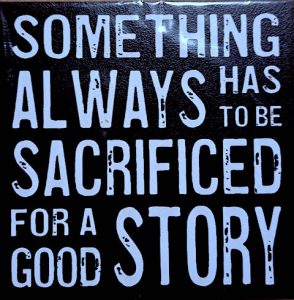
Fridge magnet by cedarmountainstudios.com, from Salt Spring Island BC
When I was a child, I was kind of terrified of babies. I couldn’t make sense of them. Once I was sitting under a Christmas tree — one of my earliest memories, as the most traumatic ones always stay with you longer — some visiting friends of my parents plunked their baby down beside me and said something like “You two play together.”
I watched this strange creature nervously, not knowing what to do. The baby proceeded to take an ornament off the tree’s bottom branch and, as babies are wont to do, proceeded to put it in its mouth. A moment later the parent came rushing over, screaming at me for, apparently, not stopping it from doing so. The baby and I both cried. If I remember correctly, the visitors promptly left.
Seventy years later, and I kind of like babies now. They seem free, for now, from those complicated judgemental human feelings that seem to plague humans. Of course they feel fear, and anger, and sadness, and joy, probably far more than we adult humans can now remember feeling. In that respect they seem closer to wild creatures than ‘real humans’, and maybe that’s why I’ve come to like them.
But I don’t patronize them, or pretend to know what they’re thinking or ‘why’ they’re doing something. I leave them their space, just like I did for the squirrel, and don’t pat them or grab their hands. I just smile at them and wink. A shared secret. They seem to like that.
. . . .
I used to think of myself as part of various human communities. I made Venn diagrams of my ‘circles’. But I never really belonged. Not to any group or any place. It was all make-believe, pretending, because I’d been conditioned to try to make the people in my life happier, and to fit in. Lost, scared, and bewildered. Behind this clever disguise.
And now I’m just an alien, a misfit, fascinated more and more with what is seemingly happening, and less and less by what it ‘means’. I’m weary of trying to make sense of things. And I’m fine not belonging.
What do you call a description of what is apparently happening, devoid (as much as is possible for humans) of sense-making, of explanation of its ‘meaning’? Not a story, surely, or at least not a ‘good’ one. More like a short video, perhaps. A vignette. But of what value is a video without the structure and context needed to make sense and meaning of it? What are we to make of a short, incomplete, disjointed video that is just a series of fragments?
That seems to be all we aliens are capable of producing. Like a story, it is perhaps just a cry into the void, a feeding back of what is seemingly perceived. Like the cry of a hawk, or a heron, or a flock of ducks, or a baby, saying not “I am here“, but instead: We are here.
Not we, plural. We, singular. All of us.