








Three current events are on a collision course, and the result of that collision is likely to be a global economic collapse:
- The global debt crisis, with trillions of dollars of debt coming due, most of it in $US, at a time lenders are neither able nor willing to renew the loans, at least not at today’s interest rates.
- The end of cheap energy, aggravated and accelerated by the Trump Administration’s deranged, illegal, and ruinous US-Israel War on Iran.
- Unsustainable and mostly worthless investment in AI, leading to the largest bubble yet in the global economy, which will soon produce a horrendous stock market crash (even seasoned sober investment advisors are substantially unanimous on this).
I have ranted for years about the fragility and vulnerability of our economic system, and recently I’ve been following five writers from different disciplines who have been writing about what is likely to happen short-term as these colliding events start to unwind our economic system — Cory Doctorow, Steven J Newbury, Adrian Lambert, Erik Michaels, and Barry Ferns.
Adrian’s most recent article clarifies that we’re not about to witness a sudden collapse. And the various waves of collapse will not be evenly distributed or occur at the same time or rate everywhere. “The world isn’t ending — It’s stopping working” is how he puts it:
Collapse does not require energy to be exhausted, and in reality it never is. It begins when the energy available to a system is no longer sufficient to sustain the level of complexity that has been built upon it. What matters is net energy – the surplus remaining after the energy cost of extraction, processing, and distribution has been accounted for.
As societies move from high-quality, easily accessible resources toward lower-quality, more difficult ones, the energy returned on energy invested declines, reducing the surplus available to maintain infrastructure, coordination, and institutional function. This decline does not present as a single, visible threshold, but as a gradual erosion of system reliability. Infrastructure maintenance is deferred as costs rise and budgets tighten, leading to increasing rates of failure. Roads deteriorate faster than they are repaired, power outages become more frequent and take longer to resolve, and hospital waiting lists stretch into years.
Supply chains become more fragile as margins shrink and redundancy is removed in pursuit of efficiency. Disruptions that would previously have been absorbed begin to propagate through interconnected systems, producing cascading effects across sectors that appear, on the surface, to be unrelated. At the same time, the coordination required to sustain complexity becomes harder to maintain. Administrative systems face increasing pressure as they attempt to manage growing instability with diminishing resources.
Financial systems absorb these stresses through debt expansion and deferral, extending the appearance of continuity while underlying conditions deteriorate. This creates a widening gap between system representation and system reality. The result is not immediate collapse, but a prolonged phase of instability in which the system continues to function, but with increasing disruptions. Failures emerge first at the edges, in regions or sectors with less resilience, and then move inward. What had been a tightly coordinated system becomes progressively less synchronised, as timing, reliability, and predictability degrade.
The system destabilises before energy is exhausted, because it is the capacity to organise energy, not energy itself, that fails first. In other words, systems fail at the level of organisation before they fail at the level of energy. This means breakdown appears as disruption rather than depletion: fuel exists but doesn’t arrive where it’s needed; food is produced, but doesn’t reach shelves; infrastructure is in place, but isn’t maintained. The system doesn’t run out: It stops working properly.
The material effects of this process are accompanied by changes in how the system is perceived and understood. High-energy systems produce stable expectations that shape behaviour at all levels. Individuals organise their lives around continuity; mortgages, careers, reproduction, and long-term plans. Institutions assume persistence, maintaining infrastructure and pension systems. Economic systems depend on forward projections, pricing assets and debt on the assumption that growth will continue.
These expectations enable coordination. Investment decisions, institutional planning, and social roles all depend on a shared assumption that the system will continue to function in broadly recognisable ways. Stability, in this sense, is not only a material condition but a cognitive one. As system reliability declines, the narratives underpinning our shared reality begin to fracture. Outcomes diverge from expectations, and the gap between what is assumed and what is experienced widens. Institutions lose legitimacy as they fail to deliver within the parameters they themselves define.
Policies based on growth and stability become increasingly misaligned with lived reality. Individuals experience a breakdown in the predictability that underpins planning, identity, and social organisation. This does not occur uniformly. Different groups encounter this breakdown at different times and in different forms, depending on their exposure to system instability.
Cory has explained that as this happens, hapless governments respond in the worst possible way: Imposing austerity (reducing the quality and extent of services even more) instead of taxing the rich to spread the burden and maintain essential services. That merely inflames anti-government sentiment, to which frightened governments respond with repression and fascism.
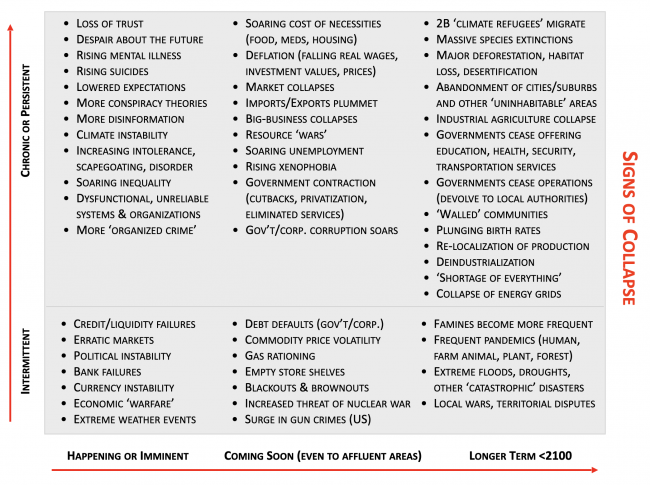
So what we should expect to see over the next few years, instead of a Hollywood Mad Mad sudden collapse, is a gradual but noticeable worsening in the quality of our infrastructure (roads, transport, communications etc), soaring increases in the costs of some hydrocarbon-energy-powered goods and services (those powered by diesel and jet fuel), and steadily-declining quality and extent of public services.
Specifically, we should expect to see the following (and note that it’s almost impossible to plan for these things to happen):
- On-and-off rationing of gasoline and other hydrocarbon fuels (remember the lineups?)
- Exorbitant prices for home heating oil (and likely government subsidies for it)
- ‘Surcharges’ (mostly opportunistic price-gouging by oligopolies) on goods and services directly using hydrocarbon energy (airlines, trucks, couriers) or which employ hydrocarbon energy higher up the supply chain (anything sent by truck, train, air, or ship)
- Failed shipments and other blockages in supply chains dependent on transport, and hence visibly empty store shelves, collapse of JIT retailers, and back-orders never filled
- Hoarding of perishable, sensitive, and critical resources (medical supplies, electronic components, etc) and huge emerging black markets and price-gouging in these goods
- Slowly but noticeably increasing power blackouts and internet outages, to the point that users will transition to more reliable means of doing things (paper, the telephone, paper currency)
- The substantial end of commercial air traffic (jet fuel is a huge user of exactly those grades of hydrocarbon energy most dependent on Middle Eastern supplies) — you might want to visit or move your family while you can
- Steadily-reducing employment in all non-essential economic sectors, though governments will continue to produce fake unemployment numbers to disguise this
- Commensurate explosion in the homeless population
- Steadily-reducing medical care access, services offered, and much longer wait times
- Huge increases in fertilizer costs (on which >50% of all food production depends) and hence in the cost of almost all foods
- Rationing of some foods, especially meats and other long-food-chain dependent foods
- Something equivalent to ‘food stamps’ but designed for everyone, without the stigma
- Dramatic reduction in availability of imported goods of all kinds, since the high cost of shipping will simply make their manufacture economically non-viable
- Reluctant government subsidies for many essentials due to citizen outrage, with the emergence of a bifurcated economy (non-subsidized ‘luxury’ goods will become affordable only to the very rich)
- The re-emergence of the bicycle as a major mode of transportation
- Stock and housing market and currency instability; moves to try to create a global currency, which will likely fail for political reasons
- Abandonment of infrastructure (roads, bridges, etc) that becomes too expensive to maintain
- The beginning of an eventual flood of bankruptcies of large corporations and governments, worsening the unemployment crisis
- A continuing increase in corruption by governments and corporations, and the beginnings of a surge in property theft and fraud
- Famines will become commonplace
- More experiments with a Universal Basic Income, most of which will fail because states endlessly at war simply can’t afford them
- Experiments with debt ‘jubilees’ to provide some relief to homeowners with mortgages way higher than their property values; and parallel ‘rent forgiveness’ programs (if you think that’s too socialistic to ever happen, study what happened in the Great Depression)
- The exodus of ‘economic refugees’ from collapsed states will accelerate, and be increasingly resisted by states that have not yet collapsed
I suspect little of this will be ‘newsworthy’, because it will be happening too gradually, too intermittently, and too sporadically between areas, for many people (notably the 24-hour-news-cycle journalists) to notice.
What we now consider almost “unthinkable here” will start to happen, and we’ll get anxious and annoyed, and eventually we will just take it for granted — as how things are.
No Hollywood-ending explosion. Just everything slowly, gradually falling apart, to the point we’ll stop grousing that “nothing works properly anymore” and instead just accept, and reminisce, about what we once had that we thought would last forever.