








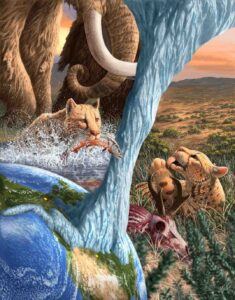
The extinct American cheetah wasn’t a true cheetah at all, say biologists in new research overturning our previous understanding of the legendary predator, revealing a cautionary tale about superficial scientific interpretations.
In a recent paper published in Current Biology, a research team led by scientists at the University of California, Santa Cruz, revealed that the so-called “American cheetah” is actually a relative of the Puma, adapted to Arctic conditions.
Scientifically known as Miracinonyx trumani, the American cheetah has turned out to be a fish-eating Puma relative and quite a distinct creature from the one envisioned by earlier researchers, as their suggestions were based primarily on the animal’s physical form. Using fossils discovered as far north as the Arctic Yukon, the team analyzed the species’ nuclear paleogenomes and stable isotopes, reconsidering the big cat at the genetic level.
Convergent Evolution
M. trumani had long front legs and a slender body, weighing roughly 150 pounds and measuring about eight feet long and three feet tall. This sleek form allowed it to cross vast swathes of Pleistocene North America and achieve cheetah-like speeds.
While it may have developed a form similar to the cheetah, this is simply a case of convergent evolution, after the “American cheetah” split from the puma lineage some 2.6 million years ago. Fossils used in the research date from 23,000 to 31,000 years old, considerably more recent than that initial split.
Although the American cheetah is extinct today, its influence is still felt. One evolutionary theory is that the fastest North American land animal, the pronghorn, which can run up to 60 miles per hour, owes its tremendous speed to evolving to escape the swift predator.
Where The “American Cheetah” Roamed
One of the most intriguing elements of the new research is that it extends the cat’s habitat north by 20° latitude, into the Arctic Yukon. The team says that, depending on latitude, the species could occupy distinctly different ecological niches, demonstrating a high degree of adaptability to prevailing conditions.
To the south, the American cheetah had long been recognized as residing in Florida and Wyoming. In these areas, rich in temperate grasslands, the cat would have behaved as a generalist predator. However, in the harsher Arctic Yukon, it acted as a tertiary predator, living off fish like salmon.
“These cats were remarkably flexible, much like pumas are across their range today,” said lead author Molly Cassatt-Johnstone, a Ph.D. candidate in the Paleogenomics Lab at UC Santa Cruz. “We found loss-of-function mutations in certain genes that regulate circadian rhythms, suggesting they may have adapted to the extreme light cycles of summers and winters in northern latitudes.”
American Cheetah Extinction
The genes revealed further peculiarities of M. Trumani. Generally, cats are known for a lack of interest in sweet foods, but this particular cat also lacked a sour taste receptor, a trait associated with specialized diets. Animals normally use this receptor to identify food that is safe to eat.
The fossils tell the story of a slow, steady decline in the species over the course of the Pleistocene. One notable factor could be their distinct lack of genetic diversity, which the researchers do not attribute to inbreeding.
“Miracinonyx persisted for a very long time without the signs of inbreeding we’d expect before a collapse,” senior author Beth Shapiro, professor of ecology and evolutionary biology at UC Santa Cruz and co-director of the Paleogenomics Lab, concluded. “The decline was slow, not sudden, and that may be what left it unable to adapt when the climate shifted.”
The paper, “Range and Diet Diversity in the Pleistocene American ‘Cheetah,’ Miracinonyx Trumani,” appeared in Current Biology on September 4, 2026.
Ryan Whalen covers science and technology for The Debrief. He holds an MA in History and a Master of Library and Information Science with a certificate in Data Science. He can be contacted at ryan@thedebrief.org, and follow him on Twitter @mdntwvlf.