





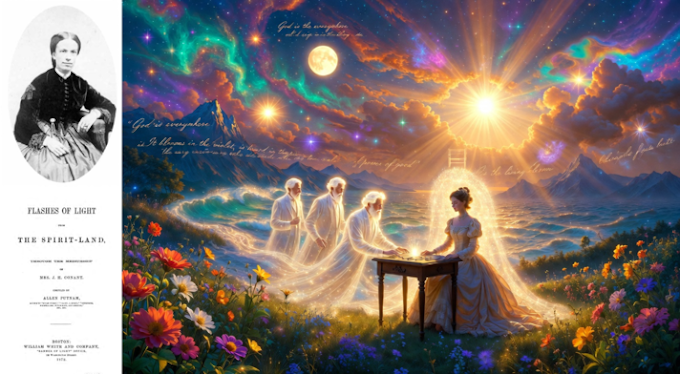
-imageonline.co-merged(1).png "Channeled Explanations About ‘God’ — Mrs. J. H. Conant (Frances Ann Crowell 1831-1875)")
Mrs. J. H. Conant (Frances Ann Crowell, 1831–1875) was a prominent 19th-century American spiritualist medium known as “the world’s medium of the nineteenth century.”
Born Frances Ann Crowell on April 28, 1831, in Portsmouth, New Hampshire, she was the daughter of Peter Crowell (who opposed formal religion) and Hannah Crowell (a member of the Chestnut Street Baptist Church who experienced spirit manifestations during her final illness). Her mother died when Frances was about 11, amid reports of raps, lights, and trances; a Baptist minister refused funeral rites, but a Methodist preacher officiated. Frances had a younger sister who died young and a brother, Charles H. Crowell, who was also mediumistic.
She received limited formal education in private and public schools in Portsmouth before leaving home around age 15 (c. 1846) to work as a tailoress in Lowell, Massachusetts. At about age 20 (c. 1851), she married John H. Conant (grandson of Prof. John Hubbard of Dartmouth College) and moved with him to Boston’s North End. They had no children; her husband later suffered mental illness linked to anxiety over her health and was eventually institutionalized.
Mediumistic abilities appeared early: as a child she experienced visions, heard spirits (including during fevers and a childhood fit), and had trance-like states. After moving to Boston, her public mediumship developed in the mid-1850s. She became known for physical manifestations (table levitation, object movement, spirit lights), trance speaking/lectures, locating hidden objects, moral guidance, and especially medical prescriptions and cures delivered through spirit controls—most notably “Dr. John Dix Fisher.” She was closely associated with the Banner of Light newspaper (founded 1857), serving as its business and circle medium. She held free public circles open to all, gave trance lectures (including at the Melodeon in Boston), and facilitated thousands of spirit communications and verified messages.
Throughout her life she suffered recurrent serious illnesses (fevers, consumption diagnosed at 21, gastric fever, etc.), which spirits were said to aid in managing. She lived in various Boston-area residences and continued her work into the early 1870s. She died in 1875 (at age 44).
The 1873 biography (compiled with input from her physician’s diary, letters, and spirit communications, and in part guided by the spirit of Theodore Parker) portrays her as a passive but powerful channel whose free circles and accessible mediumship made spirit teachings widely available. It emphasizes tested phenomena, predictions (including aspects of Lincoln’s fate), and her role in the Spiritualist movement.
This synopsis draws directly from the full text of the digitized biography available at the linked archive.org source.
-imageonline.co-merged.png)
Excerpt of a session when ‘Theodore Parker’ spoke through Mrs. Conant (Sept. 12, 1867)
The Presbyterian is bound hand and foot by a certain kind of belief, and he sticks to it, in most cases, very rigidly. Spiritualists are bound in the self-same way, for we find them here, there, and everywhere setting up certain very rigid standards of their own, and declaring that they are absolutely right, and there is no appeal from their standard. They have got the highest, the best, and the only genuine Spiritualism, when the truth is, the churches have had experience in it, and those who have no belief in any kind of God have had it. It is as free as the air. It is extensive as life. Spiritualism means something more than what is bound up in the simple name. It means the science of life. It means that life [/] God manifests through every kind of form, through every possible degree of thought. It means that God can rap upon a table to convince you that you will live after death, and not degrade himself, as he can speak through the highest angel in the courts of heaven. Spiritualism of itself is humble. It takes upon itself no crowns. It is exceedingly simple. A child may understand it. But they who prate so loudly against these lower manifestations, as they are pleased to term them, simply betray their ignorance — ignorance of God and his laws, ignorance of the alphabet of life. They would fain destroy the ladder over which they have ascended, because, forsooth, they need it no longer, or because they have entered the temple by some other way, though thousands and tens of thousands have need to enter it this way. They, in their foolishness, determine that God doesn’t understand his business, and because he doesn’t, they are going to guide the car of progress for themselves. But poor, puny humanity will find by and by that God is God, despite all forms and ceremonies, and he descends to the simplest manifestations of life without losing his Godship. He blooms in the violet, is heard in the tiny rappings. His voice is in the thunder, and his wisdom with the angels. He is everywhere
.Yes, these
manifestations are, in the majority, genuine, absolutely genuine, and whoso says they arc not, says what is false.E
xcerpt of a session when ‘William R. Channing’ spoke through Mrs. Conant (Oct. 17, 1867)Q. How do we reconcile the existence of evil in this world with the goodness and wisdom of God ?
A. We reconcile it in this way. As God is everywhere, and as there is no place without him, no condition without him, so then God is in what you call evil, and, being stronger than the evil, is amply able to take care of it. I believe that all the experiences of life, all the conditions of life, however low they may seem to he, are of a necessity, — a necessity growing out of the condition of the earth upon which you exist, a necessity growing out of the condition of the planets by which you are surrounded, and a necessity growing out of your own internal and external condition. Therefore, if this position be a correct one, the goodness of God is displayed in the exhibition of the so-called evil, as it is displayed in any other condition in life.
Excerpt of a session when ‘Professor Edgar C. Dayton’ spoke through Mrs. Conant (Oct. 31, 1867)
We are told that Massachusetts this day mourns the loss of a favorite son — an honored child. Though a sister State claims him by right of birth, yet Massachusetts claims him by right of love and public duties. But is he lost? Will no echo answer the question? Is the power that prompted him to kindly deeds and kindly words forever silenced in death? Will he linger no longer in the midst of the family circle? Will he bless no longer the Commonwealth of Massachusetts? Is he dead? These are questions that Massachusetts should answer. The spirit of the age can answer them to the entire satisfaction of Massachusetts whenever she shall call upon her for an answer. Are all those leading minds that made glorious the page of her history dead? Those who have passed beyond mortal state; those whose forms you have mourned over; those whose voices you hear no longer, are they lost? If they are, then Massachusetts is poor indeed. But thanks be to the overruling power and the Great Spirit of infinite love, they are not lost; nor are they removed to some far-off clime, to some distant star, to pursue a course of action entirely different from that they pursued while here. No; the power of love, though earthly, is infinite and grand. Death cannot touch it. Change has no power over it. It outlives all change. It bids defiance to death; for the Great Father of life has been pleased to crown it with his own being, and seal it with his own seal. It cannot die.
Even while we are speaking, the honored dead, — or he who is dead to you, — even while we are speaking, his happy spirit — happy in the consciousness of having done right so far as he understood it when here — is being welcomed to the land where the soul understands itself far better than amid the clogs of mortality. Every soul desires to hear those sublime and cheering words: “Well done, good and faithful servant; thou hast been faithful over a few things, now I will make thee ruler over many.” And the spirit of these words is being shed this hour upon him who has just left you. And he knows that his earthly labor is not done. Though the golden bowl is broken at the fountain, though the silver cord is loosed, yet life remains the same, and all those sublime traits of character that go to make up an honest man still live, and will be called into action in the world of mind whither it has flown.
Excerpt of a session when ‘William R. Channing’ spoke through Mrs. Conant (Nov. 25, 1867)
Returning spirits always inform you — such as have been informed themselves upon this point — that there is no forgiveness for sins. Every sin begets its own judge, and the judge begets the punishment therefor[e]. The three are so closely allied you cannot separate them. When you commit a sin against your physical nature, suffering is the consequence. When you commit a sin against your spiritual nature, spiritual suffering is the consequence — you produce punishment; a state of inharmony; and, as the spirit lives in heaven only by living in harmony, when it lives in the opposite it lives in hell, whether on the earth, under the earth, or in the skies. When it is in an inharmonious condition it is in hell. There are many degrees of inharmony, as of harmony. There are many degrees of heaven, as of hell. The child suffers a certain degree of hell by unconsciously outraging the laws of its physical being. The law does not excuse the little one because it does not understand the law. It acts precisely the same with the child as with the adult. It is no respecter of persons or of ages. The little one falls beneath its stroke as mature or old age falls beneath its stroke. It never fails to visit justice and judgment upon all who place themselves in antagonism to it. Your correspondent asks how it is in the case of cures performed by certain healing agents upon the earth. There is an end unto all conditions of existence. Conditions are changeable; they end that they may give place to others. Disease, inharmony, are but the conditions of life, subject to change. When the punishment has been severe enough the change comes. When the suffering one has suffered to an extent sufficient to induce him or her to seek the proper remedy, then there is a time to change. The spirit has received chastisement sufficient for the time, therefore salvation steps in in consequence of the exercise of reason. Now, when the criminal descends lower and still lower in crime, when his spirit has been deluged again and again with that which follows crime, — that mental suffering, that unrest, that dissatisfaction, — when, I say, it has been deluged again and again, by and by it begins to reason. The God without says to the God within, “Come, now, and let us reason together!” and the result is, the man or woman begins to feel that there is a better way, and that that way is for them as for others. They begin to seek to know of that way, to understand it, to walk in it, to pass out of the darkness of the present and enter the light of the future, and then begins a newer existence ; then the fogs and mists and inharmonies that are the result of crime begin to pass away, and the soul begins to be resurrected from it. Is it by a direct interposition of the Great All-Father without in the universe? It may be; but we believe that the spirit rests, progresses, and leaves the world by virtue of that glorious germ of progression that the Infinite has implanted within it. The germ cannot always remain in darkness. It will eventually find its way to the light, and eventually disperse the shadows.
Excerpt of a session when ‘William R. Channing’ spoke through Mrs. Conant (Jan. 6, 1868)
Q. Is God a power or soul permeating the universe, or a self-existent being, having habitation and personality with inconceivable capacities of knowledge, wisdom, and happiness?A. I have no belief in a personal God, except as I believe in God as being personified through every conceivable form. I believe God is a power permeating all mind and all matter, and forever and forever changing all according to his own divine life.
Q. Do the spheres exist as separate localities or one world, as the earth, presenting only a different aspect to different minds, soul-gravity and culture determining the society and scenery each one enjoys and earns?
A. The spheres spoken of by returning spirits are not localities, by any means, but they are conditions of mind, states of being. The spirit-world proper has been derived from the spiritual emanations of this world, therefore it is like unto it, only superior to it.
Q. If spirits can or are to re-manifest in human form, can they choose as to that form, and to the extent of their past earth experience elect as to their hereditary and intellectual conditions?
A. The spirit-form changes according to the requirements of the indwelling spirit, and according to the powers and capacities of the indwelling spirit.
Q. What generally becomes of families in spirit-life after a few centuries? Do they clan and cling together as on earth, or separate and become absorbed in the great family of mankind, or spirit-kind?
A. Spirits are gathered together in groups, suiting their needs. Whatever kind of intellectual life I may be attracted to, there I shall gravitate; and what is true in my case, is true in the case of every soul. If there is no natural or spiritual attraction between persons composing earthly families, they will separate in the spirit-world.
A. The will-power in each individual differs according to the capacities of the individual, and yet it is willpower, after all. The will-power that the mesmerist exercises over the mesmeric subject is simply will-power. It is his or hers. The will-power that belongs to the subject is will-power; nothing more nor less. But it belongs to the mesmeric subject, not to the mesmeric operator. Will-power is that force by which all spiritual motion is made. It is the life of intellect, mental motion; without it there could be no exercise of mentallity.
Q. The material universe, and, as far as we can understand, the spiritual universe also, are governed by fixed laws. Now, law implies a law-maker, or, in other words, an intelligence. Is that intelligence an individualized intelligence? If not, in what sense are we made in the image of God, and after his likeness? God being assumed to be the name of the author of these laws by which all things are governed?
A. Your correspondent, like thousands of others, is laboring under a great mistake when he confounds God’s laws with human laws for human laws pre-suppose the existence of a law-maker, but it is not so with divine laws. To my mind, the law of life is the God of life; the power by which all life is expressed and perfected. It is the personification of the divine power; wherever you see it, under whatever conditions it manifests, it is God. The law operating in soils, in minerals, in the atmosphere, in the water, in the skies, everywhere is God. There is no power outside of this law that we can recognize as God. No great intelligence fashioned with a human body. By no means; and the sooner you cast off this mental and theological darkness, the sooner you will rise into clearer light. I know it is almost impossible for the human mind to conceive of law without conceiving of a law-maker; but I know also that the impossibility arises from your education here, and from nothing else. You go to work here, and you make laws for the various departments in life. There is the maker. There is the law. It is not so with the law that governs in the universe. It is not so with the law that holds you and me in our proper places. It is not so with that power which determines concerning our well-being. It is a power, an all-pervading existence, that has all forms for its own, but claims no specialty of form whatsoever. Man is made in the image of God simply because he holds within his physical form all the elements that exist in the universe. There is nothing, no kind of life, that man in the physical does not hold within himself. He is a microcosm of all beneath him, and stands as the crowning glory of creation. In this sense, and in this alone, may he be said to be created in the image of God. Because created in the image of all things beneath him, he represents all things, holds all things, embraces everything. In this sense is he in the image of God
.Q. Have not good and evil always co-existed? Could we understand one without the other?
A. No, certainly not. Why, if I thought that the devil was going to take his leave from the world of mind and the world of matter, I should be miserable indeed, and for this reason: I should know that God, or the great, good power, would be robbed of half its glory. What would you know about good, fine, pleasant weather, if there were no storms? You would weary of it very soon. What would you know about appreciating the sunshine, if there were no clouds that passed over the sun’s face? Why,
I think the devil is one of our very best friends, and instead of putting horns and hoofs to him, we ought to array him in garments of light, and call him what God calls him — very good.
Q. Are we not placed here in order to gain knowledge from adverse circumstances, that we may be better fitted for the life which is to come?
A. Why, certainly. Do you suppose you would appreciate the joys of what you call heaven, the heaven of the spirit-worId, if you had always passed through a sort of an easy, free life here? Why, no. You would say, “I had about as good as this on the earth.” You would hardly know which you liked best. They who have been crushed under the wheels of adversity are the souls who know how to enjoy heaven. Why, I am only sorry I did not have more adversity when here. I am only sorry I did not drink deeper of the cup of bitterness, because if I had I should have a keener relish for the joys of heaven. My relish is very keen now, but it would have been enhanced a hundred fold if I had only suffered more when here. That is why the returning spirits always tell you that though they suffered much here, they cannot afford to part with the remembrance of it — they are very glad to have passed through it.
Q. This being the case, then, in order to secure the future happiness of our friends, ought we not to begin to torment them all in our power while here?
A. By no means. And you could not if you would, for the law of your destiny has you in its grasp, and you cannot escape it. You can torment them just so far, but no farther. If you have a mind to, you may try it, and see how far you can go. You would very soon weary of it, for you would find the torment reacting so fully upon yourself, that you would get sick of it.
Excerpt of a session when ‘Theodore Parker’ spoke through Mrs. Conant (March 19, 1968)
Q. What is God essentially?
A. Everything. Essentially you are God, I am God — the flowers, the grass, the pebbles, the stars, the moon, the sun, everything is God. Now, that may seem to be a very material idea of God, but in reality it is not. If you can show me where God is not, then you can force me to believe that God in essence and God in form is not everywhere present to our understandings. God to me speaks through the water and the dry land; through the skies, through the flowers, through the mountains and the valleys. I cannot understand God as existing outside of Nature.
Excerpt of a session when ‘Joseph Lowenthall’ spoke through Mrs. Conant (April 23, 1868)
Q. “God sent his only-begotten son into the world that whosoever believeth in him shall have eternal life.” My mind dwells on the “only-begotten” as the point at issue with the belief of Spiritualists.
A. Your speaker has no belief in an only-begotten son of Jehovah. He never did have any — therefore in all probability will fail to do justice to the subject according to the comprehension of the Christian world. Your speaker believes that every son and daughter of humanity, whether they had an existence in the past, or existing in the present, are the begotten sons and daughters of Jehovah, every one of them, not one any more than another. The breath of the Infinite is with all, and all are created in the image of God, which meaneth in the image of all things that have been, of all that are, and all that can be. This only-begotten son of God, whom the Christian Church reverences, so much, was doubtless a most excellent specimen of humanity, but nothing more. It may be determined that your speaker still lingers amid the shadows of the Jewish Church. It is not so. No shadow of any Church, Jew or Gentile, lingers around the opinion of your speaker. I believe in the greatness, in the omnipotence of God. But I do not believe that one child is more specially blessed by him than all others. I have more faith in his justice than to believe him to be a partial God. I believe him to be the Great Spirit pervading mind and matter, acting through all things, at all times, in all places, and I believe he finds expression more perfectly through human senses than anywhere else, but no more perfectly through a Jesus of Nazareth than through any other good man or woman.
Excerpt of a session when ‘William R. Channing’ spoke through Mrs. Conant (Sept. 22, 1868)
Q: Please define the Deity. In your invocation you seem to address an Eternal Spirit;
A. I can only define God to my own satisfaction, not to the satisfaction of any other individual in the universe. To me, God is the living, eternal power of good that I see everywhere. I see this power in the flowers, in the rocks, in the air, in everything that I behold. In all things with which I come in contact I recognize this power. To me it is good; it is God. There is something of good in all things to me. In this sense I am a materialist. I do not believe in a God apart from his works. I do not believe in a God outside of nature; but I believe in one that is in and around us, and in all with which we come in contact. To me this is God. You may call it Jehovah, or Brahma, or by any name you please, but it is the great, living spirit that permeates all things and controls all.
Excerpt of a session when ‘Father Henry Fitz-James’ spoke through Mrs. Conant (Dec. 8, 1968)Q: You closed your invocation with the term “Father, Son, and Holy Ghost.” How are we to understand that? A: The term is used simply to convey the idea of the past, present, and future — an all-sustaining life that ever has been, that is, and ever will be.
Q. la the Deity a being, or is he a principle pervading all Nature? If the latter, why do you address him as a being, in the invocation?
That our God is a personal, and also an impersonal God, is equally true. Since the God-power or God-life is everywhere, he, it, or she ia of course personified everywhere. I believe in the worship of all that is worthy of worship. If it is the flower, let us worship there. If it is the human soul, let us worship there. If it is a lofty thought, let us worship there. Wherever we see anything, or perceive any state, either of mind or matter, that is worthy of worship, there we should worship. All Spiritualists, I believe, consider God to be an infinite principle pervading all forms, occupying all space. I believe this. I have seen nothing during my life in the spirit-world to cause me to believe otherwise. I did not believe it when here. But the Book of Life hath been so widely opened to me since death, that I can come to no other conclusion than that God is a principle pervading all forms, and occupying all space. God is in the atmosphere, and is the atmosphere. God is in the sunlight, and is the sunlight. God is the sun and the shadow. He is everything, and is in all places. It is absolutely useless to endeavor to confine God to any particular place or state of being, for could we do that, we should rob God of the God-power. We should at once chain this great eternal principle, this infinite life, to finite space. We should at once bring it down within the scope of human analysis. And I, for one, am glad we cannot. But we have been so in the habit of addressing this Deity, this Power of Life, as though it were a man or woman, a personality like ourselves, that it is very hard to change our course; and indeed it would not be well for us so to do, because, as I before remarked, our God is a personal God, and therefore it is proper that we should thus address him.
Controlling Spirit. As we are in the constant receipt of inquiries from friends at a distance — questions propounded to the controlling spirit of the séance — it may not be amiss to make a few plain statements with regard to the case in question. In the first place, it should be understood that these séances are not controlled at all times by the same spirit, but for each occasion an intelligence is selected best adapted to that occasion. Persons sending their inquiries from a distance do not seem to understand this, and they often inquire in regard to the difference of opinion that seems to find expression through the said controlling spirit of the circle. It should be understood that each distinct intelligence, or human spirit, retains its own special intellectual integrity after death as before. All are entitled to their own opinions and the expression of the same, if they express themselves at all. All questions relating to well-developed scientific facts will, without doubt, be answered, by all intelligences coming here, in a similar manner. The idea will be one and the same, though the expression or clothing of the idea may be different in all. But with regard to all questions of theology, you must expect that each spirit will preserve his or her own opinions, and if questioned will give them according to their best ability so to do. Theology is but a vagary at best. It is founded upon speculation. It lives by speculation. It cannot by any possibility be demonstrated by science. As theology it has no part with science. Science and it have never been married, and never will be, because theology, as understood in human life, is thoroughly at variance with science; therefore all questions propounded with regard to theology, of whatever caste or color, will be answered by the spirit controlling on the occasion as he understands it. The Catholic answers in his own way, the Protestant in his, the Mahometan in his — each in accordance with the theological light they have received. You make a very great mistake, oftentimes, in supposing the departed spirit to be possessed of an almost infinite amount of knowledge regarding all subjects. You forget that they are still human, bounded about by the conditions of human life. They are not infinite. They are finite still. And though their clairvoyance is largely unfolded in spirit-life, yet it does not extend to infinity. It only reaches a very small degree into the future. It does not perceive all the past, neither does it all the future. It can take cognizance of events as they come within its sphere of action, but no farther. Now, then, consider the friends who come to you from the other life as human, fallible, and entitled, each one, to their own opinions. You gave them that liberty while they were in the mortal form, and if you are wise and just you will give them no less now.
Q. What is the medium of exchange in the spirit-world? or what is used there as our money is here?
A. Merit; that which belongs to the inner life. Whatever you merit you will have. There is no special medium of exchange that is equivalent to gold, silver, and greenbacks, in our life. You may be very sure of that. But there is a medium of exchange. If I have what I do not need, and my neighbor has need of it, I pass it to him. If he has what he does not need, and what I need, he passes it to me. There is a perpetual interchange of the good things of spirit-life. None can retain any more than they have need of. A very hard place for misers to come to, particularly before they get rid of their miserly propensities, I assure you. So if you have any such, better get rid of them here.
Excerpt of a session when ‘Theodore Parker’ spoke through Mrs. Conant (Sept. 27, 1869)
Q. We are told every person has a spirit-guide. If this is so, by whom or by what law are they appointed ?
A. It is to be supposed that every person dwelling here in physical life has some one spirit, if not more, who, in obedience to the law of want and supply, will be attracted to him or her. These spirits take a deep interest in them, and exercise a watchful care over the frailties of human life. Such would be considered guardian spirits. They are so by virtue, of spiritual law; they come to you, if at all, by spiritual attraction. All souls, as well as the atoms of life, are repelled from or attracted to each other, as the case may be, by fixed law. If a soul is drawn to you, it is drawn by law, fixed law, and becomes your guardian spirit by law. Love is an attribute of law, divine, perfect, and holy, and it is the avenue by and through which your guardian spirits work.
They love you, hence they seek to do you good; they come to you and watch over you. Because you are told that each has a guardian spirit, you are not to suppose that they are always present, and never absent. They come when the law of their being and yours demands that they shall come. Are you sick? You desire to be well, and your interior life instinctively and naturally extends out for something higher, beyond you, to make you better. It matters not whether it be the great God, or some kind spirit; and this desire reaches out to these spirits, and they come to you because they love you. When the need is supplied, they leave you, and wait till the next occasion brings them to your side.
Q. Does not the idea of a spirit-guide interfere with the freedom of our actions, and our responsibility to God?
A: By no means; because these spirit-guides are not your leaders. You may as well say that you are not responsible beings, because you were not born such; because you had fathers and mothers who diligently cared for you till you were well able to care for yourselves. These guardian spirits do not take away our responsibility or our individuality; but they only aid us when we need aid. They are to us as supporters when we need them, but they are not our leaders.
Excerpt of a session when ‘Theodore Parker’ spoke through Mrs. Conant (Nov. 1, 1869)Q. Is there such a thing as sex of the soul, independent of sex of the body; and if so, does it ever happen that male souls are incarnated in female physical forms, and vice versa?
A. The positive and negative forces of life, the male and female forces of life, are everywhere distinct in themselves until they reach such a high spiritual altitude that they are merged in one. It is then that the male and female become one in spirit, acting in divine harmony with the God-spirit. They are then, to all intents and purposes, gods, male and female. In this sense, the male becomes the female, and the female the male, but in no other sense.
Q. Will the time ever come in their spirit-life when such souls shall assume a spirit-form appropriate, in outward seeming, to their true sex?
A. Yes; a law, divine and human, is constantly outworking itself through form, for the perfection of form, for the highest revealment of the God-life; and what may be expected for one’, — namely, perfection, — may be expected for all.
*
Compare this description with transcripts from other extensively documented trance channeling case chronologies — Example Article: “Channeled Descriptions About the Creation of the Universe, Earth Beings and Soulmates”