







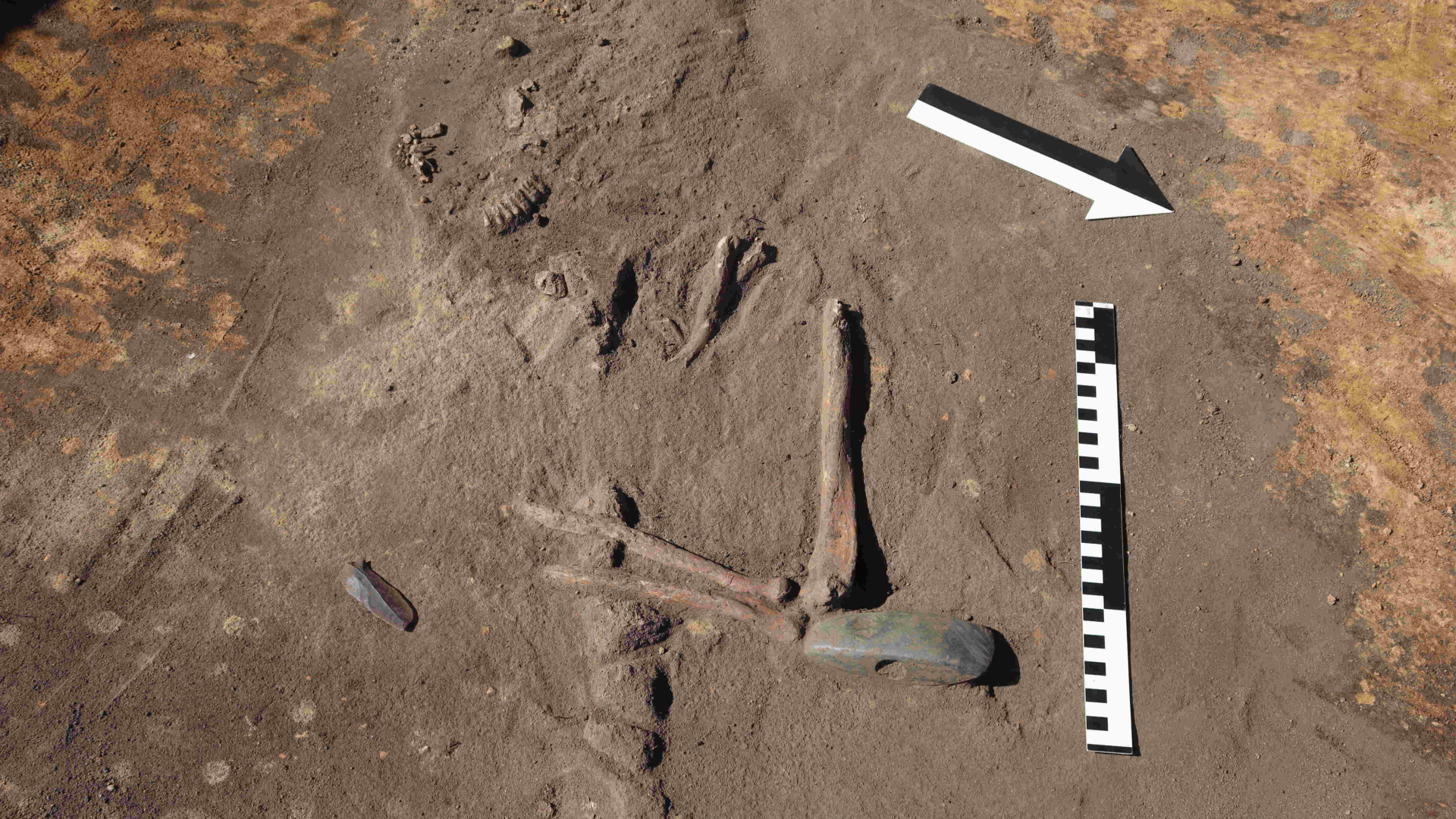
Archaeologists were excavating in a Roman-period cemetery in Poland when they came across something extremely unusual: the grave of a man who was buried with two decapitated human heads, a necklace made from 42 mammal teeth, and a battle ax. That ax provided an important clue: He was actually from the Stone Age, three millennia older than the Roman cemetery.
“We were practically packing up, and then we discovered a circular shape in the ground and began digging,” .
“It’s possible we’ve discovered the grave of a warrior or hunter, but because of this necklace, we can assume it was someone important, for example, the leader of a family clan,” Dąbrowski said.
The burial also contained the remains of two human skulls, which the archaeologists think may be from decapitated heads that were buried with the man as gifts or funeral offerings. However, further analysis of the skulls is needed to confirm or rule out decapitation, according to the first statement.
- Man rummaging in a Polish junkyard finds a 1,800-year-old shield holding the cremated remains of a Vandal warrior
- 800-year-old ‘hugging skeletons’ are genetically confirmed as Poland’s only medieval same-sex double burial
- Medieval knight ‘Lancelot’ and his stunning stone tomb found under ice cream shop in Poland
A similar elite person’s burial filled with axes, flint tools and amber beads was previously discovered nearby, the researchers noted in the statements. In that case, the bones of a calf suggested that the animal had been sacrificed at the grave. But to date, these are the only two burials of their kind in the area. According to the statements, they might be from members of the Corded Ware culture, which likely spread Indo-European languages around Europe and Asia.
According to Dąbrowski, the next step is to analyze the remains from both Stone Age burials to figure out if the people were related and what their lives were like nearly 5,000 years ago. He expects the first results of the analyses to be available later this year.
What do you know about the Paleolithic, Mesolithic and Neolithic eras? Find out with our Stone Age quiz.