







Cory Doctorow shares my fascination with statistics and the information it can reveal that would likely otherwise remain hidden. I credit regression analysis and obsessive data collection with helping me survive a debilitating bout of ulcerative colitis twenty years ago, and preventing a recurrence.
He recently pointed readers to another data analysis geek, blogger Lauren Leek, who just wrote a post ostensibly about the shrinking diversity of shops on Britain’s ‘high streets’ (‘main streets’ to us North Americans). She presented the data to prove it. But three words in her preamble suggested her assessment was a metaphor for a larger cultural phenomenon: flattening into sameness.
Twenty years ago in his better days, Canadian writer Terry Glavin wrote the awesome biodiversity-loss odyssey book Waiting for the Macaws, in which he repeatedly lamented “the dark and gathering sameness of the world”. He was writing about biological sameness and the physical monoculture of human built spaces, but Lauren is hinting at the same phenomenon in the loss of diversity of human cultures and our artifacts.
I should note that these terms sameness and flattening are not the same thing as homogenization or the notorious ‘melting pot’ metaphor, where the consequence of the process is a richer amalgam containing the best of its components, intact. Rather, sameness and flattening are attributes of extinction — the eradication of whole ‘species’ and their diverse components in favour of impoverished monoculture.
Decades of personal observation have made this phenomenon pretty impossible for me to ignore. But rather than lamenting it, I’m more interested in understanding why this impoverishment, which is seemingly counter-evolutionary, has happened, and what its consequences are.
When I started to study this, I was immediately drawn to how this phenomenon related to another phenomenon I’ve written about lately: Our species’ intolerance of difference.
It would seem sensible that intolerance of difference would tend to lead to flattening into sameness. So how would this ‘vicious cycle’ play out? And could it be ‘broken’?
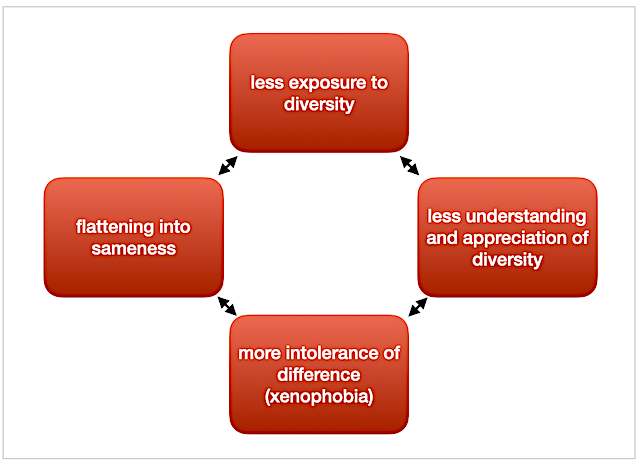
As a student of complexity, I’ve learned to be skeptical of inevitably simplistic ‘systems thinking’ diagrams, but they can be useful as a starting point for analysis. So I put together a system diagram to show some of the major components of this phenomenon, which is shown at the top of this post.
This is not a classic vicious cycle, since any of the four attributes of this phenomenon can reinforce all of the others. But it can have the same effect: Less exposure to diversity and real differences and choices -> less understanding and appreciation of the advantages of differences and alternatives -> less tolerance of differences (xenophobia) -> flattening and sameness, and on it goes.
Grow up in an area with no diversity (demographically, economically, culturally, politically uniform), you’ll never be exposed to other demographics and other ways of living and thinking, and their unfamiliarity can make you averse and even fearful of them (since you can’t understand them), and hence discourage such diversity from entering your neighbourhood, or your thinking.
This isn’t just a geographic and political/cultural/economic phenomenon. We see it often in individuals as they age, slow down, explore and mix less, and hence can easily become more conservative, fearful, intolerant, and distrustful.
And as Lauren explains, this cycle can easily be exploited by the rich and powerful to develop and entrench monopolies and oligopolies and narrow your ‘consumer’ preferences to a small range of non-choice choices they control (“you want KFC or Taco Bell”?)
This happens in all human systems. But it can’t be sustained in natural systems because the evolved laws of evolution favour continuing experimentation with minor tweaks to see whether they produce more ‘fitness’ in every evolving ecology. Diversity is constantly being introduced and tried out, and the ‘players’ have no choice but to accept and adapt to it unless it is truly ‘unfit’. And natural ecologies are staggeringly complex. If anything, they are intolerant of sameness, and will introduce belligerents (new predators, viruses) when there is too much sameness in a concentrated area reducing the ecosystem’s resilience.
In human systems, though, we constantly suppress and interfere with these natural processes. Why should this be? One argument is that too much openness between human tribes runs an increasing risk of contagion from diseases each tribe has no natural resistance to. Another argument is that humans can only survive in community with other humans, and cultural homogeneity contributes to social cohesion, without which the communities would fragment and disperse too easily. I’ve advanced another theory, that our intolerance of difference stems from a uniquely human defect called brain entanglement, which makes us unduly fearful.
Whatever the causes of our intolerance of difference and hence our civilization’s relentless flattening into sameness, what (besides self-perpetuation) might be some of its consequences?
I’ve already mentioned how vulnerable this ‘system’ makes us to exploitation by corporate oligopolies, and how it can make us xenophobic and untrusting, and reduce our societies’ resilience. It can also be exploited by politicians that propagandize us and stir up fear and hatred of ‘others’, especially in large countries like the US with poor education systems where most citizens rarely if ever travel to see different cultures.
Another consequence, I think, is the slow atrophying of imagination and innovation, which require a diversity of ideas and information to flourish. Likewise, monocultures are sterile ground for learning: We learn most from exposure to different ways of thinking, being, and doing things. And perhaps the most insidious consequence of sameness is how it can sap our personal and collective curiosity: If you’re afraid of what you don’t know, you’re not going to seek it out.
This flattening into sameness even shows up in our chosen forms of entertainment and recreation: TV, film, and music programs (as Lauren has also explained) now allow you to pick from an enormous variety of choices, but, thanks to our culture and the algorithms we use to choose what we watch and listen to, we are actively exposed to few of these choices, so we almost all choose a pathetically tiny sliver of what’s available. We have the appearance of enormous choice, but de facto we have less and less, and our tastes narrow every year. The result, as many film and music critics have lamented, is mediocrity in ‘mainstream’ offerings, as when diversity and novelty ceases to be valued by ‘consumers’, profit-minded producers quickly become disinclined to offer it.
Is there any way out of this cycle? Are there examples where this cycle is not happening?
My sense is that humans, and human cultures, change when they must, and not often before. Think of the metaphor of a vast Round-up-poisoned corn field. Good luck trying to change it into healthy permaculture farm or forest garden while the existing monoculture is profitable. But once it’s gone bankrupt and been abandoned, it will, sooner or later, self-manage until it is once again a diverse, sustainable ecosystem.
A world flattened into sameness is an unnatural world. In time it will recover. And if you’ve been fortunate enough not to get caught up in this cycle yourself, there are still pockets of diversity everywhere — geographically, economically, intellectually, creatively, socially. They’re mostly smart enough to keep a low profile, but they can be found.