





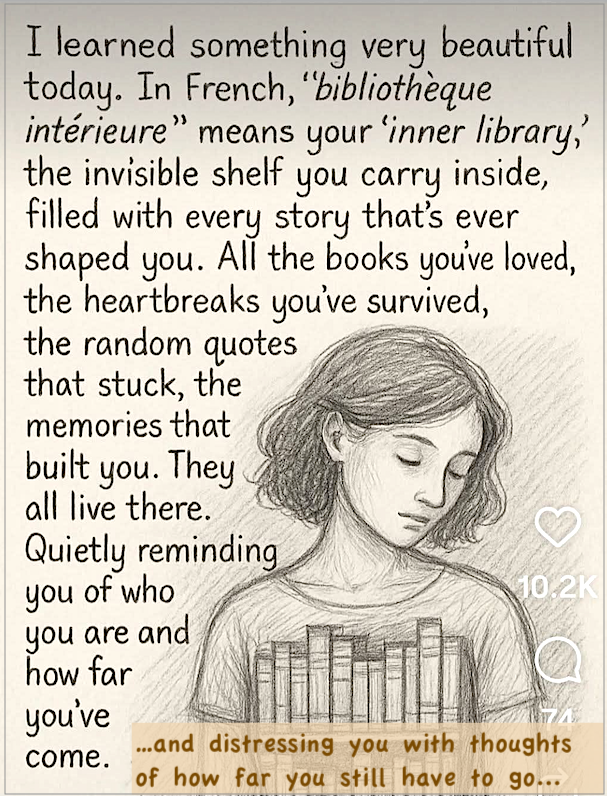
Graphic and artwork from the memebrary; original source/artist unknown. Graffiti at the bottom is, of course, mine.
In our culture, it is blasphemous to bad-mouth stories. Stories are “all we are”, we are told. They are what distinguishes us from ‘lesser’ animals. They are the building blocks of the soul, of our morality, of our ‘consciousness’, of our entire civilization. In a sense, all these assertions are correct. But not, IMO, in the sense that most story-lovers would like us to believe. As I continue to study neuroscience, human nature, human history, and the nature of reality, I am coming to believe that stories are, in addition to the above, also the essential expression of our unique human dis-ease, our species’ collective derangement.
If that idea offends you, you might as well stop reading now, because it gets worse. Go read something else about the power and magic and mystery of stories. Lots of that out there, including not a few articles I’ve written myself.
My thesis, evolving over the past dozen or so years, is that due to an accidental, unpredictable evolutionary event, the human brain, at some point in our distant past, suffered a disastrous accident — to oversimplify a bit, the left and right hemispheres of the brain, which in all other creatures, and in early humans, had specific and distinct functions to optimize our species’ survival odds, became ‘entangled’. Suddenly, we were uniquely able to imagine things that we hadn’t directly perceived, and then, having conjured up those imaginings, we were able to believe that those imagined things were somehow actually ‘real’.
The consequences of this entanglement were at once marvellous and terrible. Without it, it would seem, we would not have been able to conceive ourselves as ‘selves’, individuals, separate from ‘everything else’ and from everyone else. Without it, we would not have the cognitive capacity to invent languages and stories.
But also, without it, we would not have the capacity to invent and propagate destructive, cruel, fictitious stories and misinformation, to perpetuate propaganda to incite fear and hate and get support for wars, or to make unsupported and often unwarranted judgements of the reasons why people did things. Without the sense of a self as a continuing, separate individual being, we would not be subject to the terrible fear and need to protect that separate self from everything else that might (we imagine) pose a threat or danger to ‘us’. And, apparently, we would also not be able to feel ‘judgemental’ emotions like chronic anxiety, dread, hatred, indignation, harsh judgement, blame, shame, guilt, loneliness, nostalgia, regret, envy, and inconsolable grief.
Of course we would still feel the ubiquitous animal emotions of fear, rage, excitement, and sorrow; but in order to hate, especially for a protracted period, you have to be able to judge and to impute motive and intention, and we would seem to be the only species with a brain capable of doing that. Even the poor dogs conditioned to snarl and attack on command are merely acting out their conditioning. They do not ‘hate’ the person they’ve been trained to attack.
I’ve tried to capture this distinction in the following chart:
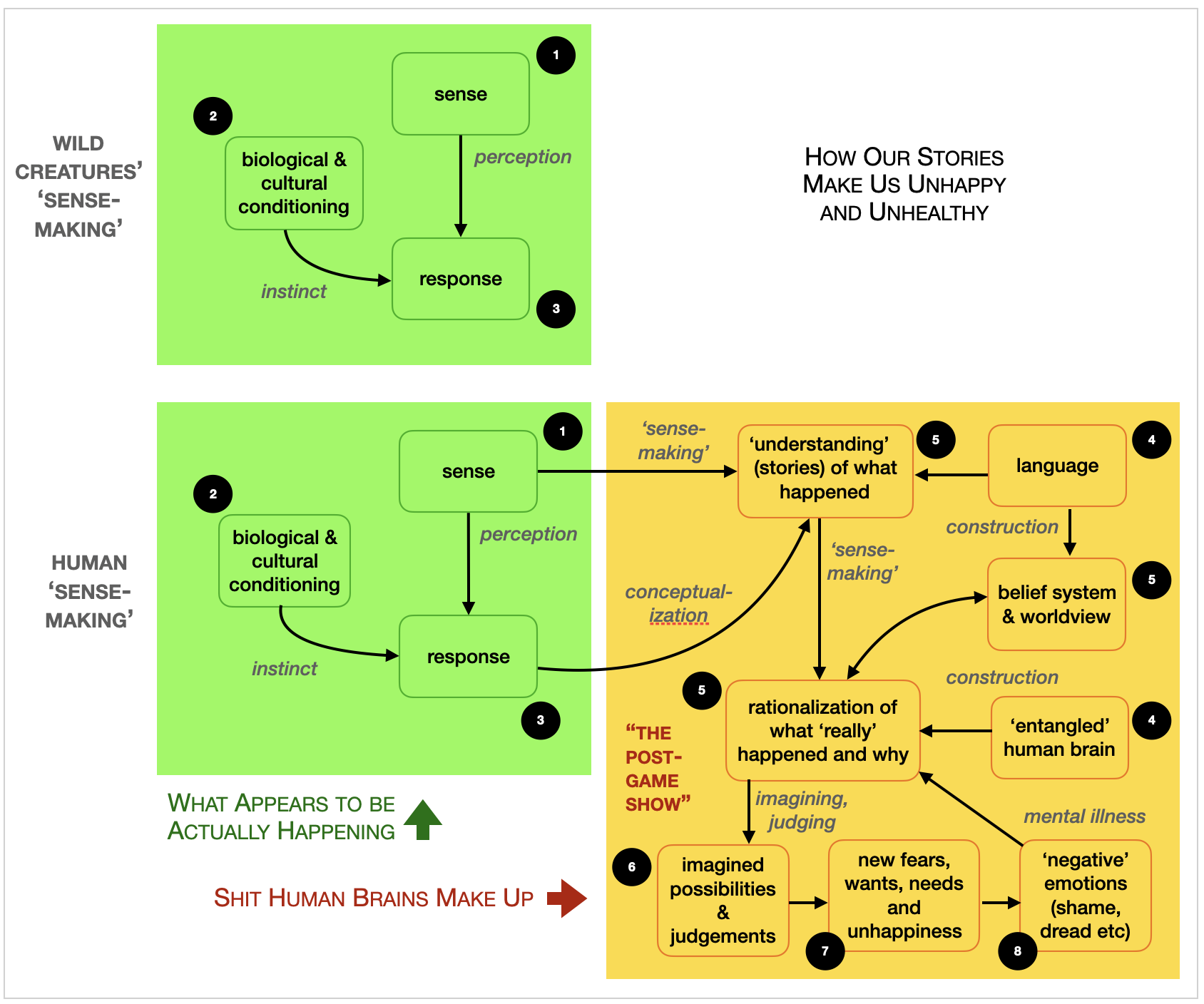
Here’s a brief walk-through of what this chart is trying to convey:
A. All animals have evolved a basic combination of perceptual and instinctive capacity needed to survive and thrive in their environments. That instinct is ‘informed’ by a combination of our biological conditioning (“nature”) and our cultural conditioning (“nurture”) (1, 2, 3 in the chart).
B. Humans, seemingly uniquely, have this additional capacity (and propensity) to try to conceptually ‘make sense’ of, and to rationalize (provide explanatory causal reasons for), what they perceive to be happening. This capacity draws on, and seemingly requires, the unique human capacities for abstract languages and story creation. And it requires, apparently, this peculiar entanglement in our brains. (4)
C. This capacity has three consequences: First, we create stories about what we perceive has happened. Those stories are necessarily fictions, but we do seem to want to believe them — even if it entails self-deception and outright invention. Secondly, we rationalize what we think all of these stories ‘mean’, and specifically what the causes are for what we think (or want to think) happened. That requires us to imagine a host of possibilities, some of them awful, some of them absurdly optimistic and just asking for letdown. And thirdly, we bundle this package of imaginings and stories and rationalizations up to create our belief system, with our ‘worldview’ as its scaffolding. And once we’ve assembled it, is seems to be in our nature to fiercely resist any challenges to it. (5)
D. And finally, this triptych of meaning-making fuels what Eckhart Tolle has called the egoic-self/pain-body vicious cycle: Our ‘thoughts’ about what is actually or possibly ‘really’ happening can, when those thoughts are unpleasant or fraught with uncertainty, provoke the host of ‘negative’ judgemental emotions mentioned above, and arguably those feelings can render us emotionally ill. And those emotions feed back into our sense-making apparatus, provoking in turn more fictional, terrifying stories, rationalizations, fears, wants, needs and other generators of deep unhappiness. (Some radical non-dualists call this “the closed loop of ‘me’”). (6, 7, 8, 6..)
Which would be sad enough if these invented thoughts and judgemental emotions were objectively, verifiably warranted. But because we seem to be the only species afflicted with this spiral of “made up shit”, it’s not only debilitating (to the point it has arguably produced the current accelerating global multi-system collapse and the accompanying great extinction), it’s also horribly tragic. No one asked for this mental machinery for misery.
And yet it’s completely understandable. There are perfectly logical reasons why our brains evolved the way they did. There are hence perfectly logical reasons why we behave the way we do, and why we are, most of us, perennially dissatisfied and unhappy.
And likewise the development of stories as perhaps our species’ most astonishing, differentiating ‘super-power’ is completely understandable. I think of stories a bit like the way I think about AI — endlessly fascinating and very likely disastrous. The little homily at the top of this post, which I have desecrated with my postscript, is a lovely and affectionate ode to stories. They’re so beautiful, so stirring, so clever — how can we possibly not love them? How can we not believe them to be true?
Here’s another story that started making the rounds on social media about six years ago, and which has been shared thousands, perhaps millions of times:
My name’s Calvin Brooks, I’m 46, and last Tuesday at Maple Ridge Market I saw something that shook me in the quietest, most unexpected way.
I was standing in aisle 3, waiting to pay for a few things for my kids’ lunches — cereal, apples, and juice boxes — when I noticed a teenage boy ahead of me.
Maybe 14.
Backpack torn at the strap.
Shoes worn out at the toes.
Holding a basket with nothing but:
• a loaf of bread
• peanut butter
• ramen noodles
• and a carton of eggs
The total came to $14.27.
The kid pulled out a handful of crumpled bills and coins — all he had — and quietly said:
“I only have six dollars. Can you put the eggs back?”
His voice wasn’t embarrassed.
Just tired.
Like someone used to making choices no teenager should make.
The cashier began removing items, scanning backwards, trying to help him find something he could afford.
He kept saying, “It’s okay… really. I’ll figure it out.”
But you could tell figuring it out was all he ever did.
And suddenly, the father in me kicked in.
I stepped forward and gently said,
“Hey buddy, put everything back. I’ve got it.”
His head snapped up.
“No, sir — you don’t have to. I can just… get less.”
I shook my head.
“My son is your age. He eats like a tornado. No way I’m letting you leave here hungry.”
The cashier paused, eyes softening.
The boy swallowed hard.
“Thank you. I… I didn’t think anyone noticed.”
I tapped my card before he could argue.
Paid for everything in his basket, and a few extras I grabbed from the impulse rack — granola bars, fruit snacks, a pack of bottled water.
He held the bag like it was made of glass.
Then he said something I’ll never forget:
“My mom works nights. I wanted to surprise her by getting groceries so she didn’t have to. She’s been really stressed. You helped more than you know.”
I felt my throat tighten.
Here was a kid trying to take care of his mom… with six dollars and a heart bigger than most grown men.
As he walked away, the woman behind me whispered:
“We need more people who step in like that.”
But here’s the truth:
I didn’t do anything special.
I just paid attention.
We can’t fix everything.
We can’t save the world in a checkout line.
But we can notice each other.
We can step in when someone is quietly drowning in the everyday battles we walk right past.
That boy taught me that.
He reminded me to look up.
To look around.
To be the kind of person I hope my kids become.
The Lesson:
Kindness doesn’t need permission.
It doesn’t need a reason.
Sometimes it’s just…
a dad behind you in line
with a little extra
and a heart that remembers what it’s like to need help.
One small act.
One kid.
One moment that could change the way he sees the world —
and how the world sees him.
Isn’t that an amazing story? I cried when I first read it. I still cry every time I read it.
But, to my chagrin, to my horror, even — when I tried to track down ‘Calvin”s site to credit him with the story and provide the link, I came up empty. No reports in any local media about the event. No ‘Calvin Brooks’ to be found. No! I shouted to myself. I refuse to believe this isn’t a true story.
And then the clincher: There are several other heart-warming, tear-jerker stories out there that use different names but the same unusual staccato story-telling format. And none of those people can be found either. These stories are entirely made up. They might even have been produced by AI. No! I could never be taken in by such a hoax. How dare someone do this?
That is the astonishing power of a story. It doesn’t matter if it’s true. It’s a wonderful story. We will believe it to be true, no matter what proof we might be given of its falsity. It fucking has to be true.
These stories! And the rest of the fictional shit our brains make up! They move us to tears. They change who we are. They move nations to war and maybe sometimes to peace.
And it doesn’t matter if they’re true. None of it matters. All there is is the organism of all life on our planet throbbing and gyrating, taking stuff in and throwing stuff out, parts of it eating and killing other parts of it. And then, layered on top of it all, this thin veneer of stories, all make-believe.
That is who we are.