






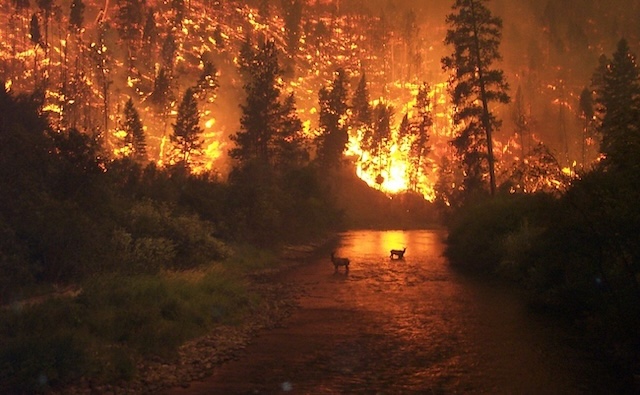
Image of wildfires in Montana comes from rawpixel.com, and is labeled Public Domain.
The media are full of ‘explanations’ (opinions) about what is going on in the world. What is Trump thinking. What does country X ‘want’. Why is this the way it is. What will happen next. Why does the Epstein Class behave like monsters.
Great fodder for the doom scroll. Easy to come up with, since every idiot has an opinion. But really absolutely useless. Un-actionable, and very reaction-able.
Meanwhile, what is important, I think, is understanding the gestalt, the sense of growing anxiety, disquiet, uncertainty, helplessness, and dread that underlies what is going on. Why, in the midst of a growing economic, political and ecological collapse, are most of us almost entirely preoccupied with some unfathomable event that’s happened in the last 24 hours?
Radical ecologist Elisabeth Robson has done us a favour by taking us above the trees and given us the broad view of the forest — the ecological state of the entire world and its longer-term trajectory. In her article Remaking the World in an Age of Overshoot she summarizes the current state of global ecological collapse — 73% of the wildlife that lived on the planet in 1970, when we were warned in Silent Spring of where we were headed are now gone — and that rate of loss is accelerating. In their place, we have ‘remade’ our world into one of urban sprawl, monoculture agriculture soaked with pesticides and herbicides, with barren soils sustained only with fertilizers imported from far away, poisoned air and water, massive forest loss from wildfires and clearcutting, and desolated wastelands no longer capable of supporting any complex life.
And still, we quibble over the arrangement of the deckchairs on Earthship Titanic, and the election every four or five years of new captains for the sinking ship.
Elisabeth starts with the well-understood phenomenon of what William Catton called overshoot — that we are now living wildly beyond the carrying capacity of our planet just to support the current population of humans, let alone future billions of humans and the dwindling numbers of all other life on Earth.
We hide the accounting for this horrific situation by endlessly borrowing from future generations, from impoverished, desperate nations, and from the out-of-sight remaining lands not already appropriated for the fragile, unsustainable, unnatural prosthetic human ‘world’, so we cannot see, after all the ‘adjusting entries’, that there is already not enough to go around.
This, and our dawning realization of its consequences, is what I think underlies everything that is happening in our world: The genocides, the wars, the hoarding and authoritarianism of the Epstein Class, the denial of what cannot be fixed or hidden from the outraged view of the citizens who are now witnessing the early stages of utter civilizational chaos and collapse. Get yours now, by any means necessary, because soon there won’t be enough. ‘They’ don’t want to tell us, and ‘we’ don’t want to know. Like children in a broken playground, we just want someone to fix it quickly and tell us that it’s all looked after, so that soon the future of our dreams will finally arrive.
I can’t imagine a better example of utter madness. Everything we are doing now is insane, when you look at it from the broader and longer-term perspective of what it means for our planet.
With our engineering mindset, Elisabeth says, we are constantly obsessed with remaking the world in some ‘better’ way. So we can’t see that ‘remaking’ things when the underlying systems are rapidly collapsing is not going to accomplish anything.
So, she says, the left just wants ‘democratic’ extraction instead of extraction controlled by the corporate Epstein Class, and has embraced the absurd ‘abundance movement’, as if positive thinking about the growing global scarcity of everything essential for our (and other creatures’) survival will magically solve the predicament of collapse.
When there is not enough to go around it is easy for us to focus on deciding who gets the essentials of life and who does not. We want to remake the political process in times of scarcity, chaos and collapse, as if redistributing power and wealth will allow us to conjure more out of less, and less, and less to go around: “A finite (or shrinking) pie, once collectivized, still has to be sliced, and slicing requires a slicer with real power over the knife”, so “reducing inequality” just doesn’t cut it. And of course, the entire more-than-human world is excluded from the redistribution process.
In short, she explains, we can’t redistribute our way out of overshoot.
Elisabeth writes:
“A program that promises ‘more’ to a working class whose standard of living has genuinely been squeezed, while operating inside a biosphere that has less to give every year, is making a promise that ecological accounting cannot honor no matter how democratically it is administered.”
So what do we do? In a rapidly collapsing world, nothing we do will, in the long run, make a difference. The only thing we can do, and eventually will have to do, is accept the inevitability of accelerating and ghastly collapse and the horrific suffering it will bring to future generations probably for centuries to come. That requires more courage, and more humility, than almost any of us is capable of. No political party or platform will ever do that, because their citizens will probably never be ready to accept that. It is simply not in our nature to do so.
That doesn’t mean ‘do nothing’, although for most of us, doing nothing would be less incrementally damaging to our planet than whatever we’re doing now.
Instead, it means doing things of immediate benefit to others, other humans of course, but also of benefit to the rest of life on Earth. That is in our nature. Despite centuries of human disconnection from the natural world, we are still biophilic — We still want and dream that all life on Earth can thrive in balance and connection together. So, fighting for the needy, the helpless, the disenfranchised, today, here, now, in our own communities, is natural, as is remediating a local waterway and protecting a local forest. As long as we’re not fooling ourselves that whatever we accomplish will last very long. Collapse does not play favourites or reward caring behaviours. Nature is indifferent to our plight, much as we may love her.
Elisabeth’s startling conclusion reflects this informed, realistic attitude of humility and courageous acceptance of our current predicament:
“The most radical thing available to us now isn’t a better plan for remaking the world. It’s the humility to recognize that the world was never ours to remake in the first place and that our perceived authorship over it has always been partial, contingent, and running against a ledger we don’t control. A politics that starts from that fact, rather than trying to argue its way around it, would look very different from anything currently on offer. It would be less interested in who gets to hold power over a shrinking world, and more interested in the much harder, much less glamorous work of shrinking our claims on it. That is not a program anyone is currently selling.”