








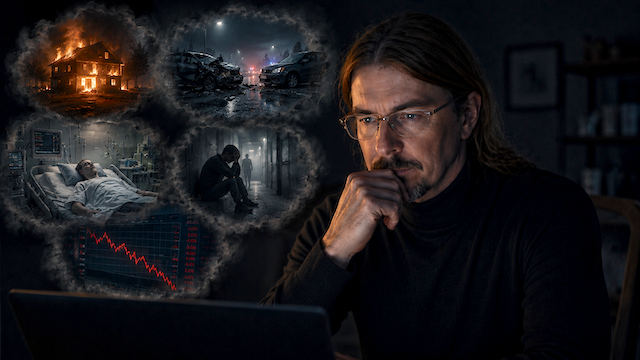
image by AI; my own prompt
Earlier this month, I was looking at my ‘upcoming blog post ideas’ list just before going into my bathroom for my morning shower. I was lamenting that none of the subjects on my list were very interesting, and contemplating skipping a couple of posts until there was something I really wanted to write about.
And then, as I was brushing my teeth, not just one, but three interesting new ideas just ‘came into my head’. I raced around for a scrap of paper and pencil to write them down so I wouldn’t forget them (oh, the joys of being 75). I was ‘talking to myself’ in my head trying to capture the essential points for each idea, basically ‘rehearsing’ what I was going to write on the scrap of paper. I contemplated what might be an engaging title for each blog post, I suppose as a means of ‘anchoring’ all these thoughts rushing around in my head on each of the three subjects. I noticed that I was looking at my reflection in the mirror (even more than usual), and that I was nodding and my lips were moving.
In the shower, I further developed the ideas that had come to me, and made some additional notes afterwards, but my ‘shower reflections’ did not unearth any more new ideas, nor do more than ‘consolidate’ the thoughts I’d already written down.
I wrote and published two of the resulting articles earlier this month. This is the third.
So of course I did a ton of research on “inner speech”, which (thanks, psychologists) goes by fourteen alternate names. I was trying to answer these questions:
- What is it, essentially, and is it basically the same phenomenon in all of us?
- How does it co-evolve with language skills (little kids notoriously talk out loud to themselves when they’re doing things alone), and how does it relate to ‘mental images’, the phenomenon of mental pictures that arise beside, or sometimes instead of, ‘verbal thoughts’ about something?
- Much has been written about exceptionally creative thoughts arising in the shower, the cliché explanation being that shower activities are rote and hence ‘free up’ the more creative parts of our brain to take centre stage in our thinking. Was this part of what was going on for me that day?
- Is it possible to ‘tame’ or ‘direct’ or ‘improve’ our inner speech processes to become better thinkers or become more creative?
- How can I reconcile what has been observed (by me and others) about inner speech with my belief that we have no real ‘self’ and no free will about what we do (or what we think)?
As I’ve come to expect, the research process was not fun. Sabine Hossenfelder has lamented the decline of theoretical physics as authors introduce more and more abstract, unverifiable theories that seem to have no purpose but to perpetuate the publication of more theories and papers about them. I’m finding much the same thing in most other ‘academic’ fields of the sciences and social ‘sciences’.
So, basically, there is no psychologists’ consensus on question 1 at all. There is no credible broadly accepted definition of inner speech, or any of the terms used synonymously for it. Some papers argue that most people ‘have’ inner speech. Others, just as long and convoluted and full of (often reciprocal) citations, assert that most people don’t have it.
Essentially, we don’t know how it might work because we can’t even agree on what it is. There are of course the usual explanations that it’s hard to study because it can’t be “directly observed” and isn’t subject to “standard measurements”. The rest, mostly, is almost unfathomable psychobabble, with every writer furthering another unsupported theory along with a host of self-coined new profound-sounding terminology. And of course the concluding paragraph acknowledges that “much more study” on this “important subject” is needed. /rant
So let me hazard a definition: Inner speech is thoughts and images that arise in the brain that the brain then attempts to make coherent meaning and sense of. They don’t need to be ‘verbal’ to get the brain’s attention, any more than a work of art needs words to explain it to capture our attention.
When a dog hears a familiar voice and conjures up an impression of its speaker, no words are needed. The idea of the person that arises in the dog’s brain needs no language, labels or nouns to be coherent.
Humans use language as a means of making sense of things. So when, in the bathroom, I looked at my phone screen and scowled at all the superfluous ‘apps’ on it, the idea — the sense and meaning-making — arose that my unhappiness was because the ‘app’ makers had deliberately made something simple (ie using the internet) unnecessarily complicated. And then the metaphor of the ‘app’ as being an ‘enclosure’ of part of the public commons as a private fiefdom arose. Aha!
What was the ‘inner speech’ in this process? It was (1) the noticing of a phenomenon, (2) an emotional response, provoking (3) some arising thoughts and images, and then (4) an attempt to articulate the reason for that response, and (5) its implications (ie its meaning). The first three of these elements are likely present in every living creature; only the latter two are probably unique to humans. And small children talking out loud to themselves are, perhaps, rehearsing these latter two elements, so that we are soon conditioned to think to ourselves instead of muttering our sense-making aloud.
It’s not the first time such ‘creative’ ideas have seemingly arisen out of nothing in my bathroom (though not necessarily in the shower or bath). When you’re my age, the bathroom is actually the most dangerous room in the house, so the theory that mundane bathroom activities liberate the creative parts of the brain to entertain our attention, just doesn’t make sense to me.
Did seeing myself in the mirror somehow ‘cue’ the conversationalist in me, as if it were another person? Maybe, but that seems a stretch. The movement of my lips when I was thinking about what to write on the scrap of paper in the bathroom was, perhaps, a regression to the young child’s vocalizations.
Thinking back to what happened after I looked at the app-filled screen on my phone in the bathroom, I wonder whether the activity of tooth-brushing that I was doing at the time was simply the first of the five steps (the noticing step) in the ‘inner speech’ process, truncated, since no emotional response or resultant thoughts or sense-making to tooth-brushing was required or forthcoming. Then, perhaps, primed by my conditioning to proceed with the next four steps, when I then noticed the screen, my brain was off to the races, and soon the blog articles ‘just came into my head’ and essentially wrote themselves.
That might be a far-fetched theory, but the idea that noticing, and hence perhaps caring are the essential preconditions for creative thoughts and ideas, is an appealing one. As Ray Naylor says: “Everything that is successful and worth doing has to begin with care as its first step. First, you care and then you do a thing.”
My sense is that, when we really notice something, really give it our attention, really “stand still and look until we really see”, then if it’s something we are really inclined to care about, we are going to care, and open ourselves to doing “everything that is successful and worth doing”. That’s my theory anyway. Wonder what, if anything, I can do to get this lost, scared, and bewildered soul, so inclined to turning away, to get better at really noticing, really paying attention?
As for my fifth question, about reconciling this process with my ‘no free will’ worldview, I think that’s pretty easy. The above five-step process is entirely beyond our control. We will notice, or not, what our conditioning has led us to notice, or not. We will emotionally respond according to our conditioning, just like any other animal. Thoughts and images will arise; they are not ‘ours’, and the ones we pay attention to and claim as ‘ours’ is likewise not our choice. And, as I have written perhaps too often, our sense- and meaning-making merely comes after the fact as a rationalization for what ‘we’ have already done, and has no bearing on what we actually do.
Still, I think it’s fun to think about. And I also wonder, if this is the process that creative ideas arise from, is there a different process that underlies truly imaginative ideas (they are not at all the same process)? And why are some people creative but not imaginative, and vice versa?