




In a recent interview by Chris Hedges, XR founder Roger Hallam, recovering from a series of imprisonments for protest activities in increasingly repressive and struggling post-Brexit Britain, talks about what we can do, and what we are likely to do, as collapse deepens.
We are already responding, largely subconsciously, to the horrifying reality that our civilization culture is living on borrowed time, and that there simply is not enough of any essentially resources to go around anymore. And it’s going to get much worse as ecological collapse weighs in on top of economic, resource, and the inevitable political collapse as the resultant anger and fear boils over into more endless wars, chaos and violence.
This is not about ‘inequality’, he says; that’s just a symptom. We can’t ‘fix’ collapse through tax reform or ‘renewal’ of our democracy, or reestablishing standards of law and justice. We’re way past that point. If we don’t get together and bring about revolutionary change, he says, we’re just all going to die, including the superrich.
Repression leads to rebellion, he argues, not the other way around. He says we’re at the immature stage now of this rebellion. And the big problem is, we are still being conditioned to think of ourselves as individuals — denying, scared, and helpless. We are actually just part of something that no one is controlling or can control. As all the systems of civilization break down, we are going to “fracture”, not so much along political or ideological lines or what we ‘believe’, but according to what we actually do in response to the gathering chaos and the first waves of collapse.
He describes this fracturing into four forces as follows:
One of them is towards internal destruction — personal suicide, nervous breakdown, domestic violence. Another fracture will go towards external hedonism — live now, forget the future. And another element will go into some form of collective cult-like behaviour or some fascistic worship of death, which is what fascism basically is. And the last fracture will be the fracture that turns towards the prophetic love of life and the human. And obviously, it’s the last one that we’re putting our bets on, right? But it’s naive to think that the others won’t exist. The point is everything will be up for grabs.
I found his arguments about this a little incoherent, and his faith in the ‘fourth fracture’ a bit overly hopeful and not well articulated. But it’s based on extensive study and research Roger has done on humans’ previous responses to large-scale existential crises throughout our history, and particularly the revolutions (successful and unsuccessful) they have prompted. It also resonates with the ways I have been inclined to behave when everything seemed to be falling apart in my own life.
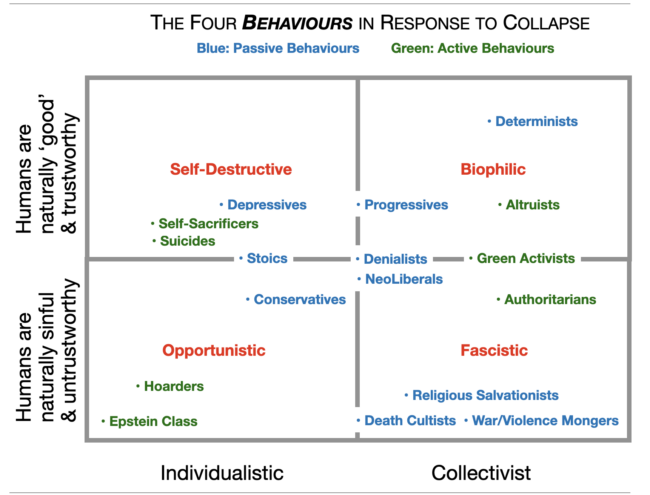
So I tried to enumerate and distinguish the behaviours of people in circumstances of growing chaos and collapse, depending on where on these four ‘fracture lines’ they fall. Again, this is not about belief systems, ideologies or worldviews. As systems collapse and circumstances rapidly change, it all comes down to what we actually do as things deteriorate.
The result of that exercise is what I’ve depicted in the chart above. The labels are mostly mine.
In studies of wild creatures, most of them (and us) tend to behave quite altruistically in times and places of abundance, ease, and consistency. But in times of scarcity, precarity and chronic stress, most mammals, at least, begin to exhibit forms of madness and depravity: The ‘alphas’ tend to hoard, while the remaining members of the troop or community tend to cower and shut down, and, if things get bad enough, will kill themselves or even eat their own young.
These two forms of high-stress behaviour would seem to correlate to the first two of Roger’s ‘fractures’, which I’ve shown in the left two quadrants of the chart above. In our modern hyper-individualistic monoculture, these intensely personal responses to catastrophic crises should not be surprising.
So we have enormous rates of depression, alienation, shut-down, isolation, and even suicide, correlating strongly with the degree of scarcity, precarity, and stress that people are facing in each time and place. And we have self-sacrificers, giving everything for their loved ones (or burying themselves in their jobs) at enormous cost to their own physical and psychological health, who, as Gabor Maté has often explained, tend to live unhappy lives and die young. And we have those who try to be stoics, striving passively and rationally to make sense of it all in a detached ‘sensible’ way.
In my experience, most of those I’ve met who have behaved in this way (as I did for much of my life) have been idealists who think humans are basically good, but that for whatever reason everything has gone horribly wrong. It shouldn’t be this way. I can still totally relate, and still sometimes find myself behaving in these ways.
In fact I suspect most of us can quickly slide into any of these four types of behaviour, depending on the circumstances of the moment. They’re all very human, understandable ways of coping with chaos and collapse, and there’s no ‘right’ behaviour. (Especially if you’re like me and believe we have no free will.)
As a hedonist, I’ve also been drawn to the behaviours in what I call the opportunistic quadrant, especially when I start feeling ‘down’ about human (mis-)behaviours and slide into misanthropy. And, as I’ve written recently, I came close to being seduced into the Epstein Class, whose behaviours reflect a sense of superiority, arrogance, and a belief that, because they think they ‘know better’ than the great riffraff of society, should be above the law.
Here’s where you find abusers and exploiters, as well as escapists hoarding their wealth and buying up acreage in New Zealand. With their wealth comes power, and in our corrupted corporate oligopolies and broken political revolving doors, that power, and their utter disconnection from what life for ‘ordinary’ people is actually like, makes them exceedingly dangerous.
I put conservatives in this quadrant (though, again, belief systems and ideology are not what differentiates these four fractured behaviour types in coping with chaos and collapse), because conservatives do, in my experience, believe that our success or failure is largely of our own making, and because they also tend to have a rather negative view of basic human nature.
The ‘fascistic’ quadrant is basically what Roger describes — people who want the world strictly regimented, largely because they also share this negative view of human nature and want something done about it. Deranged war and violence-mongers like Hegseth share this space with religious fundamentalists, militia volunteers, and ‘Rapture’ believers. When things are falling apart, their answer is repression, oppression, intimidation, propagandizing, and scare-mongering. Keep the rabble in line!
And Roger’s fourth ‘fracture’ quadrant, which I’ve shown in the upper right and labeled Biophilic, is populated with both idealists and realists, again from across the political spectrum (anarchists and eco-villagers to homesteaders), who strive to reground in a functional, sustainable, more self-sufficient, natural world connected to the rest of life on earth.
Just to show how volatile our behaviour is in times of crisis, I’ve tried to further differentiate those (few) who are actively doing things of each behaviour type in green, from those (most of us) who are on the fence, not sure what to do, or just caught up in the day to day and anxiously trying not to pay too much attention to what is happening (groups shown in blue).
When you are ‘on the fence’, and not already committed to any way of behaving, it’s easy to go either way. I know disenchanted progressives and conservatives who’ve become authoritarians. And I’ve known denialists and stoics who’ve become devout ‘born again’ salvationists.
And I agree completely with Roger that what we are likely to see in the coming decades of chaos and collapse is an increasingly frenzied struggle between these four ‘fractures’ — not an ideological one (I really don’t think elections are going to make any significant difference going forward, if they even do now). But rather, a clash of behaviours — fascistic militias, Epstein Class hoarders building walls (not just physical ones) to keep the rabble out, depressives who might decide to blow up much more than just themselves, and altruists (like Roger) who will keep organizing and perpetuating small ‘revolutions’ to try to make the world a better place for all, even if he thinks it’s hopeless.
It’s just a map, but I think it’s an interesting way of thinking about how we’re going to behave and what we’re going to do as we further devolve into chaos and collapse.
Just trying to make sense of it, as it seems more and more our behaviour makes no sense at all.