Post Views: 19
If you blow across the top of an empty bottle you’ll hear a clear, steady note. Now, engineers have used that same concept to power tiny robots that move without a single motor on board.
These new devices are powered entirely by sound. When the right frequency is aimed at them, hollow chambers built into their structure resonate and push out a jet of air, generating enough thrust to steer a small boat or lift a tiny flying
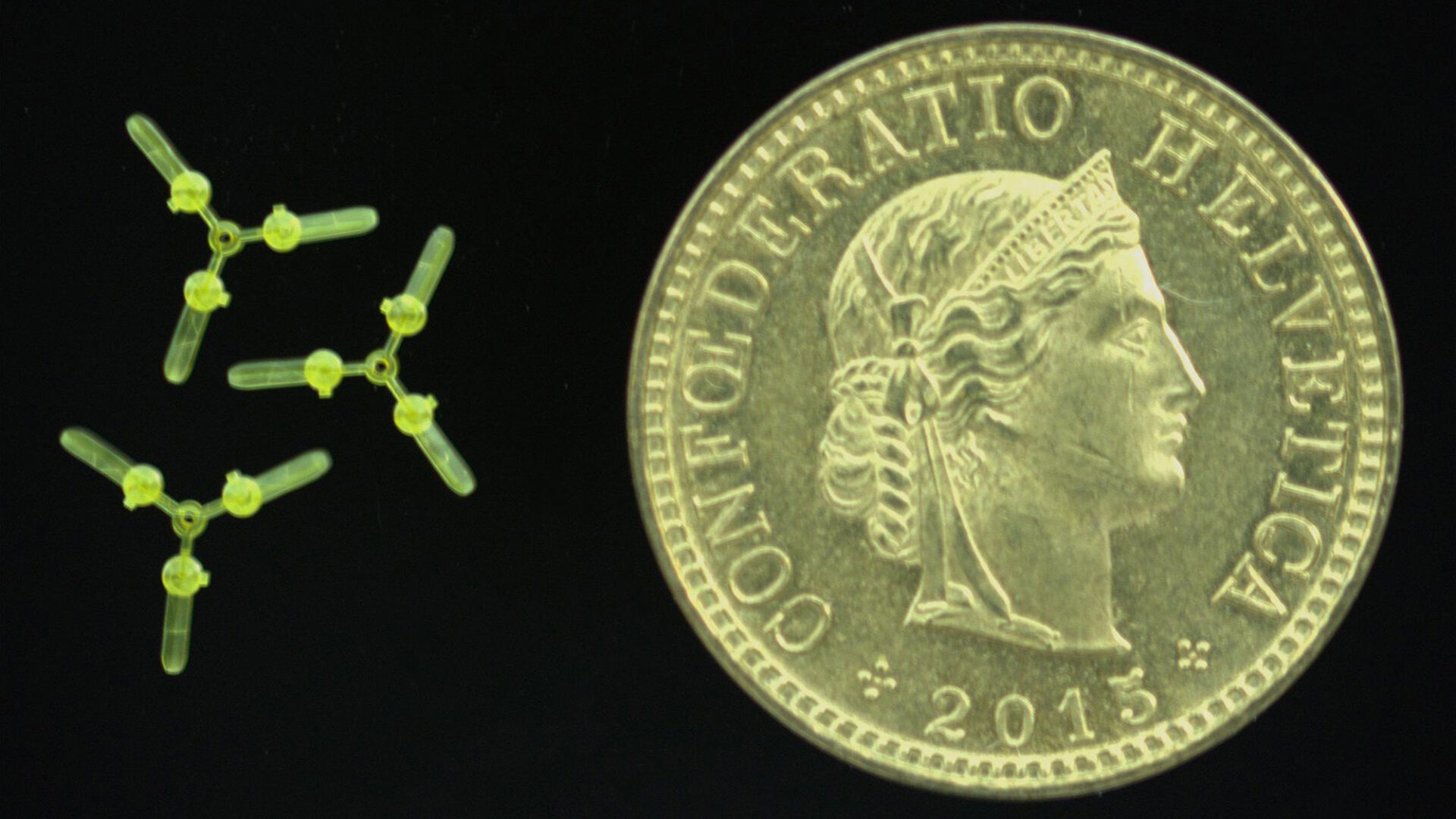
Several of the tiny, propeller-like microfliers pictured next to a Swiss franc coin for scale. (Image credit: EPFL/MICROBS – CC-BY-SA 4.0)
Boats, rockets and tiny helicopters
The team built small boats measuring roughly 2 inches (5 centimeters) fitted with multiple resonators, each tuned to a different frequency and pointed in a different direction. By changing the pitch of a nearby speaker, the researchers could steer the boats left, right or straight ahead.
At a far smaller scale — some just 0.04 inches (1 millimeter) across — the team also built “microfliers” that generated lift two different ways: some pushed thrust downward like a rocket — but using air for the thrust — while others span tiny attached blades to fly like a helicopter, using sound waves to rotate the blades.
The technology has an advantage over conventional means of power generation because it can be built at extremely small scales, Sakar said. Conventional motors have “a fundamental limit” on miniaturization because of the physical components like magnets, coils and shafts that a motor needs to work, he said. Because these resonators are just precisely shaped hollow cavities, there’s no comparable limit on how small they could eventually build.
The researchers said in the study that the same principle could eventually be used to precisely rotate and manipulate small objects in midair without touching them, or to build soft, flexible surfaces that bend and change shape on command when they “hear” a particular frequency which can be used for biomedical applications like heart stents.
For now, the study is a foundation for the researchers to build on, Sakar said. “This paper, I think, is important in the sense that we put the design principles out,” he said, adding that follow-up work could focus on more applied designs, control systems or navigation.