









We are delighted to welcome Dr Heather Lynn, author of Anunnaki Revelation: Hidden History, Altered States, and the Mystery of Humanity, as our featured author this month. Dr Heather Lynn is a historian and archaeologist, a bestselling author, a recurring expert on History Channel’s Ancient Aliens, and host of The Midnight Academy podcast. Her work investigates the gaps in our understanding of ancient civilisations, blending archaeology, comparative religion, and cognitive science to analyse ancient myth and iconography and to rediscover the lost threads of human history and consciousness. Her latest book offers a third path between mainstream archaeology and the ancient astronaut hypothesis: the Anunnaki were not aliens but human survivors of a destroyed antediluvian culture, while the Apkallu represent something else entirely — non-human intelligences accessed through altered states.
In her article, below, Heather revisits the puzzle of ancient Sumer’s sudden emergence, drawing on the Younger Dryas catastrophe and the Taş Tepeler excavations, as well as the unfolding genetic records — finding answers in cultural memory and the technologies of consciousness.
Interact with Heather on our AoM forum here.
The conventional story of civilization goes like this: humans wandered as hunter-gatherers for hundreds of thousands of years, invented agriculture independently in several locations around 10,000 BCE, and slowly built increasingly complex societies culminating in the first cities of Mesopotamia around 3500 BCE. It is a story of gradual, organic progress. It is also, I believe, wrong.
The central confusion in both mainstream and independent readings of the Sumerian record is a failure to distinguish two categorically different kinds of beings the texts describe. Correcting that single error resolves most of what has seemed mysterious for the past seventy years.
The Sumerian texts themselves describe outsiders arriving with knowledge already in hand: agriculture, metallurgy, astronomy, governance, and writing. They describe a contact event, not an invention event. Consensus archaeology has treated these accounts as mythology. Independent researchers, following authors like Zecharia Sitchin, have treated them as evidence of extraterrestrial intervention. Both readings miss what the texts are actually saying, because both readings conflate two distinct categories of being into a single explanation.
In my new book, Anunnaki Revelation: Hidden History, Altered States, and the Mystery of Humanity (New Page Books, 2026), I propose a third path. The Anunnaki were not aliens, nor were they myths. They were human survivors of an antediluvian cultural network, displaced by the Younger Dryas catastrophe, who migrated into Mesopotamia carrying the remembered knowledge of a destroyed world. The Apkallu, a categorically distinct class of being in Mesopotamian tradition, represent something else entirely: a non-human intelligence accessed through altered states of consciousness, a phenomenon that may predate human civilization itself.
The conflation of these two categories, human lords and non-human intelligences, has been the central error in both consensus and independent scholarship. Correcting it changes everything.
The Catastrophe and the Restart
Readers of this website will be familiar with the Younger Dryas impact hypothesis. Around 12,800 years ago, a catastrophic event triggered a return to near-glacial conditions. The evidence includes platinum anomalies in Greenland ice cores, nanodiamonds across multiple continents, and the simultaneous extinction of megafauna.1 Nearly every ancient culture carries a memory of this destruction: the Sumerian Deluge, the Norse Ragnarök, the Hindu Yugas, the Aztec Five Suns, and the Hopi previous worlds. These are convergent testimony, rather than isolated inventions. Something happened, and the survivors remembered.
Archaeological findings from Shanidar Cave in Iraq provide a striking correlation. Ralph S. Solecki’s excavations (1951 to 1960) revealed a 14-meter stratigraphic sequence with radiocarbon dates documenting repeated cycles of occupation and abandonment stretching back over 45,000 years.2 The uppermost layers show continuous habitation from the Neolithic to the present (Layer A, c. 7,000 BP onward) and a Proto-Neolithic/Mesolithic occupation (Layer B, c. 12,000 to 10,600 BP) that aligns precisely with the post-Younger Dryas resettlement period. Below that, the Upper Paleolithic Baradostian occupation (Layer C) ends around 28,700 BP, followed by a prolonged hiatus spanning the Last Glacial Maximum before Layer B begins. A second, deeper hiatus separates Layer C from the Mousterian deposits of Layer D below. The pattern is one of climate-driven abandonment and return: when conditions in the Zagros became uninhabitable, populations left; when conditions improved, they came back, each time carrying whatever cultural knowledge had survived the intervening millennia.
Shanidar shows us the mechanism of persistence. Whether any given wave of returning populations carried with it the kind of systematized knowledge the Sumerian texts describe is a question the cave alone cannot answer. What it demonstrates, unambiguously, is that human populations in this region repeatedly retreated from catastrophe and returned, and that the archaeological signature of that process is visible in a single stratigraphic column. The mechanism exists. The content is what we are trying to recover.
In 1956, Samuel Noah Kramer posed what remains one of the most uncomfortable questions in archaeology. He called it the Sumerian Problem: how is it that progress hit Mesopotamia all at once over roughly 200 years? Writing, mathematics, astronomy, law, irrigation, urban planning, metallurgy, organized religion. All appearing in the same place, at the same time, with no clear developmental precursor.3 The conventional answer is extraordinary convergence. My answer is simpler: it was a remembering. Rather than saying civilization started at Sumer, we can say it was restarted by survivors of a world that no longer existed, carrying knowledge that took millennia to develop the first time around.
One objection will be immediate: if the Younger Dryas catastrophe occurred 12,800 years ago, how can we connect it to Sumerian civilization, which appears in written form around 3200 BCE, a gap of over 9,000 years? The answer lies in oral tradition. The Sumerian texts we read are not contemporaneous records. They are mythologized accounts of events transmitted orally for millennia before being written down. The archaeology does not show a sharp “invasion layer” at Sumer because the arrival was gradual, cultural, and heavily overlaid with local Ubaid populations. What we see in the texts is cultural memory compressed, symbolized, and reframed through the lens of kingship theology. The Anunnaki were memory. Nine thousand years of it. Compressed, symbolized, reorganized by every culture that carried the story forward, and finally written down by Sumerian scribes.
This framework is, importantly, testable. If future ancient DNA studies of Ubaid and Uruk period remains show no Caucasian, Iranian Plateau, or steppe admixture beyond the local baseline, the migration thesis is in serious trouble. If iconographic continuity between the Taş Tepeler sites and later Mesopotamian ritual systems fails to materialize as excavation proceeds, the remembered-civilization thesis weakens. A framework that cannot be falsified is mythology. One that generates specific predictions and survives contact with new data is something else.
The Firsts That Were Not Firsts
There is a further problem with the “history begins at Sumer” narrative, and it is one that deepens with every passing year of excavation. Many of the technological and cultural achievements attributed to Sumer were not, in fact, Sumerian firsts. The wheel appears in Eastern Europe with the Cucuteni-Trypillia culture around 4500 BCE. Horse domestication begins on the Pontic-Caspian steppe with the Botai culture around 3500 BCE. Metallurgy in the Balkans, particularly at Varna, dates to approximately 4600 BCE, predating Sumerian metalwork. Poppy cultivation in the Southern Levant, as archaeologist Estelle Orrelle’s research demonstrates, predates Sumer by millennia. And Göbekli Tepe, with its monumental architecture, organized labor, and complex symbolic systems, dates to approximately 9500 BCE, six thousand years before Sumer.
What this means is that Sumer did not invent these things. Sumer compiled them. It was the place where steppe knowledge, Levantine agriculture, Caucasian metallurgy, and antediluvian memory all converged and were systematized into the first urban literate civilization. The reason everything appears “all at once” at Sumer is not that the Sumerians were uniquely brilliant. It is that Sumer was the destination, not the origin.
This compilation thesis, I want to note, is already partially consistent with mainstream archaeology. Any specialist will acknowledge that Sumerian material culture shows influences from multiple surrounding regions. Where my reading diverges is in the claim that the texts themselves memorialize this process, and that the specific narrative structure of divine instruction encodes a historical memory of knowledge transmission from displaced populations rather than allegorical invention. The evidence for the weaker claim (compilation from multiple sources) is well established. The evidence for the stronger claim (a remembered catastrophe and directed migration) is suggestive and requires the textual, iconographic, and genetic strands to hold together. I believe they do. I also believe a careful reader can find the weaker claim convincing on its own terms and use it as a foundation for considering the stronger one.
The ongoing excavations at Karahan Tepe, the broader Taş Tepeler complex, and related sites in southeastern Turkey are pushing the timeline of complex social organization further back with each season. If this framework is correct, those sites should continue to reveal not only architectural and organizational sophistication, but cosmological and iconographic continuity with what later appears in Mesopotamia. We are already seeing this. Göbekli Tepe’s Pillar 43, the Vulture Stone, depicts figures holding bucket-like objects alongside vulture and serpent imagery. Karahan Tepe has produced human-like figures with elongated features. The same structural motifs, bird-human hybrids, serpents as bearers of knowledge, the handbag held by figures in ritual posture, appear thousands of years later in Assyrian palace reliefs, in Olmec sculpture, in the chlorite vessels of Iran’s Jiroft civilization.4
Cautious scholars will point out, correctly, that the vulture imagery at Göbekli Tepe is not identical to the winged genii of Nimrud. That the bucket on Pillar 43 may not be the same object as the banduddu in Assyrian anointing scenes. These are fair objections at the level of specific iconographic identification, but the structural pattern, a human-bird figure associated with ritual mediation between worlds, paired with a container of sacred substance, is the same conceptual architecture appearing across millennia and thousands of miles. The concept of religious syncretism is well established in anthropology. We accept that Inanna became Ishtar became Aphrodite, that Enki’s attributes migrated into Prometheus and Lucifer, that Isis became the Virgin Mary. What I am proposing is that this process of transmission goes deeper and older than currently acknowledged: that the seed material for these spiritual beliefs and cultural motifs was planted in the post-Younger Dryas period by the migrating populations the texts describe, and that what we are uncovering at the Taş Tepeler sites is the nursery where those seeds were first sown.
As excavation continues at these sites, I expect we will find increasingly clear correspondences between Pre-Pottery Neolithic cosmology and the religious systems of Sumer, Egypt, and the Indus Valley. Each correspondence will be called coincidence by some and confirmation by others. The framework offered here provides a mechanism for how the transmission occurred and why the patterns persist.
The Scythians offer a parallel survival of the same tradition. Horse-riding, gold-working, masters of animal-style art, and practitioners of entheogenic shamanic rites, including the cannabis vapor baths described by Herodotus, they carried ANE-derived ancestry across the Eurasian steppe for millennia. By the time the Scythians emerge archaeologically in the ninth century BCE, the events I have been describing lie ten thousand years in their past, but the cultural template persists as a recognizable inheritance across that depth of time: mobile pastoralism, metallurgy, entheogenic ritual, and a cosmology oriented toward sky and animal. They were not the Anunnaki. They were the latest flowering of the tradition that produced them, and they demonstrate that the pastoral, knowledge-carrying, shamanistic culture described in this article was not a one-time event but a sustained tradition across the entire Eurasian landmass.
This is where the genetic evidence converges most provocatively with the question readers of this website have been asking for decades. The ANE-derived populations carrying ghost DNA, genetic material from extinct populations with no known fossil record, may represent exactly the genetic fingerprint of that lost cultural network. The ghost DNA is, quite literally, the ghost of Civilization X, and it is showing up in surprising places.
The Genetic Evidence: Braided Streams and Ghost DNA
The work of geneticist David Reich at Harvard is reshaping our understanding of human ancestry.5 What was once considered a clean evolutionary tree has become a braided stream, with branches from archaic humans grafted onto the genomes of modern populations. One of the most intriguing revelations involves ghost DNA, genetic material from extinct populations with no known fossil record, suggesting that humans interbred with species beyond Neanderthals and Denisovans.
Reich’s team identified a previously unknown population called the Ancient North Eurasians (ANE), represented by the Mal’ta boy found in Siberia (c. 22,000 BCE). This population contributed significantly to both Native Americans and Europeans. The eastern hunter-gatherers (EHG) carried substantial ANE ancestry, serving as a genetic vector that brought northern material into the steppe region.
The Tarim mummies, found in western China and dating from c. 2100 BCE to 200 CE, are often cited as evidence of ancient westward migration. The remains possess features frequently described as Western: light hair, deep-set eyes, the distinctly non-Asian features preserved in figures like the Beauty of Loulan (c. 1800 BCE).6 Zhang and colleagues’ 2021 genomic analysis revealed approximately 72 percent ANE-related ancestry.7 Their interpretation, however, is that the Tarim population was a genetically isolated local group that retained deep ANE ancestry rather than carrying it from elsewhere. This distinction matters, and it cuts in an interesting direction for the framework I am proposing. The Tarim mummies do not, in themselves, prove a directed migration. What they demonstrate is something arguably more significant: that Paleolithic ANE ancestry persisted in geographically dispersed pockets long after the populations that originally carried it had otherwise vanished from the record. They are evidence of continuity across deep time, which is the underlying phenomenon this entire article is trying to characterize.
I want to be clear about what the genetic evidence does and does not establish. It demonstrates that Paleolithic populations were far more mobile and interconnected than previously assumed. It confirms long-range ancestral continuity across vast distances. It does not, by itself, prove the existence of an organized antediluvian civilization or a directed migration into Mesopotamia. What it does is make such a migration genetically plausible in a way that would have seemed fantastical twenty years ago. The genetics open the door. The textual and archaeological evidence walk through it.
The Migration Path: From the Caucasus to Sumer
If these migrants existed, we should be able to trace their route. And we can. Archaeological and genetic evidence demonstrates sustained contact between the Near East, the Caucasus, the Steppe, and Central Europe as early as the fifth millennium BCE. The Kura-Araxes culture, emerging c. 3500 BCE in the South Caucasus, was adept at metalwork, agriculture, and pottery.8 As the climate worsened, some groups ventured southward across the Zagros Mountains. These may have been related to the Shulaveri-Shomu culture (6000 to 5000 BCE), known for early agriculture, winemaking, animal domestication, and rudimentary metallurgy.
The Yamnaya people (c. 3300 to 2600 BCE) derived ancestry from at least two sources: eastern hunter-gatherers carrying northern genetic components, and a population related to the Caucasus and Iranian peoples.9 This mixing event blended northern and southern ancestries at a crucial juncture in steppe genetic history. The point is not that any one of these cultures was the Anunnaki. The point is that the archaeological record shows exactly the kind of sustained, knowledge-carrying southward migration that the Sumerian texts describe, unfolding across millennia from highland and steppe regions into the Mesopotamian lowlands.
Meanwhile, the blue-eyed gene originated near the Black Sea through a mutation affecting OCA2 between six and ten thousand years ago. All blue-eyed individuals on Earth are linked to a single common ancestor.10 Statues of gods across Mesopotamia had blue eyes picked out with lapis lazuli. The nazar, the blue evil eye amulet still sold throughout the Middle East, is a direct survival of this ancient association.


Statue of Ebih-Il, superintendent of Mari, c. 2400 BCE. Lapis lazuli irises set into shell, with schist eyelashes. Musée du Louvre (AO 17551).
The Shining Ones
The Sumerian term dingir is usually translated as “god,” but the word carries semantic weight that complicates the simple theological reading. It functions both as a common noun for divinity and as a determinative marker placed before the names of gods in cuneiform. Some independent scholars, most notably Christian and Barbara Joy O’Brien, in their analysis of the Kharsag materials, have argued that the earlier sense was closer to “lord” or “shining one,” with the theological meaning developing later.11 Academic Sumerology has not embraced this reading. I am sympathetic to the observation the O’Briens were drawing attention to, even if I cannot endorse their full translation program, because there is independent evidence that brightness and divinity were strongly associated in Mesopotamian material culture.
The evidence is in front of us. The statues of gods and rulers throughout Sumerian and Akkadian sites have their eyes picked out in lapis lazuli, shell, and bitumen, creating a luminous, arresting gaze. Gold and electrum ornamentation on royal and divine figures served the same purpose. The melammu, a term that appears frequently in Akkadian texts, describes a radiant aura surrounding gods and kings, something like a visible divinity or supernatural brilliance. This is independently attested and widely accepted. Whatever the deepest etymology of dingir, the cultural complex surrounding divinity in Mesopotamia was saturated with the imagery of light, metal, and visual radiance.
Viewed through this lens, the Anunnaki emerge in the texts as figures who looked the part of the divine: people who arrived in Mesopotamia taller than the indigenous population (the result of protein-rich pastoral diets and selective genetic inheritance), carrying metallic implements, wearing adornments that caught the sun. They possessed knowledge of agriculture and celestial navigation. The indigenous people referred to themselves as sag-gig-ga, “the black-headed ones,” a designation well attested in Sumerian literature. To a semi-settled population whose largest males stood roughly five feet, a group of six-foot individuals wielding copper tools and wearing reflective adornments would have appeared extraordinary, perhaps divine. The cargo cults of Melanesia, documented by Worsley in 1957,12 show us exactly how this works in the modern era. Technology mistaken for divinity is an observed, repeatable phenomenon.
The Anunnaki imposed social stratification, created a priest class to serve as intermediaries, and introduced nearly one hundred mes (divine decrees) that functioned as legally binding cultural blueprints: the first covenants. Among them were kingship, law, music, metalworking, and, notably, both falsehood and enmity.13 The gods decreed not only civilization’s virtues but its vices. The order was imposed.
The Epic of Gilgamesh makes the social engineering explicit. The temple priestess Shamhat civilizes the wild man Enkidu through sexual initiation, after which he can no longer return to his animal state. This encodes the understanding that controlled reproduction was a mechanism of social transformation. Genesis 6:4 references the Nephilim as the offspring of the “sons of God” who mated with human females, also known as the Watchers in 1 Enoch. In this framework, the Nephilim are not mythological monsters but the predictable biological result of two genetically distinct populations interbreeding. The offspring would have been larger in stature, combining genetic capacity with the nutritional abundance of a newly agricultural society. Eugenics in its most ancient form, achieved not through laboratories but through old-fashioned selective breeding.
Kharsag: Where Heaven and Earth Met
If the Anunnaki were real, they had to live somewhere. The accounts of Kharsag, the Sumerian counterpart to the biblical Garden in Eden, have long been obscured by religious interpretation. Stripped of theological overlay, the texts describe something remarkably specific: an agricultural settlement, planned and irrigated, in the foothills of a mountain. The term hursag refers to a mountain range or foothills; readings that extend it toward a bounded, cultivated upland space are disputed in academic Sumerology but align well with the descriptions the texts themselves provide of the settlement’s physical layout.
According to the Kharsag narratives and related Sumerian materials, what was established there was not paradise. It was a farm. The leadership (variously described as the Anunnaki or the Council of Seven, including Enlil, Ninhursag, and Enki) oversaw the construction of a reservoir and irrigation systems, plowed the land, planted grains, established orchards, and constructed windbreaks and permanent structures. Livestock were domesticated and housed in enclosures with running water. Despite early hardships, including sickness and natural disasters, the settlement prospered, with surplus food shared with local tribespeople who transformed from foragers into skilled farmers and herders.
The Hebrew abad, usually rendered as “worship,” literally means “to work for” or “to serve.” There is a striking convergence when you lay the two frames side by side: “Adam worshipped Yahweh in the Garden of Eden” and “the adamah worked for Enlil in an agricultural settlement in the foothills.” These may be the same statement, stripped and re-clothed in different theological vocabulary. Civilization, in this reading, was an engineered hierarchy fueled by organized labor.
The Word and the Fall: Language as Cognitive Revolution
The Sumerian Problem has a linguistic dimension that may be even more provocative than the archaeological one. Sumerian is a language isolate, with no demonstrable genetic relationship to any regional language. A study by Alexei Kassian found lexical similarities between Sumerian and the Hurro-Urartian family, including words for “dog,” “hand,” and “meat.”14 Both are ergative languages with agglutinative morphology, a relatively rare combination. If confirmed, this would suggest a common ancestral language dating to c. 12,000 BCE, within striking proximity of the Younger Dryas.
The deeper question is not where Sumerian came from but what language does. Consider the Pirahã of the Brazilian Amazon, studied by Daniel Everett.15 Everett’s work, while contested by other field linguists (Nevins, Pesetsky, and Rodrigues published a notable 2009 response arguing that Pirahã does exhibit recursion),16 has suggested that the language lacks features common to most human languages: fixed color terms, grammatical tense, creation narratives, and according to Everett’s strongest claims, syntactic recursion. Whatever the final verdict on the specific Pirahã case, the broader principle that language structure shapes cognitive experience has a long and respectable history from Whorf through modern cognitive linguistics. Language does not merely describe reality. To some meaningful extent, it structures the reality a speaker can think about.
This connects to Julian Jaynes’s theory of the bicameral mind: the proposal that ancient humans experienced a split consciousness, with one part issuing commands and the other obeying, voices experienced as gods.17 The development of complex recursive language may have shattered this older mode. When Enki gave the Adamah the word, he fractured their bicameral unity and gave them ego, the ability to argue with their own minds. Perhaps this is the Fall, the exile from Eden, the knowledge of good and evil. It was given through language.
There is a biological dimension to this that is better established than the linguistic one. Gokhman and colleagues found that genes associated with vocal tract and facial anatomy underwent extensive methylation changes in modern humans after the split from Neanderthals and Denisovans.18 The physical apparatus for complex speech was being epigenetically reshaped at the deepest level of gene regulation. The capacity for language was already latent in human biology. What the Anunnaki may have provided was not the biology but the structure: the grammar, the recursion, the symbolic complexity that turned vocalization into civilization. The instrument was ready. Someone gave the players the score.
The Apkallu: The Real Ultraterrestrials
Everything I have described so far concerns human beings. The Anunnaki, in my framework, are human. Extraordinary humans, but humans nonetheless. The Apkallu are something else.
The term is Akkadian, from Sumerian abgal (“wise” or “sage”). Seven Apkallu were associated with the seven antediluvian kings. The most famous of them was Adapa, known in the later Greek account of the Chaldean priest Berossus (third century BCE) as Oannes. Berossus described Oannes as having a fish head, the feet of a man, and the tail of a fish, noting that he shared human language but did not consume food.19 The Bīt mēseri cuneiform tablets describe the seven sages as fish-men “created in the river” who “ensure the correct execution of the plans of heaven and earth.”20 These were not humans but rather ambicarnate beings, capable of existing both as spirits and in physical form.
The word egregore derives from the Greek egrēgoros, meaning “watcher” or “one who is awake.” It was first associated with the Watchers of the Book of Enoch. The Apkallu are what we now see on Assyrian temple reliefs as genies: the origin of the concept of genius, of the jinn, of the malakh (Hebrew: messenger, the root of “angel”). They are an intelligence wholly other, capable of emerging from the sea (the Oannes tradition), the sky (the winged genii), and perceptual reality itself (the daimonic and entheogenic encounter traditions). They are not confined to a single domain of manifestation.
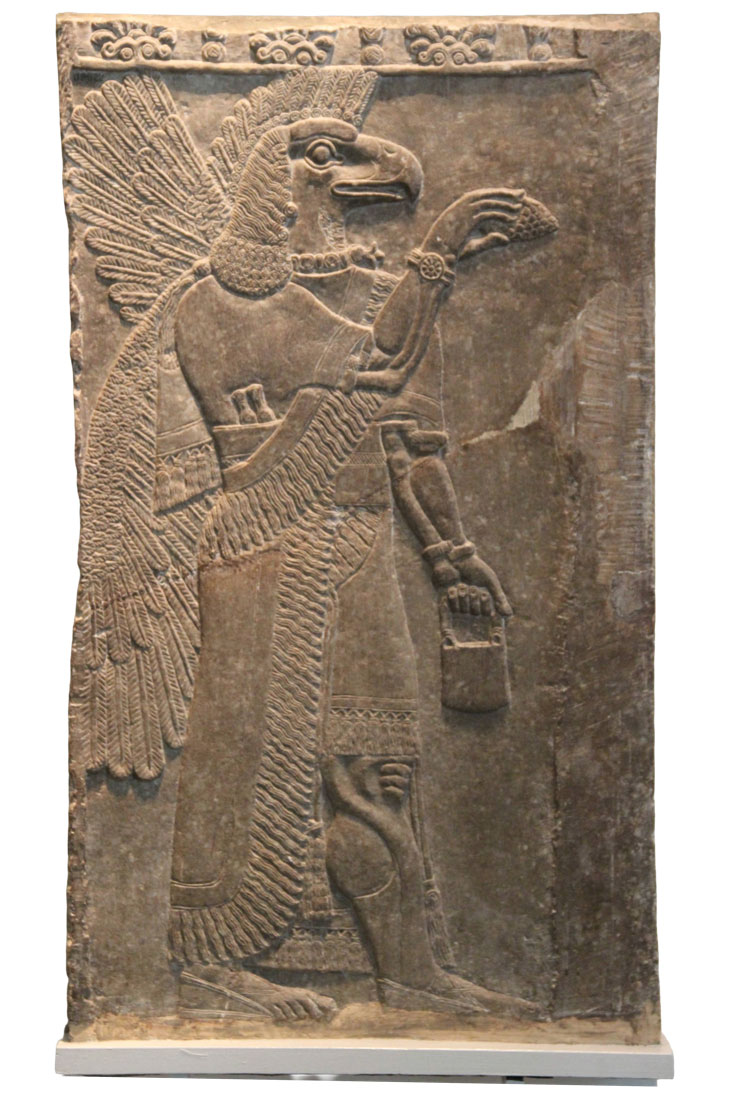
Eagle-headed winged Apkallu with bucket and cone, Northwest Palace of Ashurnasirpal II, Nimrud, c. 883-859 BCE. British Museum. Photo Gary Todd (CC0)
The Hul Gil Rite: The Joy Plant and the Technology of Kingship
If the Apkallu were accessed through altered states, the mechanism matters. The evidence has been hiding in plain sight.
Hul Gil is Sumerian, found on clay tablets from Nippur dating to the Third Dynasty of Ur (c. 2100 to 2000 BCE). Hul means “joy.” Gil refers to plants. Together: the joy plant. The opium poppy. The rosettes carved on Assyrian temple walls, defined by Helen Kantor as “radially symmetrical circular designs derived from plant forms,”21 may represent stylized poppy capsules viewed from above. When scored to harvest latex, the capsule’s dried residue forms a star-shaped pattern strikingly similar to the rosette.
In 1989, Iraqi archaeologist Muzahim Mahmoud Hussein unearthed the Queens’ Tombs beneath the Northwest Palace at Nimrud. A gold crown bore three rows of opium poppy capsules alternated with granulated rosettes. Initially mistaken for pomegranates, Hussein later identified them correctly.22 The capsules are physically present on the crown. The archaeology speaks for itself.
Alongside the crown, Hussein recovered a set of gold cuffs, sometimes called the “wristwatches of the gods” in online forums. They are not wristwatches. They are royal ceremonial cuffs depicting winged genii, rosettes, and a central eye stone, the same iconographic program found on the palace reliefs, miniaturized and worn on the body.
CLICK HERE to see image of gold cuffs with rosette and eye-stone inlays from the Queens’ Tombs, Northwest Palace, Nimrud, c. 9th-8th century BCE. Depicts poppy flowers and the Apkallu performing the Hul Gil Rite.
The juxtaposition of rosette (poppy) and pinecone (pineal gland) in Assyrian anointing scenes creates a symbolic dyad: the external catalyst paired with the internal organ of transcendent experience. I should note that the pineal association is symbolic and comparative rather than explicitly attested in cuneiform texts. No Sumerian tablet says, “This pinecone represents the pineal gland.” The connection is iconographic and cross-cultural, drawn from the persistent association between the pinecone shape and the third eye across multiple traditions. The Apkallu perform this anointing. The “handbags of the gods” appearing across cultures from Mesopotamia to the Jiroft civilization of Iran may have held the substance of the rite. The anointing was the foundation of kingship itself.
Modern neuroscience is beginning to illuminate what these rites may have accomplished. Robin Carhart-Harris and his colleagues discovered that psilocybin actually decreases activity in key brain network hubs, reducing blood flow to the default mode network.23 The brain does not light up under psychedelics. It quiets. Rick Strassman’s DMT research at the University of New Mexico uncovered striking parallels between contemporary entheogenic experiences and ancient accounts of divine encounters. Participants reported meetings with beings described as existing outside conventional reality, bearing uncanny resemblance to the Apkallu interactions described in Mesopotamian texts.24 Donald Hoffman’s “fitness beats truth” theorem suggests our perceptions are filters shaped for survival, not accuracy.25 The ancients developed technologies of consciousness to thin that filter. Whether what they accessed constitutes an independent intelligence or a deeper stratum of the human mind remains an open question. I believe the evidence points toward the former. I hold that belief with the humility it requires.
The Oldest Story
Every civilization that has told the story of how knowledge came to humanity has told it as a story of theft. Enki to the Sumerians, Prometheus to the Greeks, Lucifer to the Gnostics, Mātariśvan to the Vedics, Nanabozho to the Ojibwe, Māui to the Polynesians. Someone stole fire and gave it to the people, and was punished for it. The fire-bringer is always punished because the knowledge destabilizes the existing order. It is progress at the expense of obedience.
In 1956, Kramer called it the Sumerian Problem: how did everything arrive at once? The question has haunted the field for seventy years because the available frameworks could not accommodate the answer. Consensus archaeology required organic local development; there was none. Independent research required extraterrestrials; there were none. What there were, and what there remain, are two categories of being that the texts have been telling us about since we first learned to read them: human migrants carrying the remembered knowledge of a destroyed cultural network, and a non-human intelligence accessed through the oldest technology on earth.
If this framework is correct, the converging evidence from the Taş Tepeler excavations, ancient DNA, and entheogenic residue analysis should continue to confirm it. A framework that cannot be tested is mythology. One that generates predictions and survives contact with new data is science. Seventy years after Kramer posed the question, the answer is coming into focus. It has been there the entire time, pressed into clay and carved into stone, waiting for someone to stop arguing about whether the Sumerians meant their own words literally or metaphorically, and start asking what they were actually describing.
• • •
Dr. Heather Lynn is a historian and archaeologist who investigates the hidden architecture of civilization: the occult systems, lost knowledge, and secret histories that shape the world we think we know. The framework presented in this article is developed in full in her new book, Anunnaki Revelation: Hidden History, Altered States, and the Mystery of Humanity (New Page Books, 2026), available now.
A recurring contributor to History’s Ancient Aliens, she hosts The Midnight Academy podcast, ranked in the top ten percent globally, and writes The H Files, the #1 rising history publication on Substack. Her previous books include: The Anunnaki Connection, Evil Archaeology, and Baphomet Revealed, translated into multiple languages. Find her at drheatherlynn.com and @drheatherlynn on Substack.
• • •
Bibliography
Barber, Elizabeth Wayland. 1999. The Mummies of Ürümchi. New York: W. W. Norton.
Carhart-Harris, Robin L. et al. 2012. “Neural Correlates of the Psychedelic State as Determined by fMRI.” PNAS 109 (6): 2138–2143.
Collon, Dominique. 2008. “Iconography of the Queens’ Regalia.” In Nimrud: The Queens’ Tombs, ed. Hussein et al. Chicago: Oriental Institute.
Cory, Isaac Preston. 1828. Ancient Fragments. London: William Pickering.
Eiberg, Hans et al. 2008. “Blue Eye Color in Humans May Be Caused by a Perfectly Associated Founder Mutation.” Human Genetics 123 (2): 177–187.
Everett, Daniel L. 2008. Don’t Sleep, There Are Snakes. New York: Pantheon.
Firestone, Richard B. et al. 2007. “Evidence for an Extraterrestrial Impact 12,900 Years Ago.” PNAS 104 (41): 16016–16021.
Gokhman, David et al. 2020. “Differential DNA Methylation of Vocal and Facial Anatomy Genes.” Nature Communications 11: 1189.
Hoffman, Donald D. 2019. The Case Against Reality. New York: W. W. Norton.
Hussein, Muzahim Mahmoud et al. 2016. Nimrud: The Queens’ Tombs. Chicago: Oriental Institute.
Jaynes, Julian. 1976. The Origin of Consciousness in the Breakdown of the Bicameral Mind. Boston: Houghton Mifflin.
Kantor, Helene J. 1947. “The Aegean and the Orient in the Second Millennium B.C.” AJA 51 (1): 1–103.
Kassian, Alexei. 2014. “Lexical Matches between Sumerian and Hurro-Urartian.” CDLJ 4: 1–23.
Kohl, Philip L. 2009. “The Kura-Araxes Culture.” In Encyclopedia of Archaeology, ed. Pearsall, 1567–1570.
Kramer, Samuel Noah. 1956. History Begins at Sumer. Philadelphia: University of Pennsylvania Press.
Kramer, Samuel Noah. 1963. The Sumerians. Chicago: University of Chicago Press.
Lenzi, Alan. 2008. “The Uruk List of Kings and Sages.” JANER 8 (2): 137–169.
Lynn, Heather. 2020. The Anunnaki Connection. Newburyport, MA: New Page Books/Red Wheel/Weiser.
Lynn, Heather. 2026. Anunnaki Revelation. Newburyport, MA: New Page Books/Red Wheel/Weiser.
Nevins, Andrew, David Pesetsky, and Cilene Rodrigues. 2009. “Pirahã Exceptionality: A Reassessment.” Language 85 (2): 355–404.
O’Brien, Christian and Barbara Joy O’Brien. 1997. The Shining Ones. Cirencester: Dianthus Publishing.
Orrelle, Estelle. [citation to confirm: please supply the specific Orrelle title and year you intend to cite on Southern Levant poppy cultivation].
Perrot, Jean and Yousef Majidzadeh. 2005. “L’Iconographie des Vases et Objets en Chlorite de Jiroft.” Paléorient 31 (2): 123–152.
Petaev, Michail I. et al. 2013. “Large Pt Anomaly in the Greenland Ice Core.” PNAS 110 (32): 12917–12920.
Reich, David. 2018. Who We Are and How We Got Here. New York: Pantheon.
Reiner, Erica. 1961. “The Etiological Myth of the Seven Sages.” Orientalia 30 (1): 1–11.
Solecki, Ralph S. 1963. “Prehistory in Shanidar Valley, Northern Iraq.” Science 139, no. 3551: 179–193.
Solecki, Ralph S. 1971. Shanidar: The First Flower People. New York: Knopf.
Strassman, Rick. 2001. DMT: The Spirit Molecule. Rochester, VT: Park Street Press.
Wang, Chuan-Chao et al. 2019. “Ancient Human Genome-Wide Data from the Caucasus.” Nature Communications 10: 590.
Worsley, Peter. 1957. The Trumpet Shall Sound. London: MacGibbon & Kee.
Zhang, Fan et al. 2021. “The Genomic Origins of the Bronze Age Tarim Basin Mummies.” Nature 599: 256–261.
1 Firestone et al. 2007; Petaev et al. 2013.
2 Solecki 1963; Solecki 1971.
3 Kramer 1956.
4 Perrot and Majidzadeh 2005.
5 Reich 2018.
6 Barber 1999.
7 Zhang et al. 2021.
8 Kohl 2009.
9 Wang et al. 2019.
10 Eiberg et al. 2008.
11 O’Brien and O’Brien 1997. The O’Briens’ translation program is not accepted within academic Sumerology; I cite it here as the source of the iconoclastic reading, not as settled philology.
12 Worsley 1957.
13 Kramer 1963.
14 Kassian 2014.
15 Everett 2008.
16 Nevins, Pesetsky, and Rodrigues 2009.
17 Jaynes 1976.
18 Gokhman et al. 2020.
19 Cory 1828.
20 Lenzi 2008; Reiner 1961.
21 Kantor 1947.
22 Hussein et al. 2016; Collon 2008.
23 Carhart-Harris et al. 2012.
24 Strassman 2001.
25 Hoffman 2019.