








This is #56 in a series of month-end reflections on the state of the world, and other things that come to mind, as I walk and hike in my local community.
Two teenagers, possibly a younger brother and older sister, are sitting opposite each other at the café at the table beside mine. They are playing a game of chess, on his phone screen and on her laptop screen. Their ‘moves’ are thoughtful, probably longer than the ‘timer’ on a serious chess tournament game would permit.
I can’t resist asking them, trying not to interrupt their concentration, if they’re really playing against each other. “Yes”, they tell me, “but we’re using different AI assistants”.
What?! What’s the point of using an AI ‘assistant’? It’s then just two AI bots playing against each other, no?
Not at all, they tell me. The ‘assistants’ provide each of them with a choice of two or three possible moves, and explain the ‘thought process’ behind each choice. So they’re learning why certain moves are optimal, and that there’s not one ‘best’ move in any situation. Fascinating! Kind of like real life.
What’s more, apparently they can ‘instruct’ the ‘assistants’ to play a more or less risky and aggressive game — higher or lower upside and downside if the moves ‘work’ or ‘not’.
My final question: Do the AI assistants make mistakes?
All the time, they tell me. “They assume our moves will be ‘logical’. Especially when we choose a move that is not any of the two or three suggested moves, they will respond with a bad move. We give them ‘permission’ to learn from their mistakes, and they sometimes congratulate us on an unusual move, and apologize for their mistakes. They train us, we train them.”
Wow.
On my next visit, two women, thirty-somethings I’d guess, come into the café and settle into the table two tables over from mine. They are both wearing loose, crisp white blouses and jean shorts. One of them seems happy and talkative, the other a little shy and reticent.
I can’t hear what they’re saying, and in any case they’re deliberately talking in very hushed voices. The talkative woman has a conspiratorial look on her face, while the other woman looks a little like a deer caught in the headlights.
I turn back to my writing. Nothing to see here, folks.
And then they rise and walk over to the counter. Judging from her very animated facial features, the talkative woman is flirting with the very attractive barista. The other woman hangs back, just nodding and smiling a bit uncomfortably.
There’s something a bit ‘off’ about the scene, but I can’t quite put my finger on it.
And then, as they return to the table, I notice it: It’s the way the nervous woman is walking. It’s not a nervous walk.
It’s a male walk.
I’m a story-writer, so immediately a story arises in my mind: The confident woman has, for whatever reason, dared the nervous woman to come into the café made up and dressed as a woman to see if anyone would notice. Subplot: Maybe it’s a guy thinking of transitioning and trying out the attire and the situation? Maybe they’re reporters or researchers seeing whether the same person would be treated differently depending on which gender they appear to be?
I surreptitiously watch their hand movements. Now I’m really confused. The confident woman is sitting back with her hands laced behind her neck, which I’ve written about in previous body-language posts as a typical male display of dominance and authority, while the nervous ‘woman’ is stroking her hair and nodding, a classical display of self-comforting that I have rarely seen men display.
So I give up. Not my business. Useful fodder for a future work of fiction, perhaps, but I can’t know what I’m looking at. It shouldn’t matter anyway. Our damned ‘sense-making’ brains constantly provoking us whenever anything ‘unusual’ appears. Whatever gender either or both of them is doesn’t, and shouldn’t, matter.
But I wonder: If I met them, in a social or ‘business’ setting, would I behave differently towards them depending on whether I perceived them to be male or female? Exactly the same person. And what does that say about me, and about our society?
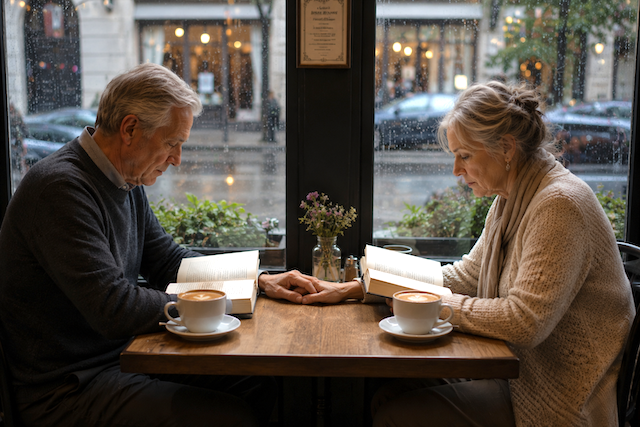
A week later when I go into the café, there’s an old couple (even older than me!) sitting opposite each other by the window. No body language here — they’re both looking down, at the food and beverages they’re eating and drinking, and not saying anything to each other.
After a few minutes, when I next look over there, the woman has taken a piece of her sandwich and is holding it up to the man’s lips. He takes a bite, seemingly not saying anything, and then bites the rest of what she’s feeding him. Nod. No facial expression or other acknowledgement.
What’s that about? He’s voraciously consuming his own meal, so it’s not as if he needs help eating.
A few minutes later, she repeats the gesture with the last bit of her croissant. He accepts her ‘feeding’ him, with another silent nod.
They move their empty plates out of their way as they drink their lattes. Now she reaches into her very large handbag and retrieves two hard-cover books. She passes one to him, and places the other in front of her. They open their books. Still no words spoken.
And then, as they read, the man gently places his free hand (the one not holding the book) on top of hers. She wordlessly accepts it, sliding her hand into his, which he embraces with a little squeeze. Not once have I seen them even looking at each other as all this is happening.
And then they just sit there, quietly, wordlessly, reading.
image by AI, my own prompt