








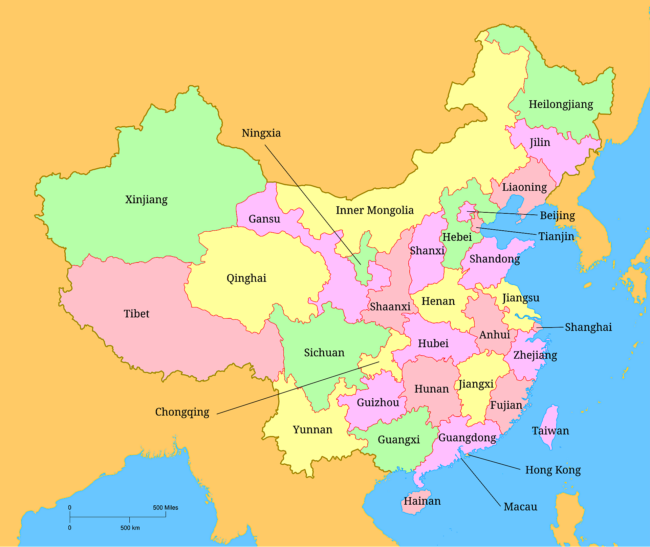
China’s provinces and administrative territories; map from wikimedia, CC-BY-SA 3.0
Until about a decade or so ago, I bought the whole western line about China — that their governments were ideological and oppressive, that they kept millions of Uyghurs in forced labour ‘reeducation’ camps in Xinjiang, killed Hong Kong protesters without a second thought, and ruthlessly persecuted the people of Tibet and Taiwan. That government corruption and incompetence had produced whole ‘ghost cities’ of fenced-off uninhabited buildings while nearby citizens were left homeless. And that everything they made was inferior, cheap junk. The endless propaganda from expat and CIA-funded anti-communist organizations like the Falun Gong’s Shin Yun religious right-wing ‘dance’ company didn’t help.
I believed all this shit until I actually met and started talking with people who actually lived, and live, in China. I’m now quite ashamed of some of the Sinophobic crap I posted on this blog in its early years, and I leave it up as a constant reminder of the dangers of believing things just because you don’t hear (for a variety of reasons) any contrary perceptions or information. But substantially everything I believed about China was utterly wrong. It joins the long list of things I was wrong about.
I’m not going to try to debunk all the nonsense we’re taught about China here. Instead, I thought I would assemble a curated list of what I think are some of the best videos that describe and show what everyday life for everyday Chinese people is really like. A video’s worth a thousand arguments, at least until AI destroys our trust in everything we see.
The first and most obvious caveat about the question in the title of this post is that, even more than life in most other countries, life in China is enormously varied. People in different provinces and cultures live very differently. People in big cities live vastly different lives from those in small villages. A lot of ‘tourist’ videos focus on and celebrate these differences, some of which are fun and interesting. But in this list I wanted to let people who actually live in China show and tell what their lives are like, warts and all. So here we go:
Two American-Chinese explain why they moved ‘back’ to China — (16 min) Grace (from Boston) and multilingual YongJian (born in China, moved as a young child to San Francisco) got married in the US and then decided to move to Guangdong province. Grace learned Fúzhōu dialect of Fujian province (unintelligible to Mandarin speakers) as a young child at home before learning English. They talk about the challenges of being Asian-Americans in the US and then Third Culture Kids in China.
What it’s like for a single woman living alone in a big Chinese city — (12 min) Mia Chen lives in Shenzhen, a city bigger than NYC in Guangdong province across the harbour from Hong Kong. A candid portrayal of a life where you need talk to almost no one, where you can get anything delivered very inexpensively in less than an hour, where technology from robots to driverless taxis feels like you’re living in the future, and where millions of e-scooters bring a whole new meaning to traffic headache.
And what it’s like living in a small Chinese village — (10 min) next, Mia takes us to the village on the coast of Northern China where she grew up. Utterly, jarringly different from modern urban Chinese life just a short hop away.
And what a day in the life of a white-collar worker is like — (10 min) and one more from Mia, as she takes you hour by hour through her workday in Shenzhen: Online shopping, moped taxis, e-cars, work check-in, breakfast, elevators, the need for VPN, WeChat, lunch delivered, after-lunch nap, self-driving cars, security robots, coffee robots, dealing with 40ºC summer weather, dinner at the mall (no one cooks for themselves in the city apparently), the tradeoff of no privacy and tiny apartments for astonishing cleanliness and absolute safety everywhere night and day, and low salaries but an incredibly low cost of living.
A walking tour of a small city — (16 min) Katherine, a bilingual American environmental consultant now living in Zhejiang province, explores small-city life in Weixin, Yunnan province and gives us a well-informed walking tour of the city.
Rural life in an unusual society — (31 min) globetrotting Swiss-Chinese Flo and her husband Flo visit the last remaining matrilinear society in China in Yunnan province for a glimpse of a very different kind of rural living — where marriage is almost unknown.
Moving from small-town US to big-city China — (11 min) the high quality and low cost of health care and education for kids, safe streets, and high quality inexpensive food (including for school-kids) are a few of the reasons 36-year-old Bradley will never take his family back to the US. But more e-scooter horror-stories. And Bradley will always be a lǎowài / wàiguórén (foreigner) to the Chinese.
Family life in Tibet — (40 min) Canadian Daniel Dumbrill, now living and working in China, visits with two friends’ families in Tibet, tours their small farms, admires their crafts, and goes mushroom gathering with them.
A socialist’s awakening to China’s life and model — (125 min) Daniel interviews a disillusioned 23-year-old leftist American named Willem about how he escaped the “China-bad” bubble and decided to move to China.
A drive around Chongqing and a talk about GenZ in China — (64 min) Daniel interviews Chinese journalist Li Jing Jing as they drive around Chongqing, China about the mixture of old and new in Chinese cities, how Chinese young people are quickly turning away from their infatuation with western ways thanks to US war-mongering, and how people in the Global South are now mostly studying China as a model for their own countries’ development.
Trevor Noah interviews Alice Han — (90 min) an interesting discussion (fast forward through the guys’ blather to hear her comments) about whether Chinese robotics will solve the looming demographic skew; why it’s illegal in China to fire employees and replace them with AI (basically because you need prosperous citizens to have a prosperous economy, duh); why lobbying is illegal and treated as corruption in China; why China is still innovative where the US is now just iterative; and questioning what will happen to China’s GenZ (with fewer jobs and a worsening economy, will they disengage or will they adapt and innovate?).
Lots more amazing videos on each of the above ‘channels’.
If I had a lot of money and no responsibilities, I would be really tempted to go to China for an extended time and employ someone there to teach me enough Mandarin to get by, and let me see for myself what is clearly a completely different way of life from the increasingly homogenized and precarious life of the west. China will of course be caught up in the global collapse of industrial civilization like everyone else, in the not-too-distant future. But I have a sense that their citizens’ pragmatic worldview, attitudes, skills, knowledge, innovativeness, openness and all-round competencies, might enable them to cope with, and adapt to, accelerating collapse, perhaps better than the citizens of any other nation in the world.