






Tyrannosaurus Rex was likely one of the Cretaceous period’s most fearsome predators, and a new discovery is revealing how the long-extinct dinosaur may have moved.
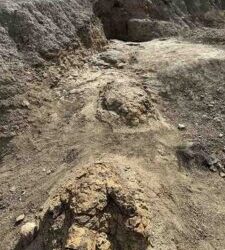
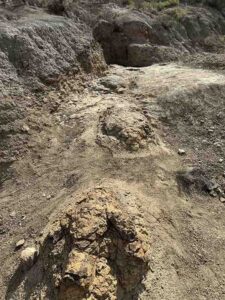
In a recent paper published in the Journal of Vertebrate Paleontology, an international team of researchers reveals the first-ever adult T. rex trackway, discovered in North Dakota.
While fiction media shows dinosaurs in motion, paleontologists still have many questions about how species actually moved. The new discovery goes a long way toward answering these questions with the first-ever record of a real T. rex gait.
Finding a T. Rex Track
The work was a collaboration between the Denver Museum of Nature & Science and England’s Liverpool John Moores University, centered on a literally groundbreaking set of footprints.
The discovery was made in the Hell Creek Formation, one of the world’s most intensely studied Cretaceous and Paleocene rock formations, which continues to reveal new secrets about Earth’s remote past. Although the formation covers thousands of square miles, this particular discovery was made on U.S. Forest Service land outside Marmarth, North Dakota.
Intriguingly, a local teacher at Northglenn High School made the discovery in a fortuitous example of citizen science. His discovery earned him an author position on the resulting paper.
“As a teacher, I’m always telling my students that science starts with curiosity, passion, and careful observation. I never imagined that could lead me to a discovery like this,” said co-author Kent M. Hups.
High Tech Analysis
“The technology we’re able to apply in the digital age means my colleagues could scan the tracks in the field and then send the 3D information over to me to visualize on my computer and in VR, enabling me to take as close a look as they did in person,” said lead author Peter Falkingham, a professor of palaeobiology at Liverpool John Moores University and a dinosaur track expert.
Using high-resolution 3D surface scanning, the team measured each footprint along the 66.5-million-year-old trackway. Using these data, they constructed digital and physical 3D models of the T. rex tracks. The footprints are about three feet long, and the trackway extends for roughly 23 feet. Their size and distinctive narrow toe shape led to the Tyrannosaurus identification, further supported by the known recovery of T. rex fossils in the area.
Tyrannosaurus Movement
This isn’t the first time paleontologists have seen a track believed to have been made by a T. rex, but it is the first time such tracks have been found in a sequence. Locating a series like this provides scientists with crucial new evidence about how the dinosaur moved while it was alive.
“Bones tell us an enormous amount about these animals, but footprints capture a moment of behavior. With a trackway, we can actually follow an animal as it moved across the landscape. That is incredibly rare for T. rex,” said co-author Tyler Lyson, senior curator of vertebrate paleontology at the Denver Museum of Nature & Science.
The stride between the footprints was about 13 feet, with a symmetrical sequence of two left and two right tracks. Due to weathering, it is challenging to be certain, but the team estimates that the dinosaur was moving at 3.5 to 4.5 miles per hour—roughly what would be a brisk walking pace for a human.
The work will continue this fall, when three of the prints will be physically removed from the location and transported by helicopter to the Denver Museum of Nature & Science. The institution plans to make the most of the opportunity, providing updates over the winter as researchers conduct an in-person analysis of the tracks.
The paper, “A Large Tridactyl Trackway from the Upper Cretaceous Hell Creek Formation of North Dakota, Likely Attributable to an Adult Tyrannosaurus Rex,” appeared in the Journal of Vertebrate Paleontology on September 8, 2026.
Ryan Whalen covers science and technology for The Debrief. He holds an MA in History and a Master of Library and Information Science with a certificate in Data Science. He can be contacted at ryan@thedebrief.org, and follow him on Twitter @mdntwvlf.