





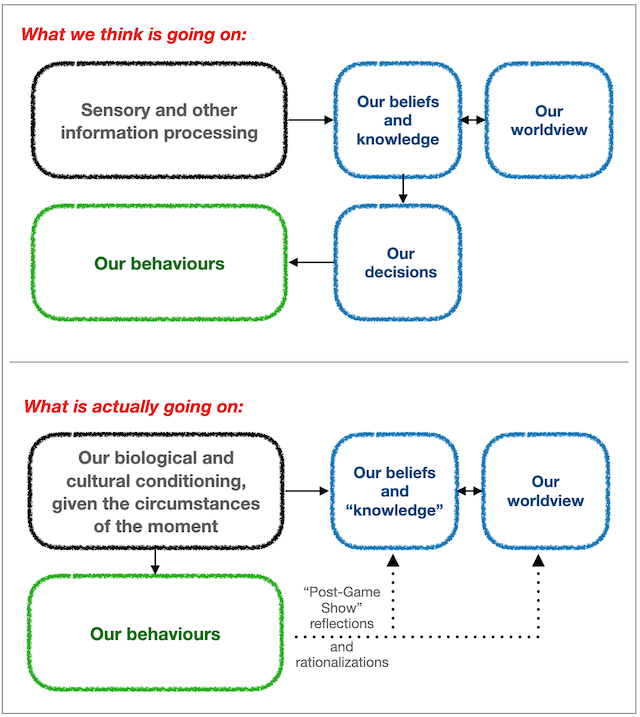
I have in past argued that our beliefs and worldviews are merely after-the-fact rationalizations of what we want to believe happened, and of what we want to believe were the reasons for these events happening. I keep insisting that our behaviours — what we actually say and do — are conditioned solely by the behaviours of others (what they say and do), and are not ‘provoked’ or influenced in any way by what we believe, since those beliefs always come after our behaviours.
This ‘one-way conditioning’ is illustrated in the chart above. I continue to ‘hold it lightly’ because it seems so counter-intuitive. I challenge it constantly, and recent events have caused me to do so again. So let’s take a specific example of recent events:
A few days ago, I read two accounts of some of the more recent (“post-ceasefire”) atrocities committed by the Israeli army, IOF and ‘settlers’ against Palestinians. Without going into detail, these accounts related to the murder of a Palestinian family and theft of their home and property by the Israeli army and “settlers”, the gruesome and deliberate murder of a helpless Palestinian child with Down’s Syndrome by Israeli attack dogs, and the gruesome torture and mutilation of a Palestinian family’s farm animals by a group of Israeli IOF ‘officers’. The facts of these and many other US-backed Israeli atrocities are really not in dispute. They have been thoroughly documented by independent observers, and often filmed, sometimes by the perpetrators themselves for subsequent ‘brag’ postings on social media.
I was, of course, aghast, but not terribly shocked, to read them.
How does my argument that our beliefs don’t influence our behaviours hold up when considered in the light of my behaviours related to these recent Israeli atrocities?
Here are the behaviours that seemingly might be considered to be a ‘consequence’ of my beliefs/worldview respecting these and other atrocities that are part of the US-backed Israeli slaughter of Palestinians:
- I high-five and cheer on the “Stop the Slaughter” protesters when I pass them.
- I decline to participate in their regular weekly protests.
- I grumble out loud about the latest US-supported Israeli atrocities.
- I add the links to these latest atrocities to my bookmarks for my next LOTM post.
- I do not talk to people I care about, about what I’ve read and seen of these latest atrocities.
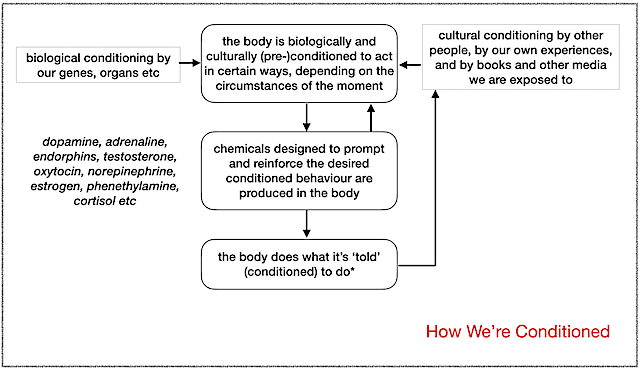
The conditioned process in each case was/is, I would argue, the same:
- Past conditioning by other people (e.g. the valve-turners) has led me to cheer non-violent activism. Hence when I witness such activism, I tend to cheer it on, rather than ignoring it or getting upset about it. This is often true even e.g. when I see (and honour) union pickets, even when I am unfamiliar with the issues and hence have no particular beliefs about their protest.
- Past conditioning by other people, and my own experiences, have led me to avoid participating in protests unless there is evidence they have been effective. My experience is that when I’ve participated in such protests, and they seemingly lead to no change or even negative repercussions, I feel sad as a result.
- Past conditioning by other people, and my own experiences, have led me to react with fear, anger and sorrow to credible news about horrific acts of violence. This is a largely instinctive response that has nothing to do with judgements about whether or not the violence might have been ‘warranted’.
- Past conditioning by other people, and my own experiences, have led me to include credible news about atrocities in my Links of the Month posts, provided readers have given me the sense they would value them, and provided they are not simply rehashes of news that can be read in many other places. My conditioning will then lead me to include these items only if they continue to be censored by mainstream news sources and only if I consider them important enough to warrant inclusion even though they are likely to be upsetting to some readers.
- Past conditioning by other people, and my own experiences, have led me to avoid talking about news, with people I care about, that those people are likely to find upsetting and not actionable.
And, I would further argue, my behaviours in each case were not the result of my beliefs or worldview:
- The reason I high-five the “Stop the Slaughter” protesters is not because I agree with their cause (although I do agree with their cause, so I can understand why people might believe that was the cause).
- The reason I decline to participate in the protests is not because I believe they won’t accomplish anything (although I strongly expect that is the case, so I can understand why people might believe that is the cause).
- The reason I grumble out loud about the latest US-supported Israeli atrocities is not because I believe they are horrific atrocities (although I do believe they are, so I can understand why people might believe that is the cause).
- The reason I (subject to the aforementioned conditions) include reports about atrocities in my LOTM post is not because I believe they are true and important (although I do believe they are, so I can understand why people might believe that is the cause).
This might sound like splitting hairs. What difference does it make whether the ‘cause’ of my behaviour was others’ conditioning of me, or my own beliefs and worldview — or some combination thereof?
To me it matters because, if my argument is correct, it is liberating. It reinforces the argument that we have no free will of any kind. It makes it clear that there is no point in judging anyone’s behaviour (including our own) as being something they (or we) had or have any control over whatsoever — even the mentally-stunted Trump, or the psychopaths in the Israeli military. We can and will naturally still be horrified by both, as we will by any credible news of atrocities. But this is the only thing that could have happened. Awful, but no one’s ‘fault’.
And in addition, the enormous amount of mental and emotional energy that we put into trying to keep our belief systems and worldviews coherent, consistent, ‘up to date’ and in order is entirely moot — it makes absolutely no difference to what actually happens. It is perfectly OK not to have a position, not to know, and to not allow the firehose aimed at influencing our beliefs and worldviews to distract our attention from this astonishing, beautiful world.
Of course, had I witnessed any of these atrocities first hand, my conditioning would have compelled me to intervene, even at the risk of my own life, health, and security.
Not that we have any free will over any of this, of course.