









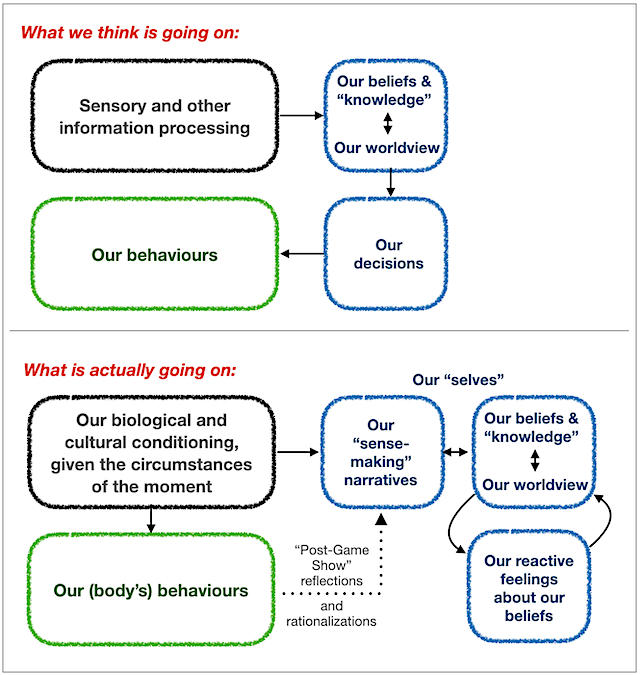
We make sense of this world by inventing stories about what our senses tell us is happening. If enough people ‘agree’ on the veracity of these stories, they then become myths (= “popular” stories), and hence very hard not to believe.
These stories, however, have no value in affecting what we actually do, as I’ve explained in several of my previous posts. Their purpose and value is actually not in helping us make decisions — our bodies do that ‘for us’ based entirely on our biological and cultural conditioning, and don’t use or need our stories, our ‘sense-making’, to do that.
The real value of these stories is social — agreeing on our stories and myths with others helps our inherently distrustful, suspicious and socially reticent species to form into tribes, communities and nations. Or in other words, to do things together — cooperate, coordinate, collaborate — without which capacity our species would quickly perish, especially outside our original homes of warmth and abundance in the tropical rainforests where we first emerged a million years ago.
(What we call culture is merely the collective name for our shared stories and myths, and the social rituals — songs, art, dance, games, gatherings and celebrations — that impart them.)
The problem with such stories (and all stories) is that they are fictions, mental constructs. They actually have no connection with reality. These stories, however, can create enormous negative energy and emotions — anger, rage, hatred, fear, anxiety, shame, guilt, envy, and a host of other helpless feelings. Most of these feelings are our visceral reactions to conceptual imagining that something ‘bad’ might happen, or did happen, or that it was avoidable, or that something else ‘should’ have happened, or that the ‘reason’ they happened was due to our or someone’s wilful misbehaviour.
We can do nothing with these negative feelings except get upset by them, and consequently become physically and/or emotionally ill because of them. The vicious cycle in the lower right of the above chart is what Eckhart Tolle calls the “egoic-mind/pain-body” cycle. (Sadly, he still preaches to his followers that we have the ability to escape the cycle, when we clearly cannot.)
In a recent article, John Michael Greer talks about the social damage that two specific types of stories/narratives can do. The first is the narrative/myth portrayed in most pornography — that sex is an angry, violent act of male domination that women somehow enjoy (or if they don’t it doesn’t matter anyway). The second is the narrative/myth portrayed in most modern ‘romance fiction’ — that the handsome, wild bad-boy he-man can be caught and tamed to become a devoted and attentive lover, if the woman is smart and patient.
These are ghastly stories that create beliefs and expectations, especially in the young and inexperienced, that guarantee conflict when exposed to real people and real events. We can thank such stories, at least in part, for the emergence of incels, and of some inconsolably unhappy women, and ‘grab ’em by the pussy’ deranged presidents and other Epstein types and their ‘bros’.
Those are just two examples of the damage that popular but utterly false narratives can produce. Our worldviews, how we ‘make sense’ of the world, are based on thousands of narratives that we have been conditioned to accept, all of them false, and many of them harmful.
Why does this cycle consistently arise, seemingly uniquely in the human species? John puts it this way:
Narratives… are the tools by which we understand the world; we think with stories as inevitably as we walk with feet and eat with mouths. Philosophers and psychologists showed long ago that the universe doesn’t present itself to us as a coherent whole—we encounter it as a “buzzing, blooming confusion,” as William James called it, a jumble of sensory inputs that we have to assemble bit by bit into patterns that make sense to us. Human cultures provide the instruction manual for making a world out of the jumble, and at the heart of every culture is a collection of stories.
This is how you build a universe: one story at a time. That’s why children are such omnivorous consumers of anything even remotely like a story, and why so many of them like to hear the same story over, and over, and over again. By being born, they’ve been flung into a whirlwind of unfamiliar experiences they have to learn to cope with, and stories are the tools they use to accomplish that Herculean task. Most of their play consists of inventing and acting out stories. Most of their thinking follows narrative patterns, and this sort of thinking remains in place straight through life.
Because these narratives are so compelling, and are reinforced by our languages and conversations with others, they become, as John puts it “the tools by which we understand the world”. The problem is that these tools create nothing but pure fiction, causing us to constantly and desperately re-rationalize our stories, beliefs and worldviews when they are inevitably shown to be not only utterly false, but, from our perspective, dangerously so.
So I would reword John’s statement as:
Our stories, myths and narratives are the tools by which we misunderstand the world.
And as I’ve said before, all of these human machinations and the resultant anguish, wasted energy, and rationalizations are completely unnecessary to thrive on this planet, as every other creature on Earth is constantly demonstrating to us. Our narratives are just the internal pundit’s blatherings in the futile, impotent “post-game show” we grandiosely call “consciousness”. In creating all the machinery of the constructed, “conscious”, human free-willed self, nature has, I believe, made a horribly blunder, and, in so doing, instead of making us more “fit”, she has rendered our entire species mentally ill.
John has offered as a prescription for this malaise that we expose ourselves to many, diverse alternative narratives (e.g. by reading a broad cross-section of fiction and non-fiction that conveys and supports alternative narratives). But I would argue that since stories are the problem, consuming more of them is a dubious solution.
In his article John then goes on to argue that today’s political leftists are still flogging narratives that have been shown to be false and naive — narratives that have been clearly and repeatedly rejected by most voters. Worst among them, he says, are the One Bad Person narratives that espouse “the self-defeating notion that all we have to do is get rid of the One Bad Person [Trump, Putin etc] and nothing else has to change”. Trump, for example, appeals to desperate, fed-up US voters because “he’s the only figure in the political scene offering them an alternative to a state of affairs they find intolerable”. Idealistic centrist politicians have for years marginalized their progressive wings and deep-sixed progressive platforms, while offering no alternatives to “the millions who have been harmed and impoverished” by status-quo centrist policies and programs that are now crumbling and ineffectual as we face the multiple system failures of the polycrisis.
So those who advance simplistic, blame-y narratives are winning elections everywhere because no one wants to accept that collapse is accelerating and inevitable and there’s nothing that can be done to prevent or even significantly mitigate it, no matter who is in “power”. That is a completely un-sellable narrative.
We self-befuddled humans desperately, urgently, constantly want a narrative that will help us navigate James’ “buzzing, blooming confusion”. If it’s absurdly simplistic and requires no effort or change on our part, all the better.
The problem is, after a while, when all of these simplistic, simple, ideologically-appealing narratives are seen to be flawed, misleading, useless, harmful and impoverishing, we are going to have to come face to face with the truth — including the truth of collapse that none of our narratives can adequately explain or even offer solace for.
When we lose confidence and faith in our stories, narratives, and myths, we might find we are actually losing our minds. I have been predicting for some time now that the prelude to the total collapse of our civilization’s systems over the coming decades (and probably continuing for centuries) will be a long Era of Chaos. It seems to me that when we lose all of the credible stories that we have used to ‘make sense’ of our lives and our world, the result will be chaotic indeed, both inside our heads and in the outside world we have ruined.
We are doomed, I fear, to have to wade through a long period of grasping for more and more absurd narratives, including those as threadbare as those of Trump and the opportunistic, egomaniacal, power-crazy billionaires and corporatists of the rising right, who are always ready to offer promises to the desperate and gullible in return for money and votes. And as they in turn are revealed to be nothing more than liars and thieves, the belligerence of the citizenry will ramp up higher and higher. That, plus soaring precarity and suffering, is what the Era of Chaos is likely to look like.
I know that’s a very unappealing narrative, but it’s the only one that my sense-making can still see as credible.