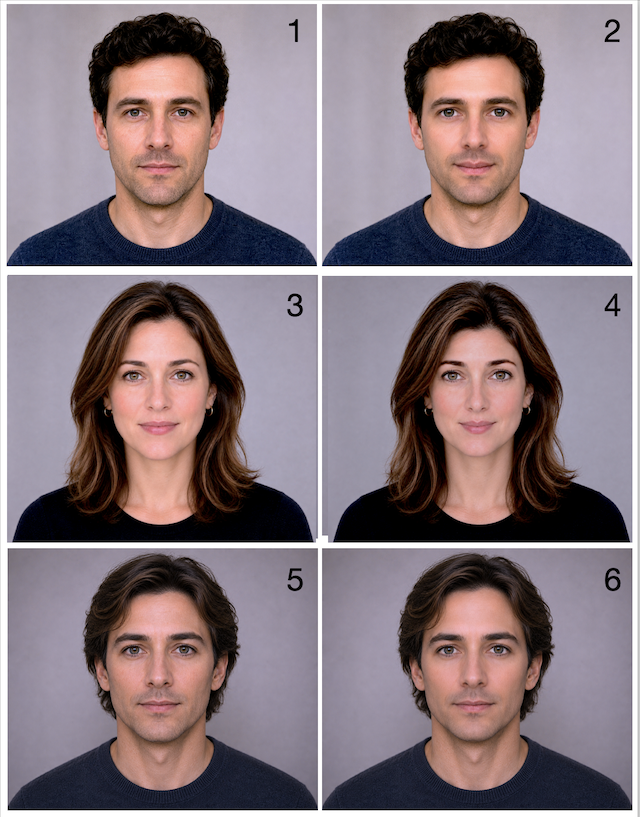



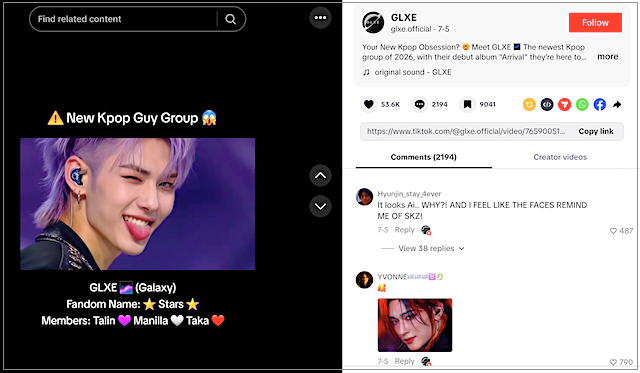
Announcement for a new K-Pop boy band earlier this year on TikTok — entirely AI: the music, the performers, the instruments, the lyrics, the photos and videos, all made up. Sample.
My curiosity has had me listening to music from countries all over the world for over 60 years. Whenever I’m ready to join those lamenting the sad decline in ‘popular’ music from its heydays, I discover the music of another country, rarely heard in North America, and my enthusiasm is reinvigorated. Ever parochial, western publishers and streamers refer to this music generically as ‘World Music’, a catch-all for anything they can’t fit into their western-oriented genre categories.
I’ve written a lot about AI, and specifically about its use in music creation, on this blog. My approach to AI music is almost the opposite of that of many hand-wringing musicians: I believe it is an enjoyable and very educational learning tool for amateur musicians (like me). I believe it can prompt lots of interesting ideas for the serious musician to consider. And I believe it can allow music listeners to create music that they personally like, quite possibly more than they like most of the music produced commercially by professionals and amateurs alike.
But it has not produced, and I don’t believe it will ever produce, great creative works, in any art form, no matter how much it ‘steals’ by mining existing artworks. This is partly because, as Gary Marcus has explained, to be able to reason and think and create like a human can, you require a human worldview — the gazillion accumulated elements of each human’s conceptions, ideas, feelings, sense-making, perspectives, and experiences, that are unique to that human ‘self’. Your worldview is not only what those elements are, but equally it’s the googolplex of elements that are not part of your worldview. It’s the lens through which you see and feel and appreciate the world. Creativity, I believe, emerges out of and is an expression of our worldview. It’s often been said that the artist’s main job is to get out of the way and allow the art to just flow out. (And then to edit the hell out of it to polish the rough into diamond.) Simply put, great art requires a human self, and AI will never be able to replicate a human self.
That doesn’t mean it can’t ‘create’ (a more accurate word would be ‘produce’) interesting and enjoyable works. It does this by mimicry, and AI is very good at mimicry. By accident, it can produce lovely turns of phrase (in the literary or musical sense). But it’s really all veneer. Do a bit of analysis of even the most carefully crafted and exhaustively-prompted AI ‘product’ and the randomness, awkwardness, and artificiality quickly shows through. That need not destroy your enjoyment of the product, though it certainly can. The hackneyed melodic line or chord sequence, or the lame lyric, once seen or heard (and they’re not very hard to see and hear if you’re paying attention) cannot then be unseen or unheard. Like those sixth fingers on AI images.
The most-often expressed concern of artists about AI is that this mimicry is effectively plagiarism that is appropriating copyright works of art and depriving the copyright holders of their hard-earned income and even their livelihoods. (Though it could be argued that the corporate music and publishing ‘industry’ oligopolies have already done more to starve artists than AI could ever hope to accomplish.) I think a much fairer statement of concern is that AI mimicry, kind of like Muzak or fanfic on steroids, is producing low-cost knock-offs and imitations of artworks, and most of the buying public likes the knock-offs and imitations almost as much as they do real art. Especially when they can get them free, and even brag that ‘I made that!’.
And so we come to World Music, and AI’s forays into all these genres unfamiliar to most western audiences.
Spotify, Deezer, YouTube, TikTok and the rest of the streamers of music, don’t know enough about any music to be able to discern real art (both good and bad) from AI mimicry. They act when they’re threatened with lawsuits, but they basically don’t care, because for the most part, their customers can’t discern the difference, and don’t much care either. This is equally true of ‘World Music’.
The largest displays of customer outrage internationally are when AI ‘impersonates’ real, beloved artists (especially if those artists are bands that have broken up), claiming that the art has been produced by those artists when it’s not. Self-acknowledged ‘covers’ and ‘tribute band’ versions are fine, and remixes and ‘sampling’ that are acknowledged as such are OK too (customers figure original artists are being compensated, and if they aren’t, it’s the artist’s job to fix that). But not counterfeit music pretending to be from real, adored artists.
So on K-Pop channels, stans angrily report imposters, and publicly shun most overtly-declared AI K-Pop music, but mostly are unable to, and uninterested in, distinguishing what’s AI (in whole or part) from ‘real’ art. Some overtly-AI K-Pop ‘bands’ do quite well.
A fascinating K-Pop/J-Pop story surrounds a song called GG EZ by Japanese ‘artist’ “M.Sasuke”, that features a bouncy beat and expletive-laden nursery-rhyme-level English language lyrics. It ‘went viral’ when the ‘artist’ issued a dance challenge to TikTok users to record themselves dancing to a 13-second segment of the song. Along with hundreds of others, a dozen big-name K-Pop stars, including a member of BTS, responded to the challenge, and their audiences produced 100M viewers of the dancing, and hence lots of publicity and royalties for M.Sasuke, who, it turns out, admitted it was all AI (except for the lame lyrics).
Once that was known, there was a flurry of discussion of what to do about the revelation, and in the process the song made the K-Pop and J-Pop top hit lists and reached 750k streams on Spotify in one month, but it settled down quickly. Most listeners (and dancers), it would appear, didn’t much care whether it was AI or not.
The same forehead-wrinkling, but mostly indifference, and often complete ignorance of their AI nature, has greeted AI’s foray into many other ‘World Music’ genres.
Among Latin American musicians, the uproar has again been mostly about spoofing —using voice-cloning to produce songs purported to be by established musicians, including Bad Bunny, currently the #2 top musical artist globally, that are actually AI, with no consultation with, contribution from, or royalties going to the actual musicians.
The other major concern from World Music artists has been about how quickly large volumes of mass-produced, inexpensive AI songs in almost every genre can ‘crowd out’ or ‘drown out’ music produced by actual musicians. The recommendation engines I use (notably but not entirely Apple Music, Soundcloud and Spotify) are rife with AI content, especially ‘World Music’ where the owners of the platforms are especially ignorant about what is AI, and which ‘artists’ are real people.
I have been fooled by AI several times recently, and I actually had to use other AI tools to confirm my eventual suspicion that the music was in fact AI, but was not acknowledged as such. And some of that music is very enjoyable. I wrote earlier this year about Portuguese Zouk music ‘by’ an ‘artist’ named Naya Zyá from Cabo Verde, which turned out to be AI.
More recently, I noticed that another musician that comes up often in my recommendation engines, Marylanah, whose smooth-as-silk Angolan Kizomba music, now has ‘her’ music denoted on YouTube (in tiny letters) as AI. Since then, I’ve discovered Kompa ‘musicians’ DJ Slone and DJ Rud are likewise AI.
The latest eye-opener for me was seeing a song called Escravo de Amor by artist 7AK3M show up on my recommendation engines. The song features an adoring crowd in the background, singing along in places incredibly well (on pitch, in harmony, on the beat). But the title in Portuguese should, I think, be Escravo do Amor. I really like the song, especially the crowd singing along to this moving lament, but it just didn’t sound quite real. Of course, it isn’t. The ‘performer’ has apparently never performed in public. Damn. What this ‘artist’ has done, in effect, is to invent a ‘crowd’ as an additional digital ‘instrument’ that can be added to songs.
And indeed, a search led me to the song that reached #1 in Nigeria by the artist Fave, backed entirely by an AI choir. And that led me to another top Nigerian hit that doesn’t even acknowledge that it’s entirely AI-produced, as explained in this article:
Papaoutai – Afro Soul (Stromae Remix): This fully AI-generated cover exploded into a major viral sensation in early 2026. Created by producers mikeeysmind and Chill77 in collaboration with Unjaps, the track uses advanced AI voice-cloning technology to replicate the emotive vocal style of Congolese-Russian singer Arsène Mukendi performing Stromae’s 2013 hit “Papaoutai.” Retaining the original lyrics but reimagined with rich Afro-soul instrumentation and grooves, the song quickly captivated global audiences. It debuted as the highest new entry on the Global Spotify chart at No. 168, amassed millions of streams within weeks, and climbed to number one on Nigeria’s Spotify Viral chart in January 2026. Many listeners were initially unaware they were hearing an AI creation, sparking widespread debate about authenticity in music while highlighting AI’s growing influence on viral hits.
Where will it end?
Of the last 50 ‘new music’ songs recommended to me by Apple Music, fully 15 would seem to be at least partly AI. On Spotify, the proportion is even higher. Given the relentlessly declining quality of Apple’s and Spotify’s recommendations over the past two years, this is not a good sign. Is it possible that instead of ‘crowding out’ human-produced art, AI is actually filling a void created by the music ‘industry’ oligopoly’s reliance on dumbed-down derivative music by known ‘brand name’ artists to goose profits at the cost of innovation and promotion of new artists?
Half of all the new songs uploaded to streaming services (2M songs a month) are now fully AI-generated. Fully 97% of listeners can’t tell the difference. And ironically, the people who are telling artists these alarming facts are trying to sell artists something to prove to listeners they’re human — music videos to accompany their songs, created by AI.
Here’s a repeat of my caveat on AI that accompanies all my posts that include or refer to AI-generated or -assisted content:
1. I have a love-hate relationship with AI. When it’s used properly and carefully as a tool, as an aid to learning and creativity, I believe it can be very useful, and enormous fun. But most of its large-scale applications (like replacing jobs and facilitating wars and surveillance) are ill-conceived, immoral, incompetently designed and conceived, vastly overreaching the capabilities of AI, ecologically disastrous, socially disruptive, and extremely dangerous.
2. The staggering amount that has been invested in AI has absolutely no viable business case to justify it. It represents possibly the most astounding squandering of money based purely on imagined and improbable future developments and blind faith, in history. Those who have studied this have concluded that this massive bubble will soon burst, and those who’ve invested in it will lose their shirts. At that time, the window to use AI as a learning and creativity tool will quickly close forever. Our playing with these essentially-free tools now is not going to aggravate its abusive uses, nor will it have any impact on the timing or extent of the coming AI crash. So my view is: use it while you can; it will soon be gone.