








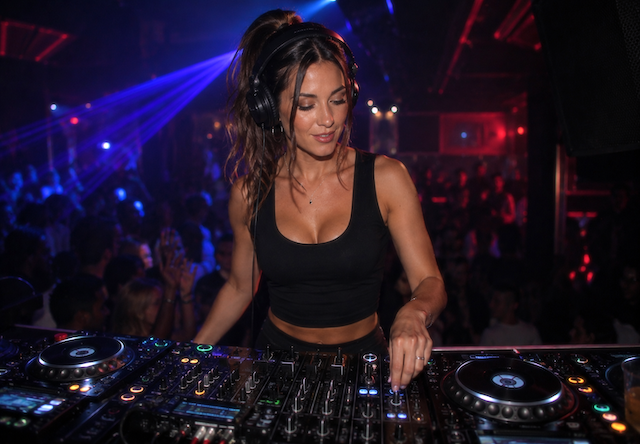
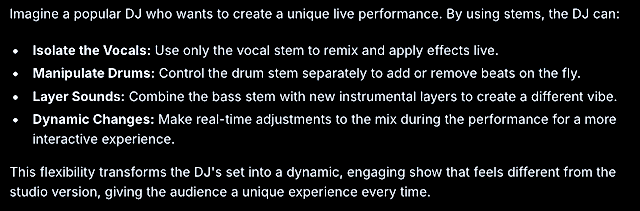
AI image, my own prompt; text screenshot from the website of Soundraw music software.
All music lovers who perform others’ work are constantly walking a line between plagiarism (stealing music from other artists without acknowledgement) and appropriate use (eg singing in choirs, or building on others’ musical compositions and ‘ideas’).
This line has become murkier as digital technology, and now AI, allows users (and plagiarists) to effortlessly cut and paste from one work into another. This takes a number of forms beyond obvious outright plagiarism:
- Unintentional plagiarism — where a significant portion of music under copyright appears in a subsequent work, unacknowledged and uncompensated (most famously George Harrison’s My Sweet Lord unintentional plagiarizing from Ronnie Mack’s Chiffons’ hit He’s So Fine).
- Covers — where some or all of a published work is ‘affectionately’ performed by an appreciative band, with or without acknowledgement or compensation; historically these have been faithful to the original version, but recently much-changed versions have also been labeled as ‘covers’.
- Muzak — where a bland version of a published work is created and produced as ‘background’ music in elevators, cafés etc, with or without acknowledgement or compensation.
- Karaoke — where an instrumental version of a song is produced for singers to add their own voices, either by creating a precise cover version or by stripping the voice out of the original version electronically, sometimes even by the producers of the original version for extra PR, sometimes not, almost always with acknowledgement, and with or without compensation.
- Sampling — where a small or large part of a published work is directly embedded as part of a new composition, with or without acknowledgement or compensation.
- Remixes and Mashups — where parts of one or more published works are blended together in (usually dance) ‘mixtapes’, sometimes unadulterated, sometimes with some or all of the original instruments and voices replaced or voiced over or with additional tracks superimposed, with or without acknowledgement or compensation.
Further complicating the issue is that many DJs produce ‘mixtapes’ live, without a recording, so there is no enduring evidence of what was played, beyond a ‘playlist’. But now with sites like SoundCloud and YouTube, these ‘mixtapes’ are also being ‘recorded’, sometimes by attendees of the live performance, with or without acknowledgement or compensation. The line between a simple ‘playlist’ and a ‘mixtape’ is now blurred.
I’m not going to get into the ethical or legal aspects of any of these processes — there’s a ton of writing on this subject, much by those who don’t understand the technologies and processes used to create/steal this music. I’m not going to add to that noise, beyond saying musicians are right to be concerned, especially because the producer oligopolies that control the commercial music ‘industry’ don’t care a bit about the composers and performers, only about their profits, and new technologies will allow them to starve and abuse their artists even more.
Now, enter AI. New technology allows music creators to strip out parts of published works, and alter them in ways that makes them almost unrecognizable. Transpositions of tempo, key signature, rhythm, etc, changing the ‘voice’ to a completely different one, keeping only a small part of the work (like just one of the drum ‘tracks’) and many other ‘remakings’ of small portions of existing music, even from analogue recordings, are easy for anyone to do now. And with enough ‘processing’ it is essentially impossible to tie their ‘signature’ back to the original recording.
And this is where ‘stems’ come into play. A ‘stem’ is simply an isolated instrument or voice from a recorded work (published or not), stripped/separated out from all the other instruments, so it can be reused in some other composition. Until the advent of AI, creating ‘stems’ was exceedingly difficult (except in MIDI and other digital music), with a lot of ‘crosstalk’ left from other instruments and voices in the stripped excerpt, leaving a ‘trail’ to allow possible prosecution for plagiarism, and generally creating a rather ‘muddy’ sounding piece of music.
At this point I should talk about tracks. Tracks have been around forever, and are different from stems. Modern music can have an almost unlimited number of tracks, each of them separately recorded and ‘laid down’, and then ‘mixed down’ to create final versions of a song, or intermediary products.
Music producers will often create multiple tracks of a single singer or performer, to allow them to sing harmony to their own song, or allow accompanists to play multiple parts all intended to be played at once, or to give subtle richness to a voice by double-recording, or for many other reasons. What AI extracts as a ‘stem’ is all the tracks it perceives to belong to a single ‘voice’ — all the vocals, or all the snare drum licks, or all the violins, combined together into one ‘stem’. Without access to the ‘pre-mixed-down’ tracks, that’s the best that AI-produced ‘stems’ can offer, at least so far. Think of a stem as like a ‘section’ of an orchestra, all the ‘instruments’ that belong to that identifiable section.
And for amateur musicians, and an increasing number of professionals, that’s just fine. You can create karaoke instrumental versions of just about any song that are good enough for most performers. You can ‘steal’ stems (a drum part, a string section, though probably not the vocals) for your own composition that will likely never be traced back to the published work you took it from.
But while that’s a concern to music professionals (and the corporate music industry oligopoly — it looks as if as much as 30% of ‘streamed’ music is actually AI-produced ‘works’ that use stems or other processed reworkings of published work) — it’s now creating whole new ways to work with published music.
The K-Pop world has recently started including instrumental versions of their music in EPs, doubling the number of ‘cuts’ on the EP, to generate additional revenue. In some cases, these versions are getting more plays and downloads than the vocal versions (perhaps for karaoke, but maybe not just that)?
AI music software producers are now inviting subscribers not only to create their own ‘covers’ (in the broader sense of the term) of other subscribers’ ‘creations’ (and connecting and giving ‘credit’ to both subscribers so amateurs can ‘riff off’ each others’ works), but now, enabling them to extract the stems of these AI-produced songs to use the stems as building blocks for additional compositions. I explained how I did this with ‘my’ own AI-produced music in an earlier post. (Stems are not to be confused with ‘hooks’, which are short catchy excerpts from your songs that you can, with AI software, invite other amateur composers to build on, either AI-assisted or not).
Original music creators are now getting into the act, encouraging amateur musicians to create remixes of their songs, and then re-publishing that music, with entire EPs and albums of professional and amateur-produced remixes of their hit songs. This has been done for a couple of decades (one of Jennifer Lopez’s best selling albums, way back in 2002, was entirely remixes by others of her earlier music). But that was mostly due to music producers (that greedy bunch again) inviting other well-known names to produce remixes.
More recently, remix ‘albums’ have been released that merely scoop up a selection of already-produced remixes of hit songs (authorized or not) that have garnered some popularity on streaming services. And, for better or worse, some of these remixes are actually better than the original versions in many listeners’ opinion.
And now, of course, guess what?: Some music creators are offering the stems of their own music to listeners, encouraging them to create new songs from the stems, and promising to (re?)-publish the ‘best’ of these derivative works through their studios, with credit to the amateur creators. This is perhaps the musical equivalent of fanfic. Or maybe the musical equivalent of paint-by-number. Not great art, but great fun.
Whether all of this is good or bad for the production of quality music (and the livelihoods of professional musicians) is, of course, debatable. But while most fanfic is unimaginably awful, some of it is quite good, and the creation process can be enormous fun, and a good learning practice, for amateurs. I think the same is true of these rapidly-evolving forms of music ‘reworking’ (or plagiarism, depending on how you look at it).
And this is evolving so quickly that it boggles the imagination. What else might we do with ‘stems’ of music, both our own and others’? Just as AI is starting to produce ‘fanfic’ that utilizes the ‘attributes’ of plot and character and setting that fans say they especially love, to the point it may be able to produce novels and films that will be more popular than what their authors and screenwriters could produce, might we soon see AI capable of learning so much about the ‘attributes’ we love (individually and collectively) in our favourite music, that it can produce ‘new’ music that we prefer (individually and collectively) to what our favourite artists can produce?
I’m being provocative in asking these questions. The answer might well be ‘no’. And I’m talking about popular music (and fiction), not great music (and fiction). I don’t believe any AI-created or -enabled work will or can ever be a great work of art. But I’m not sure most people much care. They want what they like, discerning or not. And now they might be able to (kind of) create it ‘themselves’, and have a lot of fun, and have an engaging amateur learning experience, in the process.
Here’s a repeat of my caveat on AI that accompanies all my posts on the subject:
1. I have a love-hate relationship with AI. When it’s used properly and carefully as a tool, as an aid to learning and creativity, I believe it can be very useful, and enormous fun. But most of its large-scale applications (like replacing jobs and facilitating wars and surveillance) are ill-conceived, immoral, incompetently designed and conceived, vastly overreaching the capabilities of AI, ecologically disastrous, socially disruptive, and extremely dangerous.
2. The staggering amount that has been invested in AI has absolutely no viable business case to justify it. It represents possibly the most astounding squandering of money based purely on imagined and improbable future developments and blind faith, in history. Those who have studied this have concluded that this massive bubble will soon burst, and those who’ve invested in it will lose their shirts. At that time, the window to use AI as a learning and creativity tool will quickly close forever. Our playing with these essentially-free tools now is not going to aggravate its abusive uses, nor will it have any impact on the timing or extent of the coming AI crash. So my view is: use it while you can; it will soon be gone.