








An exploration of the nature of time, why it seems so ‘real’ to us, and the profound implications of that in terms of humans’ unique and often destructive and unhealthy behaviours.
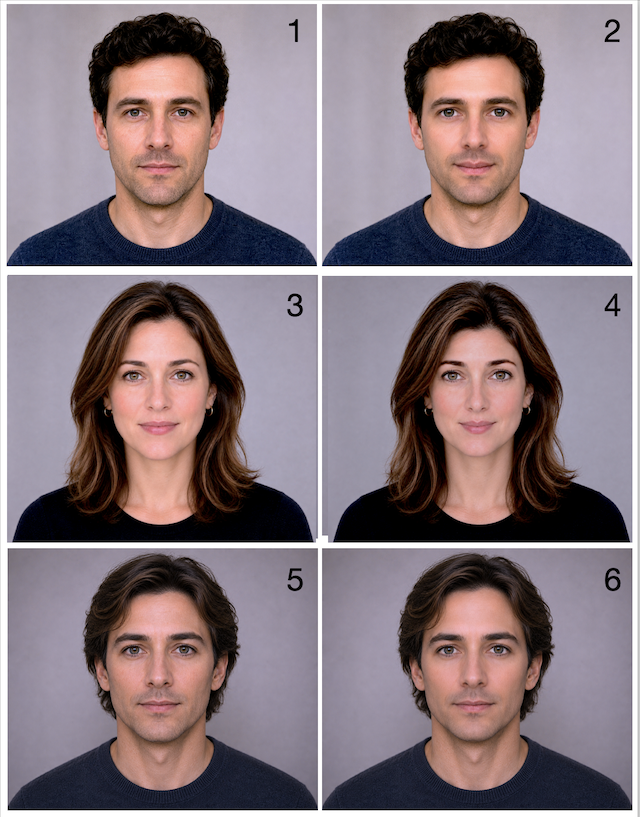
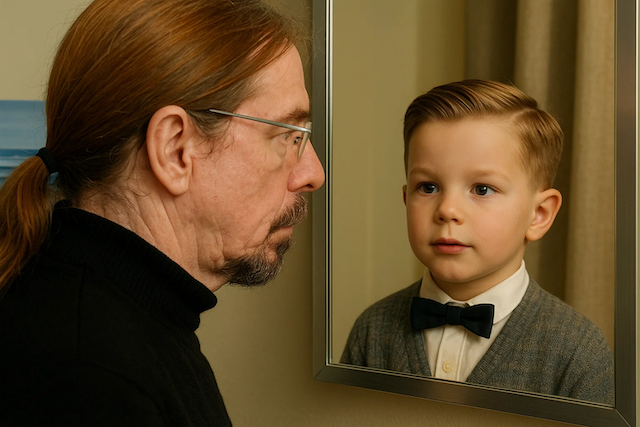
Sora used my sidebar photo, taken last week, and a black-and-white photo of me taken when I was 6, to create this composite photo of me looking into a mirror.
One of the most challenging issues regarding the nature of the universe and the place of humans in it, is the phenomenon of time. Many physicists now say that time is simply a mental construct, and it has no basis in reality. In fact, we seem to be the only species on the planet that has the conception of time, although many animals have a sensitivity to change and to ‘interval’ that prompts instinctive responses (bird migrations, dogs waiting for us at the door, bees seeking pollen at specific times of day etc) that we might anthropomorphize as being evidence of a ‘sense of time’ like ours.
A sense of time — and with it all the baggage that comes with it, including memories, nostalgia, remorse, vengefulness, regret, shame, fear and anxiety about the future, and hopeful anticipation and imagining of the future — don’t seem to be essential or even particularly useful from an evolutionary perspective.
The main reason we have this sense, scientists are now telling us, is that our brains have the capacity for such a sense, and nature has a propensity for ‘trying out’ random evolutionary changes when there is capacity for them, even if there is no imperative to do so. Those changes that turn out to advance the animal’s fitness — its ability to fit in well with the rest of life in its ecosystems and hence sustain the welfare of all life — will be retained, while those that make it maladapted to its environments will be genetically eliminated as the creatures with this dysfunction die off and cease to procreate.
One could easily make the argument that our current civilizational collapse and the accompanying Great Extinction are simply nature’s way of removing the maladapted human species before it further fucks up the global ecosystem. By this reasoning, post-collapse life on Earth is likely to be either absent the human species entirely, or populated only by humans that lack these maladaptive qualities. My recent poem and song If It Wasn’t For Words speculates on how evolution might have proceeded had nature not ‘tried out’ endowing creatures with very large brains with the capacity to abstract — to imagine things as being other than how they really are, and then to believe that these imaginings actually ‘represent’ reality. This capacity is model-building, and the creation of models that purportedly represent reality, complete with a sense of ‘self’ at their centre, a sense of separation of that self from ‘everything else’, and the necessary dimensions of separation — what we call space and time — needed to scaffold this model coherently.
This model, which we convey to every human child and reinforce to each other throughout what we call our lives, is not ‘correct’ or ‘wrong’, any more than a toy miniature or a map is ‘correct’ or ‘wrong’. They are merely representations of reality, or more exactly agreements that, until and unless a better model comes along, we humans use as a shared model. Human infants, like wild creatures, don’t inherently have a ‘sense of time’ or a ‘sense of self’. They must be conditioned to accept and agree to the model that includes those elements. It doesn’t matter whether they are ‘real’ or not, as long as they are agreed to by one’s ‘tribe’ and apparently useful. It also doesn’t matter if they are needed. And it doesn’t matter whether they are actually useful or not. An AI synopsis of this emerging understanding puts it this way:
From evolution’s point of view, truth is less important than usefulness. Time doesn’t have to be real; it only has to work. The human sense of linear time, with its past causes and future goals, enables planning, tool-making, cooperation, and culture. It is, in effect, a collective hallucination that allows billions of people to coordinate their activities — to meet at 3 p.m., plant crops in spring, and prepare for winter.
The hippocampus, responsible for memory, and the default mode network, which projects imagined futures, are mirror images of each other. They allow the brain to simulate scenarios based on past experiences. The self depends on this simulated timeline: “I was,” “I am,” “I will be.” Without it, the notion of a continuing identity collapses. So time, from an evolutionary standpoint, may have co-evolved with selfhood as part of the same adaptive narrative structure.
Once humans began using language, the illusion of time deepened. Grammar demanded tenses—past, present, future—so our stories could be understood. The linguistic codification of time reinforced our inner timeline: verbs literally forced us to locate ourselves in imagined temporal coordinates. Culture then magnified this by building calendars, clocks, and histories — externalizing what began as a neural convenience.
In short, the illusion of time likely evolved because it was an extraordinarily efficient way to organize experience, build memory, and coordinate behaviour. The brain “invented” time as a narrative framework that made the unpredictable world navigable. From a philosophical or physicist’s standpoint, this means that what we call “time passing” is not a feature of reality itself, but a storytelling device.
And so we are this unique, strange creature that nature is ‘trying out’ this capacity for abstract model-creation and model-use on. We arrogantly call this ‘consciousness’, including self-consciousness, as if it were a ‘higher’ state, a necessary evolutionary advance that other creatures might aspire to and one day achieve, when it is nothing of the sort. And so we believe and agree that the time we have invented to make our model coherent is absolutely real, while the rest of life on Earth believes no such thing, and has no need to, and arguably is infinitely ‘fitter’ for it than our deluded, angry, fearful and destructive species.
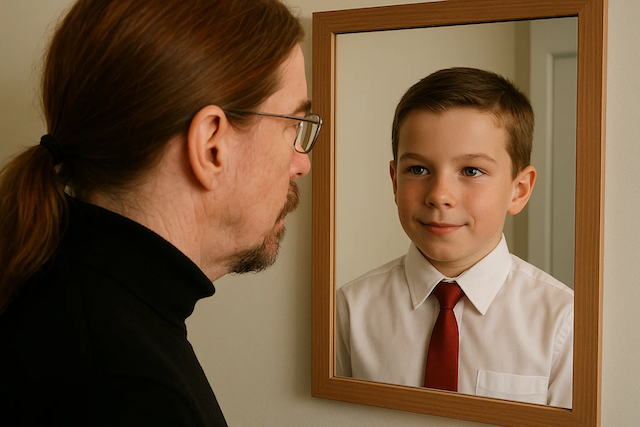
Next, Sora used that sidebar photo, taken last week, and a black-and-white photo of me taken when I was 12, to create this composite photo of me looking into a mirror.
And along with this sense and belief and agreement and collective delusion that time is ‘real’, comes the baggage:
1. Our brains ‘stitch together’ their discrete sensory perceptions to create a sense of continuity so that they can then be ‘placed’ in the time model. Without this invented sense of continuity, there is no place for the ‘self’ to be ‘located’ and the model would fall apart.
2. With that sense of continuity comes a sense of semi-permanence. Suddenly the body that the self presumes to inhabit is now alive. Horrifyingly, along with the sense of continuity and aliveness, comes the conception of death.
3. Religions of course immediately had to create the concept of after-life and reincarnation, because without them, this sad and brutal model would be too unbearable to accept.
4. Hot on the heels of the conception of ‘real’ time and continuity come the conceptions of a past and a future, and commensurately the concepts of causality and consequence. This-thing-really-happening-in-time was apparently ‘followed’ by that-thing-really-happening-in-time. Ergo, our patterning brains conclude, the first possibly or probably caused the second, and the second was a consequence of the first. Now we have truly opened a Pandora’s Box of ever-more-abstract and dubious elements of our simple, neat model of reality.
5. Along with these conceptions comes the idea of experiences — things that, we rationalize, ‘happen’ to us in time, and how we make sense of them, including attributing causality and meaning and making other ‘how’ and ‘why’ judgements about them, consistent with the rest of the model.
6. And as a social as well as a ‘meaning-making’ creature, those experiences are then captured by means of stories that have sequence and causality and all that other conceptual baggage embedded in them. Those shared stories are much of the fabric from which our worldviews, belief systems, and entire cultures, are created.
7. So the simple instinctive neuron-synapse mix that the rudimentary human brain produced to advise it how to survive — such as the association of fast-moving-yellow-thing (possibly dangerous) with spontaneous fight/flee/freeze responses — now gets conceptualized and reinterpreted as the recall of a ‘memory’ of something that actually ‘happened’ in the ‘past’. And things that ‘actually happened’ in the past, once causality and consequence have been assigned to them, can and will of course be mourned, regretted, revisited nostalgically, can fester a desire for vengeance or atonement or denial, or can be reimagined and further falsified to better fit with our worldview, what we want to believe really happened. “I must be remembering that wrong; what I think I remember couldn’t have happened because it doesn’t make sense with what I know. It must have instead happened this way. Yes, I remember now, this is what actually happened.”
8. Likewise we can now project and predict a whole set of completely imagined futures continuous with the flow of time from the past through now. And we can hope and pray for some of those imaginary futures. We can dread, and be incapacitated by fear and anxiety about, others of those imaginary futures. All kinds of imagined things are suddenly possible, now that we have time and continuity and life and death as scaffolding to imagine them with. So much now to worry about, plan for, scheme against, and get angry, fearful and sick about. Crazy-making!
As ‘unreal’ as it is, the model is extremely compelling. Einstein famously said:
Time and space are modes by which we think and not conditions in which we live… The distinction between the past, present and future is only a stubbornly persistent illusion… Time does not exist – we invented it…
(He also said, humorously but with an underlying truth: “The only reason for time is so that everything doesn’t happen at once.” We invented time for that very reason.)
So the ‘baggage’ that necessarily accompanies an acceptance of our model of time as being an expression of something that is ‘real’ — existing independent of the human brain conceiving it — includes continuity, permanence and impermanence, life and death and ‘events’ and ‘experiences’ in between, past, present and future, causation and consequence, ‘real’ memories, projections and predictions, and stories we tell (ourselves and others) about all of these things. Plus all of the beliefs and emotions that these conceptions instil in us. None of this baggage could exist without the invention of time. And, I would argue, based on all the studies of other animals I have read, the human species is the only animal that conceives of, or has any need to conceive of, any of these things.
This model that embraces the illusion of time and all of its baggage as ‘real’ is so compelling for several reasons:
- It enables us to ‘make sense’ of sensations and thoughts and feelings that otherwise would make no sense. We don’t like when things make no sense. We would rather invent a reason than admit we don’t know the reason for something. Or that things don’t have to have a reason. And in any case, we believe what we want to believe.
- It is reinforced by language and conversation and stories. If you hear something often enough from enough people, you cannot help believe it must be true. And the very structure of our languages requires a belief in this model of time and all its baggage. If we reject the model, we simply cannot use any commonly-understood language or terminology to convey what we perceive, mean, or believe.
- As Einstein said, the illusion of time is a very persistent one. Most of the time (heh), it seems to accurately represent the flow of things, what appears to be actually happening. When a model seems to work really well, eventually we cease to doubt its veracity and accuracy.
- Our brains’ neural structures actually develop as we grow to reinforce this illusory understanding of reality. What has been called the ‘default pathways’ of our cognitive processes are built upon the false scaffolding of self, separation and time, and the related conceptual ‘baggage’. Those who have experienced a sudden temporary or permanent disruption of these default pathways (Jill Bolte Taylor, Michael Pollan, the radical non-duality speakers, et al) report that immediately all of these mental constructs were seen to be just that — concepts with no basis is reality. Including time.
I have argued elsewhere that what we conceive of as our ‘choosing’ to do something is likewise illusory. The brain is both too slow and too feeble to be up to such a task. Instinctive perceptual and muscle responses like those of wild creatures take a few tens of milliseconds to occur. It takes ten to a hundred times as long before the brain is able to conceptualize that action, and then consider it as being ‘its’ decision. When you step on a nail, your foot retracts long, long before the pain message reaches the brain.
Likewise, The body’s sensory systems deliver roughly 10 million bits per second of information to the brain, but conscious processing handles perhaps 50–100 bits per second. It’s a very good thing we don’t have to rely on our vaunted ‘consciousness’ to make decisions for us!
So what’s going on when ‘we think’ we are consciously making a decision to do something? AI’s summarization of this process is:
Researchers such as Benjamin Libet, Michael Gazzaniga, and Daniel Wegner have long argued that the sense of volitional prediction is post hoc: Libet’s experiments (1980s) showed readiness potentials in the brain occurring hundreds of milliseconds before conscious awareness of deciding to move. Split-brain studies (Gazzaniga) revealed that the left hemisphere invents explanations for actions initiated elsewhere — the brain’s “interpreter module.”
The evolutionary implication: cognition’s main job may not have been prediction, but rather social justification — explaining and coordinating behaviour after it occurred. This “narrative exaptation” view sees prediction as a comforting fiction, useful for storytelling, coordination, and social cohesion rather than moment-to-moment survival.
And it is the same for the entire conceptual but illusory model of reality, including the illusion of time: What we think of as ‘real’, including our descriptions of ‘what happened’ and ‘our memory’, is merely an after-the-fact rationalization of what apparently happened, consistent with our, and other humans’, belief systems about the nature of reality, time, causality etc.
OK, you might ask, but if there is no real ‘time’ how can our conceptualization of events be ‘after the fact’?
Well, it is apparently after the fact. But that appearance of sequence and continuity is just a story. And every story is, bewilderingly but consistently, just a fiction, another conceptualization to try to make sense of what cannot (except within our constructed, self-referential, vastly simplified sense-making model) possibly make sense. We are caught in what radical non-dualists call the “closed loop” of self and separation.
And when asked for a way out of the loop, all we can say, unsatisfactorily, is “that is just what is apparently happening”. Time seems to exist, just as we, our selves, seem to exist ‘inside’ of time. All we can do is tell another story, and because that ‘no-time’ story inevitably violates our core assumptions about self, separation and time, it cannot possibly ‘make sense’, no matter how elaborately we try to lay out the argument and deflect the obvious criticisms of it.
That’s not a cop-out. This is a poor metaphor, but explaining why time is an illusion is a bit like trying to explain to a fervent believer in a god why that belief is irrational and not supported by evidence. The believer simply cannot be convinced. Their worldview simply cannot accommodate your arguments, because that worldview is based on assumptions inconsistent with and irreconcilable with those arguments.
And this is why — notwithstanding all our meditation, ‘self-reflection’, and other mystical mumbo-jumbo — we cannot perceive, or conceive of, time being illusory. Even while I am (for ‘now’) quite convinced that self, separation and time are all illusions, I cannot help ‘believing’ and ‘seeing’ them as real. And then rationalizing, without too much difficulty, all my conceptualizations and behaviours as being explicable on the basis that these things are real, that my story of what happened is ‘true’, and that these apparent behaviours of this body are the ‘result’ of my decisions. Even though intellectually and instinctively I ‘know’ all of that is delusional.
Part of my willingness (some would say zeal) to believe that all these conceptualizations are illusory, stems from my endless search for an explanation for human behaviours (like wars and genocides) that I can’t bear to assess as being inherently human behaviours. It’s more acceptable to me to appreciate that we can’t help ourselves, and that our stories — all of them fictions — can drive us to inflict horrific cruelty, misery, and suffering on other living creatures. I would sooner believe that these clearly pathological behaviours are not in our nature, and that “the stories made us do it”. I’m not sure I really believe that, but I’d like to.
I look at the photos above, which purport to portray ‘me’ in the past, at age 6 and 12. There is a recognition there, a noticing of features in these children that I ‘still’ seem to retain. Every picture tells a story, of course, and these photos purport to tell part of the story of me. They tell the story of a little boy, lost, scared and bewildered at first ‘learning’ that people can lie and cheat and be ‘deliberately’ hurtful to others. They tell the story of a student ready to start middle school, full of protective false bravado, armoured against the world and convinced that he is on his own, and is doing OK under those terrible circumstances.
The bodies of those depicted children, scientists assure me, contained none of the atoms that comprise the body I presume to call ‘mine’ today. I ‘know’ that there was and is actually no continuity between the ‘time’ of these photos and today. I know that the bodies depicted in these photos, none of them, are or were ‘me’, or ‘my’ body. What I conceive to be my ‘self’ today is not really causally connected in any way to who I conceive the boys staring back at me in the mirror to have been back ‘then’. What I call memories of those ‘times’ are just this brain’s imaginings, pure conceptualizations. Those little boys in the photos, and I, were not ‘born’ in the ‘past’ and will not ‘die’ in the ‘future’, though this apparent body may, I imagine, appear to die. Or at least that will be the apparent survivors’ story about it. All fictions. None of it real. All just constructions, like the AI photos, made up.
Still, the photos haunt me. The characters in them ‘look like’ me, all of them. Such is the closed loop of me. I am condemned to believe that all of the stories they tell must somehow be true.
John Gray, in the chapter titled The Deception in Straw Dogs, said: “We cannot shake off the sense that we are enduring selves, and yet we know we are not.”
We are nothing, appearing as everything. For no reason, with no purpose or meaning. Timelessly. Just stories we’re caught up in, unable to escape, even if we wanted to. A uniquely human insanity.
Or so it would appear.