







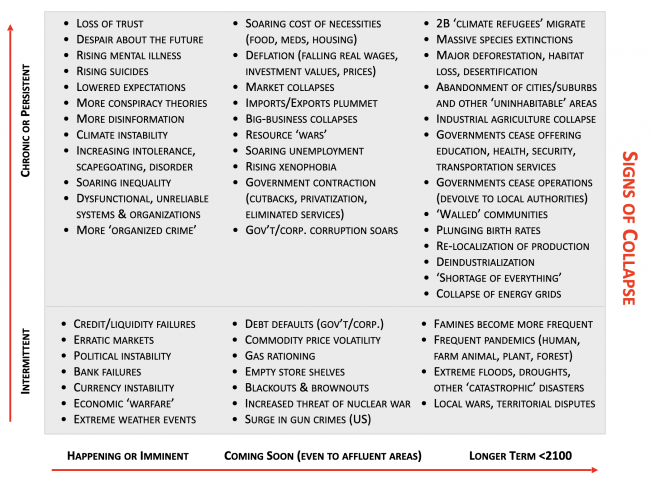
Now that the collapse of our political, economic, social and ecological systems is accelerating, the signs of this collapse, including scapegoating, corruption, and social disorder are becoming more obvious. This is the seventeenth of a series of articles on some of these signposts.
In the “old days” when I was growing up (the 1960s) we started to hear the term “disposable society”. In part this was due to an inevitable failing of capitalism: the preference to produce cheap, shoddy products that more people could buy (and more often) rather than high-quality, durable goods. And in part it was a reflection of a growing “short-termism” in our way of thinking — why invest in something that could last decades when the world could end before then?
This mentality, dangerously, also applied (and still applies) to our provision of services and government spending. When you’re elected for just four or five years, why dare ask today’s taxpayers to pay for infrastructure (roads, sewers etc) that will outlive their children, when it’s easier to buy something cheaper without needing new tax funding, and foist the problem of later maintenance onto the next government?
But today, while that’s still going on, there’s a different phenomenon also at work: We throw things out not just because it’s cheaper to buy a new one than repair them, but because they cannot be fixed at any price.
Part of this phenomenon is technology-driven: New technologies are constantly emerging that render older, perfectly-functional products dysfunctional. So, for example, with all our software, we find that for half the software we use, the version we own just won’t work with the newest version of the operating system, while for the other half, the version of the software we own will only work with the newest version of the operating system. For no valuable reason (“oh, but the new version includes AI!”) half of our software now has to be replaced (“upgraded!”) just to continue to offer the same functionality we want and are used to.
But the other aspect of this phenomenon has to do with the never-ending complexity of our society and everything in it. When software, to continue with the same example, gets more and more bloated as it is patched and re-patched to work with all the new functions it needs to have to work with other software, to the point it becomes logistically impossible to replace it with a streamlined start-from-scratch product. And soon after that, it becomes completely impossible to do so, because so many people were involved in the patching up that no one knows how the whole product works any more. Lots of those people have died or left the organization, or forgot what they did in version 38.9045.667a to patch that awful bug.
So then what happens? What happens when no one is competent (etym.: “unable to do what needs to be done”) to fix something millions of people rely on?
It ceases to function, people stop using it and scramble to find something else, and then it’s permanently disposed of. This is complex system collapse in microcosm.
I’ve been trying to get a bunch of annoying bugs in Apple’s proprietary software fixed for over a decade. Lots of users on “user forums” (where customers have taken over dealing with bugs because Apple itself doesn’t want to, can’t afford to, or simply doesn’t know how to, fix them themselves). Every new version of its OS brings a new little trauma of dread, to discover that these bugs have now worsened, and new ones have emerged. And Apple is far from unique in this.
To make it worse, the tech bros are now so desperate for their decaying products to generate ever more profit, that they are now charging you recurring annual fees for essential “upgrades” to products you already bought outright. Microsoft and Adobe are the worst for this, but Apple has announced it will no longer support its ancient ‘office’ products either, forcing users to pay a monthly or annual extortion payment to continue to use products we have already bought and paid for. (“oh, oh, oh, but extra functionality!”).
It would be easy to blame this all on the relentless greed of the tech branch of the Epstein Class, but these problems are not limited to tech products. My involvement in our local “Fix-It Fairs” is teaching me that more and more of the products we use every day have now become “unfixable” despite the valiant efforts of people who’ve been fixing things since they were kids. Instead of using your tool kit, you now have to replace an entire circuit board, and good luck if the manufacturer is no longer in business or no longer “supports” your old product.
And the overworked and under-appreciated people who “service” products for a living are dwindling in number as they age out and die. Who (perhaps other than my friend Ben Brangwyn) still knows how to machine-tool replacement parts for broken but perfectly ‘serviceable’ bicycles made by no-longer-existent manufacturers?
This is what happens when systems get so large and complex that they become impossible to “fix”. They just keep getting more and more dysfunctional until they collapse.
Our health care system, whether it is “privately” or “publicly” unaffordable, is so dysfunctional that it could not be “fixed” even if the governments of the day were allowed to raise taxes on the rich to pay for the repairs. Same with both our corrupt “private” for-profit and baby-sitter public education systems.
Every weekday the garage underneath my apartment building empties out as at least 80% of the vehicles make the hour-long commute to the city. It’s a trip that a fully-functional road or public transit system could allow residents to make in a third the time. But that’s unaffordable. And the disruption that the un-envisioned necessary construction would now entail makes it a non-starter.
All this to enable commuters to do work they could almost-100% do from home, saving vast amounts of time, money, and environmental damage. Why aren’t they allowed to? Because employers don’t trust employees when they’re not present to intimidate not to ‘slack off’. Why is there no trust? Because the employers are required by the economic system they’re equally trapped in to constantly screw their workers to maximize short-term profits. Why does this system that serves none but the idle ultra-rich 1% rentier-shareholders exist in this form? Because it can’t be fixed. It’s just too big, to self-reinforcing, too complex, and has too many ‘working parts’. Theoretically it could be fixed. But not practically. Not really. Large complex systems just get bigger and more dysfunctional until they collapse.
What do we do in the meantime? What people coping with dysfunctional systems have always done — we find temporary workarounds. We patch what we can, for a while, and then we abandon the parts of the system that no longer work, and find workarounds. With no expectation or hope that they’re sustainable, this at least provides the basis of some kind of semi-permanent alternative way of doing ‘business as usual’. And then we leave, or die, and the next poor souls trying to cope with the system have to find their own, increasingly complicated and unsatisfactory workarounds.
Workarounds work for a while. And then they don’t. Systems collapse from the bottom up, like sandcastles facing the slow inundation of rising tides. The Global South knows; almost everything their citizens do is now by way of workarounds. They never trusted, never relied on, the “system”. We’ll learn too, soon enough. We should be studying them to learn what comes next.
Or we can watch the AI bubble burst, which will be a more spectacular demonstration of the collapse of a complex system that was incompetently designed from the outset.
A new article from Cory Doctorow explains how this temporary patching has begun to pervade everything we do. He talks about it in terms of “today’s work” (make it function OK today and don’t worry about anything more permanent) versus now-impossible “accretive work” (etym.: “work that builds competently and effectively on what already exists”).
And another new article from Elisabeth Robson entitled The Invisible Systems Holding Industrial Civilization Together describes how the valiant and relentless work of people in what could broadly be called “maintenance” work, enable our teetering systems to function just a little longer. Until they don’t.
Her example is the brilliant, coordinated, and arduous work of international scientists who have released millions of sterile screwworm flies for over a decade to prevent their invasion into US cattle populations and hence prevent them infecting herds with a horrific and deadly contagious disease. Until the funding ran out, the availability of ‘sterile’ flies and the process to sterilize them ran out, and the number of people who knew the process dwindled. So now the disease has arrived. They’re trying a desperate ‘patch’, but no one knows if, or for how long, it will work.
We can’t prepare for collapse, because we can’t know exactly when it will occur (repeatedly, and differently), where it will occur (everywhere, but at different times and in different ways in different places) and how it will occur (depends on our, and our communities’, specific circumstances, and what happens elsewhere).
But perhaps we can learn to see the signs. And the fact that less and less of what we buy and use, and less and less of the infrastructure we rely on, is still mostly functional (even with workarounds), still fixable (even if we could afford to fix it), still competently designed and maintained or even maintainable, is a pretty good sign of where we stand.
Careful now. The basement is full of water and rust, and no one knows what to do, other than running up and down the stairs with pails trying to bail it out. And still the water is rising.