
This is the fourth of a series of articles — opinionated, fanciful writings, speculations — about The World After Collapse. It draws on what I’ve learned about pre-civilization humans and other large-brained creatures, and speculates on how, after civilization’s fall is complete — probably centuries from now — the remnants of the human species might be unrecognizably different from how we behave and think now. But they may be also ‘recognizably’ similar to how we know, deep down inside, we really are, and always have been. The series is not intended to provide hope, or solace, or a prediction, or least of all a pathway to change. Just a speculation about how the world, with a smaller number of us, or without us, might look long after those of us living through the fall have gone.
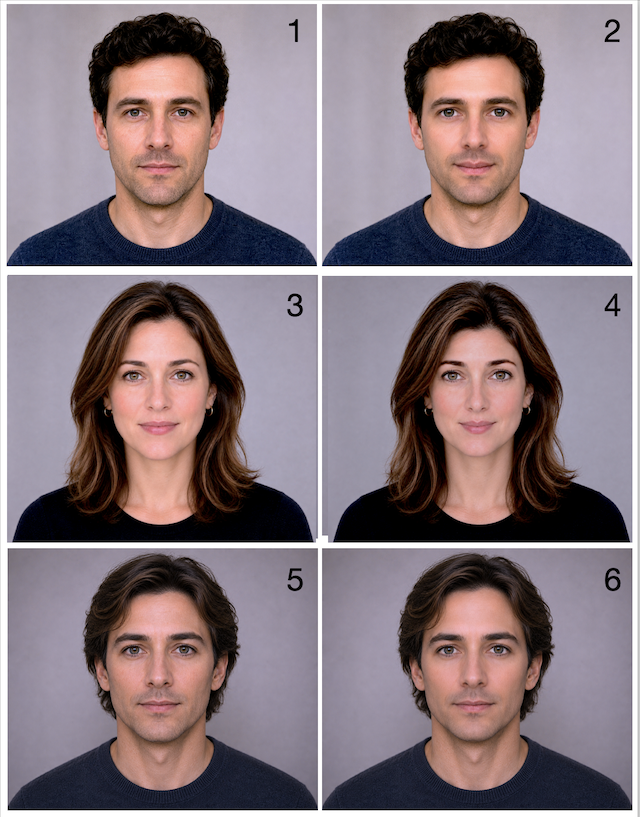
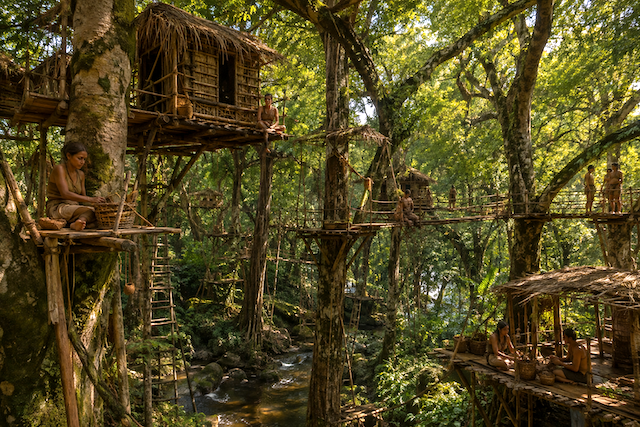
image by AI; I decided not to try to argue with the bot about whether this far-future tribe might not wear clothes
We live in a world — or at least the prosthetic human simulacrum of one — where massive amounts of our attention are afforded to ‘individual’ matters: individual rights and freedoms, the individual opinions that pass for ‘facts’ and ‘news’ in most media (and in academia), and individual choice.
In this our species is probably unique. When we ascribe these qualities to other species’ instinctive behaviours, that ascription is almost always anthropocentric — an arrogant projection of human behaviours onto those other species, in the lonely desire that they be like us, only to a lesser degree.
Most of the species on our planet have no apparent need for the sense of an individual self with its own separate wants and expectations, and there’s increasing evidence that this sense is illusory — one of nature’s experimental exaptations or spandrels that we humans, uniquely, have taken to heart as an essential requirement for our species’ survival.
And since most (but not all) humans appear to have been conditioned to accept that our ‘individual’ qualities are real and essential to us and to our species, it’s not surprising that we can hardly even imagine humans living totally communally — where instincts about the optimal health of the tribe, the community, and the larger community of all life on the planet, drive all our behaviours, and ‘individual’ preferences and wants are subordinated or simply don’t arise at all.
Indeed, as Ludovic Slimak has explained, it appears likely that Neanderthals, a human species that looked not unlike us, had no need for language, or art, or perhaps even the internal construction of a separate ‘self’ in their brains, in order to thrive for millennia before our species exterminated them. And, likewise, other species that have large brains seemingly have no need for these things.
There is no necessary logic to evolution, and many species have arisen and then become extinct either quickly after their emergence or after millions of years.
Our species certainly needs abstract language and other complex adaptations to continue to function in our staggeringly unnatural modern societies. But the more interesting question, I think, is the opposite one: Will human societies need abstract language and other ‘technologies’ to thrive (in very small numbers in local communities in ecosystems to which they are naturally suited) in a post-collapse world? And if they don’t need them, will these human inventions simply die out along with the no-longer-sustainable technologies that required their use?
That is of course an unanswerable and debatable question, and rather than debating it, I’d like to speculate on what post-collapse human societies, perhaps several millennia from now, might look like without them.
In a previous article in this series I explained my belief that abstract languages will not survive industrial civilization’s demise. My speculation here is that, without such languages and the trappings that require them, future humans will cease to be conditioned to believe and act as if they are separate ‘individuals’.
I’m not suggesting we will be all ‘kumbaya’ peace-loving, violence-free creatures, any more than any other species is. And even current human cultures that have been relatively uninfluenced by industrial civilization, while tending to be more collaborative and collective in their behaviours, nevertheless have developed abstract languages that incorporate the sense of the self as a separate individual — so post-civ cultures are not likely to be any more like modern indigenous cultures than they are like us creatures enmeshed in industrial civilization. Our far-future descendants are, perhaps, likely to be more like the Neanderthals.
So here are the qualities that I think a future human species whose members don’t think of themselves as conceptually separate individuals with separate individual needs, wants, rights, and ‘important’ opinions, might have. Totally my own ‘individual’ speculative opinion of course:
- They will have no concept of ‘personal’, ‘private’ property. They will just belong to the ecosystem and the tribe they have always found themselves in.
- They will be territorial. They will not be protecting and claiming ‘ownership’ of a territory, but rather instinctively ‘spacing themselves out’ from other tribes to ensure their ecosystem can continue to sustainably support their numbers.
- Their decisions will be made instinctively and collectively. Just as roosting pigeons suddenly start flying around in flocks, with no identifiable ‘leader’ or initiator, they will migrate, and do other things, when the collective decides they will.
- They may or may not be what we would call ‘hierarchical’ and violent in their behaviour, depending on their circumstances (not on their ‘innate nature’). Much of what we call ‘hierarchical’ behaviour in other creatures is in fact recognition of intrinsic specialized capacities. The physically strongest aren’t at the ‘top’ of the hierarchy — they are the ones instinctively called upon to watch over and protect the weaker members from predators. I would speculate that in situations of abundance, egalitarian, sharing, generous behaviours will prevail, while in conditions of scarcity and precarity, more ‘selfish’ behaviours will emerge: If there’s not enough to go around, it makes sense that the collective would allow a few ‘alphas’ access to the limited resources, rather than allowing the whole tribe to starve.
- Without the technologies to recreate prosthetic environments, their behaviours will automatically self-regulate their numbers. Nomadic creatures only have babies once their current infants are able to walk independently. Fertility chemistry is naturally self-regulating in response to environmental conditions in most mammals and birds. Ecological crises may drastically reduce human numbers or even render us extinct, but there will be no new human ‘population explosion’.
- They will be mostly tolerant of, but ambivalent about, their fellow tribe members. Social animals seem to recognize that they can’t survive without each other, but they don’t always get along. That’s instinctive behaviour, not ‘selfishness’. We are naturally averse to crowds, fearful of being in any way confined or enclosed, and intolerant of greedy and otherwise obnoxious behaviour.
- They may well be intolerant of ‘outsiders’. As Ludovic has explained, our species seems uniquely fearful of, and intolerant of, ‘difference’. We may never know why, because that intolerance (as expressed in racism, misogyny, and other fear-based forms of hatred, violence and discrimination) does not seem to be particularly evolutionarily useful or advantageous. He writes:
We Homo sapiens citadensis are absolutely normalized by our society. You just have to walk down any street to see that our expression of diversity is more or less limited to the case we put on our smartphones or the colour of car we choose. Our societies do not tolerate any real expression of plurality. We belong to an over-normative society, and that is basically true of all sapiens societies, at all times: difference is frowned upon and only superficially tolerated at the periphery.
Not the idealistic picture of humans living in perfect harmony with each other and with all other life on Earth. But perhaps, as we were for the first million years of our existence on the planet, at least sustainable, stable in numbers, and minimally disruptive of the ecosystems we were an essential and inseparable part of.
Sci-fi and speculative fiction writers wouldn’t be happy about this speculation, of course: Just as all sci-fi aliens need to be recognizable humanoids with modern human sensibilities speaking human-like languages, speculative novels set in future millennia must entail struggle, conflict, triumph over adversity, and a story conveyed through the humans’ spoken and written languages. We just can’t imagine humans any other way.
But, boring and incomprehensible as that might be, that’s what I would speculate post-civilization human societies (if there are any) being like. Not the stuff of fable or myth. Just tribes getting along as best they can given the circumstances of their birth.