





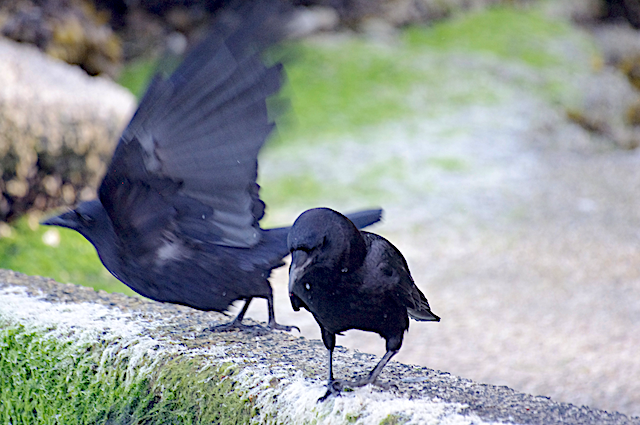
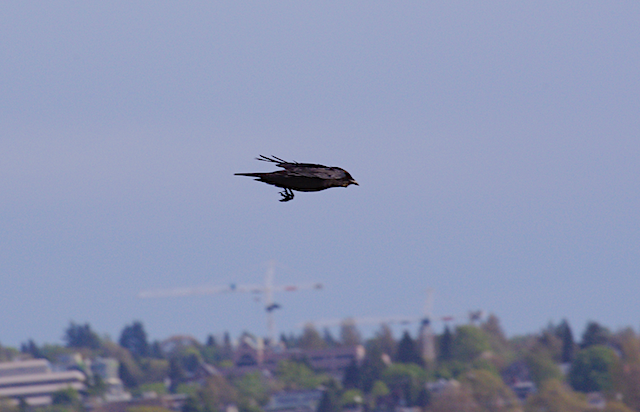
all images in this post are my own photos (not AI)
There seems no limit to the number of writers, artists and scientists intrigued and even obsessed with the challenge of trying to understand what it’s ‘like’ to ‘be’ a non-human creature. I’ve read more than a dozen books on the subject.
My sense is that there might be strong clues if we were to study human babies, before they acquire the skills of language and form a sense of themselves as separate from everyone and everything else.
I’m one of those obsessed with this subject, and I tried to see if music might help me imagine what it’s ‘like’.
I started with just a prompt to Suno AI of the sense of wonder and awe and simple acceptance that I was trying to evoke. No words — wild creatures don’t need abstract language to be just how they are.
What it responded with was a song with very lame lyrics that missed my point entirely, along with a very evocative, IMO, instrumental musical composition.
So I stripped out the vocal part of the song, and started over again with the instrumental:
The World Through Different Eyes, take 1 (instrumental background only)
How might Suno do if asked to ‘amplify’ this instrumental by creating a more sophisticated instrumental in a particular style? Not bad, and certainly worth keeping as an addition to my music library.
The World Through Different Eyes, take 2 (fully developed instrumental)
But its tone really didn’t get to the wonder and awe and mystery I was hoping to capture.
Usually when I compose music (without AI assistance) I start with the lyrics and then layer in the music — rhythm, bass notes, melody, chords and fills, in that order. I wondered — could I do it in the opposite order? Could I start with the nice stripped-down instrumental and layer the melody, lyrics and vocals over top of that?
To do that, I needed to know the chords. Too hard for my amateur ear to piece together, especially since it entailed that old rock standby technique — a whole tone key shift upwards 2/3 the way through the song. So I got Chordify to analyze them for me, and with a little tinkering came up with this chord map:
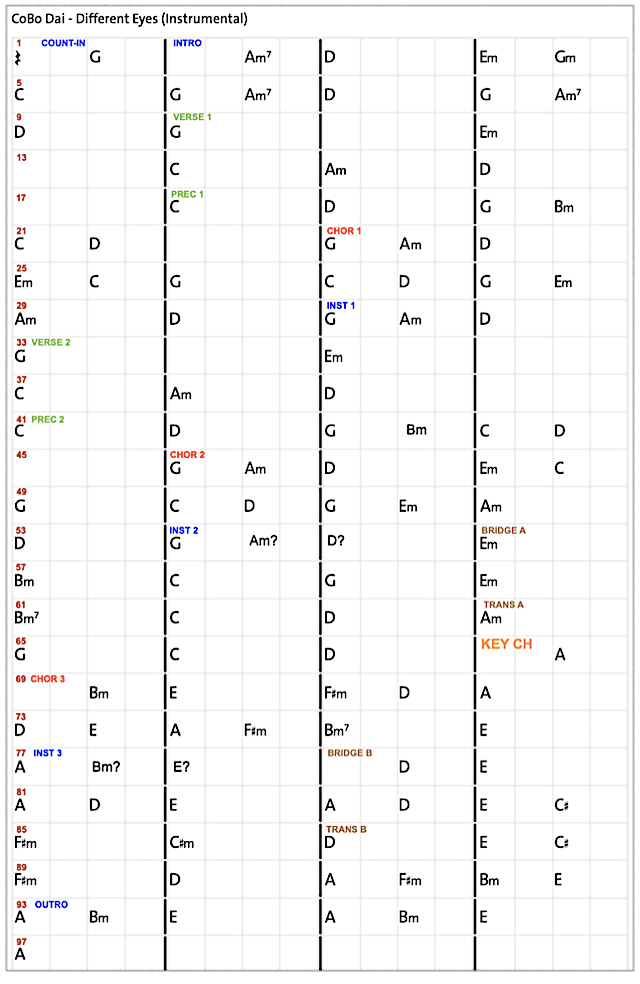
This was a great learning experience for me, not only appreciating but also correcting the chord sequences, and also understanding how ‘bridges’ and ‘transitions’ create a more sophisticated work than just verse-chorus structures. Out came my Alesis synth and many hours were then spent trying to come up with a compelling melody and lyrics that ‘fit’ with those chords.
To no avail. Perhaps the poetry muse has left me, but I couldn’t come up with any rhyming verse that ‘matched’ the mood of the music and also conveyed what I was trying to convey in the song. But I had a lot of fun ‘jamming’ with the instrumental, now I had the chord chart as my cheat sheet. (Since it was in Gmaj, shifting to Amaj, jamming was pretty easy).
So, what to do? I decided to write in prose what I wanted to say, and even though correcting the metre and making it rhyme properly seemed beyond me, I was pretty happy with the ‘prose poem’ I came up with:
The World Though Different Eyes
Look there, at that crow.
First he drops a pebble from the tower roof and then dives down, retrieves it in mid-air, and soars back up triumphantly.
And then he does it again. And again.
Ignore your brain’s incessant attempts to rationalize ‘why’ he does this. There are no other crows around to impress.
There doesn’t have to be a reason to have fun.
Imagine the world seen through the crow’s eyes —
The very act of flying, and watching the movement of things faster than human eyes can perceive.
And colours that human eyes can’t discern.
Or the moment when the crow ceases to be a bird and becomes just a part of a flock.
Set your ‘self’ and your thoughts and judgements aside and just see the world, for one brief moment, through different eyes.
The ornithologist JA Baker wrote:
“A falcon lives in a pouring-away world of no attachment, a world of wakes and tilting, of sinking planes of land and water.
We who are anchored and earth-bound cannot envision this freedom of the eye. The hardest thing of all for the human animal is to see what is really there…
It will not be meshed in words…
To hawks, our gritty country lanes look like shingle beaches; the polished roads gleam like seams of granite… All the monstrous artefacts of man are natural, untainted things to them.”
. . . .
Look, there, 50 crows amassed on the roof, chattering, squawking, aligning themselves.
This roof is one of hundreds of ‘staging areas’ where the crows gather, noisily, every evening, just before sunset.
Soon they will fly together, converging with hundreds of other flocks, all headed to a single cacophonous nighttime roost, by Still Creek. Twenty kilometres ‘as the crow flies’.
More than ten thousand birds in all. Every tree in the area alive with the rustle of feathers and the jockeying for place with a hundred other crows.
Just watch them, a symphony of chaos and excitement.
Don’t try to make sense of it. They don’t have to do this. Just watch, and wonder.
Imagine what it might be like to be part of this chorus, this agglomeration of noise and movement.
They are one.
One body.
The word ‘flock’ is singular.
. . . .
Look, now, as a pair of crows plays in the updrafts between the city towers, riding the airwaves like ersatz surfers.
Now watch the aerial ballet: As two of them fly towards each other and then, somehow knowing what to do, they angle off slightly.
One turns, eases effortlessly into a barrel-roll, the type skilled aviators take a lifetime to master.
And then, when he is what we would call ‘upside down’, his claws grasp the claws of the other crow, and they tumble together in midair, making astonishing aerial circles before releasing their hold and fluttering back into side-by-side formation.
How can you witness such a thing and not be changed?
In the winter, I have watched solitary crows sliding down the icy gabled roofs of houses on their backs. And then fluttering their wings, three times as wide as their tiny one-pound bodies are long,
back to the rooftop to do it again, over and over.
Author Ray Naylor recently said in an interview about his book Palaces of the Crow:
“Other animals have smell, sight, hearing, all the senses we have,
but also senses we do not.
Ways of knowing we humans have no name for.
Senses we have lost or neglected.
Senses we never had.”
. . . .
What is it like to be a bird? We cannot imagine.
What is it like to see the world through different eyes?
We can only dream.
We are caught in this mental prison of our own construction.
The freedom of crows cannot be ‘known’. We lost track of that knowledge a long time ago.
Now we can only watch, and wish.
Tom Waits described an encounter with a crow this way:
“I saw a crow building a nest, I was watching him very carefully.
I was kind of stalking him and he was aware of it.
And you know what they do when they become aware of someone stalking them when they build a nest, which is a very vulnerable place to be?
They build a decoy nest.
It’s just for you.”
Way too much ‘stuff happening’ for a 4-5 minute song, even though a spoken voice rendition of it only takes that long. And my attempts to whittle it down into rhyming metered form continued to prove futile.
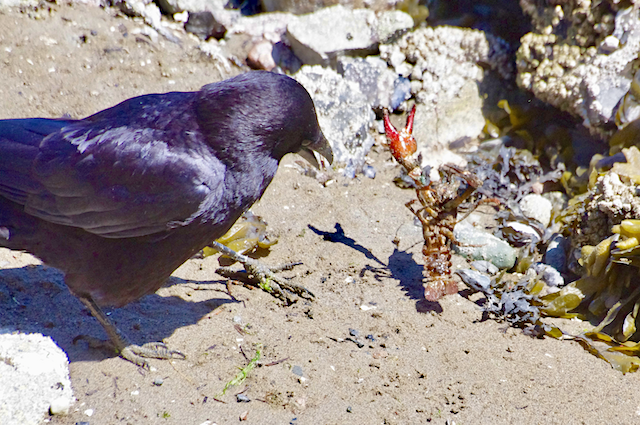
Aha! Spoken word. What if instead of a song, I just read the prose?
I tried that. My old voice wasn’t up for the task. Could I get Suno to ‘read’ it for me, in a more distinguished voice, without ‘singing’ it?
Indeed Suno can do this. And its phrasing and metre are quite compelling, with a few extra prompts to get the parsing and intonation right. And telling Suno to use a powerful male voice that it had employed successfully in a couple of my earlier songs made a huge difference (though strangely it acquired a British accent). A trace too much Captain Picard in overdramatic tone, but, I think, perfectly acceptable. (I also tried a female voice.)
But despite my telling it not to add quiet background music to the reading, it couldn’t resist. Though its background music was subtle and wasn’t at all bad:
The World Through Different Eyes, take 3, male voice (spoken word reading, unrequested musical accompaniment)
At that point I was tempted to call it good enough. I’d learned a lot, had a lot of fun (and some frustration). But of course I couldn’t resist one final tweak: What if I stripped out the unrequested music background from Take 3 (Suno can do that), and then used Audacity (excellent free software) to combine the Take 3 reading with the instrumental I had started with in Take 1. So I did that:
The World Through Different Eyes, take 4, male voice (spoken word reading, instrumental background from Take 1)
Yes! Good enough! I had to repeat the last 30-second phrase from Take 1 so that the spoken words and music ended at the same time, but this wasn’t hard.
I could of course make it better. And I probably will. But now I have four creations that I like, and that will do for now.
Here’s a repeat of my caveat on AI that accompanies all my posts on the subject:
1. I have a love-hate relationship with AI. When it’s used properly and carefully as a tool, as an aid to learning and creativity, I believe it can be very useful, and enormous fun. But most of its large-scale applications (like replacing jobs and facilitating wars and surveillance) are ill-conceived, immoral, incompetently designed and conceived, vastly overreaching the capabilities of AI, ecologically disastrous, socially disruptive, and extremely dangerous.
2. The staggering amount that has been invested in AI has absolutely no viable business case to justify it. It represents possibly the most astounding squandering of money based purely on imagined and improbable future developments and blind faith, in history. Those who have studied this have concluded that this massive bubble will soon burst, and those who’ve invested in it will lose their shirts. At that time, the window to use AI as a learning and creativity tool will quickly close forever. Our playing with these essentially-free tools now is not going to aggravate its abusive uses, nor will it have any impact on the timing or extent of the coming AI crash. So my view is: use it while you can; it will soon be gone.