








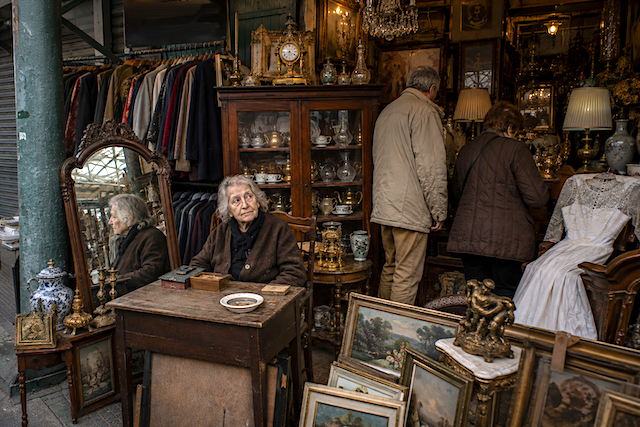
This is a work of fiction. Deep thanks to Claire, Paul and Pete at Good Day Mockingbird, for the prompt that provoked this story, and for their enormously helpful editorial review and fact-checking of the piece. I used AI to brainstorm ideas for the post, to check spelling and grammar, and for the image below. The actual composition is entirely mine.
On rue Jules Vallès, the ambiance was perpetually kind of sad and dreary. Rainwater trapped in plastic tarps. Cardboard softened at the corners where it got damp. Dust undisturbed for decades in the grooves of objects. Porcelain cups with hairline cracks that someone had tried to repair with gold-coloured glue. You know, what you think a flea market is like.
This is where Mathilde’s stall was located. Not in the nice part of Les Puces de Saint-Ouen, Paris’ famous ‘flea market’. Not like the stalls a few blocks north, where you might buy a 300-year-old Louis XV armoire for 20,000 euros, and where the stalls were much fancier and less chaotic than the Marché Jules Vallès section where Mathilde sold secondhand pottery, ceramics, furniture, artworks, and vintage clothes.
On that fateful day, Mathilde carried me, as she usually did each morning that the Marché was open, from the back room, and laid me rather inconspicuously across some furniture near the front of the stall. And then she brought out the old ornate mirror and positioned it so that, seated at her desk, she had a view of the entire marketplace with all its bustle and clutter. And so she could also see me, and be reassured I was safe.
I liked the view from where she draped me each day. From where I was placed, I could see, in the stall opposite Mathilde’s, a delightful array of rows of mirrors that reflected nothing but each other. I loved that! And I could also sometimes hear a plaintive music box in the stall beside that, playing an ersatz version of Non, je ne regrette rien, with a couple of hiccups. Playing for no one, since I hardly ever saw anyone in that stall.
That day, as usual, most of the customers in the Marché section were complaining about the quality and prices of the goods they perused, and of course about how Les Puces was a mere shadow of the wonder it had been in its ‘heyday’. This is Paris, after all!
Of course, most of those in the Marché spoke French — not many tourists courageous enough to venture into Les Puces without knowing the rules that have governed commerce here for a century. But don’t worry — my English is as good as my French, and I’ve translated what happened that day, so you can hear the story:
. . . .
A couple, middle-aged, frowning at the furniture and pawing me as they did so. She said: “How much for the dress? I think I might be able to make something of it.”
Mathilde: “It comes as a set. You have to buy the mirror beside me with it.”
The customer: “What?! That’s ridiculous. I don’t need another mirror. I just want the dress.”
Mathilde: “They can never be separated. Sorry.”
The customer: “Pffft!” (Only French people can say this word, or convey the expression that always accompanies it.) “OK, how much?”
Mathilde: “Ten thousand francs… Ten thousand euros.”
The customer mutters to her shopping companion: “She’s demented. Let’s get out of here.”
The customer: “Thanks for nothing, Madame. Hope you get better soon.”
Mathilde raised her eyebrows, and made a ‘moue’ with her mouth. She’d finally kind of got that expression down. Took her decades though. She smoothed the creases that the customer had left in me when she’d dropped me like a hot potato.
. . . .
The next few hours passed uneventfully. Some customers chatted with Mathilde. Here are some of their conversations:
Customer: “Interesting mirror. Looks almost like a New World design trying to copy the French of an earlier era. How did you come by it?”
Mathilde: “Um… I don’t really recall. I think I must have acquired it in an estate sale… But… maybe not. I don’t usually go to estate sales. I’ve… had it a long time.”
Mathilde had started to get like that. When she couldn’t remember, or didn’t know, she made stuff up. You know, kind of like AI.
. . . .
Later, another customer: “You must find it fascinating to see what people do and don’t buy. So curious what some people want!”
Mathilde: “People don’t buy things because they want them. They buy things because they remember wanting them.”
That evoked strange looks from the customer, of course.
. . . .
And shortly after that, a comment from a customer who looked and acted more like a ‘flipper’ — someone who’d researched what the market for a specific item was, and then when he found it in the Marché, would offer the vendor half that amount, ready to resell it if the vendor accepted his offer: “The wash-stand. Looks 1920s-vintage, am I right?”
Mathilde: “I don’t know. It’s older than me, I suspect. You’d have to ask it, I suppose. These things know a lot more than they let on, you know. That one remembers for sure.”
He laughed. I smiled. Sometimes Mathilde knows more than she lets on. Sad that she hardly remembers anything anymore. Back when she’d acquired the wash-stand, she knew full well it was from the 1890s.
. . . .
The market was drawing to a close, so I figured I would probably be left in peace for the rest of the day. And then:
Mathilde: “I told you, they can never be separated!”
The customer she was speaking with shrugged, accusingly. Parisians have at least fifteen different shrugs for different purposes. He stood there, as if expecting she would change her mind if he waited her out. She didn’t of course.
At that moment, an older couple, I’d guess sixty-ish, walked by the stall. Something about them said they were tourists. Eyes open a little wider than the locals, perhaps. They were speaking English to each other, another giveaway.
The gentleman: “Hang on a sec, Celeste. I want to look at this mirror.”
The lady: “Don’t you go buying any big heavy stuff, Blue. We’ll never get it back on the airplane.”
My owner suddenly looked alarmed and her mouth opened. That usually meant she’d just remembered something she’d forgotten. It was happening less and less.
The gentleman (Blue): “Something about that…”
The lady (Celeste — pffft! Anglicized hippie name; at least make it Célestine — sorry, I’m getting off track, but really!): “What…? What’s wrong?”
It was like time stopped. The two of them, wide-eyed, looking around crazily, while Mathilde stared ahead, as if she was hallucinating or something.
Celeste walked over beside Blue and looked into the mirror.
And then she saw me. And she gasped. She ran over to me and grasped me as if I were a long-lost friend. And then she spun around and stared at Mathilde. And screamed: “Tilly?… Tilly!”
And Blue spun around and looked at Mathilde too, with eyes even wider, and said: “What?… Mom?”
I would have looked around for the TV cameras at that point, if Celeste hadn’t called my owner ‘Tilly’. I hadn’t heard that name in fifty years. OMG.
Celeste practically tripped over me dragging me over to where Mathilde was staring, partly at Celeste and Blue, and partly into space, completely flummoxed.
Celeste: “Are you… Matilda Dawn Martin? From Toronto?”
She held her breath. Mathilde just looked confused.
They dragged her to her feet and hugged her a little awkwardly from both sides.
Blue: “OMG, mom. After all these years. It was the mirror, and then the dress. Otherwise we’d never have guessed.” He was crying, in that kind of clumsy, apologetic way guys cry.
Mathilde: (speaking English without any trace of an accent) “They can never be separated.”
Celeste: “That was what you always said about us, mom, when you adopted us, back in Yorkville, at Rochdale, fifty years ago. Remember?”
Mathilde looked upset: “You’re trying to fool me. I don’t know you. You shouldn’t do such things. You can’t have the dress or the mirror. Ten thousand euros.”
Celeste and Blue were teary-eyed. Kind of touching really. Mathilde looked like a deer in the headlights. And I was getting rather squished in the uncomfortable crush.
Celeste: “I know! Blue, on your phone, do you still have the photo of the magazine cover?”
Blue: “Yes!”
He grabbed his phone and scrolled through a mass of photos. And then he stopped and enlarged a photo. It was of the cover of an edition of Toronto Life magazine, dated June 1972. ‘The Wedding Edition’. And the cover photo was: Mathilde (‘Matilda Martin’) in a field, looking into that mirror. And wearing me!
Celeste: “Now do you remember, mom? That’s you, with that mirror, and wearing that dress. OMG I can’t believe this.”
Mathilde pulled away from them, and shouted: “You’re trying to trick me! That’s not me in that photo. I’ve never been married, and never had children. Why are you doing this to me?”
Celeste: “No, you’ve never been married. That was a photo shoot by a wedding company. The photo won an award. You said marriage was a patriarchal institution, and that it was wrong to bring kids into a world with no future. But you did the photo shoot because you needed the money to help support us, who you’d adopted.”
Mathilde frowned, as if searching her memory.
Celeste continued: “Blue and I, we’re not related, but when they tried to argue you weren’t a fit mother in the hippie commune at Rochdale, you swore ‘They can never be separated’, and everyone in the commune helped run interference when the cops tried to take us away from you, and split us up. Please say you remember.”
Mathilde: “That’s really me in that picture? It does look like me, I guess. And no mistaking the mirror or the dress. You know that dress can be separated into two parts so it’s not just for weddings. They were just starting to use Velcro then.”
Celeste: “OMG the dress! The Velcro at the back at the join. I put a little note inside the Velcro cover back then. Please let it still be there!”
Frantically she hoisted me up and unceremoniously pulled apart my back seam. Most undignified!
Celeste: “You have some scissors, mom? I sewed it shut.”
Mathilde drew some embroidery scissors from her desk drawer.
Celeste: “You do it please, mom? Just cut the few threads top and centre of the seam, here.” And then: “OMG it’s still there!”
Mathilde pulled out a small scrap of rolled up paper and unrolled it.
It was a small sketch of three people, seemingly a mother and her son and daughter.
Celeste laughed: “I was only 10 when I drew it, remember. You should see some of the drawings I’ve made since then!”
Underneath the drawing, carefully printed, were the five words.
. . . .
That was five years ago now. There were a couple of relatively happy years, as Mathilde (I’m too old to start calling her Matilda Dawn again now, though I vaguely recall that name from just after I was sewn) had brief moments of clarity and remembered some things from her tumultuous youth that she had long forgotten.
She remembered most vividly the cops, when they closed Rochdale in 1975 for non-payment of the mortgage and property taxes, dragging the three of them, with the rest of the commune members, out into the street, and then welding the doors shut.
She remembered being given me, and the mirror, in payment for the photo shoot, because despite the award, the photographer, who she’d had quite a crush on, couldn’t afford to pay her for her modelling services. She laughed and said What use would she have for a wedding dress? Hence the Velcro modification. Those were the days of miniskirts, so without the ‘train’ I was pretty naughty even for those days!
Sometimes I think about what might have happened…
Most of the rest of her past remained lost to her, and I was too young to remember much either. Mathilde was a basket case after the expulsion and closing of the commune. In those days I guess that would be called a ‘nervous breakdown’. She’d abandoned her adopted kids and fled to France with a cult wing-nut named Jared, who disappeared from her life so fast I don’t even remember him. Her commune mates had promised to keep Celeste and Blue safe, and it seems like they did a pretty good job of it.
They’re a strange couple, not related, never married to each other or anyone else, and from what I can figure never a couple in the legal or biblical sense, but they’ve never lived apart. I guess that’s a vestige of growing up as part of a commune.
Mathilde started the stall with two young Parisian women in the late ’70s. Both her partners had passed away several years ago, before she did last year. Her last two years were not happy. Alzheimer’s is a cruel disease.
I still hang proudly in Celeste and Blue’s new flat in the 17th arrondissement, reflected in the mirror (yes, that mirror) across the bedroom from me. Celeste sometimes wears me as a mini dress, which, perhaps uniquely in Paris, doesn’t raise many eyebrows even though she’s 64 now. She’s aged better than her mom.
The other day Blue said to her, in response to something she’d said about paying attention, that he was always afraid that if he didn’t pay attention he might miss what he’d been looking for all his life.
And then Celeste laughed at him and said:
“If you discover what you’ve been looking for all your life, let me know, will you?”
Here’s a repeat of my caveat on AI that accompanies all my posts that include AI-generated or -assisted content:
1. I have a love-hate relationship with AI. When it’s used properly and carefully as a tool, as an aid to learning and creativity, I believe it can be very useful, and enormous fun. But most of its large-scale applications (like replacing jobs and facilitating wars and surveillance) are ill-conceived, immoral, incompetently designed and conceived, vastly overreaching the capabilities of AI, ecologically disastrous, socially disruptive, and extremely dangerous.
2. The staggering amount that has been invested in AI has absolutely no viable business case to justify it. It represents possibly the most astounding squandering of money based purely on imagined and improbable future developments and blind faith, in history. Those who have studied this have concluded that this massive bubble will soon burst, and those who’ve invested in it will lose their shirts. At that time, the window to use AI as a learning and creativity tool will quickly close forever. Our playing with these essentially-free tools now is not going to aggravate its abusive uses, nor will it have any impact on the timing or extent of the coming AI crash. So my view is: use it while you can; it will soon be gone.